


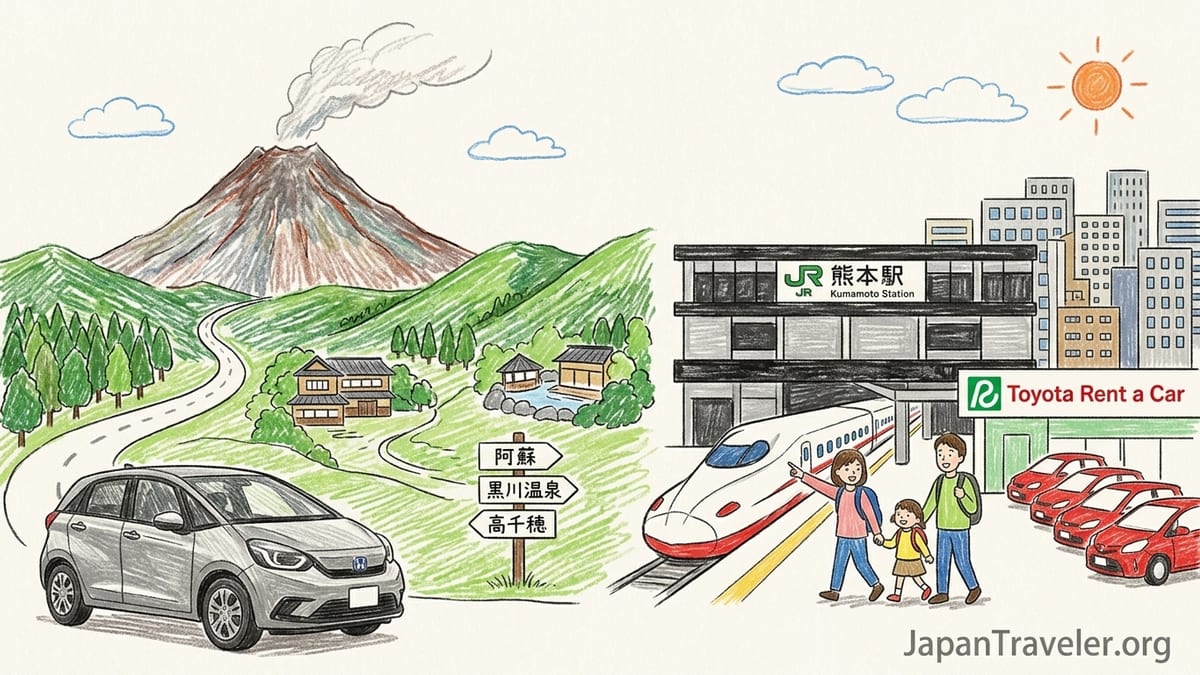
Kyushu is one of Japan’s most rewarding regions for a road trip, but the smartest itineraries do not drive the whole way. Instead, travelers are increasingly using a rail plus car hybrid strategy: riding JR trains between big cities like Fukuoka, Kumamoto, Nagasaki and Kagoshima, then picking up a rental car only for the rural sections around Aso, Kurokawa Onsen, Takachiho Gorge, Kirishima and the hot spring countryside. The result is less stress, lower cost and more time on the scenic roads that matter.
Why a Rail + Car Hybrid Strategy Works in Kyushu
Driving in Kyushu is most enjoyable in the mountains and rural onsen areas, not in the dense cores of Fukuoka, Kumamoto or Nagasaki. These cities have excellent public transport, from the subway lines in Fukuoka to trams in Kumamoto and Nagasaki, and parking in central districts can be both expensive and hard to find. For example, overnight parking near Hakata Station often runs the equivalent of 15 to 25 US dollars per day, which quickly erodes the benefit of having a car you barely use in town.
By contrast, the roads around Mount Aso, the Yamanami Highway, Kurokawa Onsen and Takachiho Gorge are sparsely served by trains and buses, with timetables that can limit your sightseeing. Here a car opens up small onsen villages, trailheads and viewpoints that would otherwise require awkward transfers or costly taxis. Many visitors now ride the Shinkansen to Kumamoto or Kagoshima, then rent a car for two to four days to explore the countryside before returning the vehicle in the next major hub.
JR Kyushu and major rental brands actively encourage this hybrid style. Campaigns that tie JR Kyushu Rail Passes to discounts at Toyota Rent a Car outlets in Kyushu, and dedicated Rail & Drive packages sold by companies such as JTB and other agencies, reflect how mature this style of travel has become. Current products often package a rail pass, rental car, ryokan stays and route suggestions into one plan, making it easy even for first-time drivers in Japan to combine trains and roads smoothly.
In practical terms, a rail plus drive itinerary might look like this: take the Shinkansen from Fukuoka to Kumamoto, spend a night car free in the city, pick up a rental car near Kumamoto Station, loop Aso and Kurokawa Onsen over two days, then return the car in Oita or Beppu and continue by train to Fukuoka. You avoid city driving and maximize your time on Kyushu’s scenic highland roads.
Where to Pick Up: Airports vs City and Station Locations
Kyushu’s main gateways for car rental are the airports and major JR stations of Fukuoka, Kumamoto, Oita, Nagasaki, Miyazaki and Kagoshima. Each has its own pros and cons depending on whether you are flying in, continuing by rail, or finishing your trip in another prefecture. Most big brands such as Toyota Rent a Car, Nippon Rent a Car, Times, Nissan and ORIX cluster around these hubs with multiple outlets.
Fukuoka Airport is often the first entry point for international travelers. The domestic terminal has a dedicated rental car zone serviced by frequent shuttle buses. Picking up here works well if you are leaving the city immediately for Yufuin, Beppu or Aso, but it is less convenient if you plan to spend the first one or two nights in central Fukuoka. In that case, riding the subway into town and renting later near Hakata Station or Tenjin keeps you from navigating heavy traffic right after a long flight.
Kumamoto, Oita and Kagoshima offer excellent station pickups that dovetail with Shinkansen or limited express trains. At Kumamoto Station, for instance, several rental counters lie within a short walk of the ticket gates, letting you arrive from Fukuoka or Hakata on the Shinkansen and be on the road to Aso in under an hour. Similarly, Beppu and Oita stations host outlets for multiple companies, which is ideal for travelers ending an Aso or Yufuin loop and immediately boarding a Sonic or Nichirin limited express back toward Fukuoka or down the coast.
Nagasaki and Miyazaki airports are compact and easy to navigate, so starting and ending a coastal drive there can be efficient, especially if you are flying on to other parts of Japan. Kagoshima has both Kagoshima Airport, a common gateway for Kirishima and Ibusuki, and Kagoshima Chuo Station on the Shinkansen line. One popular pattern is to ride the Shinkansen from Hakata to Kagoshima Chuo, explore the city car free, then rent from a station outlet for a two or three day loop to Kirishima, Ibusuki and Chiran before returning the car to the airport for an onward domestic flight.
Choosing a Car: Compact vs Kei, and Automatic Availability
Japanese rental fleets in Kyushu are dominated by compact cars and kei cars, both of which are suitable for most foreign visitors. Kei cars are the smallest class allowed on highways in Japan, with strict limits on engine size and dimensions. For travelers, that translates into slender, tall hatchbacks that are excellent for squeezing through village lanes and parking in tight onsen ryokan spaces, particularly around older hot spring towns like Kurokawa and the back roads of Takachiho.
Compact cars, such as Toyota Yaris or Honda Fit class vehicles, offer a bit more power for climbing mountain passes and more stable highway handling without being overly large. For two adults with modest luggage, either a kei or a compact will usually work, but taller travelers or those carrying large suitcases often feel more comfortable in a compact. Families with children or groups of three to four adults typically step up to compact wagons or small minivans to avoid packing bags onto laps during longer drives.
Rental listings in Kyushu nearly always specify whether the vehicle is automatic, and for mainstream companies almost all passenger cars are automatic by default. Firms such as Nippon Rent a Car publicly state that passenger cars and minivans in their fleets are automatic, with manual transmission limited to special request or commercial categories. In practice, if the booking site does not highlight “MT” or “manual,” you can assume you will receive an automatic. This is reassuring for visitors who are already adapting to driving on the left.
Fuel efficiency is another factor when choosing between kei and compact models. Kei cars excel at low-speed fuel economy and are popular with cost-conscious travelers exploring short distances each day. However, on long expressway runs between Fukuoka and Kagoshima or Nagasaki, their smaller engines can feel strained in strong crosswinds or on steep grades. A compact car often provides a calmer ride and more confident acceleration for only a modest increase in rental price, which can be worthwhile if your rail plus car plan still includes significant highway segments.
Licensing, International Driving Permits and Language Barriers
To rent and drive a car in Japan, including Kyushu, you must be at least 18 years old and hold a valid driver’s license plus either an International Driving Permit based on the 1949 Geneva Convention or a Japanese translation of your license if you are from specific countries and regions. Major rental companies throughout Kyushu check both your physical license and the IDP or official translation at the counter, along with your passport. Without all the required documents, they will refuse to release the car even if you have a prepaid reservation.
For travelers from the United States, Canada, most of Europe and many other countries, the standard process is to obtain a 1949-format International Driving Permit before departure, usually from an automobile association. Visitors from countries whose licenses are convertible to Japanese licenses without testing, such as Germany, Switzerland or Taiwan, may instead use a certified Japanese translation of their home license as specified by Japanese authorities. Holders of permits based on the newer 1968 Vienna Convention are not permitted to drive in Japan, a detail that surprises some European travelers who assume their international permit is universally valid.
Language at the rental counter is generally manageable. Airport and major station outlets in Kyushu routinely serve international visitors and provide English contract forms and basic explanations. Navigation systems in rental cars almost always include an English option and often accept entry of phone numbers to set destinations, which is extremely helpful when driving to rural ryokan in Aso or Kirishima. Still, it is wise to preprint booking confirmations, your accommodation addresses and approximate driving routes in case of weak mobile reception in the mountains.
Because license rules and accepted document formats can change, it is safest to confirm requirements with both your local issuing authority and your chosen rental company shortly before travel. Booking platforms and rental websites provide up-to-date guidance on which permits they accept, and some even send reminders about IDP validity and expiration dates in pre-departure emails.
ETC Cards, Expressways and the Kyushu Expressway Pass
Most foreign visitors renting in Kyushu benefit from using an ETC card, the system that lets you pass through expressway toll gates without stopping to pay cash. Rental companies at airports and major stations typically offer an ETC card as an optional add-on, often at little or no upfront cost. The card records your toll usage during the rental, and you settle the total in yen by cash or credit card when you return the car. Having ETC saves time at toll plazas and avoids the stress of sorting coins while queuing behind trucks and buses.
For itineraries that include a significant amount of expressway driving, such as a loop from Fukuoka through Beppu, Miyazaki and Kagoshima or a circuit combining Nagasaki and Kumamoto, the Kyushu Expressway Pass can offer good value. This product, linked to an ETC card and valid only for foreign tourists in rental cars, provides unlimited use of designated expressways in Kyushu for a fixed number of days. You book it in conjunction with your rental through participating companies, then enjoy the freedom to choose routes based on scenery and convenience instead of hunting for toll-free back roads.
In real-world terms, a couple driving three or four days on expressways around Kyushu can easily spend the equivalent of 70 to 120 US dollars in regular tolls, depending on how many long segments they cover. A Kyushu Expressway Pass of the same duration is often priced competitively with this range, so even slight detours and spontaneous side trips end up feeling “free” in marginal cost. Travelers who mostly stick to national roads and short hops between nearby onsen towns, however, may not need the pass and can simply rent an ETC card and pay tolls as they go.
Regardless of whether you use the pass, driving etiquette on Kyushu’s expressways is straightforward: keep to the left lane except when overtaking, observe posted speed limits and watch for service areas where you can refuel, rest and sample local specialties. Many travelers enjoy stopping at roadside stations and highway service areas near Aso, Yufuin or Kirishima, which often double as compact local food markets showcasing regional produce and sweets.
Insurance, One-way Rentals and Winter Tires
Japanese rental companies in Kyushu build basic insurance into their pricing, usually covering compulsory liability and a standard level of vehicle damage protection. At pickup, you will be offered additional options such as supplemental liability, collision damage waivers and so-called “NOC” coverage that reduces or eliminates the non-operation charge you must pay if the car is damaged or requires towing. In practice, many international visitors choose at least one additional layer so that any minor scrape in a tight onsen village parking lot does not result in a stressful bill.
One-way rentals are widely available within Kyushu and fit perfectly with rail plus car hybrids. For example, you might pick up in Kumamoto, drive through Aso and Kurokawa Onsen, then return the car in Beppu or Oita before catching a train north. Most companies charge a one-way fee that rises with distance between outlets, though short drops within the same city or prefecture may be free or relatively modest. Travelers report fees in the range of the equivalent of 50 to 150 US dollars for longer cross-island drops, which can be worthwhile if it saves a full day of backtracking behind the wheel.
Winter tires are another important option, especially if you visit Kyushu from December to February or plan to drive highland areas like Aso, Kuju, Yamanami Highway or Kirishima. While Kyushu’s coastal cities are milder than northern Japan, snow and icy patches can appear on mountain roads several times each winter. Rental companies often recommend or automatically fit studless winter tires for bookings that specify pickup in colder months, and travel campaigns by regional authorities explicitly highlight winter tire use in highland areas. If your itinerary includes early morning or late night driving in the mountains, confirming winter tire availability in advance is wise.
Comprehensive packages sold by major travel agencies frequently bundle rental car, insurance, winter tires in season and even ryokan stays with dinner and breakfast. For example, a three-night drive plan might include Shinkansen tickets to Kumamoto, two days of rental with full insurance, a night in Kurokawa Onsen and a night in Yufuin, plus breakfast and dinner, with pricing that undercuts booking each component separately. These road-trip products underline how mainstream multi-day drives in Kyushu have become and can be a stress-free way to secure both your car and highly sought-after ryokan on popular weekends.
Where a Car Helps Most: Aso, Kurokawa, Takachiho, Kirishima and Beyond
Inside major Kyushu cities such as Fukuoka, Kumamoto, Nagasaki and Kagoshima, a car often adds more hassle than flexibility. Subways, trams and buses cover the main sightseeing areas efficiently, and cabs are plentiful for short hops with luggage. Parking garages around Hakata or Tenjin can be costly, streets can be congested at rush hour, and many popular food districts cluster within compact, walkable zones. As a result, many experienced visitors keep their itineraries car free on city days and only start driving when they head into the countryside.
The story changes as soon as you reach the Aso caldera and surrounding highlands. Public buses do run to Aso Station and a few trailheads, but they are infrequent and limit how many viewpoints and crater roads you can tackle in a single day. With a rental car, you can link the Daikanbo lookout, Kusasenri grasslands, onsen villages like Uchinomaki and small family-run cafes along the way, stopping for photo breaks whenever clouds part to reveal the volcanic peaks.
Kurokawa Onsen is a classic example of where a car provides freedom. The village is reachable by bus from both Kumamoto and Beppu, yet many ryokan sit on hillside lanes that require stair climbs or long walks from the bus stop. With your own vehicle, you can drive directly to each ryokan to drop luggage, then park in the large shared lot above town and explore on foot. Having a trunk also makes it easy to keep extra towels and clothing on hand if you are hopping between multiple outdoor baths with the village onsen pass.
Takachiho Gorge and the surrounding plateau are similarly suited to self-drive. Buses exist, but timing them with boat rentals in the gorge, shrine visits and nearby viewpoints can be challenging. A car lets you visit Takachiho Gorge early in the morning before crowds build, detour to the Amanoiwato Shrine area, and still reach an overnight stay in Aso or Miyazaki by evening. Farther south, the slopes of Kirishima and the volcanic plateau above Kagoshima are dotted with trailheads, highland onsen and lakes that are difficult to access in a single day by public transport alone, making a rental car almost essential for flexible hiking-focused itineraries.
Planning Real-world Rail + Drive Itineraries
Putting all these elements together, a typical seven or eight day Kyushu trip might weave trains and cars in several segments. One concrete example: arrive in Fukuoka and spend two nights without a car, exploring Hakata food stalls, Ohori Park and nearby Dazaifu by train. On day three, ride the Shinkansen to Kumamoto in under an hour, drop bags at a hotel near the castle, and continue sightseeing by tram. The next morning, pick up a compact car from an outlet near Kumamoto Station, drive the panoramic roads of Aso and stay overnight in Kurokawa Onsen.
On day five, cross the Kuju highlands to Yufuin, stopping at viewpoints, farm stands and small onsen along the Yamanami Highway. After a stroll around Yufuin’s lake and art galleries, continue to Beppu or Oita and return the car near the station. From there, a limited express train carries you back to Fukuoka or onward to Kokura and the Honshu side, where you might connect to another regional rail pass. This pattern gives you three days of rural driving where it matters most and avoids the cost and stress of parking a car in cities for the whole week.
Another realistic pattern for southern Kyushu is to fly into Kagoshima Airport, pick up a car immediately and make a loop through Kirishima, Ibusuki and the Satsuma Peninsula over three or four days. After soothing soaks in sand baths and highland onsen, you can return the car either at Kagoshima Chuo Station to board the Shinkansen back to Fukuoka or at the airport before a domestic flight to Okinawa or Tokyo. Some travelers then add a separate short rental from Nagasaki or Miyazaki later in the trip, treating each driving segment as its own focused rural chapter.
For cost-conscious travelers or those nervous about driving, sharing a rental among three or four people can make the rural segments very affordable, especially when combined with a regional rail pass such as the JR Kyushu Rail Pass for intercity legs. Promotions that offer discounts on rental cars when you show a valid rail pass make this combination even more attractive. Whether you book each component yourself online or through a packaged road-trip deal from a travel agency, the key is to map out which nights truly require a car and arrange your pickups and drop-offs around those.
FAQ
Q1. Do I really need a rental car to explore Kyushu?
For major cities like Fukuoka, Nagasaki, Kumamoto and Kagoshima you do not, but a car becomes very helpful for Aso, Kurokawa, Takachiho, Kirishima and other rural areas where public transport is infrequent.
Q2. Is it better to pick up my rental at the airport or at a train station?
If you are leaving the city immediately, airport pickup is convenient. If you plan to spend time in the city first, it is usually easier to ride the train in and pick up from a station outlet on the day you head to the countryside.
Q3. Are kei cars powerful enough for Kyushu’s mountain roads?
Kei cars can handle most routes, but on long expressway stretches or steep passes a compact car usually feels more stable and comfortable, especially with two or more adults and luggage.
Q4. Will my rental car in Kyushu be automatic?
Almost all passenger rentals from major companies in Kyushu are automatic by default. Manual transmission is uncommon and usually needs a special request, so you can safely assume an automatic unless clearly labeled otherwise.
Q5. What kind of driver’s license and permit do I need?
You must carry your valid home country license plus an International Driving Permit issued under the 1949 Geneva Convention, or a Japanese translation if you are from certain countries specified by Japanese authorities, along with your passport.
Q6. Is an ETC card or Kyushu Expressway Pass worth it?
If your itinerary includes several long expressway segments, an ETC card combined with a Kyushu Expressway Pass can save both time and money. For mostly local driving on national roads, paying ordinary tolls or avoiding expressways is often fine.
Q7. How expensive are one-way rentals within Kyushu?
One-way fees vary by distance and company, but for cross-island drops travelers often see additional charges roughly equivalent to 50 to 150 US dollars, which can be worthwhile if it saves a full day of backtracking.
Q8. Do I need winter tires in Kyushu?
In coastal cities they are usually not necessary, but if you plan to drive in highland areas like Aso, Kuju or Kirishima between December and February you should request studless winter tires when booking.
Q9. Is parking difficult in Kyushu cities?
Central areas of Fukuoka, Kumamoto and other big cities can have tight, expensive parking, so many travelers avoid driving in town and only rent a car for the rural parts of their trip.
Q10. Are there ready-made rail and drive packages for Kyushu?
Yes. Major travel agencies and JR-affiliated products offer plans that combine JR Kyushu Rail Passes or train tickets with rental cars, insurance, ryokan stays and suggested driving routes, which simplifies planning for first-time visitors.