


The Shimanami Kaido is Japan’s most famous long-distance cycling route, a roughly 70‑kilometre journey that links Onomichi in Hiroshima Prefecture with Imabari in Ehime via a chain of island-hopping bridges across the Seto Inland Sea. Demand for rental bikes, seaside accommodation and luggage transfers grows every year, and advance planning now matters as much as fitness. This guide focuses on turning the classic Onomichi to Imabari ride into a smooth adventure, with concrete advice on bike types, one‑way rentals, family‑friendly pacing and how to keep your bags moving while you pedal light.
Understanding the Shimanami Kaido Route
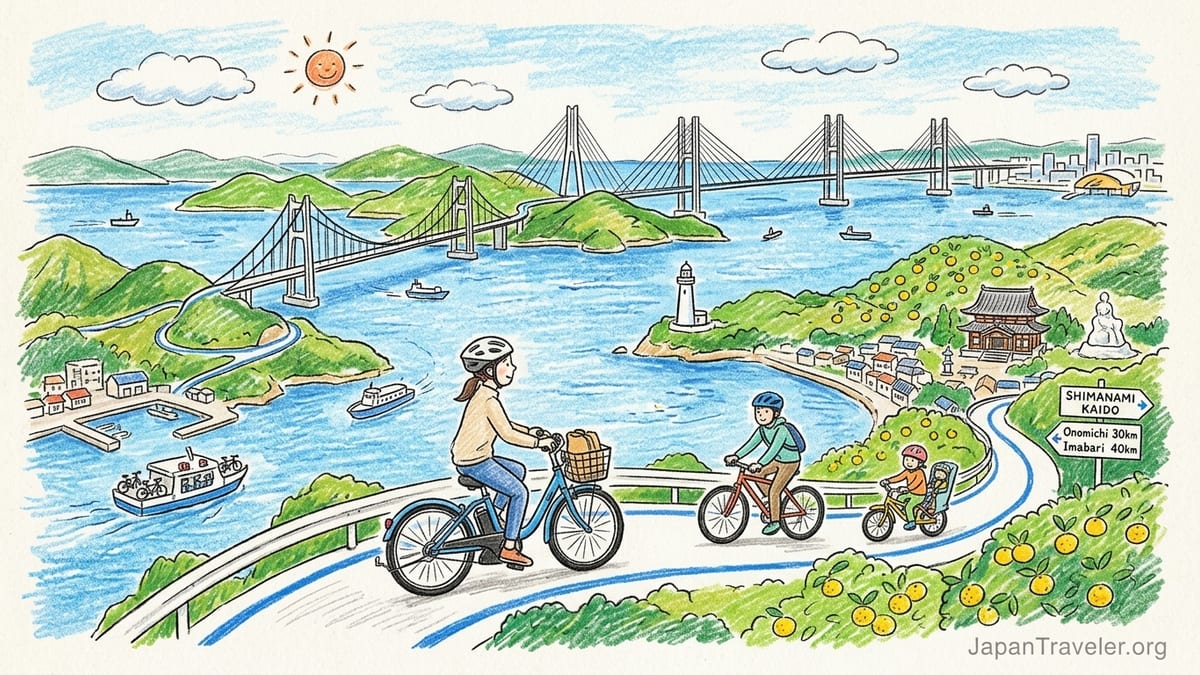
The official Shimanami Kaido cycling route runs about 70 kilometres between central Onomichi and Imabari, marked for most of its length by a blue line painted on the road. It is slightly longer than the expressway above but deliberately avoids the heaviest traffic and steepest gradients. Intermediate cyclists often complete the route in one long day, while many visitors break it into two or three stages to allow time for detours, viewpoints and island stays.
Although the route is often described as flat, each major bridge sits high above the water and is reached by a spiral or ramp-style approach. None of the climbs is especially long, but beginners feel them by mid-afternoon, especially in summer heat or strong headwinds. Electric-assist bicycles significantly flatten these approaches, while cross-bikes and road bikes reward fitter riders with faster progress between islands.
In practical terms, the ride breaks down into a string of island segments: Onomichi to Mukaishima via a short ferry, then Innoshima, Ikuchijima, Omishima, Hakatajima and Oshima before the final Kurushima Kaikyo Bridge drops you into Imabari. Most rental and luggage services are designed around this structure. Major rental terminals cluster near Onomichi Port, Setoda on Ikuchijima, Tatara Shimanami Park on Omishima and Sunrise Itoyama or Imabari Station on the Shikoku side.
First-time visitors often underestimate the value of starting early and riding in the Onomichi to Imabari direction. Morning light over the inland sea, easier bus and train connections back from Imabari, and the psychological advantage of finishing with the spectacular Kurushima Kaikyo Bridge all work in your favour. It also aligns nicely with same-day luggage services that move bags from hotels in Onomichi to partner properties or cycle terminals around Imabari in time for evening check-in.
Island-by-Island Highlights and Key Detours
From Onomichi, the ride begins with a short passenger ferry to Mukaishima. This tiny hop avoids a more complex bridge approach and gives a flavour of local maritime life. On Mukaishima, many riders simply follow the blue line along the coast, but a worthwhile short detour heads to the island’s quiet northern shore, where small shipyards, citrus groves and views back to Onomichi offer a softer introduction before the first proper climb to Innoshima Bridge.
Innoshima features a mix of industrial shoreline and gentle hills. Near the base of the bridge ramp, simple cafes and convenience stores make good places to stock up on drinks and snacks. Riders with more time can leave the blue line to explore Innoshima Suigun Castle, a small hilltop museum themed around the local maritime clans with broad views over the sea. The extra climb adds effort but breaks up the otherwise functional feeling of this section.
Ikuchijima is where the ride truly becomes scenic. The blue line leads through Setoda, a compact port town that has embraced cycling visitors. Kousanji Temple, with its elaborate reconstructed buildings and marble-covered Hill of Hope, lies a short way off the main route, and the Shinshoji Zen Museum and Gardens on a hillside above town provide a quieter cultural stop. Setoda’s beachfront promenade and the refurbished Shiomachi Shopping Street host bakeries, gelato stands and seaside cafes that make this the natural overnight stop for many two- and three-day itineraries.
Leaving Ikuchijima via the Tatara Bridge brings you to Omishima, one of the larger islands and home to several of the route’s most atmospheric attractions. The blue line skirts the coast, but a small inland detour leads to Oyamazumi Shrine, known for its collection of samurai armour and sacred camphor trees. Tatara Shimanami Park beside the bridge serves as a major rest hub with a rental terminal, seafood eateries and a dramatic vantage point back toward the Tatara Bridge’s soaring cables, while the southwestern coast offers quiet lanes lined with mikan orchards for riders with time to wander.
From Hakatajima and Oshima to Imabari
Hakatajima is smaller and quieter than its neighbours and often passes quickly for one-day riders intent on reaching Imabari before dusk. Even so, the islands of Hakatajima and Oshima are connected by the Omishima Bridge and offer short deviations to peaceful fishing harbours. Around Hakata-Osaki, small eateries serve local seafood rice bowls and udon, providing a useful lunch stop for riders who overnighted in Setoda or Omishima.
Oshima is the last stepping stone before Shikoku and combines gentle coastal riding with a noticeable climb on the southern side, where the road leaves the shore to approach the Kurushima Kaikyo Bridge. A popular viewpoint is the Kirosan Observatory Park, accessed via a demanding climb that many casual riders tackle using e-bikes or skip entirely. On clear days the vantage point reveals the entire sweep of the Kurushima Kaikyo Bridge and the patchwork of small islets dotted across the Inland Sea.
The Kurushima Kaikyo Bridge itself is often considered the highlight of the route. Its long series of suspension spans carries a dedicated cycling and pedestrian path, with multiple stopping points where you can lean your bike against the railing and photograph the ship traffic below. The approaches are steady but not extreme, yet they feel longer at the end of the day, which is another reason to choose an early morning start from Onomichi.
Once you roll off the final bridge ramp, the blue line funnels you into Imabari. Depending on where you rented your bike, you will either follow signs to Sunrise Itoyama near the base of the bridge or continue into the city centre to Imabari Station or port terminals. Imabari offers modern business hotels, onsen-style public baths and izakaya-lined streets where post-ride dinners often feature local specialties such as Imabari yakitori and sea bream dishes. For many riders this evening in Imabari marks the celebratory end of the trip.
Bike Rentals, E-Bikes and Guided Cycling Packages
Rental demand along the Shimanami Kaido has grown significantly, and there are now several overlapping systems. Public rental operated through regional tourism bodies offers hundreds of basic city bikes, cross-bikes and a growing number of electric-assist models at cycle terminals in Onomichi, Setoda, Omishima, Oshima and Imabari. Private operators such as Giant stores in Onomichi and Imabari, as well as independent shops in Onomichi and on the islands, provide higher-spec road bikes and sport e-bikes alongside more tailored service.
Current published reference rates for visitors planning budgets are around ¥3,000 per day for standard adult bicycles, about ¥4,000 per day for electric-assist city e-bikes and roughly ¥8,000 per day for certain sport e-bikes and high-end road models. These figures sit above the base prices listed on some older rental leaflets but reflect what riders commonly encounter when booking in 2025 and 2026 with helmet, basic lock and tax included. One-way rental where you start in Onomichi and finish in Imabari usually involves either forfeiting a deposit or paying an extra one-way fee in the region of a few thousand yen per bike.
Standard city bicycles suit relaxed two- or three-day itineraries that keep daily distances around 20 to 30 kilometres and stay close to the blue line. Cross-bikes and entry-level road bikes let confident cyclists cover the full 70 kilometres in a single day and still include detours such as Kousanji Temple or Oyamazumi Shrine. Electric-assist city bikes bridge the gap, especially for families and couples with mixed fitness. Sport e-bikes and performance road bikes benefit riders who want to add serious hill climbs like Mt Kiro or side trips along quieter backroads without worrying about fatigue.
Guided cycling packages are now offered by several regional tour operators and guesthouses. These typically bundle mid-range cross-bikes or e-bikes, overnight stays in places like Setoda and Omishima, luggage transfer and an English-speaking guide who handles navigation and ferry timing. Per-day costs are notably higher than independent rental, but the premium buys local knowledge, mechanical support and pre-arranged meals, which many first-time visitors find worthwhile during busy seasons such as spring cherry blossom or the autumn foliage period.
Rental Terminals, One-Way Options and Gear for Families
The backbone of independent riding is the network of public rental terminals spread across the route. Key locations include Onomichi Port near the station, Setoda on Ikuchijima, Tatara Shimanami Park on Omishima, terminals on Oshima and facilities at Sunrise Itoyama, Imabari Port and Imabari Station. Hours typically run from morning to late afternoon, so same-day riders must plan to reach their final drop-off before closing time, particularly outside peak holiday periods when hours may shorten.
One-way rentals between Onomichi and Imabari are widely available but subject to bike type and capacity limits. For public rental bikes, the one-way element is often handled through a deposit system where returning your bike at a different terminal means forfeiting a deposit that effectively becomes your one-way fee. Private shops usually charge a clearly stated one-way supplement per bike. Because capacities for one-way returns can sell out on popular weekends, especially for e-bikes and higher-end models, advance online reservations are strongly recommended whenever possible.
Families benefit from the range of children’s bicycles, small-wheel bikes and child seats offered at larger terminals. Sizes are limited, so parents should aim for early-morning pick-up and reserve where systems allow. Helmets are strongly encouraged along the route and provided by most rental operators at no extra charge, although bringing a personal helmet can improve fit and comfort, particularly for children. Kid trailers and tandem bikes are usually restricted or prohibited on bridge approaches for safety reasons, so families should check equipment rules carefully before arrival.
Choosing a bike also shapes the overall trip budget. For example, a couple renting two standard bicycles for a single-day crossing might spend around ¥6,000 on bikes, while the same couple opting for sport e-bikes could see that figure approach ¥16,000. Over a three-day trip, the difference becomes significant. Balancing cost against comfort and fitness is essential. Many riders choose standard cross-bikes for a two-day ride with one luggage-free day in the middle, then reserve e-bikes primarily when traveling with children or older relatives.
Luggage Transfers, Bike-Friendly Hotels and Backup Transport
Riding the Shimanami Kaido feels much easier without panniers or large backpacks, and the region has developed a surprisingly robust luggage-forwarding ecosystem. Sagawa Express promotes a “Cycling Without Baggage” or “Hands-Free Cycling” service specifically branded for Shimanami, delivering bags on the same day between affiliated facilities at the start and end of your ride. This allows, for example, a morning drop at a counter in central Onomichi and evening collection at a partner hotel or cycle terminal around Imabari.
Yamato Transport and Japan Post also handle luggage between hotels and convenience-store counters along the route. Same-day delivery is sometimes limited to specific corridors, while next-day delivery is more widely available. For riders on a two-day itinerary, a common pattern is to send a suitcase from an Onomichi hotel to a property in Imabari with next-day or two-day delivery, then ride with only a small overnight bag for a stay in Setoda or Omishima. Many minshuku, guesthouses and cycle-friendly hotels cooperate with these services and help guests fill out shipping labels in English or simple Japanese.
Accommodation for cyclists concentrates around Setoda on Ikuchijima, Omishima and Imabari. In Setoda, renovated guesthouses and boutique hotels line the old shopping street and beachfront, often providing bike storage, laundry facilities and early breakfast. Around Omishima and the Tatara Shimanami Park area, there are waterfront lodges and small inns that welcome cyclists, some with on-site hot baths and dinner plans built around local seafood. In Imabari, standard business hotels near the station or port work well for an efficient end to the trip and frequently offer secure bike parking or accept delivered luggage on guests’ behalf.
Not every rider finishes as planned, and the route is fortunately backed up by ferries and highway buses. From several islands, local ferries and buses connect to Onomichi, Imabari or nearby mainland stations, and some public rental schemes allow bikes to be returned at island terminals so that riders can continue by public transport. In cases of injury, severe weather or mechanical failure that cannot be fixed on the roadside, this safety net makes it possible to cut the ride short without stress, particularly for families with children or less confident cyclists.
Weather, Road Conditions and Handling Problems En Route
The Shimanami Kaido can be ridden year-round, but conditions vary sharply by season. Spring and autumn offer mild temperatures and relatively stable weather, while midsummer brings intense heat and humidity. Strong winds are a defining feature, especially on exposed bridge decks where gusts can push bikes sideways. Riders should be prepared to slow down, keep both hands firmly on the bars and, in extreme crosswinds, dismount and walk short sections for safety.
Rain transforms the experience. Painted surfaces on bridge approaches become slippery, visibility drops, and the scenic views that draw many visitors may vanish into low cloud. Light rain in warm seasons can still be manageable with proper jackets and waterproof phone storage, but widespread forecasts of heavy rain or storms are good reasons to reschedule. Many rental operators will advise against departure during typhoons or severe weather warnings, and same-day luggage services may adjust cut-off times to match transport disruptions.
Traffic is moderate on most island segments but occasionally busy near small towns, factory gates and ferry terminals. The blue cycling line typically keeps riders on quieter side roads, yet there are short stretches of shared national road where trucks and cars pass at speed. Here, riding single file, using mirrors if you have them and signaling clearly are essential. Pedestrian and cycling paths on bridges can be narrow in places, which calls for patience when groups and families meet going both directions.
Mechanical issues do occur, especially punctures caused by debris or drainage grates. Rider-preparedness ranges widely. Confident cyclists often travel with spare inner tubes, tyre levers and a mini pump. Casual riders may prefer to rely on rental companies and roadside support. Public rental systems list contact numbers on the bike or paperwork, and staff can sometimes arrange replacement bikes from the next terminal if you can slowly roll there. Private shops and some guesthouses along the route offer basic repair tools and pumps. For more serious failures, taxis and support vehicles can transport bikes to the nearest rental base for swap or refund discussions.
Itineraries: One-Day, Two-Day and Three-Day Options
Choosing the right itinerary depends on fitness, appetite for sightseeing and the type of bike you plan to ride. Confident cyclists on cross-bikes or road bikes often tackle the full Onomichi to Imabari distance in one day. A realistic schedule might involve an 8:00 departure from Onomichi Port, steady progress with short breaks on each island and a mid-afternoon arrival in Imabari between 15:00 and 17:00, covering roughly 70 to 80 kilometres including small detours.
Many visitors prefer two days, which balances effort and sightseeing. A typical pattern is to ride from Onomichi to Setoda on Ikuchijima on day one, a distance of about 30 kilometres including time for Kousanji Temple and the Setoda beachfront. Riders then enjoy a relaxed evening in town. Day two covers the remaining distance through Omishima, Hakatajima and Oshima to Imabari, approximately 40 to 45 kilometres. This structure suits moderate fitness levels and groups with teenagers, as it keeps daily riding hours manageable while still feeling like a proper journey.
Three-day itineraries suit families with younger children or travellers keen on deeper exploration of side roads, art museums and shrines. For example, day one could cover Onomichi to Setoda, day two Setoda to Omishima with a visit to Oyamazumi Shrine and time at Tatara Shimanami Park, and day three Omishima to Imabari including optional climbs or coastal detours on Oshima. Daily distances in this model often sit between 20 and 30 kilometres, allowing extended lunches, beach stops and unhurried photography.
Whatever the structure, riders should plan around daylight and rental opening hours. In winter, sunsets come early, and finishing bridge ramps in the dark is not ideal, even with lights. Time buffers also help when unexpected headwinds or repeated photo stops slow progress. Luggage transfer cut-off times, usually in the late morning for same-day services, can further shape your schedule, especially on departure days from Onomichi or Omishima.
Costs and a Sample Budget for the Shimanami Kaido
Overall costs for a Shimanami Kaido trip vary widely according to bike choice, accommodation style and itinerary length. For a one-day crossing using standard rental bicycles at around ¥3,000 per adult, a couple might spend ¥6,000 on bikes, ¥1,000 to ¥2,000 on ferries between Onomichi and Mukaishima and any other short hops, around ¥3,000 to ¥4,000 per person on meals and snacks across breakfast, lunch and drinks, and possibly a one-way bus or train ticket from Imabari back to a larger hub such as Fukuyama or Hiroshima.
For a two-day itinerary with an overnight in Setoda or Omishima, mid-range double rooms in cycle-friendly guesthouses or small hotels might run between roughly ¥10,000 and ¥18,000 per night, often with breakfast included. Dinner in a local izakaya or inn can range from ¥2,000 to ¥4,000 per person without drinks. Luggage transfer services such as Sagawa’s cycling-focused product or Yamato’s hotel-to-hotel delivery might cost on the order of a few thousand yen per item, depending on size and distance, but this allows you to ride each day with only a light daypack.
If you opt for electric-assist bicycles at around ¥4,000 per day, a two-day ride for two people might see bike costs alone reach about ¥16,000 compared with roughly ¥12,000 for standard bikes, while a switch to sport e-bikes or high-end road bikes at approximately ¥8,000 per day could push bike rental for two over ¥30,000 across the same period. Guided tours that include bike hire, guiding, accommodation and luggage transfer can cost significantly more, but they compress many planning tasks into one payment and appeal to travellers with limited time or language skills.
Hidden costs to watch include late return surcharges if you reach a terminal after closing, cancellation fees during peak seasons, and optional extras such as insurance, upgraded saddles or clipless pedals from specialist shops. On the other hand, the route itself carries no dedicated cycling tolls beyond modest bridge access charges that are increasingly waived or consolidated into rental schemes, so once your bikes and beds are booked, daily running expenses remain relatively modest by Japanese travel standards.
Cycling Shimanami 2026 and Event-Day Restrictions
On Sunday 25 October 2026, the international Cycling Shimanami 2026 event is scheduled to take place along sections of the Shimanami Kaido. During the event, parts of the Nishiseto Expressway that usually carry car traffic are temporarily closed to general vehicles and opened to registered participants on sport-type bicycles. This creates a one-day transformation of the route, with mass starts, feed stations and organised courses instead of the usual independent touring flow.
For regular recreational cyclists who are not registered for the event, the primary impact is a series of road and access restrictions that differ markedly from normal weekends. Entry ramps to certain bridges may be closed for portions of the day, and support vehicles, shuttle buses and race logistics occupy spaces that are usually quiet. Travellers planning a casual ride that week should check official traffic regulation maps and consider riding on a different day, particularly if they rely on public rental bikes or luggage services that may adjust operating hours.
Those who do join Cycling Shimanami 2026 must observe the event’s specific bike requirements, which focus on sport-type bicycles such as road bikes, hybrids and mountain bikes. Leisure city bikes, tandem bikes and certain e-bikes may be restricted or placed in separate categories, and helmets become mandatory under event rules. Distances vary by course, ranging from family-friendly shorter circuits to long sportive-style rides that traverse much of the expressway alignment rather than the everyday blue-line route.
Whether you ride during the event or in the days before or after, allow for busier accommodation and rental bookings across that late-October weekend. Rooms in Onomichi, Setoda, Omishima and Imabari can fill months in advance, and one-way rental capacity for higher-spec bikes is particularly tight. If your priority is a quiet, contemplative crossing, planning your ride for dates that avoid 25 October 2026 is the simplest solution.
The Takeaway
Riding the Shimanami Kaido is less about sheer athletic challenge and more about stitching together a chain of islands, viewpoints and small-town experiences into a coherent journey. Success depends on matching your bike and itinerary to your fitness, reserving rentals and key rooms well ahead in busy seasons, and taking advantage of hands-free luggage services so that the ride itself feels light. Bridges, winds and occasional showers add spice, but the route’s careful design, frequent rest areas and multiple bailout options keep it approachable for a wide range of travellers.
Onomichi, Mukaishima, Innoshima, Ikuchijima, Omishima, Hakatajima, Oshima and Imabari each offer their own textures, from shipyards and shrines to citrus groves and sweeping suspension spans. Whether you cross in one ambitious day on a fast road bike or wander over three days on an e-bike with overnight stops in Setoda and Omishima, the core experience is the same: a rare opportunity to pedal directly across the sea in comfort and safety.
For beginners, a two- or three-day trip with standard bikes or electric-assist models, luggage shipped ahead and nightly stays in cyclist-friendly inns will feel both achievable and rewarding. Experienced cyclists might opt for cross-bikes or road bikes, push for a one-day crossing with extra climbs and rely mainly on simple business hotels. Families can lean on e-bikes, child seats and modest daily distances centred on Setoda and Omishima, while couples planning a supported cycling holiday will find guided packages and boutique lodgings that turn the journey into a relaxed seaside escape.
Whichever profile fits you best, planning around the October 2026 event dates, clarifying one-way rental terms and pencilling in backup transport options will minimise surprises. With those elements set, the Shimanami Kaido delivers exactly what its reputation promises: one of Japan’s most rewarding and accessible long-distance rides, rich in views, culture and small logistics victories that make the final roll into Imabari all the more satisfying.
FAQ
Q1. Can I cycle the Shimanami Kaido in one day if I am not very fit?
Many moderately active travellers manage the roughly 70 kilometres in one day on cross-bikes or e-bikes, but if you rarely cycle, choosing a two-day itinerary with an overnight in Setoda or Omishima is usually more enjoyable and less stressful.
Q2. Do I need to reserve a rental bike in advance?
Advance reservations are strongly recommended, especially for weekends, holidays and electric-assist or sport bikes. Walk-up rentals sometimes work on quiet weekdays but are risky if you need specific sizes, one-way drop-off or child bikes.
Q3. Are e-bikes allowed across all bridges on the Shimanami Kaido?
Yes, standard electric-assist bicycles within typical Japanese power and speed limits are permitted on the bridges for everyday touring, though some high-powered or modified models and certain event-day rides impose stricter rules.
Q4. How does luggage forwarding work for a two-day ride?
For a two-day ride, many cyclists send large suitcases from their first-night hotel in Onomichi directly to a hotel in Imabari using Sagawa, Yamato or similar services, then carry only small overnight bags to a mid-route stay in Setoda or Omishima.
Q5. What happens if I get a puncture or my bike breaks?
If you rented from a public terminal or bike shop, contact details on your contract or the bike itself usually connect you to staff who can advise basic repairs, direct you to a nearby terminal for a swap or arrange recovery in more serious cases.
Q6. Is the route safe for children?
The route is generally safe when adults supervise closely, choose shorter daily distances and use child seats or correctly sized bikes. Parents should pay particular attention at road crossings, shared national-road sections and narrow bridge paths.
Q7. How busy is the route during Cycling Shimanami 2026?
On Sunday 25 October 2026, event courses and related closures make the area significantly busier than usual, with many riders using sport bikes and some ramps restricted, so leisure cyclists often prefer adjacent days instead.
Q8. Can I stop often for food and drinks along the way?
Yes, convenience stores, vending machines and small cafes appear regularly, though spacing can be wider on quieter stretches. Carrying a spare drink bottle and a few snacks is still wise, especially for families and slower riders.
Q9. Do I need travel insurance specifically for cycling?
While not legally required, travel insurance that covers recreational cycling, medical treatment and potential liability is sensible, particularly if you plan faster riding, high-end bike rentals or travel with children.
Q10. What is the best season to ride the Shimanami Kaido?
Late March to early June and late September to early November balance pleasant temperatures and relatively stable weather, whereas midsummer can be very hot and winter brings shorter daylight and cooler winds.