


If you have already seen Tokyo, Kyoto, and Osaka and want a deeper slice of Japan, the next big decision is often Kyushu or Shikoku. Both southern islands offer hot springs, coastal scenery, and slower cities, but they deliver very different styles of trip. With limited vacation time, choosing the right one can make the difference between a rushed checklist and a relaxed, memorable journey.
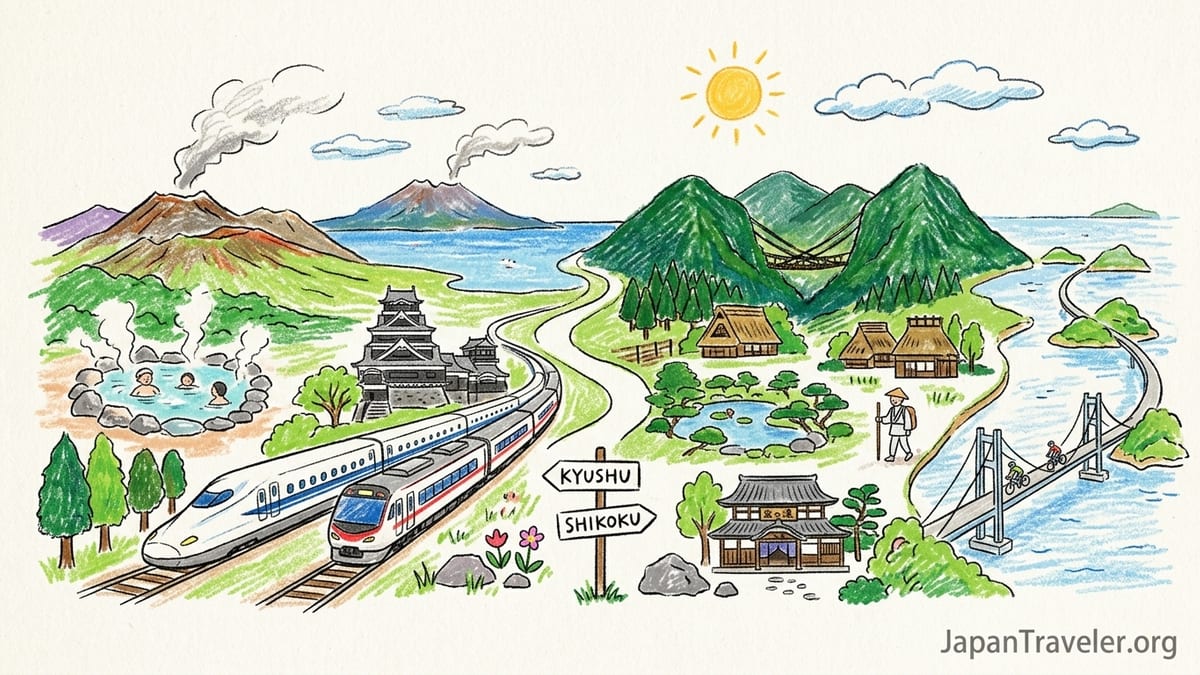
Kyushu vs Shikoku at a Glance
Kyushu is larger, more populated, and far better connected by Shinkansen and limited express trains. Its main cities, Fukuoka, Nagasaki, Kumamoto, and Kagoshima, are linked by frequent rail services, and there is a dense web of local trains and buses to onsen towns like Beppu, Yufuin, and Kurokawa. You can land at Fukuoka Airport in the morning, be in Beppu by early afternoon, and finish the day in a hot spring with a city view.
Shikoku is smaller and more rural, with gentler cities such as Takamatsu, Matsuyama, Kochi, and Tokushima. There is no Shinkansen on the island itself, and while there are good limited express trains and buses along the coasts, mountainous interiors like the Iya Valley are often only reachable by twisting local roads and infrequent buses. The payoff is a quieter, slower trip that can feel closer to countryside Japan of a few decades ago.
In broad strokes, Kyushu suits travelers who want variety and easy logistics: volcanoes near Kumamoto, big-city food in Fukuoka, the onsen clusters around Beppu, historic Nagasaki, and even access to the southern tip at Kagoshima. Shikoku suits those who would rather choose two or three bases, take their time, and focus on one theme such as the 88 Temple Pilgrimage, cycling the Shimanami Kaido, or staying in a traditional onsen town like Dogo Onsen in Matsuyama.
For most first-time visitors choosing only one, Kyushu offers more clearly defined “must see” stops and faster transport between them, while Shikoku rewards travelers who are comfortable with patchier public transport and a bit more planning, or who are happy to rent a car.
Trip Length and Ideal Itineraries
With one week, Kyushu works well as a loop using public transport. A typical seven-night trip might start in Fukuoka for food stalls and shopping, continue to Nagasaki for one or two nights to visit Dejima and the Peace Park, move to Beppu or Yufuin for hot springs, and finish in Kumamoto or Kagoshima for castle ruins and views of active volcanoes like Sakurajima across the bay. All of these legs are practical on trains and highway buses, and you rarely need more than two or three hours between stops.
A similar one-week Shikoku trip tends to be more compact. Many visitors arrive via Okayama and cross to Takamatsu for the Ritsurin Garden and udon, then head to Tokushima or the Iya Valley for vine bridges and mountain scenery, and finish in Matsuyama for Dogo Onsen. On paper that looks simple, but in practice, the jump from the Iya Valley to Matsuyama can easily eat half a day on local trains and buses, and some bus routes only run a few times daily, especially outside peak seasons.
If you have 10 to 14 days, Kyushu can support a deep dive that includes places like Kurokawa Onsen, Aso caldera, and the remote islands off Nagasaki or Kagoshima, but that longer timeframe arguably benefits Shikoku even more. With two weeks you can string together stretches of the 88 Temple Pilgrimage, spend a full two or three days cycling the Shimanami Kaido at an easy pace, and still linger in Matsuyama and Kochi without racing across the island.
For travelers with only 4 or 5 days beyond Kansai or Hiroshima, Kyushu is usually simpler. You can, for example, take the morning Shinkansen from Hiroshima to Hakata, stay two nights in Fukuoka, spend a night in Yufuin, and return to Osaka by Shinkansen without ever needing a car. Shikoku can be done in this time, but you will likely need to focus on just Takamatsu and Matsuyama, or a direct trip to Matsuyama for Dogo Onsen and the castle.
Getting Around: Trains, Buses and Car Dependence
Kyushu’s headline advantage is its rail infrastructure. The Kyushu Shinkansen runs from Hakata in Fukuoka down to Kagoshima-Chuo, with fast services that can cover Fukuoka to Kumamoto in about 35 minutes and Fukuoka to Kagoshima in around 1 hour and 20 minutes, depending on the train. Limited express services fill in the gaps: the Sonic between Fukuoka and Oita for Beppu and Yufuin, or the limited express from Hakata toward Nagasaki. This means you can realistically base yourself in one spot and do day trips by rail, or move between cities without detailed timetables in hand.
Many of Kyushu’s famous onsen towns and volcano viewpoints are also reachable by well-used highway buses. For example, Yufuin is commonly accessed by direct highway buses from Fukuoka’s Hakata Station and the airport, taking roughly two and a half hours. At Beppu, local buses fan up into the hills for the “Hells” geothermal area and up to viewpoints that overlook steam rising from neighborhood onsen baths. For a first-time visitor using a rail pass or contactless cards, Kyushu’s system feels familiar and forgiving.
Shikoku is more car-dependent, especially away from the main coastal corridor. There are limited express trains linking Okayama with Takamatsu, and then running onward around the island, and these are comfortable and reasonably frequent. However, when you want to reach the Iya Valley, the Oboke Gorge, secluded pilgrimage temples, or the interior mountains of Kochi prefecture, train lines quickly give way to buses on narrow roads. Services might only run once every couple of hours, and you may need to coordinate arrivals carefully to avoid long waits at rural bus stops.
Car rental transforms Shikoku. For example, driving from Takamatsu to the Iya Valley typically takes under two hours, and from there to Kochi’s coastline is another couple of hours, making it easy to pair river gorges, thatched-roof farmhouses, and Pacific beaches in a single itinerary. The same is true around Matsuyama, where having a car lets you combine Dogo Onsen with small fishing villages and hillside viewpoints without worrying about bus timetables. Drivers should be comfortable with left-side driving and winding, sometimes single-lane, mountain roads.
Nature and Landscapes: Volcanoes vs Valleys and Inland Sea
Kyushu’s landscapes are shaped by volcanoes and hot springs. Near Kumamoto, Mount Aso sprawls as one of the world’s largest calderas, with highland grasslands, viewpoints reachable by bus or car, and, when conditions allow, monitored access areas where you can see smoke rising from active craters. Around Kagoshima, the silhouette of Sakurajima dominates the bay, often puffing gently, and visitors can take ferries to the island for short hikes and hot springs with volcanic views.
The Beppu and Yufuin area on Kyushu’s eastern side combines coastal scenery with geothermal activity. In Beppu, entire neighborhoods are laced with steam vents, public bathhouses, and the famous “hells” hot spring displays. A short local train or bus ride inland leads to Yufuin, where ryokan cluster along a small river beneath Mount Yufu, and an early-morning walk around Lake Kinrin might include the sound of trains passing and the smell of woodsmoke and sulfur together.
Shikoku’s standout nature is subtler but arguably more intimate. The Iya Valley in Tokushima prefecture is a deep, narrow gorge with emerald rivers, vine bridges, and steep, terraced slopes dotted with hamlets. Rather than dramatic volcanic craters, the appeal lies in misty mornings, quiet walking paths, and the feeling of being far from major cities even though you may be only a few hours away. Guesthouses here often occupy renovated farmhouses, where you sit by an irori hearth while watching the valley fall into evening darkness.
Along Shikoku’s northern edge, the Seto Inland Sea offers a gentle maritime landscape of small islands, fishing ports, and long bridges. The Shimanami Kaido, stretching roughly 60 to 70 kilometers between Onomichi on Honshu and Imabari on Shikoku, links six islands by a series of bridges with dedicated cycling and pedestrian paths. Cyclists ride a blue line marking the route, stopping at viewpoints, citrus farms, and small seaside cafes. On the west coast, around Matsuyama, the sea is calmer and dotted with small islands, while Shikoku’s Pacific side near Kochi has bigger surf and long beaches more suited to rougher seaside walks and surfing.
Culture, Cities and Signature Experiences
Kyushu’s cities feel like extensions of Japan’s main urban belt, but with their own character. Fukuoka is a modern city of shopping streets and food stalls, where in the evening you can sit at a yatai near the river and eat hakata ramen or grilled skewers with local office workers. Nagasaki weaves together Japanese, Chinese, and European influences in its hillside neighborhoods, with tram lines, churches, and Chinese temples all within easy reach of the port. Kumamoto, though damaged in the 2016 earthquake, has continued reconstruction of its castle area and retains an easygoing feel with wide streets and tram lines.
On Kyushu, the network of onsen is part of daily life rather than just a special weekend away. In Beppu, many business hotels offer free access to modest hot spring baths, while upscale ryokan have private open-air tubs. In smaller onsen areas like Kurokawa Onsen, a popular experience is buying a wooden onsen-hopping pass that lets you try baths at multiple inns, wandering between them in yukata. Even in Fukuoka and Kagoshima you can find urban bathhouses using natural hot spring water, making it easy to incorporate onsen into almost any itinerary.
Shikoku’s urban culture is quieter, and its signature experiences tend to revolve around tradition and pilgrimage. The 88 Temple Pilgrimage loops around the island, and even travelers who are not doing the full route often visit a handful of temples, noticing white-clad pilgrims with walking sticks on trains or at bus stops. In Matsuyama, Dogo Onsen Honkan is often described as one of Japan’s oldest hot spring bathhouses, a multi-story wooden structure where locals and tourists mix. Taking the retro tram from Matsuyama’s castle area to Dogo, slipping into the communal baths, and finishing with a stroll through the arcade outside is an everyday ritual for residents and a highlight for visitors.
Shikoku’s cities also each have a distinct, small-town flavor. Takamatsu is known for Ritsurin Garden and lively covered shopping arcades, Kochi for its Sunday market and nearby beaches, and Tokushima for the Awa Odori dance festival in August, when streets fill with dance teams and spectators. None of these cities feel as intense as Fukuoka, which can be a plus or a minus depending on whether you crave urban energy or calm evenings.
Food and Local Flavors
Kyushu is often considered one of Japan’s best food regions. Fukuoka is the spiritual home of tonkotsu ramen, with chains like Ichiran originating here and local shops serving bowls of rich pork broth with thin noodles for around 900 to 1200 yen. In Hakata’s yatai food stalls, you can combine ramen with yakitori or oden in one casual meal. Across the island you find regional dishes like Nagasaki champon noodle soup, basashi horse sashimi in Kumamoto, and Kagoshima’s kurobuta black pork shabu-shabu.
Seafood is also strong in Kyushu. Cities such as Fukuoka, Nagasaki, and Kagoshima serve sashimi and sushi that benefit from nearby fishing grounds, and coastal towns offer specialty dishes like seaside charcoal-grilled seafood or squid in Yobuko. Even in inland onsen villages, dinner at a ryokan typically features multiple seafood courses alongside local vegetables and beef or pork. If food variety is your priority, Kyushu’s combination of big city dining scenes and regional specialties is hard to beat.
Shikoku’s culinary identity is more tightly focused but very satisfying. Kagawa prefecture, where Takamatsu sits, is famous nationwide as “Udon Prefecture,” and self-service udon shops where you choose your toppings and pay just a few hundred yen for a big bowl are both a local staple and a tourist attraction. In Ehime, around Matsuyama and Imabari, citrus fruits are a big feature, with mikan juice, soft-serve ice cream, and seasonal citrus-based sweets easy to find. Kochi is known for katsuo no tataki, seared bonito, often eaten with garlic and local salt rather than soy.
Because Shikoku’s cities are smaller, dining options can be more concentrated, especially at night, but that can work in your favor if you like walking from your guesthouse to one or two izakaya that serve regional dishes. In Matsuyama, for example, it is easy to combine a Dogo Onsen soak with casual yakitori or izakaya dinners in the streets surrounding the hot spring district, and in Takamatsu you can snack your way between udon shops and small taverns near the station and shopping arcades.
Access and Combining Each Island with Kansai or Hiroshima
If you are starting in Kansai, Kyushu is straightforward. Shinkansen from Shin-Osaka to Hakata in Fukuoka can be as fast as about two and a half hours on a direct service, and from Hiroshima it is roughly one hour. This makes it easy to treat Fukuoka as an extension of a Hiroshima or Osaka trip. For example, you might spend three days in Hiroshima and Miyajima, then continue by Shinkansen to Fukuoka for two nights and a side trip to Dazaifu Tenmangu shrine, without changing how you use public transport.
Accessing Kyushu’s interior is similarly convenient. From Fukuoka, limited express trains and buses head to Beppu and Yufuin, and Shinkansen continue toward Kumamoto and Kagoshima. As a practical example, many travelers leave Hiroshima after breakfast, arrive in Beppu around lunchtime via a Shinkansen to Kokura and then the Sonic limited express along the coast, check into a ryokan, and are relaxing in outdoor baths by late afternoon. That kind of same-day shift from city sightseeing to full onsen immersion is easier in Kyushu than almost anywhere else in Japan.
Shikoku connects to Kansai and Hiroshima in a more piecemeal way. From Osaka or Kyoto, the common route is to take the Shinkansen to Okayama, then change to a limited express across the Seto Ohashi Bridge to Takamatsu. Total travel time from Osaka to Takamatsu is usually around three to three and a half hours, depending on connections. From Hiroshima, you can reach the Shimanami Kaido area by local or rapid trains to Onomichi and begin the cycling route that eventually delivers you to Imabari on Shikoku, or you can bus directly to Matsuyama ferries and cross that way.
This patchwork of trains, buses, ferries, and bicycles is part of Shikoku’s charm, but it does add planning steps. If you want to combine Kyoto, Hiroshima, the Shimanami Kaido, and Dogo Onsen in Matsuyama in a one-week itinerary, you will usually need to book some buses or stays in advance and pay attention to train times, especially on the Shikoku side between Imabari and Matsuyama or onward toward Kochi. For confident planners, this is rewarding. For travelers who prefer to improvise, Kyushu’s more uniform fast-rail network will feel easier.
Which Island Is Better for You?
Kyushu is the better choice if you want a wide range of experiences without renting a car. In one compact trip you can sample a serious food city in Fukuoka, trace international history in Nagasaki, soak in onsen at Beppu or Yufuin, and stand on the rim of an enormous volcanic landscape near Aso or look at Sakurajima across Kagoshima Bay. Train and bus networks are robust enough that a Japan Rail Pass or regional rail pass will cover most of your movements, and travel times between major stops are short enough that you do not lose whole days in transit.
Shikoku is the better choice if you value quiet, slow travel and are willing to deal with lighter infrastructure or to rent a car. It shines for travelers interested in the 88 Temple Pilgrimage, in cycling the Shimanami Kaido between Onomichi and Imabari as a one or two day ride, or in staying at onsen towns like Dogo Onsen that still feel very local. With more time, you can follow the coastlines, weave into the Iya Valley, or attend seasonal events like the Awa Odori festival in Tokushima, where local culture takes center stage.
If you are undecided and your main concern is “ease,” Kyushu is usually the safer choice, especially for first-time visitors to regional Japan or travelers with children or large luggage. If your main concern is “atmosphere” and you actively seek out places that feel less discovered, then Shikoku will often feel more special, even if you only manage a short combination of Takamatsu, the Shimanami Kaido, and Matsuyama.
In short, choose Kyushu for breadth and convenience, Shikoku for depth and slowness. Both islands pair well with Kansai and Hiroshima, and both will show you sides of Japan that lie well beyond the standard Tokyo–Kyoto–Osaka axis.
FAQ
Q1. Is Kyushu or Shikoku better if I do not want to rent a car?
Kyushu is generally better without a car because the Shinkansen and limited express trains connect most major destinations, and popular spots like Beppu and Yufuin have frequent highway buses. Shikoku’s main cities are reachable by train, but interior areas such as the Iya Valley or more remote pilgrimage temples often require slower buses, so no-car travel demands more planning.
Q2. Which island works better for a 5 to 7 day trip from Osaka or Kyoto?
For 5 to 7 days, Kyushu usually offers a smoother experience. You can reach Fukuoka by Shinkansen, then combine Fukuoka, Nagasaki, and either Beppu or Yufuin in a simple loop. Shikoku can work in this time frame, but itineraries often need to be more focused, for example only Takamatsu and Matsuyama or a Shimanami Kaido ride plus Dogo Onsen.
Q3. How difficult is it to cycle the Shimanami Kaido as part of a Shikoku trip?
The Shimanami Kaido is around 60 to 70 kilometers between Onomichi and Imabari, with dedicated cycling and pedestrian routes over the bridges and rental shops at both ends. Most reasonably fit people can complete it in one long day or two relaxed days, and many visitors integrate it into a wider Shikoku trip by staying overnight on one of the islands or in Imabari or Onomichi.
Q4. Are Kyushu’s volcanoes safe to visit?
Areas around volcanoes such as Mount Aso and Sakurajima are closely monitored, and access to active craters is sometimes restricted when activity increases. In practice, visitors usually enjoy viewpoints, hiking routes, and onsen towns nearby without going into high-risk zones, following local signage, transport updates, and any temporary closures announced by authorities.
Q5. Can I visit the Iya Valley in Shikoku using only public transport?
Yes, but it requires careful timing. You can reach Oboke or Awa-Ikeda by train and then transfer to local buses that run into the valley to areas with vine bridges and guesthouses. Services are limited, so you may want to book accommodation that offers pick-up from bus stops or taxis and avoid tight same-day connections.
Q6. Which island has better onsen experiences, Kyushu or Shikoku?
Kyushu has a wider and more varied onsen scene, with major hubs like Beppu, Yufuin, and Kurokawa Onsen, as well as many smaller hot spring towns. Shikoku’s standout onsen is Dogo Onsen in Matsuyama, which is rich in history and atmosphere, but overall the density and variety of hot spring destinations is greater in Kyushu.
Q7. Is it easy to combine Hiroshima with Kyushu or Shikoku?
Hiroshima connects very easily with Kyushu via the Shinkansen, making trips from Hiroshima to Fukuoka or even farther south straightforward. To combine Hiroshima with Shikoku, many travelers use Onomichi as a gateway to the Shimanami Kaido, or travel to Okayama and switch to trains across to Takamatsu, which adds an extra transfer but is still practical within a day.
Q8. Where will I find better food, Kyushu or Shikoku?
Kyushu offers more variety overall, from Fukuoka’s famous tonkotsu ramen and yatai food stalls to Nagasaki’s champon and Kagoshima’s black pork dishes. Shikoku has standout specialties like Sanuki udon and citrus-based sweets, but fewer large dining districts. If food is a major priority, Kyushu tends to provide more options in a compact area.
Q9. Which island is less crowded with international tourists?
Shikoku is generally less visited by international tourists than Kyushu, especially outside well-known spots like Dogo Onsen and the Shimanami Kaido. Kyushu still feels less crowded than the Tokyo–Kyoto–Osaka corridor, but its major cities and onsen hubs receive more overseas visitors than most of Shikoku’s interior and smaller towns.
Q10. If I want a mix of city life and countryside, which island should I choose?
Kyushu is usually the better choice for mixing big-city energy with easy countryside escapes. You can enjoy urban Fukuoka or Nagasaki and be in hot spring towns or volcanic landscapes within a few hours by train or bus. Shikoku can also provide this mix, but its cities are smaller and the transitions between city and countryside often involve slower, less frequent transport.