


With only a few days in the Seto Inland Sea, many travelers face the same dilemma I did: if you cannot give two full days to the region, should you spend your precious art-island time on Naoshima, with its world-famous museums and iconic pumpkin sculptures, or on the quieter, more concentrated experience of Teshima? I devoted one long day to each island on separate trips, carefully tracked what I actually spent, and paid attention not only to the art but to the ferries, buses, hills, food and crowds that shape the experience. This is the comparison I wish I had read before I booked my own tickets.
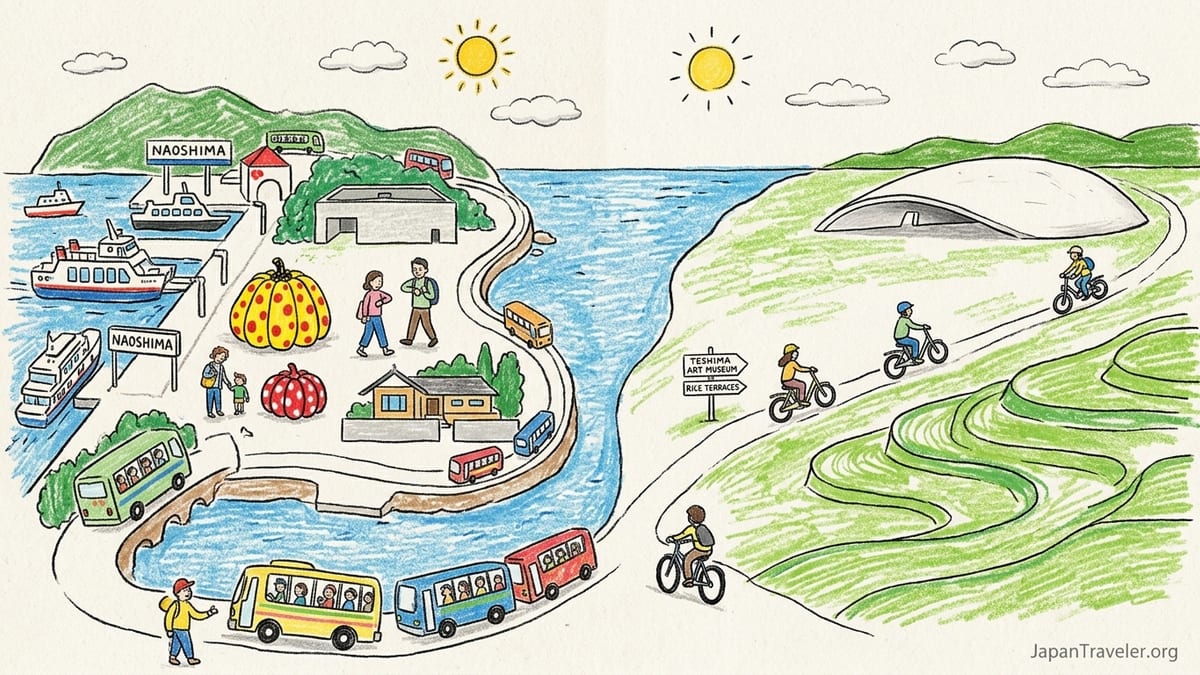
What I Expected From Naoshima and Teshima
Before visiting, I expected Naoshima to feel like a compact, walkable open-air museum, where I could drift between Chichu Art Museum, Benesse House, the Art House Project and the new Naoshima New Museum of Art in a relaxed loop. The reality is more complicated. Naoshima is still a small island, but the art facilities are spread across distinct districts and hills, served by local buses that can be crowded in peak season. I also assumed that once I was on the island I could play things by ear with tickets. That turned out to be very wrong for the most popular sites.
Teshima, by contrast, I imagined as the side trip for people who had extra time. In my head it was “Naoshima-lite”: fewer works, a bit harder to reach, and nice if you had already seen the main attractions. I knew about the Teshima Art Museum, the Teshima Yokoo House and Les Archives du Cœur, but I thought of them as optional add-ons rather than a destination in their own right. I did not expect the rural landscape and the slowness of moving around the island to matter as much as the art.
On both islands my goal was the same: arrive on an early ferry, rely on public transport and rental bicycles, visit a realistic number of museums without sprinting, eat on the island instead of packing food, and get back to the mainland before dark. I booked timed tickets for the museums that now require them, and I took notes on what I paid, how long I actually spent in each place, and where the friction points were.
What surprised me was not just which artworks moved me the most, but how strongly logistics shaped my memories. The question “Naoshima or Teshima?” is not only about which art you prefer. It is also about how you like to travel: tightly scheduled or meandering, museum-focused or landscape-focused, social or solitary.
The Museums That Impressed Me Most
On Naoshima, my most intense experience was at Chichu Art Museum. Built largely underground and designed by Tadao Ando, it is one of the few museums where the building, the art and the light are inseparable. My weekday online ticket cost 2,500 yen, with a specific 11:00 entry time that I had booked weeks in advance. That time slot dictated my entire Naoshima schedule. Inside, the Walter De Maria room, James Turrell installations and Monet’s Water Lilies created exactly the meditative, time-slowing atmosphere that drives people to cross half of Japan just to visit. I spent roughly 90 minutes there and never felt it was too long.
Benesse House Museum impressed me in a different way. The online weekday ticket was 1,300 yen, and the museum opens earlier than many others on the island, from 8:00 in the morning. I used that to my advantage by catching an early ferry and arriving at Benesse House soon after opening, before tour groups filled the galleries. The collection is not enormous, but I loved how the art bleeds out of the building into the coastal landscape: seeing works by artists like Yayoi Kusama and Shinro Ohtake outdoors with the Seto Inland Sea as a backdrop felt specific to this island, not something I could replicate in Tokyo or New York.
The new Naoshima New Museum of Art, which charges 1,500 yen online on weekdays, filled in some of the gaps between Chichu’s ultra-minimal focus and Benesse House’s hotel-museum hybrid. I visited in the mid-afternoon, and the architecture once again played a major role. Meanwhile, the Art House Project in Honmura, accessed with a 1,200 yen multi-site ticket, gave me a very different scale of experience. The installations are embedded in old houses scattered through the village streets, and wandering between them created more contact with everyday Naoshima life: schoolchildren on bicycles, small shrines, vegetable gardens and the smells drifting out of family kitchens.
On Teshima, the Teshima Art Museum was simply on another plane. The ticket, booked online, cost 1,700 yen after the October 2024 price update, with a timed slot that I chose for late morning. The “museum” is really a single, shell-like concrete space open at the edges to rice terraces and sky. There are no framed works on the wall, only water, gravity and light. I stayed inside for nearly two hours, longer than I had planned, just watching the tiny streams of water form and reform across the floor, listening to footsteps and distant crows. It was easily one of the most memorable art experiences I have had anywhere.
What Disappointed Me Along the Way
Naoshima’s disappointments were mostly about logistics and crowds, not the quality of the art. Because several facilities now require date-and-time reservations, including Chichu Art Museum and the Naoshima New Museum of Art, I felt I was constantly checking my watch. My 11:00 reservation at Chichu meant I could not linger as long as I wanted at Benesse House in the morning. Later, my afternoon slot for the New Museum cut short my time in Honmura and forced me to skip one of the smaller Art House Project sites when I saw the line snaking out the door and realized it would risk making me late.
I was also surprised by how little photography was allowed. Chichu bans interior photography almost entirely, and several of the most powerful spaces at Benesse House and the Art House Project are camera-free. Intellectually, I understand why. In practice, it meant that friends who are passionate photographers felt some frustration after paying multiple admission fees, only to be told they could not shoot in many of the indoor spaces. Instead, they took most of their pictures around the famous outdoor sculptures and coastline.
On Teshima, my main disappointment was that I could not do more in one day without rushing through what I had come to see. The island is hillier than Naoshima, and while there are local buses, they run infrequently compared to Naoshima’s, and some key spots are best reached by rental bicycle or e-bike. After spending two unplanned hours inside Teshima Art Museum, I realized I would have to make trade-offs. I did manage to visit Teshima Yokoo House, an immersive, color-saturated conversion of a traditional house in the port area, and Les Archives du Cœur, Christian Boltanski’s long-running project that records and plays back human heartbeats in a small building by the sea. But I missed a couple of smaller installations in the interior of the island.
I had hoped Teshima would feel logistically more relaxed because there are fewer marquee museums. Instead, the hills, heat and the need to match my movements to the sparse bus schedule created their own kind of time pressure. On a humid summer day, the ride back up from Les Archives du Cœur to my return ferry felt longer than it looks on the map, even on an e-bike, and I saw more than one visitor walking their bike up steeper stretches in the midday sun.
How Easy Each Island Was to Explore
Naoshima is not large, but most visitors underestimate distances and vertical gain, especially between the Benesse/Chichu area and Honmura village. The main art zones are spread around the coast and inland ridges, so you alternate between short bus rides, walks and, if you choose, rental bicycles. Local buses connect Miyanoura Port, Honmura, Benesse House and Chichu Art Museum. When I visited, a bus ride cost only a few hundred yen, but during busy periods the buses were often standing-room-only, and I saw two departures pass full at Miyanoura in the mid-morning rush.
I decided on a hybrid strategy. From Uno Port I took a morning ferry to Miyanoura, paying just under 400 yen for the 20-minute crossing after a fare rise in 2026. At Miyanoura I rented an electric bicycle for about 1,500 yen for the day from a small shop opposite the ferry terminal, then also used the island bus for the steeper uphill stretch to Chichu in the heat of the afternoon. The e-bike made linking up Benesse House, Chichu and some outdoor works far easier, but I still needed to factor in time to park and walk from the bus stops and parking lots up to the museum entrances.
Teshima felt physically smaller but more demanding. Ferries and high-speed boats connect it not only to Uno and Takamatsu but also to Naoshima, which is how I arrived, paying around 1,000 yen for the crossing from Naoshima’s port. Jeune Port on Teshima is compact, and the Teshima Yokoo House is just a few minutes’ walk from the pier, which makes it an ideal first stop. From there, though, the Teshima Art Museum sits on a hill above rice fields and the inland bus service is limited. I paid 1,500 yen to rent an electric bicycle near the port, and even with battery assistance, the ride to the museum involved some sustained climbs.
Because I was there on a weekday outside any Setouchi Triennale festival period, the roads were quiet, but that also meant fewer food options open in the smaller hamlets. It was essential to time my loop so that I could eat near the museum cafe at lunchtime. For less confident cyclists or families with small children, Teshima’s topography will feel like more of an obstacle than Naoshima’s. The upside is that once you reach the main sites, there is far more space and silence than on Naoshima, with fewer tour buses and less background noise.
The Real Costs of My Days on Each Island
On Naoshima, my full day started and ended in Uno, on the Okayama side of the inland sea. I paid just under 400 yen for the morning ferry to Miyanoura and the same again for the evening return. My e-bike rental came to roughly 1,500 yen for the day. For museums, I purchased online weekday tickets to Chichu Art Museum for 2,500 yen, Benesse House Museum for 1,300 yen, the Naoshima New Museum of Art for 1,500 yen and an Art House Project multi-site ticket for 1,200 yen. That brought my total admission fees to 6,500 yen.
On top of that, I spent about 600 yen on two local bus rides to avoid the steepest climbs, and just over 1,000 yen on lunch and a drink at a cafe near Benesse House, plus another 600 yen for coffee and a snack at Miyanoura while waiting for the evening ferry. In round numbers, my Naoshima day, excluding accommodation, cost roughly 10,000 yen: around 800 yen in ferries, 1,500 yen for the e-bike, about 1,200 yen on buses and food, and 6,500 yen on museum tickets.
My Teshima day started from Naoshima because I chose to base myself there overnight. The high-speed boat from Naoshima to Teshima cost just under 1,000 yen, slightly more than the standard ferries to and from Uno. I rented another e-bike for 1,500 yen at the port. The major admission was the Teshima Art Museum at 1,700 yen for a timed ticket after the most recent price revision. Teshima Yokoo House and Les Archives du Cœur each charged admission in the low 500 to 600 yen range, for a total of a little under 3,000 yen in museum fees.
Food on Teshima was more constrained. I paid around 1,200 yen for a simple pasta lunch and drink near the Teshima Art Museum, one of the few options within easy walking distance. Back at the port in the afternoon, I bought an ice cream and drink for about 500 yen while waiting for the boat. The return fare to Naoshima mirrored the outgoing one. All told, my Teshima day cost in the 6,500 to 7,000 yen range: about 2,000 yen in boat travel, 1,500 yen for the e-bike and 3,000 yen on admissions and food. It was notably cheaper than my Naoshima day, but I also visited fewer paid facilities.
Value, Atmosphere and Which Felt More Memorable
On paper, Naoshima clearly offers more art for your yen. I paid for four separate tickets and could easily have added Lee Ufan Museum or the Hiroshi Sugimoto Gallery on another day. The density of high-profile architecture, installations and museums is hard to match anywhere else in Japan. If your priority is to see as much contemporary art as possible in one day, Naoshima justifies the multiple admissions, with the caveat that you will need to move efficiently and book the key facilities in advance.
Yet when I think back on both days, the single ticket I bought for the Teshima Art Museum feels like it delivered a disproportionate share of my most vivid memories. I left Naoshima impressed and satisfied, with my phone full of photos of outdoor sculptures and sea views, but also somewhat tired from reshuffling my movements around bus times, hills and reservation slots. Teshima, by contrast, left me with fewer photographs but a clearer emotional imprint: a specific quality of light inside the Teshima Art Museum, the sound of waves near Les Archives du Cœur, and the view of rice terraces cascading toward the sea as I coasted downhill on my bike.
If I judge by cost per museum, Naoshima is the better value for quantity. If I judge by cost per profound experience, Teshima comes out ahead. That is the heart of the decision. Naoshima feels like a carefully curated contemporary art destination wrapped in tourism infrastructure, with plenty of cafes, multiple convenience stores in Miyanoura and a wider choice of accommodation. Teshima feels more like entering someone else’s quiet countryside, where the artworks coexist with farming, fishing and small villages rather than dominating them.
Photography plays into this contrast. Both islands restrict photography heavily inside their flagship museums, but Naoshima gives you many more outdoor sculptures, beaches and architectural exteriors to shoot. Teshima offers far fewer obvious “Instagram spots,” and the most powerful space on the island, the Teshima Art Museum interior, is firmly no-photos. For me, that made it easier to be present. For some travelers, especially photographers, it might feel like a limitation.
Where I Would Return, and For Whom Each Island Works Best
If I had to choose where to return tomorrow with a single day to spare, I would choose Teshima. The combination of the Teshima Art Museum, Teshima Yokoo House and Les Archives du Cœur, framed by rice terraces and small fishing villages, created a day that felt both artistically rich and emotionally calm. I liked that there were fewer decisions to make. Once I had my museum times fixed and my e-bike rented, the rest of the day unfolded at walking and cycling pace, dictated as much by the heat and the hills as by the clock.
That said, if I were advising someone on their first trip to Japan who might never return, I would still point them to Naoshima first, provided they can handle a relatively structured day. Naoshima simply carries more cultural weight: people read about Chichu Art Museum and Benesse House in international magazines, and there is a particular thrill in stepping into spaces you have seen in photographs for years. For visitors building their trip around contemporary art, Naoshima remains the flagship, but I would strongly encourage staying one night on or near the island rather than trying to combine Naoshima and Teshima in a single day.
For art enthusiasts with two days to spend in the Seto Inland Sea, my ideal itinerary would be one full day on Naoshima focused on Chichu, Benesse House and the Art House Project, followed by a Teshima day with generous time at the Teshima Art Museum. Families with younger children might struggle more on Teshima, where hills and longer cycling stretches can wear kids out, and food choices are fewer and less flexible. Naoshima’s buses, beaches and more varied dining options make it easier to adapt to changing moods and energy levels.
For photographers, Naoshima is the better playground, with its outdoor sculptures, coastal promenades and village streets. For travelers seeking a quieter, more contemplative experience with fewer moving parts, Teshima is hard to beat. Ultimately my preference for Teshima is personal and rooted in the kind of travel I value most: fewer tickets, more time in a small number of spaces, and long pauses where not much happens except watching light move across concrete and water.
The Takeaway
Naoshima and Teshima are often mentioned in the same breath, but they deliver different kinds of days. Naoshima is the more complex puzzle: several separate tickets, strict timed entries at major museums, bus routes looping between ports and museum districts, and enough marquee sites that you cannot realistically see everything in one day without feeling rushed. It rewards advance planners who are comfortable stitching together ferries, bikes and reservations into a precise schedule.
Teshima is simpler on paper, with fewer major attractions and lower total costs, but its hills, limited buses and sparse restaurant options add their own layer of challenge. The reward for that extra effort is space, quiet and a sense that the art has been woven gently into rural life rather than dominating it. For me, the Teshima Art Museum alone justified the trip, and the supporting experiences on the island deepened that feeling instead of competing with it.
If you have only one Setouchi art-island day and care most about breadth of contemporary art and architecture, choose Naoshima, book Chichu Art Museum and one or two other key facilities in advance, and accept that you will miss a few things. If you have one day and care more about depth, slowness and a single unforgettable experience, choose Teshima, reserve the Teshima Art Museum for the heart of your day, and give yourself time to move between sites without watching the clock too closely.
Either way, the real key is to align the island with your travel style. If you thrive on packed itineraries and checking off major names, Naoshima will thrill you. If your ideal day involves long stretches of walking or sitting in one extraordinary space, with the sound of wind in rice terraces or waves on the shore, Teshima may well become the island you remember longest.
FAQ
Q1. If I only have one day in the Seto Inland Sea, should I choose Naoshima or Teshima?
For a first-time visitor who values seeing famous contemporary art museums and iconic outdoor works, Naoshima is the stronger single-day choice. If you care more about a quieter, more contemplative experience built around one extraordinary space, Teshima is the better fit.
Q2. How much should I budget for a full day on Naoshima?
For a day starting and ending in Uno, a realistic budget is around 10,000 yen per person, including round-trip ferries, an electric bicycle, several bus rides, lunch and coffee, and admissions to Chichu Art Museum, Benesse House Museum, Naoshima New Museum of Art and the Art House Project.
Q3. How much does a full day on Teshima usually cost?
Expect to spend roughly 6,500 to 7,000 yen for a day that includes boat travel to and from the island, an electric bike rental, admission to the Teshima Art Museum, Teshima Yokoo House and Les Archives du Cœur, plus a simple lunch and drinks.
Q4. Do I really need to book museum tickets in advance?
Yes for the flagship venues. Chichu Art Museum, the Naoshima New Museum of Art and Teshima Art Museum all use timed, limited-capacity tickets, and popular slots often sell out days or weeks ahead, especially in holiday periods. Smaller sites usually have more flexible entry, but you still need to plan around timed bookings.
Q5. Which island is easier to get around without renting a bicycle?
Naoshima is easier for non-cyclists because its local buses run more frequently and connect major museums with the ports and Honmura village. You can still expect short uphill walks to entrances. On Teshima, the bus network is sparse, and many visitors rely on bicycles or e-bikes to reach the Teshima Art Museum and inland sites.
Q6. Are there good food options on both islands?
Naoshima offers more variety, with cafes near Benesse House and Chichu, small restaurants and a few convenience stores around Miyanoura and Honmura. Teshima has fewer choices, and opening hours can be limited, so it is wise to plan to eat near the Teshima Art Museum or bring snacks in case smaller cafes are closed.
Q7. What should photographers know before choosing between Naoshima and Teshima?
Both islands forbid photography in many indoor installations, including most of Chichu Art Museum and the interior of Teshima Art Museum. Naoshima compensates with more outdoor sculptures, beaches and village scenes to photograph. Teshima offers fewer obvious photo subjects but more opportunities to simply experience the spaces without a camera.
Q8. Is either island suitable for families with young children?
Families tend to find Naoshima more manageable. Buses reduce walking, beach areas offer space to play, and there are more food options. On Teshima, hills, longer cycling distances and stricter quiet in spaces like the Teshima Art Museum can be challenging for younger kids or parents pushing strollers.
Q9. Can I reasonably visit both Naoshima and Teshima in one day?
It is technically possible using high-speed boats, but doing both islands in a single day usually means rushing each one and risking missed ferries or reservation slots. If you value the art, it is far better to dedicate one full day per island or at least avoid stacking them on the same day.
Q10. For contemporary art lovers, is Teshima worth the effort if I already spend a full day on Naoshima?
Yes. Even if you have seen many museums on Naoshima, the Teshima Art Museum in particular provides a distinct, immersive experience that many visitors rank among their most powerful art encounters in Japan. If you can spare a second day, Teshima adds depth rather than duplication.