


I arrived in Onomichi on a clear autumn morning with slightly sore legs and chain oil still on my trousers after two days of cycling the Shimanami Kaido from Imabari. The plan was simple: store my panniers at the station, spend at least half a day walking through the city’s hillside temples and narrow backstreets, ride the Senkoji Ropeway once, and see whether Onomichi deserves more than its reputation as just a starting or finishing line for cyclists.
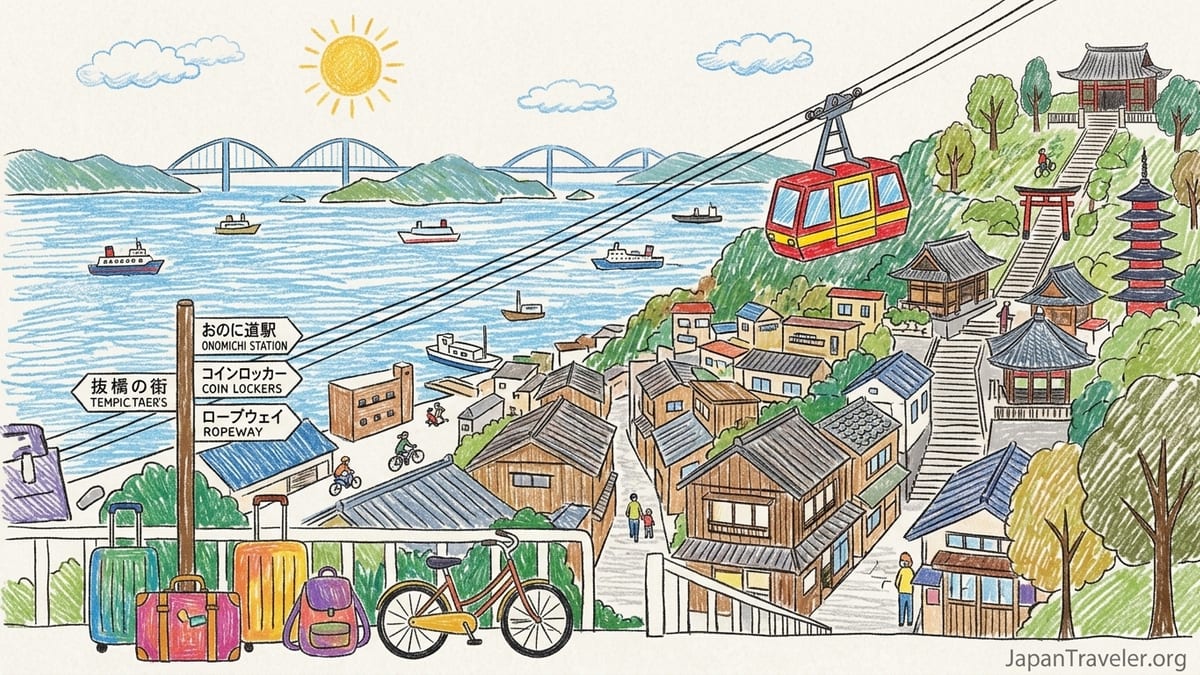
Starting at Onomichi Station and Stashing the Luggage
Onomichi Station sits practically at the water’s edge, with the Seto Inland Sea only a short stroll away. Stepping off the local train from Mihara just after 9 a.m., I joined a small wave of cyclists wheeling rental bikes toward the waterfront and Shimanami-related shops, while others in daypacks moved straight toward the ticket gates. Before walking anywhere, I followed the international signs for coin lockers. Inside the station building and just outside near the south exit there are clusters of lockers in several sizes. Recent local information and travel reports in 2026 indicate that standard lockers here accommodate luggage for up to about three days, with small lockers usually around a few hundred yen and larger ones closer to the thousand-yen mark, payable in coins or IC card depending on the unit.
By mid-morning there were still several large lockers free. I slid my rear panniers and a helmet into one large unit, closed the door with a satisfying clang, and fed in the coins. The cost for the day was only a little more than a cup of coffee, and the freedom of walking Onomichi without wrestling luggage instantly felt worth it. For travelers arriving the night before or leaving bags longer, there are also delivery services around the station and waterfront that can send luggage along the Shimanami Kaido to overnight stops. On this visit, having already finished my cycling, a simple locker at the station was enough.
Stepping outside the south exit, the relationship between Onomichi and the water becomes clear. The station looks across a narrow belt of flat land toward the harbor, with low ferries shuttling to Mukaishima and the hills rising almost immediately behind you. From the first few minutes it is obvious why the town has appealed to painters and filmmakers for generations: everything is layered vertically, with train line, national road, shopping arcade and the first line of houses wedged between sea and slope.
Through the Shopping Arcade Toward the Ropeway
From the station, I crossed the road and turned right, following the covered Onomichi Hondori shopping arcade in the direction of the Senkoji Ropeway lower station. The walk takes around 15 minutes at a relaxed pace. The arcade begins with a nostalgic cluster of kissaten-style cafés, barbershops and small clothing stores, then slowly mixes in more contemporary bakeries and souvenir boutiques aimed at cyclists and weekend visitors. On a Wednesday in October the shutters were still down on a few places, but enough shops were open to give a sense of local life.
Halfway along, I passed a quiet family-owned udon restaurant with steam fogging the windows and plastic sample bowls in the front case. A chalkboard outside listed lunch sets from around 800 to 1,000 yen, including a simple tempura udon and rice bowl combination. A little further on, a retro kissaten advertised siphon coffee for 500 yen and toast sets in the morning. None of these places felt stage-managed for tourists. Elderly couples lingered over newspapers, and a schoolboy dodged around me on his way to buy a snack.
As the arcade bends closer to the base of the mountain, the side streets begin to slope more sharply. Looking left up the narrow alleys, I could see staircases climbing between two-story wooden houses, washing lines fluttering overhead and the occasional stone retaining wall that looked as if it had been patched and repatched across decades. Glancing back toward the harbor through gaps in the buildings, the sea appeared in thin slices at the end of each lane, lined with low ferries and the deck cranes of small shipyards. Onomichi’s unusual geography means that the harbor is never far out of sight, even when you are deep inside the hillside neighborhood.
The covered arcade ends near the main road that runs under the railway tracks. From here it is only a couple of minutes’ walk to the ropeway’s lower station at Nagaeguchi. Signage in both Japanese and English points the way, and if you arrive by bus from the station, you would get off at the Nagaeguchi stop and walk about a minute. I chose to follow a side street, where the sound of traffic softened and the smell of incense from a small roadside shrine drifted over the asphalt.
Riding the Senkoji Ropeway: Cost, Queues and Views
The Senkoji Ropeway’s lower station is compact and faintly retro, with a ticket counter, souvenir stand and large windows looking up at the hillside. Official city information and the ropeway operator list the adult fare in 2026 as 500 yen one way or 700 yen for a round trip, with children’s fares at roughly half that. Operating hours typically run from 9:00 to around 17:15, with gondolas departing every 15 minutes. During busy periods they operate in rapid succession, almost like a shuttle. There are occasional inspection closures, and a more extended closure is announced from early to late December 2026, so checking dates before you plan a winter visit is important.
I decided to purchase a one-way ticket uphill for 500 yen, planning to walk down via the temple-lined paths. Recent walking and ropeway guides often recommend this approach to get both the aerial views and a leisurely descent through the neighborhoods, and it matched my goal of spending serious time on foot. At 10:15 a.m., the station was calm. There were six people in front of me at the ticket counter and a handful of day trippers checking the view from the plaza. Within ten minutes we were boarding.
The ropeway cabins are small, with large windows on all sides. As we climbed away from the lower station, the harbor immediately opened up behind us. Onomichi Channel was busy with short-hop ferries heading to Mukaishima and small workboats moving between shipyards. The flat ribbon of land that held the station, national road and shopping arcade looked narrower with every meter of altitude. To the right, the curved roof of Tenneiji Temple’s three-storied pagoda appeared among the trees, one of many religious buildings scattered along the slope.
The ride lasts only about three minutes, but it felt longer because of the changing perspectives. Halfway up, you get a textbook view of the way hillside houses stack one above another, each clinging to the slope but oriented toward the water. Many have tiny vegetable patches or citrus trees terraced into the hillside, some connected only by steep concrete lanes just wide enough for a scooter. As the ropeway approached the upper station, the Senkoji Park observation areas came into view, backed by low ridgelines and the distant islands of the Seto Inland Sea. For travelers hesitant about the round trip price, a one-way ticket up makes sense, especially if your knees are happier going down steps than climbing hundreds of them from sea level.
Senkoji Park, the Peak Observatory and a Writer’s View of Onomichi
Stepping out at the upper station, I followed the signs to Senkoji Park. The first viewpoint is only a few minutes’ walk away along a gentle, mostly flat path suitable for most visitors. The main observatory deck, also promoted as the Senkoji PEAK Observatory in local maps, offers a broad, almost cinematic view over the town, though the atmosphere on a weekday morning is subdued rather than crowded. A handful of couples posed for photos, and a group of cyclists with matching jerseys took turns spotting their route from Imabari across each of the Shimanami bridges.
This is one of the best places to understand why Onomichi has been associated with writers and filmmakers for more than a century. The novelist Fumiko Hayashi, born in nearby Shimonoseki, set parts of her work in towns like Onomichi, exploring the emotional lives of people squeezed between land and sea. Film director Nobuhiko Obayashi, who grew up here, famously used Onomichi’s slopes and harbor in films such as "Toki o Kakeru Shōjo" and "Tenkosei," capturing how everyday stairways and back alleys can feel like portals between childhood and adulthood. Standing at the observatory, you can trace the same staircases and lane-ways that appear in those movies, still dovetailed into everyday life rather than frozen as open-air museum pieces.
Senkoji Park itself spreads over the mountaintop, with a mix of paved walkways, patches of pine trees and clusters of rocks that overlook the water. On a clear day the islands of the Inland Sea step away into the distance, and the pale arcs of the Shimanami bridges are visible to the east. There are public toilets near the observatory and several vending machines selling bottled tea and soft drinks for around 150 to 200 yen. Benches face the water, and it is easy to spend 20 or 30 minutes here, especially if you have just come off a multi-day ride and are happy to let your legs rest.
Even with a steady trickle of visitors, the park did not feel crowded during my visit. People spread out among the terraces and rocky outcrops, and the only sustained noise came from schoolchildren laughing near the playground. If your image of a viewpoint involves lining up for a photo in a tight crowd, this will feel refreshingly relaxed, particularly outside weekends and Japanese holidays.
Exploring Senkoji Temple and the Path of Literature
From the park, a short sloping path leads directly to Senkoji Temple, one of Onomichi’s signature religious sites. The temple sits on a granite outcrop that falls sharply toward the town, its vermilion main hall and bell tower visible from much of the harbor. Coming from the ropeway side, the approach involves only a few dozen steps and moderate slopes, manageable even for less confident walkers, though handrails become important on rainy days when the stone can feel slick.
The temple grounds are compact but full of vantage points. Standing at the rail beneath the main hall, Onomichi spreads below in a tight mosaic of rooftops and power lines. The railway line and Route 2 run parallel to the sea, and the ferries dart back and forth to Mukaishima. Bells from neighborhood temples drift upward, and if you pause long enough you can hear the announcement chimes from the station. There is a small shop where you can purchase omamori charms or write wishes on wooden ema plaques, typically priced from a few hundred yen. Incense smoke curls in the breeze, and the smell anchors the scene firmly in the present, despite the often-photographed views.
From Senkoji, I joined the Bungaku no Komichi, the Path of Literature, a walking route that threads along the hillside and past stone monuments engraved with quotations from writers connected to Onomichi and the Seto Inland Sea. Many of the inscriptions are in Japanese, but the route itself is self-explanatory, following a contour line along the slope before linking back to stairways that drop toward the town. In several places, the path narrows between retaining walls, offering sudden framed glimpses of the harbor through gaps in the houses. Where the trail widened, I passed a couple of cats sunning themselves on the warm stone. Onomichi is sometimes promoted as a "cat town," but it is important to understand that the famous Cat Alley and feline encounters are not curated attractions. On this particular walk I saw a handful of cats, but you should treat any sightings as a small bonus, not a guarantee.
The Path of Literature is one of the easiest ways to experience the city’s cultural associations without losing focus on the walk itself. Rather than detouring to individual museums, you encounter literature, film and everyday religion in the same spaces that residents use to move between home, temple and harbor. The stones with quotations are simple and unassuming, sometimes half-hidden by foliage, which helps the hillside feel like a lived-in neighborhood rather than a themed park.
Descending the Temple Walk: Steps, Side Streets and Effort
From a junction near the Path of Literature, I began descending toward the city center along the Old Temple Walk, a signed route that zigzags between several historic temples. The descent starts gently, with short runs of steps and sloping concrete lanes, then steepens into longer staircases where the drop becomes more noticeable. In total, if you walk all the way from Senkoji level down to the main road, you should be prepared for several hundred steps spread across different segments, though the exact count depends on which branch you choose.
On a dry day, the physical difficulty is moderate for anyone with reasonable fitness, but you do feel it in your calves and knees, particularly if you have already spent days cycling. The stairs are mostly in good condition, often with a handrail on at least one side, but in shaded corners a thin layer of moss makes some stones slightly slippery. The saving grace is the sheer number of natural pauses built into the walk. Every few dozen steps, the stairs cross a narrow lane, skirt a small temple gate or pass a tiny shrine, creating opportunities to stop, catch your breath and take in the view. It is almost impossible to descend quickly because there is always some detail that invites a photograph.
At one landing I stopped beside a weathered stone lantern to watch a delivery worker maneuver a handcart up a lane that no car could navigate, past flowerpots and stacked beer crates. At another, I met a local woman carrying groceries up to her house; we exchanged a greeting, and she laughed when I admitted the stairs were harder than expected. Looking back uphill, I could trace the ropeway line overhead and the park’s observation deck perched on the rock, now far above.
The route also threads past several notable temples, including Tenneiji with its three-storied pagoda and small cemetery terraces, and Jikoji tucked into the hillside with narrow stone approaches. Some of these temples request a modest admission fee for access to inner halls or special viewing areas, often in the range of a few hundred yen. Even if you do not enter every complex, simply passing their gates and courtyards adds rhythm to the descent. Along the way, vending machines appear at key intersections, offering chances to buy cold tea or sports drinks for 150 to 200 yen. These short breaks, combined with benches at occasional viewpoints, mean that most visitors who are comfortable with stairs can manage the walk as long as they are not rushing.
Coffee, Lunch and Harborfront Viewpoints
By late morning the descent delivered me back toward the shopping arcade, where the smell of broth and grilled fish had grown stronger. I chose a small family-run teishoku restaurant near the arcade entrance, one I had spotted earlier. Inside, the menu was handwritten on vertical strips of card. I ordered a set lunch of fried local fish, miso soup, pickles and rice for about 1,100 yen, along with hot tea included in the set. The fish was crisp without being oily, and several other diners appeared to be local workers on their break, which is usually a good sign in a town this size.
After lunch, I walked two blocks down to the waterfront. Between the station and the ferry piers, the harborfront has been partially redeveloped with modern cafés and a repurposed warehouse complex that combines accommodation, restaurants and bike-friendly facilities. One café facing the water advertised pour-over coffee for around 600 yen and simple desserts. I opted for an iced coffee and took it out to a bench with a direct view over the channel. Cyclists tinkered with rental bikes nearby, and a couple of people wheeled suitcases along the promenade toward their hotels.
This stretch of waterfront, directly opposite Mukaishima, ended up being my favorite harbor viewpoint of the day, even more than the higher, grander panoramas from Senkoji Park. From here the ferries slide almost silently between the piers, their engines a soft thrum rather than a roar, and you can see both the lower ropeway station and the line of hillside houses rising behind it. The proximity of sea, railway and steep streets feels tangible at eye level. In mid-afternoon the area was lively but not overcrowded; there were always free benches, and the cafés still had tables available without a wait.
For travelers on a budget, it is worth noting that there are also convenience stores near the station where you can pick up onigiri, sandwiches or bottled drinks for a fraction of café prices. Eating on the public benches while watching the ferries is entirely acceptable behavior here, and you will not be alone in doing so.
Hopping Across to Mukaishima by Ferry
With a few more hours before my evening train, I decided to extend the visit by taking a quick ferry across to Mukaishima. Several short-hop ferries link the Onomichi waterfront to the island throughout the day. Recent regional transport maps list the fare for these crossings at roughly 100 yen for adults on the main commuter routes between the central piers and Mukaishima, with bicycles incurring a small additional fee or included depending on the operator. Services typically run every few minutes during the day, so you rarely need to check a timetable for crossings between the station-side piers and the island.
I walked to the nearest pier, bought a paper ticket from the small booth and boarded along with local residents carrying shopping bags and a few cyclists in jerseys. The crossing takes only a few minutes, but it gives a fresh angle on Onomichi’s staircase cityscape. From the middle of the channel, the verticality is even more pronounced: the dark line of the railway and road, the tight band of shops and low houses, and then the cascade of hillside homes, temples and trees climbing to Senkoji Park and the ropeway wires cutting across the sky.
On the Mukaishima side, I disembarked and walked a short distance along the seawall, taking in the reverse view. For cyclists beginning or ending the Shimanami Kaido here, Mukaishima is the first island you ride across, and rental shops cluster on both shores. Since this article focuses on walking Onomichi rather than duplicating a cycling guide, I limited my exploration to a brief stroll before catching the next ferry back. Even so, the side trip underscored how intimately connected Onomichi’s identity is with the water and its ferry rhythms.
Back on the Onomichi side, the return walk to the station was only a few minutes. The whole Mukaishima detour, including waiting, crossings and a short stroll, took less than an hour and added less than 300 yen to the day’s expenses. For travelers with an afternoon to spare, it is an easy way to broaden the sense of place without committing to a full island exploration.
The Takeaway: Is the Ropeway Necessary and Should You Stay Overnight?
By the time I collected my panniers from the coin locker in the late afternoon, I had spent close to seven hours in Onomichi almost entirely on foot. The walk had taken me from station to arcade, up by ropeway to Senkoji Park, along the Path of Literature, down through temple-lined stairways, across the waterfront and over to Mukaishima and back. In the process, Onomichi stopped being just "the town at the end of the Shimanami Kaido" and emerged as a place where hillside neighborhoods, religious life, cinema history and the daily commute by ferry all mesh together.
Looking back, my favorite part of the experience was the sequence of viewpoints while descending from Senkoji Temple to the shopping streets. Unlike the single, all-encompassing panorama from the observatory, these smaller landings put you at eye level with individual houses, shrines and back alleys. You glimpse laundry on balconies, hear conversations drifting from open windows and watch cats navigate narrow railings. The effort of managing the steps, combined with the smells of cooking and incense, makes the town feel less like a backdrop and more like a living stage set where everyday routines unfold.
Was the ropeway necessary? For me, yes, particularly after two cycling days. It allowed me to conserve energy for the descent and gave a unique aerial sense of how the harbor and hillside interlock. At 500 yen for a one-way trip in 2026, the fare felt reasonable, especially when compared with the time and effort of climbing all the way up from sea level. That said, travelers who enjoy uphill walking and want to save money could absolutely hike up via the temple paths instead, treating the steady ascent as part of the experience. In that case, you might choose the ropeway for the way down if your knees prefer it, though most people seem to use the cable car primarily for the uphill leg.
The biggest surprise in terms of difficulty was not the headline number of steps but the cumulative wear on joints when moving downhill for an extended period, especially after cycling. The stone surfaces can be uneven, and occasional mossy patches demand attention. Anyone with knee or balance issues should budget extra time, use handrails where available, and consider trekking poles or a walking stick. Sturdy footwear is strongly recommended over sandals. Fortunately, frequent stopping points and vending machines make it easy to pace yourself.
Should travelers spend a night in Onomichi before setting off toward Imabari or after finishing the ride? Having now done both a ride and a dedicated walking day, my answer is that an overnight stay is highly worthwhile if your schedule allows. Staying the night lets you experience the town early in the morning or after dark, when the ropeway cabins glow above the hillside and the harbor lights reflect on the water. It also gives you time to explore additional temples or delve deeper into Onomichi’s film heritage without watching the clock. At minimum, I would recommend planning a half-day walk like the one described here on either your arrival or departure day, rather than treating Onomichi purely as a bike pickup point. The town rewards anyone willing to slow down, climb a few extra staircases and look back at the harbor from as many angles as possible.
FAQ
Q1. How long does this Onomichi temple and ropeway walk take?
For most visitors walking at a relaxed pace, the route from Onomichi Station through the arcade, up by ropeway, around Senkoji Park and Temple, down the temple walk and along the waterfront takes about half a day, roughly four to five hours, not counting long café stops or a ferry side trip to Mukaishima.
Q2. How much should I budget for a half-day Onomichi walk like this?
If you use a coin locker, ride the ropeway one way, eat a simple restaurant lunch and buy one café drink, expect to spend around 3,000 to 4,000 yen per person in 2026, not including train fares to and from Onomichi.
Q3. Is the Senkoji Ropeway suitable for people who are afraid of heights?
The ropeway cabins are enclosed and the ride is only a few minutes long, but there are moments when you are suspended high above the hillside. Travelers with mild discomfort usually manage by standing near the center of the cabin and avoiding looking straight down, while those with severe vertigo may prefer to walk up via the temple paths instead.
Q4. Are there many places to rest on the hillside temple routes?
Yes. The descent from Senkoji passes multiple landings, small plazas, shrines and temple gates where you can pause, as well as occasional benches and vending machines. It is easy to break the stairs into short segments with natural rest points.
Q5. Can I do this walk with heavy luggage instead of using a locker?
Carrying large suitcases or full touring backpacks on the hillside stairways is not recommended. The steps can be narrow and uneven, and many routes are unsuitable for wheeled bags. Using station lockers or a luggage delivery service, then walking with only a daypack, makes the experience far more comfortable.
Q6. Is Onomichi crowded during weekdays?
Outside peak holiday seasons and major events, weekdays in Onomichi tend to feel pleasantly busy rather than crowded. You may share the ropeway and viewpoints with small groups and school excursions, but you can usually find quiet corners in Senkoji Park and space on the waterfront benches.
Q7. Are cat sightings and Cat Alley guaranteed on this route?
No. While Onomichi has a reputation as a cat-friendly town, encounters with cats are a matter of luck, and the paths near Senkoji and the temple walk do not guarantee sightings. Treat any cats you see as a bonus and avoid feeding or disturbing them.
Q8. Can I combine this walk with starting or finishing the Shimanami Kaido on the same day?
It is possible but can feel rushed. If you cycle a full stretch of the Shimanami Kaido and try to squeeze in the ropeway and temple walk on the same day, you may be short on time and energy. Many travelers prefer to separate the activities, dedicating one day to cycling and at least half a day to exploring Onomichi on foot.
Q9. Is an overnight stay in Onomichi essential?
Not essential, but highly rewarding if you have the flexibility. Staying one night lets you experience the town’s evening atmosphere, try local restaurants at an unhurried pace and start your walk early when the streets are quieter.
Q10. Do I need to speak Japanese to follow this walking route?
Basic English signage exists for major sights like the ropeway, Senkoji Park and the main temples, and the route is fairly intuitive once you know the general direction. A map from the tourist information center or a smartphone map app is helpful, but you can enjoy the walk without speaking Japanese, especially if you are comfortable asking for simple directions.