


If you are planning a spring trip to the Kanto region and can fit in only one big flower day trip from Tokyo, the decision often comes down to two heavyweights: Ashikaga Flower Park in Tochigi and Hitachi Seaside Park in Ibaraki. One offers glowing wisteria tunnels and romantic evening illuminations, the other rolls out endless hills of baby blue nemophila under a wide Pacific sky. Both are famous, both get very crowded in late April and over Golden Week, and both look very different depending on where the bloom is that particular year. This guide compares the two directly so you can decide which better fits your schedule, travel style and photography goals.
Overall feel: immersive garden vs sweeping seaside landscape
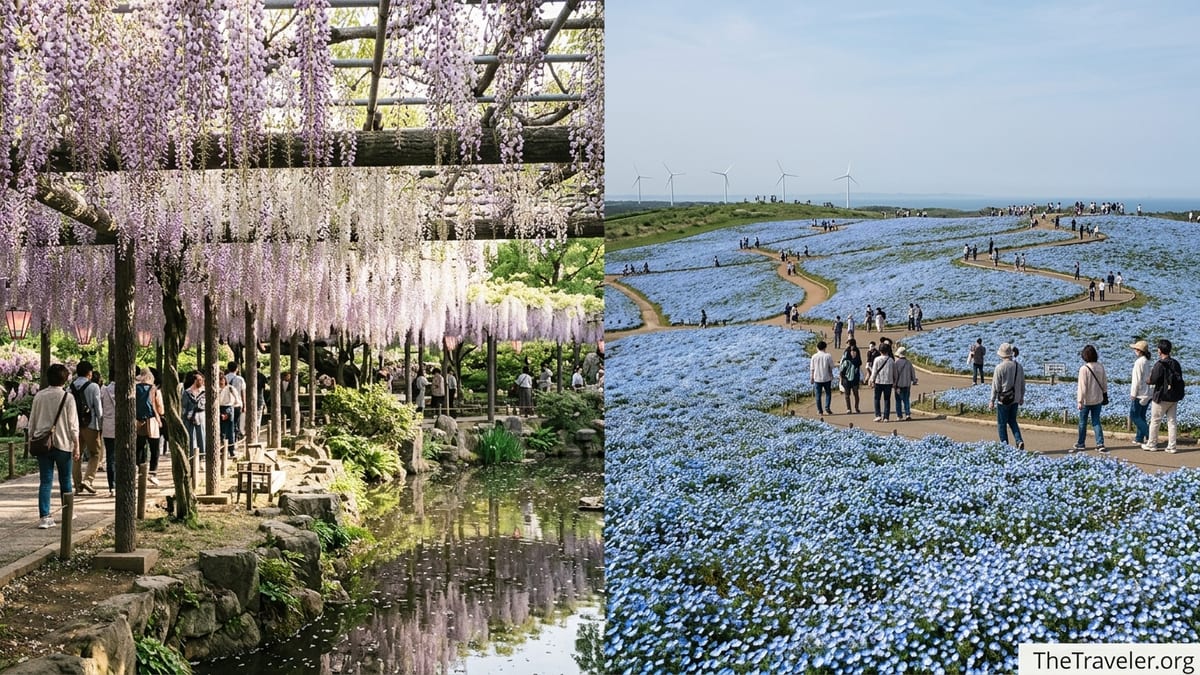
Ashikaga Flower Park feels like stepping into a carefully composed flower world. Paths wind under trellises and around ponds, with several ancient wisteria trees supported on broad wooden frames and tunnels of pale pink, white and yellow blossoms. At peak time in late April or early May, the view of a 150-year-old wisteria canopy reflected in the water can feel almost enclosed, like being inside a purple and white cathedral of flowers. The atmosphere is intimate and very focused on the wisteria story, with signboards, themed sweets and seasonal illuminations built around the blossoms.
Hitachi Seaside Park is the complete opposite in scale and mood. The star attraction in spring is the nemophila, or baby blue eyes, planted across the broad slopes of Miharashi Hill. On a clear day the effect is of a blue carpet merging with the sky and the distant Pacific, with wind turbines and the coastline visible from the top. Paths loop across the hill and through tulip gardens and open lawns, so the experience is more about broad landscapes than individual plants. Where Ashikaga feels like a botanical attraction, Hitachi feels like a national park with seasonal showpieces.
For travelers who love tight, detailed garden scenes, Ashikaga’s trellises, ponds and arches will be more satisfying. Those who prefer big views and wide-angle photography will likely find Hitachi Seaside Park more exciting, especially if the nemophila are at or near peak.
Travel time and logistics from Tokyo
Both parks can be done as day trips from central Tokyo without a car, but the routes and travel times matter if you are squeezing them between other plans. To reach Ashikaga Flower Park, most visitors take a shinkansen or local train to Oyama then transfer to the JR Ryomo Line, getting off at Ashikaga Flower Park Station, which sits a short walk from the entrance. Door to door, a typical journey from Tokyo Station or Shinjuku takes around 90 minutes to 2 hours one way depending on the chosen trains and transfer times, with costs varying from roughly the price of regular JR commuter services to a higher fare if you use limited express services for comfort.
Hitachi Seaside Park is best reached by taking a JR Joban Line limited express train such as Hitachi or Tokiwa from Tokyo or Ueno to Katsuta Station, which usually takes around 80 to 90 minutes. From Katsuta, you either take a local bus or seasonal shuttle to the park’s west gate, typically about 15 to 20 minutes in light traffic. Travelers describe the journey as roughly 1 hour 20 minutes on the train plus the short bus ride. During the nemophila peak and Golden Week, though, queues for buses at Katsuta can be long, and return traffic toward Tokyo in the late afternoon can be heavy, so it is smart to catch an earlier train back or stay for dinner in the area before returning.
In simple terms, both trips are comparable in time and complexity for a visitor already comfortable with JR trains. If you want to minimize transfers, Hitachi often requires just a single train plus a bus. Ashikaga requires a rail transfer but rewards you with a station directly beside the park and no need for buses or taxis. In bad weather or when traveling with children or older relatives, that short walk from Ashikaga Flower Park Station can feel easier than navigating crowded buses.
Tickets, opening hours and seasonal pricing
Ticketing at both parks changes in spring, and that can influence your choice if you are on a tight budget or timing your visit late in the day. Ashikaga Flower Park uses flexible pricing that goes up during the Great Wisteria Festival. Exact prices change year by year and even by bloom stage, but adult entry typically costs more during peak than during off-peak spring days, with a separate or combined ticket for evening illumination on especially popular dates. Children’s tickets are cheaper, and preschoolers under a certain age may enter for free. Because pricing can adjust quickly as the park monitors the bloom status, it is important to check the official website’s daily ticket information just before you go.
Hitachi Seaside Park is a national park with a base entrance fee, but during the nemophila and autumn kochia seasons it adds a seasonal surcharge for adults. In recent years the spring seasonal period has covered roughly early April through the first week of May, with higher entrance costs than in winter. The park and local railway also sell combined tickets that include park admission plus a Minato Line day pass, useful if you plan to explore the nearby coastal area as well as the flowers. As with Ashikaga, pricing details are updated each year, so travelers should reference the latest information a few weeks before their trip.
In terms of hours, Ashikaga is particularly attractive because of its evening openings during wisteria season. On peak nights, the park stays open into the evening and switches on extensive lighting that illuminates the wisteria trellises, tunnels and reflections in the ponds. Hitachi Seaside Park usually keeps daytime hours, closing by late afternoon even during nemophila peak, and does not rely on nighttime illuminations. If you want a late start from Tokyo or hope to enjoy flowers after sunset, Ashikaga is generally the more flexible choice.
Walking, accessibility and on-the-ground experience
The physical experience of each park is significantly different and can be a deciding factor if someone in your group tires easily or if you are planning a tightly scheduled day. Ashikaga Flower Park is compact. Most signature wisteria trees and tunnels are clustered relatively close together around the central pond. The main paths are mostly flat, with some gentle ramps and short slopes. It is realistic to see the major highlights in 2 to 3 hours at a relaxed pace, even if you pause often for photos. Visitors with limited mobility can focus on the main wisteria trellis near the entrance and the tunnels, which are within a short walk.
Hitachi Seaside Park, on the other hand, spreads over a very large area with hills, broad lawns and multiple themed gardens. To enjoy the full nemophila display, you must walk up Miharashi Hill, which, while not steep by mountain standards, involves a sustained gentle climb. Many travelers report easily walking 8 to 10 kilometers during a half day if they visit the nemophila hill, tulip gardens and amusement area. There is a loop “seaside train” that circulates the park for an additional fee, which helps those who want to reduce walking, but you will still need to manage the slopes on foot to reach the most photogenic viewpoints.
Families with strollers, older travelers or anyone dealing with jet lag often find Ashikaga’s layout kinder for a short, intense visit. Active visitors who enjoy long walks and want to combine flower viewing with time in open lawns or cycling paths may prefer Hitachi. In both parks, surfaces are mostly paved or well-maintained gravel, so regular sneakers are sufficient, but waterproof shoes are helpful if it has rained, especially at Hitachi where the soil can stay damp on grassy slopes.
Photography: tunnels and illuminations vs blue hills and horizons
For photographers, the choice between Ashikaga and Hitachi can be framed as a choice between intimate compositions and wide landscapes. At Ashikaga, the iconic shots include standing under the giant wisteria trellis with the flowers hanging in curtains around you, walking through the white wisteria tunnel, or capturing the reflections of purple and white blossoms in still ponds at dusk. A standard zoom lens performs well here, but many visitors enjoy using fast prime lenses to isolate individual flower clusters, especially at night when the illumination creates gentle highlights and bokeh. The park’s lighting design is a key feature, allowing low light photography without needing to stay out very late.
At Hitachi Seaside Park, nemophila photography is all about scale and perspective. The classic image is a wide-angle shot from halfway up or at the top of Miharashi Hill, showing the winding paths and bands of visitors walking through seas of blue, with wind turbines or the ocean on the horizon. On clear days, the bright sun can be harsh around midday, so many photographers aim for early morning entry or late afternoon light that softens the colors. A wide zoom lens around 16 to 35 millimeters on a full frame camera lets you exaggerate the sense of endless flowers, while a telephoto compresses the paths and people into dense layers of blue and color.
Both parks can be crowded, and that affects photos. At Ashikaga, patience and tight framing can hide crowds, especially when shooting upward into the trellises or close to clusters of blossoms. In the evenings, tripods may be restricted or discouraged in peak areas, so be ready to shoot handheld at higher ISO. At Hitachi, it is almost impossible to avoid including other visitors in your images during nemophila peak. Some photographers lean into this, using the silhouettes of walkers in hats or bright coats to give a sense of scale and atmosphere. If empty paths are important to you, aim for the very first entry slot on a weekday and head straight for Miharashi Hill before exploring other areas.
Food, facilities and combining with other sights
Neither park is a food destination in itself, but both provide enough options for a full day out without needing to leave the grounds. Ashikaga Flower Park has casual restaurants and food stands selling typical Japanese park fare such as curry rice, noodles, fried items and soft serve ice cream, including seasonal wisteria-themed flavors and sweets. There are also gift shops stocking boxed sweets and souvenirs branded with the park’s imagery. Seating areas can fill up around lunch on busy days, so consider eating early or late, or grabbing lighter snacks and focusing your main meal back in Tokyo or in Ashikaga town.
Hitachi Seaside Park offers several cafeteria-style restaurants, fast food corners and snack stands scattered around the grounds, serving dishes such as hamburgers, Japanese curry, local seafood snacks and ice cream. The park is also popular for picnics; many families bring bentos or pick up onigiri from a convenience store before boarding the train. There are wide lawns where you can spread out a picnic sheet, something less common inside Ashikaga’s more structured garden environment. Restrooms are frequent across both parks, but Hitachi’s size means you may walk longer distances between them, so plan bathroom breaks when you are near major hubs or restaurants.
In terms of add-on sightseeing, Ashikaga pairs well with a short look at Ashikaga’s historic town, including the Ashikaga School and traditional streets not far from the station, for those with energy after the park. Hitachi Seaside Park can be combined with a quick coastal stop or a visit to local seafood markets in nearby Hitachinaka, though doing so on a nemophila peak weekend can be ambitious given crowds and traffic. If your Japan itinerary already includes Nikko or Tochigi destinations, Ashikaga is geographically closer and may fit more naturally into your route. If you are exploring Ibaraki, Mito or the coastal area north of Tokyo, Hitachi integrates easily into that plan.
Crowds, late April and Golden Week realities
For both parks, late April and Golden Week will decide much about your experience. When wisteria and nemophila bloom timings line up with the Golden Week holidays from late April into early May, you should expect extremely heavy crowds, longer queues for trains and buses, and busy restaurants in and around the parks. In recent seasons, warmer springs have pushed both wisteria and nemophila toward slightly earlier peaks, with reports of Ashikaga’s main wisteria reaching full bloom around the final week of April in some years, and Hitachi’s nemophila often peaking between mid and late April.
At Ashikaga, this means that if your only possible day is around April 28 to May 3, you need to be mentally ready for shoulder-to-shoulder walking in the most famous tunnels and trellises, timed or controlled entry into some zones, and queues for food and restrooms. The park responds by extending opening hours and running more frequent trains to and from Ashikaga Flower Park Station, but it remains one of the most crowded flower sites in eastern Japan on those peak days. Evening can be marginally less congested than mid-afternoon, but many travelers now specifically plan to stay for illumination, so it is never truly quiet at peak bloom.
Hitachi Seaside Park, thanks to its larger footprint, can absorb crowds a bit more easily, but the approach from Katsuta Station can be a bottleneck. On popular days during the nemophila season and Golden Week, expect lines for buses and shuttle services and heavier car traffic approaching the parking lots. Inside the park, Miharashi Hill becomes a slow-moving stream of visitors, and photography from the most popular viewpoints may require patience and courtesy as people queue informally for certain photo spots. Arriving right at opening and heading straight to the hill is the single biggest way to improve your experience.
If you are highly crowd averse, consider adjusting your date by a few days where possible. For example, visiting Ashikaga on a weekday just before the absolute peak or going to Hitachi on a weekday in the first half of the nemophila season rather than on Golden Week itself can give you nearly as good flowers with notably fewer people.
Bloom timing: why live reports matter more than averages
When choosing between Ashikaga and Hitachi, many travelers look at historical averages that suggest wisteria in early May and nemophila in mid to late April. In reality, year-to-year variation has become significant. In some recent seasons, Ashikaga’s earliest wisteria colors have opened around mid April, with the largest purple and white trellises hitting full bloom in the final week of April, a bit earlier than older averages suggested. In other years, cooler springs have delayed peak into the first days of May. Similarly, at Hitachi, local tourism boards and the park itself have noted that nemophila often reach their best color between about the third week of April and the end of the month, but can peak slightly earlier or later depending on weather.
Because of this variation, travelers who only rely on average bloom calendars risk arriving after the best displays or when only part of the park is at peak. For example, one year’s Golden Week may perfectly overlap with Ashikaga’s most famous wisteria trellises, while another year’s holidays may see the earliest varieties already past their best and the later varieties still coming into color. Likewise, a trip planned around seeing nemophila on May 3 based on an old brochure could coincide with a year when the flowers peaked two weeks earlier and are already fading.
The safest approach is to monitor live flowering reports in the weeks leading up to your visit. Both Ashikaga Flower Park and Hitachi Seaside Park publish regular updates and photos on their official websites and social media feeds, often with phrasing that indicates whether the blooms are just beginning, at 50 percent, approaching full, or starting to decline. In addition, regional tourism boards, Japanese media and traveler communities often share on-the-ground photos that give a less polished but realistic sense of conditions. When you see multiple recent images showing dense color and the parks describing the flowers as at or near full bloom, that is the moment to prioritize the relevant park in your schedule.
If you are planning months in advance and your dates are inflexible, use historical trends only as a rough guide and maintain realistic expectations. Instead of promising yourself “full bloom,” think in ranges. For instance, if you are in Tokyo from April 20 to April 28, there is a good chance of seeing at least some wisteria at Ashikaga and nemophila at Hitachi, but whether either is at absolute peak will depend on that year’s weather. The better your flexibility within those dates, the more you can adjust based on short-term forecasts and live reports.
The takeaway
For travelers who can visit only one park, the decision between Ashikaga Flower Park and Hitachi Seaside Park comes down to the kind of flower experience you value most, your tolerance for walking and crowds, and the specific dates of your trip. Ashikaga is the stronger choice if you love dramatic individual plants, atmospheric garden design and evening illuminations. Its compact layout, direct station access and extended hours during wisteria season make it ideal for those who want an intense but manageable excursion, especially couples or solo travelers who enjoy slow, detailed viewing and handheld photography after dark.
Hitachi Seaside Park is the better match if you are drawn to open skies and large-scale landscapes. The nemophila fields on Miharashi Hill, backed by distant turbines and coast, create images that are impossible to replicate at smaller sites. The park also offers lawns for picnics, playgrounds and an amusement area, making it particularly appealing for families and groups who want both a signature flower view and room for children to run and play. The trade-off is more walking, reliance on a bus connection and the near certainty of sharing the views with many other visitors during peak season.
When your travel dates fall in late April or overlap Golden Week, let live bloom reports rather than historical averages guide your final choice. If Ashikaga’s main wisteria are clearly at their best while nemophila are already fading, prioritize Ashikaga. If reports show Miharashi Hill at brilliant blue while Ashikaga’s wisteria are still in early stages, choose Hitachi. For wisteria lovers, Ashikaga is the clear winner, especially if you can visit in the last week of April or first days of May and stay into the evening. For landscape photographers and travelers who dream of wide, minimal compositions and soft blue hills, Hitachi Seaside Park will likely be more satisfying. Families and those planning day trips tightly around a specific date should factor in walking distances, bus queues and park hours as much as the flowers themselves, and keep a flexible mindset in case the season runs early or late in the year of their visit.
FAQ
Q1. If I can only visit one park in late April, which should I choose?
If your dates fall around the last week of April, check recent photos and official bloom updates a few days before your trip. In many recent years, both Ashikaga’s wisteria and Hitachi’s nemophila have been strong at this time. If wisteria is your priority or you value evening illuminations and gentler walking, choose Ashikaga. If your dream is a wide blue hillside and you do not mind more walking and daytime-only viewing, choose Hitachi.
Q2. How far in advance should I buy tickets for either park?
Entry is usually sold on the day at the gate, and advance reservations are not always required, though some seasons may introduce timed systems or online sales. Because policies can change, especially around Golden Week, it is best to confirm the latest ticketing information on each park’s official channels in the weeks before your visit and, if possible, purchase any available advance tickets to save queue time.
Q3. Is Ashikaga Flower Park or Hitachi Seaside Park better for families with small children?
Both can work for families, but they offer different strengths. Ashikaga is compact and stroller friendly, and the short walk from the station simplifies logistics with toddlers. Hitachi offers more space to play, picnic lawns and an amusement area, but requires longer walks and a bus transfer from Katsuta Station. For a short, flower-focused outing with minimal transfers, Ashikaga is often easier with very young children. For a full family day with flowers plus open space and rides, Hitachi is attractive.
Q4. Can I see both parks in one day from Tokyo?
Technically, it is possible with an early start, efficient connections and a very tight schedule, but it is not recommended. Each park deserves at least several hours to enjoy without rushing, and the transfers between Tochigi and Ibaraki add significant travel time. Most travelers find that visiting one park per day provides a far better experience, especially during crowded spring weekends.
Q5. What happens if the wisteria or nemophila bloom earlier or later than expected?
If the season shifts and your chosen flower is clearly past peak or still in very early stages, you will still find other seasonal flowers, garden areas and photo opportunities in both parks, but the signature views may be less dramatic. This is why it is essential to monitor live reports and remain flexible. If your dates allow, consider moving your visit forward or back by a few days based on the most recent updates.
Q6. Which park is less crowded during Golden Week?
Neither park can be described as quiet during Golden Week, but Hitachi’s larger area helps disperse crowds once you are inside, even though the hillside paths remain busy. Ashikaga feels more concentrated because its headline wisteria displays are closer together. If you must travel during Golden Week, aim for the earliest possible entry at either park and consider visiting on the least busy holiday or adjacent weekday, based on local calendars.
Q7. Do I need special camera gear to photograph either park?
No special gear is required, and many travelers are happy with smartphone photos. For Ashikaga, a fast lens can help in evening illumination, while a standard zoom is enough for most compositions. At Hitachi, a wide-angle lens enhances the feeling of endless nemophila fields, but a normal zoom still works well. A lightweight tripod can be useful in low light at Ashikaga, but always follow park rules, which may restrict tripods in crowded areas.
Q8. Is it possible to visit even if it rains?
Both parks remain open in light rain, and showers can make colors appear richer, especially the blue of nemophila and the purple of wisteria. However, paths may become slippery, and outdoor seating and picnic areas are less comfortable. Bring a compact umbrella or rain jacket, waterproof or water resistant shoes, and consider shorter visits or focusing on easily accessed areas near entrances. Heavy rain or strong wind may temporarily close some facilities or reduce the appeal of long walks.
Q9. Can I combine Ashikaga Flower Park or Hitachi Seaside Park with other sightseeing in the same day?
Yes, if you plan carefully and do not visit on the most crowded dates, you can combine Ashikaga with a quick look at Ashikaga’s historic quarter or pair Hitachi with a short coastal stop or meal near Katsuta. However, during peak bloom and Golden Week, moving between multiple attractions can feel rushed due to crowds and transport delays. Many travelers find it more enjoyable to dedicate most of the day to the flower park and keep additional sightseeing light.
Q10. Which park is better if I am traveling on a very specific fixed date?
If your schedule is locked to a single spring day and you cannot adjust, base your decision on which park’s live updates look strongest in the week before you travel. If, for example, Ashikaga’s wisteria reports describe full bloom while Hitachi’s nemophila are already described as past peak, prioritize Ashikaga for that fixed date, and vice versa. With fixed timing, respond to actual conditions rather than historical expectations, and accept that you may see the flowers slightly before or after their absolute best.