


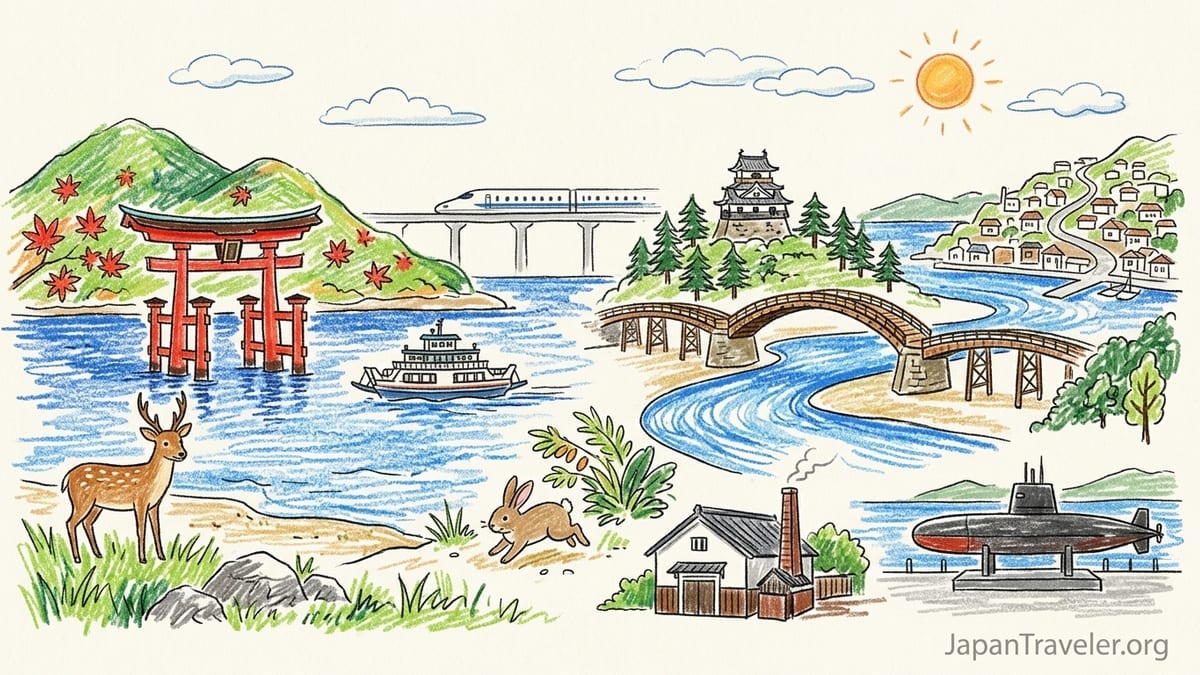
Hiroshima is one of Japan’s strongest bases for day trips. The Sanyo rail corridor and the Seto Inland Sea ferry network put a string of very different destinations within roughly one to two hours. From shrine-filled islands and samurai bridges to naval museums and sake breweries, you can leave Hiroshima after breakfast and be back in time for okonomiyaki at dinner. This guide compares the main contenders for your limited days: Miyajima, Iwakuni, Onomichi, Okunoshima, Kure, Saijo and nearby Kurashiki.
How to Choose the Right Hiroshima Day Trip
Before diving into individual destinations, it helps to think about what you want from your Hiroshima base. All of the trips in this guide are reachable in around 30 to 120 minutes each way, but they offer very different moods: shrine visits, scenic coastlines, retro port towns, naval history, sake tasting or rabbit-filled islands. Most travelers realistically have time for two or three day trips, so picking the right mix matters more than ticking every box.
Broadly, Miyajima and Iwakuni are the most iconic pairing, often done over one or two days. Onomichi appeals to walkers and cyclists, Okunoshima is a niche but memorable rabbit and history stop, Kure draws anyone interested in maritime history, Saijo is ideal for sake lovers, and Kurashiki works best if you are also moving toward Okayama or Kansai. Hiroshima’s role as a rail hub means you can make decisions late: local JR trains seldom require reservations, and most routes run at least two to three times per hour in daytime.
Time and money are usually the next filters. Miyajima and Onomichi warrant a full day. Iwakuni, Kure, Saijo and Okunoshima can be compressed into a long half day if you start early, though many people prefer to slow down. Typical round-trip transport from Hiroshima for any destination in this list falls in the range of about ¥1,000 to ¥4,000 if you use regular JR tickets and ferries, which makes a regional JR-West rail pass worth considering if you are chaining several of them together.
Rail passes are a final piece of the puzzle. The nationwide Japan Rail Pass covers the JR Sanyo Line, JR Kure Line and the JR Miyajima ferry but not private ferries or local buses. Several JR-West passes, such as the Kansai Hiroshima Area Pass, also cover Hiroshima-based day trips and can pay off quickly if you are continuing onward to Osaka, Kyoto or Okayama. When comparing options, think of your Hiroshima days as one part of a wider Chugoku and Kansai itinerary rather than a standalone decision.
Miyajima: Classic Shrine Island and First-Time Essential
Miyajima is usually the first day trip people plan from Hiroshima, and with good reason. The island’s floating torii gate at Itsukushima Shrine, friendly deer, maple-filled Momijidani Park and ropeway to Mount Misen combine into a full day of walking and easy sightseeing. Even with crowds, the experience feels distinct from mainland Japan, particularly at high tide when the gate appears to float and at low tide when visitors can walk out to its base.
Getting to Miyajima from Hiroshima Station is straightforward. Take the JR Sanyo Line local train to Miyajimaguchi Station, which usually takes around 25 to 30 minutes and costs just over ¥400 one way. From there, it is a five minute walk to the JR Miyajima ferry, a ten minute crossing for roughly ¥200 each way plus a small visitor tax collected on the outbound leg. The total one-way journey typically takes 45 to 50 minutes platform to shrine approach, assuming smooth transfers and no long ferry queues.
Both the JR local train segment and the JR West-operated Miyajima ferry are covered by the Japan Rail Pass and eligible JR-West regional passes, which means the transport portion of a Miyajima day can be effectively free for pass holders. Without a pass, budget around ¥1,200 to ¥1,500 total for the round trip including the ferry and visitor tax. Many travelers join small-group guided tours that bundle Hiroshima Peace Memorial Park in the morning with Miyajima in the afternoon; these commonly cost in the range of ¥12,000 to ¥18,000 per person depending on group size and inclusions.
In terms of time, Miyajima is best treated as a full day. A compact visit focused only on Itsukushima Shrine and the waterfront could be done in half a day, but once you factor in the ropeway, hiking, and breaks for oysters or momiji manju sweets, most people are happy to have six to eight hours on the island. If you are deciding between Miyajima and another day trip, remember that Miyajima is particularly atmospheric in the early morning and late afternoon, making an overnight stay on the island or a very early train from Hiroshima especially rewarding.
Iwakuni: Kintai Bridge and Castle as a Relaxed Companion Trip
Iwakuni lies southwest of Hiroshima along the same JR Sanyo Line corridor that serves Miyajimaguchi, which makes it easy to pair with Miyajima or visit on its own. The city’s claim to fame is Kintai Bridge, a multi-arched wooden bridge over the Nishiki River, backed by low mountains and Iwakuni Castle on the hill. The riverside park and nearby samurai district give the area a slower, small-town feel that contrasts nicely with Hiroshima’s urban core.
From Hiroshima Station, local JR Sanyo Line trains reach Iwakuni in roughly 45 to 55 minutes, with typical one-way fares a little under ¥1,000. Trains run regularly throughout the day, making Iwakuni one of the easiest drop-in excursions if you have a few spare hours. From Iwakuni Station, a local bus covers the roughly 15 minute ride to Kintai Bridge for a modest fare, often around ¥300 to ¥400. The bridge itself has a small admission fee, with round-trip tickets for the bridge and ropeway priced in the low hundreds of yen per adult.
All JR trains between Hiroshima and Iwakuni are covered by the Japan Rail Pass and most relevant JR-West passes. Local buses and the bridge admission are not covered, so budget separate cash for these. Guided day tours that include Iwakuni often bundle it with Miyajima, departing Hiroshima in the morning, walking Kintai Bridge and riding the ropeway to the castle, then continuing to Miyajima for an afternoon shrine visit. These combination tours usually fill a long day of 9 to 10 hours and appeal to travelers who prefer not to manage the separate bus and ferry segments alone.
On its own, Iwakuni works as a half-day trip. You can comfortably leave Hiroshima after breakfast, stroll Kintai Bridge, visit the castle and riverside park, try Iwakuni sushi or seasonal sweets, and be back in the city for late afternoon. If you are short on time, consider a half day in Iwakuni combined with a sunset visit to Miyajima on a different day, rather than trying to compress both into a single rushed itinerary.
Onomichi: Hills, Temples and a Gateway to the Shimanami Kaido
Onomichi, northeast of Hiroshima along the Sanyo Main Line, offers a very different atmosphere from Miyajima and Iwakuni. The port town climbs the hillside above the Seto Inland Sea, with narrow alleys, old houses, temple-lined walking routes and views that feel almost Mediterranean on clear days. It is also the traditional start point of the Shimanami Kaido cycling route that links Honshu to Shikoku via a chain of bridges and islands.
Fast trains from Hiroshima to Onomichi typically take around one hour, depending on whether you use a mix of shinkansen to Shin-Onomichi plus a local connection or a direct conventional train. Typical one-way fares are in the region of ¥2,000 to ¥3,500. Japan Rail Pass and JR-West passes cover the JR segments but not bike rentals or local cable cars in town. Once you arrive, the waterfront and central district are walkable from Onomichi Station, while the short ropeway to Senkoji Park saves a steep uphill climb.
Onomichi is best treated as a full day unless you are simply passing through. Many visitors follow the temple walk, ride the ropeway up for views, then slowly descend through narrow backstreets, stopping at cafes, stray-cat hangouts and small museums. Others rent bicycles at the station and ride part of the Shimanami Kaido, returning the bikes at a mid-route rental office or looping back. Full-day guided cycling tours from Hiroshima sometimes include hotel pickup, bike rental and van support, with prices reflecting the logistics and often sitting well above typical walking-tour rates.
If you are traveling onward to Osaka or Okayama after Hiroshima, Onomichi can be woven into your transfer day. One common pattern is an early train from Hiroshima to Onomichi, a full day exploring the town or cycling, then an evening train onward to Okayama or further east. This reduces backtracking and makes good use of a rail pass that already covers shinkansen segments between Hiroshima and Kansai.
Okunoshima and Saijo: Rabbits, History and Sake Breweries
Okunoshima, often nicknamed Rabbit Island, sits in the Seto Inland Sea northeast of Hiroshima. It is known today for its large population of semi-wild rabbits that approach visitors in search of food, but the island also has a darker history as a former site of wartime gas production. Small museums, coastal paths and abandoned structures hint at this past, making the island more complex than its cute nickname suggests.
Reaching Okunoshima from Hiroshima typically takes about 90 minutes each way. The common route is a JR Sanyo Line train from Hiroshima to Mihara, followed by the JR Kure Line or local train to Tadanoumi, then a short walk to the ferry port and a roughly 15 minute boat ride to the island. Total transport costs generally fall in the range of ¥2,000 to ¥3,000 round trip including the ferry, depending on train type. The JR segments are covered by the Japan Rail Pass and many JR-West passes, but the local ferry is not, so plan to pay the boat fare separately in cash or by local card.
Given the transfer steps, Okunoshima works as a half to three-quarter day trip if you start early, with most people spending two to four hours on the island itself. There are a handful of walking trails, rental bicycles and a small hotel, but facilities are limited compared with Miyajima. If you prefer structured visits, occasional guided tours from Hiroshima and Mihara include rabbit feed, a loop of the island paths and time at the small museum, though many travelers simply visit independently.
Saijo, inland to the east of Hiroshima, provides a very different focus: sake. The town’s “Sake Town” district, with several breweries and tasting rooms clustered around the station, is an easy hop from Hiroshima by JR Sanyo Line, often taking around 35 minutes with one-way fares in the mid-hundreds of yen. The ride is fully covered by the Japan Rail Pass and JR-West regional passes. Once in Saijo, you can follow a self-guided walking route past brewery chimneys and whitewashed storehouses, sampling limited pours for small coin-level fees.
Saijo works as a relaxed half day, particularly attractive in cooler months or on rainy days when hiking-focused destinations are less appealing. Some visitors pair Saijo and Okunoshima on a single long day, starting with an early train from Hiroshima to Mihara and Tadanoumi for the island, then stopping in Saijo on the way back for late afternoon tastings. If you do this, keep an eye on the clock and train timetables, and remember to pace your alcohol intake so you can navigate transfers safely.
Kure and the Seto Inland Sea: Naval History and Port-Side Wandering
Kure sits along the coast southeast of Hiroshima and grew as a major naval port and shipbuilding city. Today it draws visitors with its maritime museums, including a large submarine display and family-friendly exhibits explaining Japan’s naval history. The town also has a lived-in, workaday feel that contrasts with the more tourist-oriented streets of Miyajima or Kurashiki.
From Hiroshima, the JR Kure Line runs along the coastline, with many local and rapid trains continuing through to Kure. The journey usually takes around 35 to 45 minutes and costs in the mid-hundreds of yen one way. The views alone, with the tracks hugging the Seto Inland Sea, make this a rewarding ride on a clear day. All JR segments are covered by the Japan Rail Pass and JR-West passes that include Hiroshima and Kure, which is one reason Kure appears frequently in up-to-date Hiroshima day-trip recommendations.
Kure lends itself to a half-day or slightly longer visit. Many travelers spend three to four hours between the main naval museum, the retired submarine that you can walk through, and a waterfront stroll, then return to Hiroshima for the evening. Others connect Kure with Miyajima using a combination ticket sold by a local ferry company that links the two ports, turning the journey itself into a mini-cruise through the Seto Inland Sea rather than doubling back by train.
While Kure does not yet attract as many international group tours as Miyajima, some Hiroshima-based guides offer private itineraries that combine Peace Memorial Park in the morning with Kure in the afternoon, aimed at travelers specifically interested in naval and wartime history. These tours typically price a bit higher per person than standard walking tours due to the additional train or boat segments and museum entry costs included.
Kurashiki and the Wider Sanyo Corridor
Kurashiki sits further east in Okayama Prefecture and technically falls outside the immediate Hiroshima commuter belt, but it is often considered a viable day trip thanks to the Sanyo Shinkansen. The town’s Bikan Historical Quarter, with preserved canals, white-walled storehouses and traditional townhouses, condenses much of its charm into a small, easily walkable district. The area is also associated with Japanese denim, drawing fashion-focused visitors to its boutique-lined streets.
From Hiroshima, shinkansen rides to Okayama typically take around 35 to 45 minutes, with an additional local JR segment of about 15 minutes to reach Kurashiki Station. One-way fares for non-reserved shinkansen seats can approach ¥7,000 or more in 2026 pricing, which makes Kurashiki a stronger value if you are already traveling with a Japan Rail Pass or a JR-West regional shinkansen pass. With a pass, the incremental cost for a Kurashiki day trip drops to local transport, food and admissions.
Because Kurashiki’s Bikan district is compact, many travelers feel satisfied in half a day: a stroll along the canal, a short boat ride, a visit to one or two museums and a denim or craft shopping stop. However, the cumulative travel time from Hiroshima pushes this toward a full-day commitment. Some people reduce backtracking by staying a night in Okayama and using that as a base for both Kurashiki and Hiroshima, particularly if they are also heading onward to Kansai or Shikoku.
Compared with Miyajima or Onomichi, Kurashiki presents a more curated, almost museum-like experience. That can be a pro if you enjoy polished historical districts with clear walking routes, but a con if you prefer the slightly scruffier, lived-in charm of port towns like Onomichi or Kure. When weighing Kurashiki from a Hiroshima base, think carefully about your overall route through western Japan and whether you will be passing through Okayama anyway.
Practical Comparisons: Time, Cost, Passes and Tours
When you place the main Hiroshima day trips side by side, clear patterns emerge. In rough terms, travel times from Hiroshima Station cluster as follows: about 45 to 60 minutes each way for Miyajima, Iwakuni, Kure and Saijo; about 60 minutes to Onomichi; roughly 90 minutes to Okunoshima once you include the ferry; and about 70 to 90 minutes to Kurashiki using the shinkansen and a local connection. Any of them are possible on a day trip, but destinations that sit around the one-hour mark feel more relaxed if you want to retain a generous evening in Hiroshima.
In cost terms, simple there-and-back day trips without passes usually come in between about ¥1,000 and ¥4,000 for transport alone. Miyajima and Iwakuni sit at the lower end once you factor in their short JR segments and modest ferry or bus fares. Onomichi, Okunoshima and Kurashiki trend higher, partly due to longer distances and, in Kurashiki’s case, shinkansen pricing. Add admissions and meals, and many travelers find that a full day out from Hiroshima runs somewhere in the ¥5,000 to ¥10,000 range per person, excluding any high-end dining or private guiding.
For rail passes, the nationwide Japan Rail Pass covers JR trains to Miyajima-guchi, Iwakuni, Onomichi, Saijo, Kure, Mihara and Okayama, plus the JR Miyajima ferry. JR-West regional passes such as the Kansai Hiroshima Area Pass often include Hiroshima, Miyajima, Onomichi and Kurashiki on their validity map, which makes them strong options if your wider trip connects Osaka, Kyoto, Okayama and Hiroshima. However, no pass covers every private ferry, ropeway, bus or boat you might use, so it is wise to keep a small cash buffer for local legs.
Guided options range from budget-friendly small-group walking tours in Miyajima or Iwakuni to private car and driver arrangements that can chain multiple day-trip destinations in a single day. As a real-world example, you might find a full-day small-group “Hiroshima Peace Park and Miyajima” tour for a mid-range price that includes transport and shrine admission, or a more expensive private excursion that adds Iwakuni’s Kintai Bridge. For destinations like Okunoshima and Kure, most visitors still travel independently, relying on posted English signage and smartphone navigation, which are generally sufficient for experienced travelers.
Putting it together, a three-day Hiroshima base might look like this: Day one in the city and Miyajima, day two in Iwakuni and Kure along the coast, and day three in either Onomichi or Saijo plus Okunoshima depending on your interests. If your itinerary continues toward Kansai, you could instead spend your final Hiroshima day in Onomichi, then continue by train to Okayama or Osaka, keeping Kurashiki for a later stop from an Okayama base rather than as a back-and-forth from Hiroshima.
The Takeaway
Hiroshima’s strength as a base lies not only in the quality of its individual day trips but also in the variety packed into a manageable radius. Within roughly an hour, you can be stepping through a famous shrine gate at Miyajima, crossing an elegant wooden bridge in Iwakuni, wandering Onomichi’s hillside lanes, cycling past rabbits on Okunoshima, touring submarines in Kure, sipping sake in Saijo or gliding along Kurashiki’s canals. The Sanyo rail corridor and Seto Inland Sea ferries quietly knit these experiences together, turning Hiroshima into a natural hub for exploring western Honshu.
From a commercial and logistical standpoint, the key is aligning your day trips with both your interests and your broader rail strategy. Iconic first-time stops like Miyajima deserve a full day, while secondary destinations such as Iwakuni, Kure, Saijo and Okunoshima can be mixed and matched into half-day or combined itineraries. Onomichi and Kurashiki reward a bit more time and pair especially well with onward travel toward Okayama, Osaka or Kyoto.
If you are using a Japan Rail Pass or a JR-West regional pass that includes Hiroshima, consider front-loading your rail-intensive days here: stack Miyajima, Onomichi and Kurashiki while your pass is valid, then leave more bus and ferry-focused outings for when you are back on single tickets. Above all, allow yourself some flexibility. Part of the appeal of basing in Hiroshima is the ease with which you can wake up, glance at the weather over the Seto Inland Sea and decide that today is the day for shrines, ships, hills, rabbits or sake.
FAQ
Q1. Is Miyajima better as a day trip or an overnight from Hiroshima?
For most travelers, Miyajima works very well as a full-day trip, but staying overnight lets you enjoy the island before and after the main crowds, especially around the shrine and waterfront.
Q2. Can I visit both Miyajima and Iwakuni in a single day from Hiroshima?
It is possible with an early start, using the JR Sanyo Line for both destinations, but many people prefer to give Miyajima a full day and keep Iwakuni for a more relaxed separate half day.
Q3. Are the trains from Hiroshima to Miyajima-guchi and Iwakuni covered by the Japan Rail Pass?
Yes, the JR Sanyo Line between Hiroshima, Miyajima-guchi and Iwakuni is covered by the Japan Rail Pass, as is the JR-operated Miyajima ferry, though local buses and private ferries are not.
Q4. Do I need a rail pass to make these Hiroshima day trips worthwhile?
No, you can comfortably do all of these day trips with regular JR tickets and IC cards, but a Japan Rail Pass or JR-West regional pass can save money if you are also riding shinkansen on other days.
Q5. How long do I need for Onomichi if I want to walk the temple routes but not cycle the Shimanami Kaido?
A full day is ideal, allowing time for the ropeway, temple walks, backstreets and cafes, but you can get a good feel for the town in a focused half day if schedules are tight.
Q6. Is Okunoshima (Rabbit Island) suitable for a quick half-day trip?
Yes, with an early start you can visit Okunoshima in a half day, but once transfers and the ferry are included, many travelers find that three-quarters of a day feels more relaxed.
Q7. How much time should I budget for Kure and its naval museums?
Three to four hours in Kure is usually enough for the main museum, submarine visit and a waterfront walk, making it a comfortable half-day excursion from Hiroshima by JR Kure Line.
Q8. Can I combine Saijo’s sake district with another day trip on the same day?
Yes, Saijo pairs well with other eastbound destinations such as Okunoshima or Onomichi, especially if you treat Saijo as a late-afternoon stop on the way back to Hiroshima.
Q9. Is Kurashiki really practical as a day trip from Hiroshima?
It is practical thanks to the shinkansen, especially with a rail pass, but travel time and cost mean it makes the most sense if you are also passing through Okayama or continuing toward Osaka or Kyoto.
Q10. Do I need to book guided tours in advance for these day trips, or can I decide once I arrive in Hiroshima?
For popular small-group tours to Miyajima or combined Hiroshima and Miyajima itineraries, advance booking is wise, while independent trips by JR train to places like Kure, Saijo and Onomichi can usually be decided on short notice.