

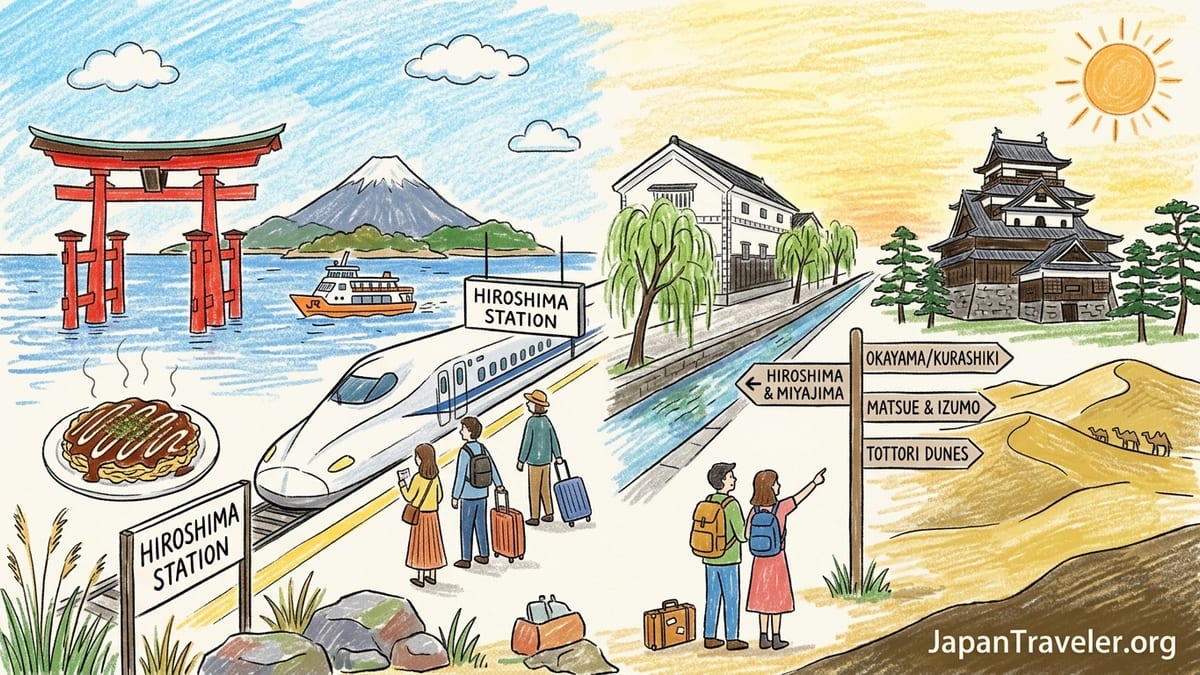
Chugoku is compact on the map, but it feels much larger once you start plotting ferries to Miyajima, buses to the Tottori Sand Dunes, or local trains out to Izumo Taisha. With Shinkansen lines skimming the Sanyo coast and slower JR services and buses tracing the quieter Sanin side, where you choose to sleep can make or break your itinerary. This guide focuses on real trade-offs between Hiroshima, Okayama, Onomichi, Matsue, Izumo, Tottori and nearby Yonago so you can pick the right base for your own Chugoku trip.
How to Choose a Base in Chugoku
Before comparing individual cities, it helps to be clear about what you want your base to do for you. In Chugoku, almost every traveler is balancing three things: fast access to the Shinkansen, a comfortable hotel and dining scene, and simple day trips to a few headline sights such as Miyajima, Kurashiki, the Shimanami Kaido, Izumo Taisha or the Tottori Sand Dunes. The right base depends less on one perfect city and more on how many times you are willing to repack your bag.
Most first-time visitors to Chugoku split their nights between at least two bases: often Hiroshima plus either Okayama or Matsue. Travelers with a Japan Rail Pass or regional rail pass sometimes prefer to stay put in one hub such as Hiroshima or Okayama and day trip aggressively, accepting longer train rides in exchange for fewer hotel changes. On the quieter Sanin side, where JR lines are slower and buses connect many of the best onsen and coastal areas, an overnight in a smaller town such as Izumo or Tottori can be worth the extra transfer.
Accommodation markets also vary a lot in size. Hiroshima and Okayama have a broad mix of business hotels, global chains and mid-range properties, often with rooms under the equivalent of 150 US dollars per night outside peak holidays. Smaller cities like Onomichi and Tottori have fewer rooms overall, so simple guesthouses and business hotels can sell out quickly during Golden Week, Obon or local festivals. Booking early matters more the smaller and more seasonal your base is.
In the sections that follow, we look at each of the major Chugoku bases in turn, with a focus on what they are realistically good for, what they are not, and when it is worth enduring an extra transfer or a slower local train for a more atmospheric stay.
Hiroshima: Best Base for Miyajima and Western Sanyo
Hiroshima is the obvious base for western Sanyo, especially if Miyajima is on your list. The city sits on the Sanyo Shinkansen line, with direct services to Osaka, Kyoto and Hakata. Many visitors arriving from Kansai stay near Hiroshima Station to make early starts to Miyajima or easy onward Shinkansen departures. Hotels such as the Sheraton Grand Hiroshima and several newer mid-range chains cluster right by the station, making it realistic to step off a bullet train in the evening and be in your room within minutes.
If you prefer to be in the thick of the city, consider staying closer to the Peace Memorial Park and the Hondori shopping arcade. This central area has a dense concentration of restaurants, from okonomiyaki houses where you can sit at the griddle for around 1,500 to 2,000 yen per plate to casual izakaya serving local oysters in season. Nightlife here is livelier than in most other Chugoku cities, with small bars, craft beer pubs and late-opening dessert cafes around Nagarekawa and Yagenbori. A tram or bus ride of about 15 to 20 minutes links this district to Hiroshima Station, so you still have reasonable access to Shinkansen services.
For Miyajima, many travelers debate overnighting on the island versus basing entirely in Hiroshima. A typical pattern is to stay two or three nights in Hiroshima, take a full day trip to Miyajima by JR or tram plus JR ferry, and then decide whether the appeal of seeing the torii gate at dawn or after dark justifies repacking for one night in a ryokan. A basic guesthouse on the island often starts around the equivalent of 80 to 120 US dollars for a small room, while a traditional ryokan with dinner and breakfast can easily cost several hundred dollars. If your time or budget is tight, Hiroshima makes a very effective base for a long Miyajima day trip without the need to move hotels.
Hiroshima also works well for western Sanyo day trips. Himeji is roughly an hour by Shinkansen, making it feasible to leave Hiroshima after breakfast, tour the castle and garden, and be back in your Hiroshima hotel that night. To the east, Onomichi is usually under 90 minutes away by a combination of Shinkansen to Fukuyama and local JR, putting the Shimanami Kaido within reach for a long cycling day. With this kind of network, Hiroshima is the strongest base if you want both the gravity of the Peace Memorial and a flexible platform for exploring western Honshu.
Okayama vs Kurashiki: Rail Hub or Historic Quarter
Okayama is the main rail hub in western Chugoku. The Sanyo Shinkansen stops here, and limited express trains fan out toward the Sanin side and Shikoku. If your itinerary involves fast hops between Kansai, Hiroshima and Kyushu, a night or two in Okayama keeps transfers simple. Hotels cluster around Okayama Station, from standard business chains with rooms often starting under 10,000 yen per night to slightly higher-end options with larger rooms and on-site restaurants. From this station area you can walk to Okayama Castle and Korakuen Garden, and you have easy tram and bus connections around the compact city center.
Kurashiki, by contrast, is a smaller historic town about 15 minutes away by frequent JR trains along the Sanyo Line. Its Bikan Historical Quarter, with white-walled storehouses and a willow-lined canal, is one of the prettiest traditional townscapes in Chugoku. Many visitors stay in Okayama for the transport convenience, then make a half-day or day trip to Kurashiki to stroll the canal, visit the Ohara Museum of Art, and browse small craft shops and cafes. This works especially well if you are carrying large luggage and prefer not to haul suitcases along narrow, often cobbled streets.
However, Kurashiki itself is an increasingly important accommodation market, with options ranging from the long-established Kurashiki Kokusai Hotel near the canal to smaller renovated machiya guesthouses. Staying overnight here gives you the Bikan Quarter early in the morning and after day trippers leave, when the streets are notably quieter. It also suits travelers who care less about bullet train schedules and more about atmosphere. In practice, if you are planning a lot of regional day trips, Okayama Station is the better base. If your priority is a photogenic town with characterful lodgings, Kurashiki makes a rewarding alternative at the cost of one extra local train ride when you arrive and depart.
From a connections perspective, Okayama is also stronger for side trips outside Chugoku. Trains to Takamatsu and the Seto Ohashi Bridge region in Shikoku depart from here, as do services toward Matsue and Tottori via the Yakumo limited express and other lines. That means you can use Okayama as a bridge between the Sanyo and Sanin coasts. If you are coming from Tokyo or Osaka and want to pivot north into Shimane or Tottori, spending a night in Okayama before heading up to Matsue or Yonago keeps your travel days manageable.
Onomichi: Gateway to the Shimanami Kaido
Onomichi is a compact hillside port town that serves as the traditional starting point of the Shimanami Kaido, the island-hopping cycling route linking Honshu with Shikoku. For travelers focused on this route, Onomichi is a natural base. The town has bike rental outlets near the water, including operators that provide one-way rentals so you can cycle to Imabari on Shikoku and return your bike there. Accommodation ranges from basic guesthouses and hostels popular with cyclists to mid-range hotels like the Onomichi Kokusai Hotel by the waterfront, as well as several stylish renovated townhouses that cater to small groups.
In terms of rail, Onomichi sits on the JR Sanyo Main Line, not the Shinkansen itself. Most long-distance travelers reach it by taking a Shinkansen to nearby Shin-Onomichi or Fukuyama, then transferring to a local train. This extra step adds 15 to 30 minutes to your journey compared with staying in Hiroshima or Okayama. However, once you are in town, most places are walkable, and the compact center has an appealing retro atmosphere, with narrow lanes, temple walks and small cafes selling local lemon-based sweets.
Onomichi shines as a base if your priority is the Shimanami Kaido or slow travel along the Seto Inland Sea. Spending two or three nights here allows a flexible cycling plan. For example, one common pattern is to spend a warm-up day exploring Onomichi’s temple walk and ropeway viewpoints, then rent bikes early the next morning, ride as far as an island such as Ikuchijima or Omishima, stay in a minshuku or small inn there, and complete the ride to Imabari on day three. Returning to the same Onomichi hotel each night is possible but involves returning by bus or ferry, which reduces the sense of a point-to-point journey.
On the downside, Onomichi is not ideal as a general regional base. Nightlife is limited, with a handful of local bars and izakaya that close earlier than those in Hiroshima. Hotel supply is more constrained, and rates can be high during cycling season in spring and autumn. If you mainly want to visit Miyajima, Kurashiki or Tottori, you will end up backtracking. In those cases, Onomichi works best as a two-night specialist stop for the Shimanami Kaido embedded in a longer Chugoku itinerary, rather than your only base.
Matsue: Eastern Shimane and Onsen Access
Matsue sits on the Sanin side of Chugoku, between Lake Shinji and Nakaumi. It is an important regional city and one of the most atmospheric bases for exploring eastern Shimane Prefecture. The JR Sanin Main Line runs through Matsue, and limited express trains connect it to Okayama and Tottori. There is also the Ichibata Electric Railway linking Matsue-Shinjiko-Onsen Station with Izumo, which makes it convenient to combine lake views, castle town sightseeing and shrine visits without a car.
As an accommodation base, Matsue offers a good mix of business hotels near JR Matsue Station, lakefront properties around Lake Shinji, and traditional inns in nearby onsen areas. Tamatsukuri Onsen, for example, is a short train ride away and has a cluster of ryokan with hot spring baths. Many of these packages include kaiseki dinners and breakfast, so while nightly rates can start around the equivalent of 200 US dollars for two people, they cover most of your food and that classic Japanese onsen experience. If you prefer to stay in town, hotels around Matsue-Shinjiko-Onsen Station often have their own hot spring baths or easy access to local bathhouses.
Matsue is also a strong cultural base. Matsue Castle, one of Japan’s few remaining original wooden castles, anchors a preserved district with old samurai residences and tea houses. From a practical standpoint, this means your sightseeing days can be low-stress: you can stroll around the castle, take a boat cruise on the castle’s moat system, visit Lafcadio Hearn–related sites and be back at your hotel within minutes. Restaurants in Matsue tend to focus on local seafood and lake fish, soba noodles and sake, with small izakaya and bars clustered near the station and along the canals. While nightlife is quieter than in Hiroshima, there is enough choice for a relaxed evening out after a day of sightseeing.
As a base for day trips, Matsue is well placed for both nature and culture. Buses and trains run to nearby onsen such as Tamatsukuri and Yunokawa, and the Sanin Expressway provides road access along the coast. With two or three nights in Matsue, you can comfortably visit Izumo Taisha, explore coastal fishing towns, or even take a long day to Tottori or Yonago if schedules align. The trade-off is that travel times from the Sanyo Shinkansen corridor are longer: getting from Osaka or Okayama to Matsue can easily take three hours or more. That makes Matsue a better choice for travelers who can commit several nights to the Sanin side rather than trying to squeeze it into a tight, Shinkansen-heavy schedule.
Izumo: Shrine-Focused Travel on the Sanin Coast
Izumo is best known for Izumo Taisha, one of Japan’s most important Shinto shrines. It attracts worshippers year-round and sees particular surges during certain festivals and New Year. The city itself is smaller and quieter than Matsue, with a compact accommodation market centered around Izumoshi Station and the approach to the shrine. Most hotels are business-style properties, with a few ryokan and guesthouses providing more traditional stays closer to the shrine precinct.
As a base, Izumo works best for travelers whose primary goal is spiritual or cultural. Staying near Izumo Taisha allows you to visit the shrine early in the morning or in the evening when tour buses have gone, which changes the atmosphere considerably. You can walk the shrine grounds at a slower pace, explore nearby museums, and sample local specialties such as Izumo soba in small restaurants without feeling rushed. A typical pattern is to spend one night in Izumo specifically to experience the shrine outside peak hours, then move on to Matsue or another Sanin base.
Transport-wise, Izumo is on the JR Sanin Main Line and is also linked to Matsue by the Ichibata Electric Railway. There is a small regional airport near Izumo with flights to major Japanese cities, which can be useful if you are short on time and do not want a long overland journey in both directions. However, the rail network here is slower than the Sanyo corridor. That means Izumo is not ideal as a base for exploring a wide area, but it can slot effectively into a northbound or southbound itinerary if you are already moving along the Sanin coast.
Because the hotel market is smaller, rooms during peak shrine periods and national holidays can sell out quickly. If you plan to visit during autumn festival season or around the New Year, booking well in advance is wise. Otherwise, a flexible traveler might choose to base in Matsue, then visit Izumo Taisha as a day trip of roughly an hour each way, returning to the broader dining and hotel options in Matsue in the evening.
Tottori and Yonago: Dunes, Daisen and the Sanin Coast
On the eastern Sanin coast, Tottori and Yonago form another pair of potential bases. Tottori City is best known for the Tottori Sand Dunes, an extensive coastal dune landscape a short bus ride from the city center. Yonago, further west, is close to Mount Daisen, a prominent volcanic peak and hiking area, and acts as a gateway to parts of western Tottori and eastern Shimane. Both cities sit on the JR Sanin Main Line, and both have regional airports with flights to Tokyo and other cities, which can significantly shorten travel compared with returning by train to Osaka or Okayama.
Tottori City’s accommodation scene leans heavily toward modest business hotels near Tottori Station, with nightly rates often under the equivalent of 100 US dollars for a double room. From here, buses run to the sand dunes and the Sand Museum, where large indoor sand sculptures are displayed. A practical pattern is to base in Tottori for one or two nights, spend a half day exploring the dunes including optional activities such as sandboarding or camel rides, and then use the other day for a coastal drive or bus ride to nearby fishing towns. Dining in Tottori revolves around seafood, crab in season, and local izakaya, with a limited but sufficient choice of casual restaurants near the station.
Yonago is more of a transport hub for western Tottori and eastern Shimane. It offers convenient access to Mount Daisen by bus or car, as well as to coastal hot spring areas and the port of Sakaiminato. Accommodation again is dominated by business hotels near Yonago Station, though there are higher-end ryokan and resort-style lodgings scattered in the Daisen foothills and along the Sea of Japan. For example, small seaside villas and pensions around Daisen and the nearby coast cater to families and groups seeking a quieter, nature-focused stay, at higher per-night rates but with proximity to hiking trails and beaches.
As bases, Tottori and Yonago are most worthwhile if you are deliberately focusing on natural landscapes. Travel times from the Sanyo Shinkansen corridor are longer and require transfers, so using either city as a hub for both coasts is inefficient. Instead, think of them as two or three night stops on a slow Sanin itinerary, perhaps arriving from Kyoto or Osaka via limited express, then leaving by flight or continuing west toward Matsue. Choosing between them is straightforward: pick Tottori if the dunes are your non-negotiable highlight, and pick Yonago or a nearby onsen resort if Mount Daisen and coastal hiking appeal more.
When a Smaller Town Stay Is Worth the Extra Transfer
One of the core decisions in Chugoku is whether to stay in larger, better-connected cities like Hiroshima and Okayama, or to commit to smaller towns like Kurashiki, Onomichi, Izumo or Tottori. Each time you move hotels, you lose part of a day to logistics, but you may gain early morning and late evening access to quieter, more atmospheric places. The trade-off is very specific to your interests and schedule.
If your trip is short and you are carrying heavy luggage, prioritizing Hiroshima and Okayama makes sense. From Hiroshima you can see Miyajima, Himeji and Onomichi as full or long day trips without changing hotels. From Okayama you can reach Kurashiki, Takamatsu and even Matsue on early trains. In this scenario you enjoy a wide choice of restaurants and nightlife each evening and minimize time spent waiting on platforms with suitcases.
On the other hand, there are several situations where the extra transfer is genuinely worth it. One is when the experience heavily depends on early or late access, such as seeing Izumo Taisha at dawn, walking Kurashiki’s canal by lantern light, or soaking in a hot spring after dark in Tamatsukuri Onsen. Another is when a linear route is part of the appeal, as with cycling the Shimanami Kaido across islands or hiking in the Daisen area. In those cases, a stay in a smaller town or rural ryokan turns a day trip into a more immersive experience.
Costs also play a role. While luxury ryokan in Miyajima, Daisen or the onsen towns can be expensive for what might be a single night, mid-range guesthouses in places like Onomichi or Tottori often undercut central Hiroshima or Osaka prices, especially on weekdays outside major holidays. For budget-conscious travelers who still want a feel for small-town Japan, scheduling one or two nights away from the Shinkansen corridor can both enrich the trip and reduce average nightly costs, provided you are prepared for simpler restaurant options and quieter evenings.
FAQ
Q1. If I only have two nights in Chugoku, where should I base myself?
For a first visit with limited time, Hiroshima is the most efficient single base. You can see the Peace Memorial Park, take a long day trip to Miyajima, and still have restaurants and nightlife at your doorstep.
Q2. Is it better to stay in Hiroshima or on Miyajima for visiting the shrine?
Most travelers base in Hiroshima and visit Miyajima as a day trip. Staying overnight on Miyajima is worth the extra cost and transfer only if you specifically want quiet shrine visits at dawn or after dark.
Q3. When does it make sense to stay in Kurashiki instead of Okayama?
Choose Kurashiki if you value a historic canal district and atmospheric evenings over fast rail access. Pick Okayama if you plan many rail-based day trips and want direct Shinkansen connections.
Q4. Is Onomichi a good general base or mainly for the Shimanami Kaido?
Onomichi works best as a base for the Shimanami Kaido and slow Seto Inland Sea travel. For broader sightseeing, such as Miyajima and Kurashiki, Hiroshima or Okayama are more practical hubs.
Q5. How many nights should I spend in Matsue?
Two to three nights in Matsue suits most travelers. That allows time for the castle and lake area, a nearby onsen visit, and a day trip to Izumo Taisha without feeling rushed.
Q6. Is Izumo convenient as a base for exploring the wider Sanin region?
Izumo is best as a one- or two-night stay focused on Izumo Taisha and nearby sights. For broader Sanin exploration, Matsue offers more frequent transport and a wider hotel and restaurant choice.
Q7. Should I stay in Tottori or Yonago for visiting the Tottori Sand Dunes?
For the dunes, Tottori City is more convenient, with straightforward bus links from the station. Yonago is preferable if your priority is Mount Daisen and nearby coastal or mountain hiking.
Q8. Are smaller Sanin towns difficult to reach without a car?
Many key sights such as Izumo Taisha, the Tottori Sand Dunes and main onsen towns are reachable by train and bus, but services are less frequent than on the Sanyo side. Planning around timetables is important if you rely on public transport.
Q9. How far in advance should I book accommodation in these cities?
For large hubs like Hiroshima and Okayama, a few weeks is usually enough outside major holidays. For smaller markets such as Onomichi, Izumo or Tottori, booking several months ahead is wise for peak cherry blossom, autumn foliage or festival periods.
Q10. Is it realistic to use one base for both the Sanyo and Sanin coasts?
It is possible but not ideal. Travel between the coasts takes several hours each way, so most travelers split time between at least one Sanyo base such as Hiroshima or Okayama and one Sanin base such as Matsue or Tottori for a smoother trip.