

If you are planning a Chugoku or Setouchi trip, the choice of base often comes down to two names: Hiroshima or Okayama. Both sit on the Sanyo Shinkansen line, both offer easy access to the Seto Inland Sea, and both are discussed constantly in current traveler forums as hub cities for multi-night stays. Yet they offer different atmospheres, price points and day-trip patterns. This guide walks through the trade-offs in concrete terms so you can decide where to sleep, where to eat, and whether it is worth splitting your stay between the two.
Big Picture: How Hiroshima and Okayama Fit into a Chugoku Itinerary
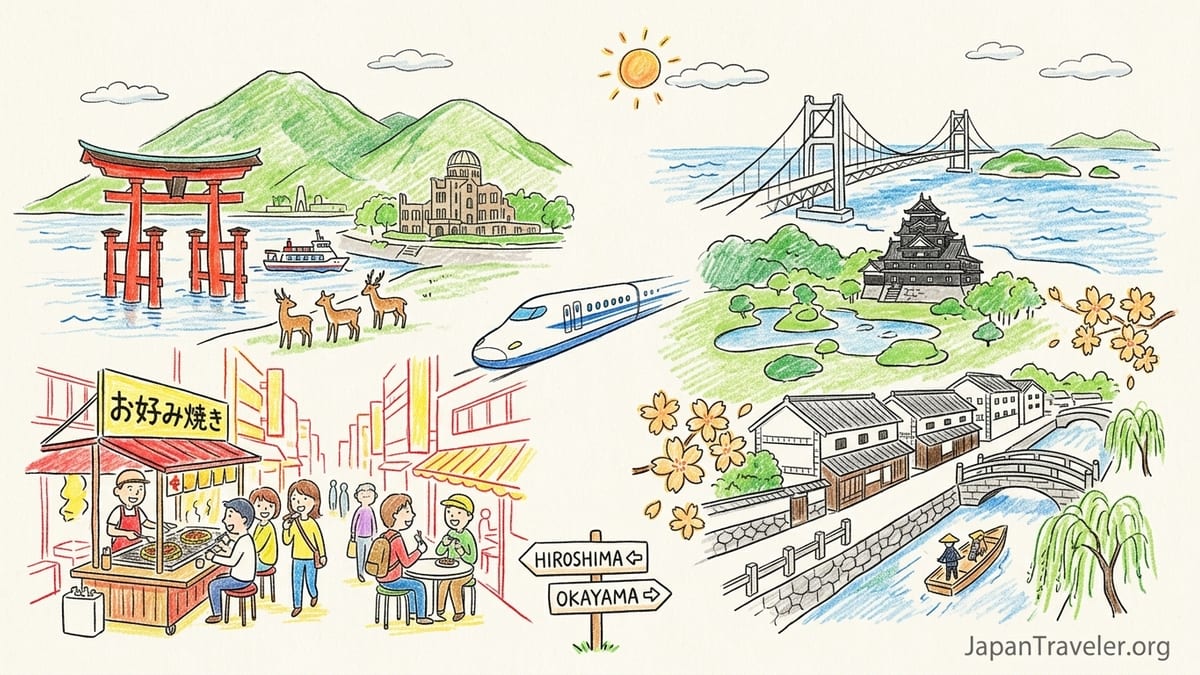
For a classic first-time Chugoku itinerary, most travelers are balancing two clusters of sights. West of Okayama you have Hiroshima, Miyajima, Iwakuni and Onomichi. Around and east of Okayama you have Kurashiki, Okayama’s own Korakuen Garden and castle, and connections across the Seto Inland Sea to Takamatsu and the art islands of Naoshima and Teshima. Both Hiroshima and Okayama sit on the main Sanyo Shinkansen trunk, with frequent Nozomi and Hikari services linking them to Osaka and Tokyo, so either can function as a practical hub for this wider region.
Hiroshima appeals to travelers who want emotional depth and iconic UNESCO sights close at hand. Hiroshima Peace Memorial Park and Museum, the Atomic Bomb Dome, and day trips to Miyajima for Itsukushima Shrine and Mount Misen are among Japan’s most memorable experiences. From Hiroshima Station, local and JR trains put Miyajimaguchi and Iwakuni within roughly 30 to 45 minutes, so you can easily string several headline sights together over two or three days without spending long stretches on trains.
Okayama, by contrast, is positioned as one of western Japan’s transport gateways. Official prefectural tourism materials describe Okayama as a major hub city facing both the historic Sanyodo route and the Seto Inland Sea, which is reflected in today’s rail and ferry network. From Okayama Station you can reach Kurashiki’s Bikan Historical Quarter in about 15 minutes, Takamatsu on Shikoku in roughly an hour by rapid train, and Uno Port for ferries to Naoshima in around an hour door to door. For travelers planning to alternate between Honshu and Shikoku without constantly changing hotels, Okayama has a very practical, central feel.
In practice, the decision often comes down to where you expect to spend more days. If your trip is weighted toward Miyajima, Iwakuni, Sandankyo Gorge or western Chugoku cities like Yamaguchi and Hagi, Hiroshima is usually the better base. If you are drawn more to Kurashiki, the Setouchi art islands, Takamatsu, and Kansai connections, Okayama tends to edge ahead. Many recent visitor reports show people using both: two or three nights in Hiroshima, then two or three in Okayama, connected by a Shinkansen ride of about 35 to 50 minutes depending on train type.
Hotel Prices and Value: Where Your Yen Goes Further
Recent hotel market data indicates that Hiroshima’s average hotel rates have risen markedly in the last two years as inbound tourism has rebounded. Industry analysis in 2026 shows overall average daily rates in Hiroshima Prefecture moving into the low 30,000 yen range for city and business hotels at peak times, with high occupancy often above 90 percent on busy months. That does not mean every traveler will pay those headline figures, but it does signal a market that is running hot, particularly around weekends and holiday periods.
On the ground, mid-range business and city hotels around Hiroshima Station and central downtown Hatchobori commonly price standard double rooms around 12,000 to 18,000 yen on a typical weekday outside major holidays, and above 20,000 yen for popular Saturdays in high season. Well-known chains like Daiwa Roynet, Mitsui Garden and Hotel Granvia Hiroshima (integrated with the station) sit at the upper end of the business category but offer the conveniences of on-site restaurants and quick train access. Budget travelers can still find business hotels or simple guesthouses dipping under 10,000 yen per night, yet competition for the cheapest beds is now intense during cherry blossom and autumn foliage seasons.
Okayama’s accommodation scene is slightly calmer and generally a bit cheaper for similar categories. While there is no single definitive figure, comparison of current listings on major booking engines shows many solid three-star business hotels around Okayama Station pricing doubles around 9,000 to 14,000 yen midweek, nudging higher on weekends but often under Hiroshima’s equivalent. Properties like ANA Crowne Plaza Okayama, directly linked to the station, and Hotel Granvia Okayama tend to post rates similar to Hiroshima’s upper mid-range, but there are numerous mid-tier options within a short walk of the station for less.
Because Okayama sees fewer overnight tourists than Hiroshima, last-minute availability can be more forgiving. Travelers who want to keep plans flexible, book on short notice, or secure a slightly larger room for the same budget may find Okayama kinder to the wallet. That said, special events such as the Okayama Art Summit, Golden Week and domestic holiday weekends can still push rates up quickly, so it is wise to scan a few dates before committing your itinerary there.
Transport and Shinkansen Access: The Case for Each Hub
Both Hiroshima and Okayama sit on the Sanyo Shinkansen and are served by fast Nozomi trains, which do not require reservations for non-JR pass users but are typically excluded from the older nationwide passes. From Shin-Osaka to Hiroshima, the fastest Nozomi services take around 1 hour 25 minutes, while Shin-Osaka to Okayama is roughly 45 minutes. Tokyo to Hiroshima comes in around 4 hours by Nozomi with a change often at Shin-Osaka or on a through train, while Tokyo to Okayama is about 3.5 hours. In other words, Okayama sits roughly halfway between Osaka and Hiroshima in time terms and can feel more central if your wider trip includes Kansai on one side and Kyushu or Shikoku on the other.
Within the region, the local network shapes the day-trip picture. From Hiroshima, JR services make Miyajimaguchi Station reachable in roughly 25 minutes, followed by the short ferry ride to Miyajima. Iwakuni, with its famous Kintaikyo Bridge, is usually around 45 minutes or less by local or rapid train. Trains to Onomichi, a favorite starting point for the Shimanami Kaido cycling route, take around 75 to 90 minutes with at least one change, which is feasible but pushes Onomichi closer to a long day out than a half-day jaunt.
Okayama functions as a spoke for multiple lines spreading across Honshu and Shikoku. Rapid and local trains reach Kurashiki in about 10 to 15 minutes, so staying near Okayama Station and heading to Kurashiki for late afternoon light along the canal, then returning for dinner, is very straightforward. Trains to Takamatsu over the Seto Ohashi Bridge typically take about an hour, and the combination of train to Uno Station and ferry to Naoshima or Teshima makes the art islands realistically accessible as day trips without predawn starts. This is why Okayama’s official guide highlights the station area as a multimodal hub for buses, trams and rail, with modern traveler information facilities clustered on the east side of the station.
For itineraries that also include Shikoku loop trips or hops down to Matsuyama and Kochi, Okayama’s geography becomes especially compelling. You can take advantage of area rail passes like the Setouchi Area Pass or regional JR West passes, using Okayama as a place to start and finish circular routes that mix ferries and conventional lines. Hiroshima can still reach many of the same destinations, but the journeys are longer and often involve backtracking through Okayama anyway, so you are practically sleeping one change further out.
Atmosphere, Nightlife and Food: Which City Feels Better After Dark
Hiroshima offers a more obviously urban and evening-friendly streetscape than Okayama. Neighborhoods around Hondori shopping street, Nagarekawa and the area between the Peace Boulevard and the river are dense with izakaya, okonomiyaki counters, standing bars and compact clubs. Travelers walking from the Peace Memorial Park back toward the city center will notice neon-lit alleyways filled with small yakitori joints and craft beer bars. Hiroshima-style okonomiyaki, cooked on a teppan with layers of noodles, cabbage and meat, is the city’s best-known specialty, and there are entire buildings such as Okonomimura where multiple stalls compete for visitors.
The station area in Hiroshima has also grown livelier in recent years thanks to the redevelopment of the ekie complex. Inside the station mall you find rows of restaurants serving local oysters, Hiroshima tsukemen, and more okonomiyaki, which is convenient if you are arriving late on a Shinkansen and do not want to head deep into downtown. For many travelers, this combination of powerful daytime sightseeing and a genuinely busy night scene makes Hiroshima feel like a complete short-break city, even if you never leave the urban core.
Okayama’s evening atmosphere is more compact and low-key. The main nightlife zones cluster around Okayama Station and the Tenmaya department store area, with pockets of bars and izakaya in the Omotecho shopping arcade and side streets. There are good places to eat, including local specialties such as bara-zushi and fruit-focused desserts using Muscat and Shine Muscat grapes, but you will not find the same concentration of late-opening venues as in Hiroshima. After dinner, many visitors simply stroll the illuminated moat area around Okayama Castle and Korakuen Garden or return to their hotels.
For travelers who prioritize food hunting and nightlife, Hiroshima generally wins. If your perfect evening is trying two or three izakaya, sampling sake from nearby Saijo and then walking back through bustling streets to your hotel, Hiroshima will feel more satisfying. If you mainly want a convenient meal near the station after a long day doing excursions to Kurashiki or the islands, Okayama’s quieter center is usually sufficient, and the slightly more residential feel can be appealing to families seeking calmer nights.
Signature Day Trips: West from Hiroshima vs East from Okayama
When you base in Hiroshima, two day trips dominate most itineraries. The first is Miyajima, where Itsukushima Shrine’s torii gate stands in the sea and deer wander the village streets. A typical day from Hiroshima involves a morning train to Miyajimaguchi, a few hours at the shrine, a ropeway ride and hike on Mount Misen, and a return to Hiroshima for dinner, all without feeling rushed. You can also stay overnight on Miyajima at a ryokan for quieter evenings, but many travelers report that a well-planned day trip from Hiroshima gives them plenty of time on the island.
The second classic day from Hiroshima is Iwakuni. Travelers usually combine a walk across the five-arched Kintaikyo Bridge, a ride on the ropeway up to Iwakuni Castle, and a riverside stroll with lunch before heading back by late afternoon. Because the train ride is relatively short and the bridge area is compact, this trip fits easily into a half or three-quarter day, leaving time for an evening visit to the Peace Memorial Park or downtown Hiroshima. More ambitious travelers add Sandankyo Gorge for hiking or head further west into Yamaguchi Prefecture, but those push into very long days and are better for people comfortable with early departures.
From Okayama, the most obvious excursion is Kurashiki. The Bikan Historical Quarter’s preserved canal-side warehouses, white plaster walls and small museums make it one of the most atmospheric old-town areas in western Japan. Many travelers report that Kurashiki comfortably fills half a day to a full day, depending on how many museums and cafes you visit. Because it is only around 10 to 15 minutes by train, some visitors go twice, once in bright daylight and once toward dusk for photographs of the lantern-lit canal.
Beyond Kurashiki, Okayama’s strength lies in access to the Setouchi art islands and to Shikoku. Trains to Uno Port, followed by ferries to Naoshima and Teshima, can turn into long day trips, but if you start early it is realistic to visit museums like Chichu Art Museum and Benesse House, then return to Okayama in the evening. Trains over the Seto Ohashi Bridge to Takamatsu bring you within reach of Ritsurin Garden and the udon culture of Kagawa Prefecture. For those with more time, Okayama also offers routes north into the Chugoku Mountains, to places like Tsuyama and hot springs areas, though these are more niche options for repeat visitors.
Should You Split Your Stay Between Hiroshima and Okayama?
With the Shinkansen taking roughly 35 to 50 minutes between Hiroshima and Okayama, it can be tempting to pick a single base and day-trip to the other city. In theory, staying all four or five nights in either location and using the Shinkansen or rapid services for long day trips will work. In practice, recent traveler discussions frequently point out that splitting your stay often feels more relaxed, especially if you want to visit both Miyajima and the art islands without repeated pre-dawn departures.
A typical split that works well looks like this: two or three nights in Hiroshima to cover the Peace Memorial Park and Museum, at least one full day on Miyajima, and possibly Iwakuni or Onomichi. Then you move to Okayama for another two or three nights, aiming to visit Kurashiki, one of the Setouchi art islands, and perhaps Takamatsu or a second island day. Because the transfer day between cities is so short, you can leave Hiroshima after breakfast, drop your luggage at an Okayama hotel before noon, and still have almost a full afternoon for Korakuen Garden and Okayama Castle.
Where splitting may not be necessary is on shorter trips or when your interests lean heavily one way. If you only have three nights in the region and your main goal is the Peace Park and Miyajima, it is reasonable to stay entirely in Hiroshima and treat Kurashiki as a side trip from there, even if that does involve 1.5 to 2 hours each way by train. Conversely, if your primary focus is Naoshima, Teshima and Kurashiki, and you only want to see Hiroshima’s Peace Memorial Park once, you could base exclusively in Okayama and dedicate a single long day to Hiroshima, likely leaving early on a Shinkansen and returning at night.
Your tolerance for hotel changes matters too. Some travelers prefer to unpack only once and will happily trade longer train rides for the convenience. Others find that moving once mid-trip keeps things fresh without becoming tiring. Given that check-in times in Japan often start around 15:00, planning your transfer between cities to land around midday, leaving bags at the next hotel, then sightseeing locally for the afternoon is usually the least stressful pattern.
Practical Tips: Booking, Timing and Traveler Profiles
For Hiroshima, advance booking is strongly recommended around major domestic travel periods such as Golden Week, Obon in August and the autumn foliage season. The combination of school trips, domestic tourism and international visitors can push central hotels to full capacity. If you know you want a specific category such as a modern tower hotel near the station with large beds and Western-style breakfast, securing that room several months out often saves both money and frustration. Flexible travelers who are content with smaller business-hotel rooms may still find something closer to their dates, but choices narrow quickly.
Okayama generally allows more flexibility, though events like the Okayama Art Summit or large conferences can cause brief spikes in demand. Families and travelers hauling larger luggage often gravitate to hotels attached to or immediately beside Okayama Station since they shorten transfer times to platforms for morning trains. Because many day trips from Okayama require early-morning departures to maximize time on islands or in Kurashiki, booking a property where you can quickly grab breakfast and head straight to the gates is particularly valuable.
In terms of traveler profiles, Hiroshima tends to suit first-time visitors to western Japan who want a strong emotional and historical core to their trip, enjoy evenings in busy neighborhoods, and are comfortable with slightly higher prices in exchange for being close to headline sights. Okayama is often favored by repeat visitors, people building complex Setouchi itineraries involving both Honshu and Shikoku, and travelers who place a premium on smooth rail logistics and slightly quieter nights. Solo travelers report feeling comfortable in both cities; couples often choose Hiroshima for its atmosphere, while families sometimes prefer Okayama’s calmer station area and more predictable pricing.
Whichever base you choose, it is wise to look at your likely day-trip roster, sketch rough travel times using current train timetables, and count how many early starts each plan would require. Often the most revealing exercise is to ask yourself where you want to be most evenings. If the vision that excites you is walking along the river near the Atomic Bomb Dome after dark and then wandering into an okonomiyaki restaurant, Hiroshima should probably be your home base. If the picture is watching sunset over Kurashiki’s canal or planning art island ferry schedules at a café near Okayama Station, then Okayama is more likely your city.
FAQ
Q1. Which city is better as a base for visiting Miyajima: Hiroshima or Okayama?
Hiroshima is clearly better for Miyajima because trains from Hiroshima Station to Miyajimaguchi take roughly 25 minutes, followed by a short ferry, so you can reach the island quickly and return easily in the evening. From Okayama, you would spend well over two hours each way, which makes for a much more tiring day.
Q2. Is Okayama really more central for transport than Hiroshima?
Okayama sits roughly halfway between Osaka and Hiroshima on the Sanyo Shinkansen and connects directly to Kurashiki, Takamatsu, Uno Port and northbound lines into the Chugoku Mountains, so for itineraries that include Kansai, Shikoku and parts of Chugoku, it functions as a more central rail hub than Hiroshima.
Q3. Where are hotel prices generally lower, Hiroshima or Okayama?
Prices fluctuate, but Hiroshima’s hotel market has tightened recently with higher average rates and occupancy, especially around holidays, while Okayama typically offers slightly lower prices for similar mid-range business hotels and somewhat better last-minute availability.
Q4. Can I see both Hiroshima and Kurashiki without changing hotels?
Yes, you can base in either city and use the Shinkansen or rapid trains for long day trips, but this means accepting journey times of around 1.5 to 2 hours one way, so many travelers find that splitting stays between Hiroshima and Okayama makes the pace more relaxed.
Q5. Which city has better nightlife and restaurant choices?
Hiroshima has the edge for nightlife, with busy districts like Hondori and Nagarekawa full of izakaya, bars and okonomiyaki counters, plus an expanded restaurant zone in and around Hiroshima Station, while Okayama’s evening scene is more modest and focused near the station and central shopping arcades.
Q6. Is it worth staying overnight on Miyajima instead of just day-tripping from Hiroshima?
Many travelers are happy with a full-day trip from Hiroshima, but staying one night on Miyajima lets you enjoy the island after the day crowds leave, see the torii at different tides, and experience ryokan hospitality, which can be worthwhile if your budget allows.
Q7. How many nights should I spend in Hiroshima versus Okayama?
For a balanced trip that includes both western Chugoku and the Setouchi area, a common pattern is two or three nights in Hiroshima for the Peace Memorial Park, Miyajima and Iwakuni, followed by two or three nights in Okayama for Kurashiki, the art islands and possibly Takamatsu.
Q8. Is Okayama a good base for visiting the Setouchi art islands like Naoshima and Teshima?
Yes, Okayama works well because trains from Okayama to Uno Port, combined with ferries to Naoshima or Teshima, fit into a full-day outing, and returning to a hotel near Okayama Station after a long museum day is logistically simple.
Q9. I am traveling with children. Which city is easier with luggage and early trains?
Okayama is often easier for families because many hotels are directly connected to or very close to the station, the station plaza is compact, and early departures for day trips to Kurashiki or the islands involve minimal transfers and walking with bags or strollers.
Q10. If I must choose only one base for a short trip, which should I pick?
If your main priorities are the Peace Memorial Park, Miyajima and a lively evening atmosphere, choose Hiroshima. If you are more interested in Kurashiki, the art islands and convenient links between Kansai and Shikoku, choose Okayama. In very short itineraries with only two or three nights, it usually makes sense to focus on one base rather than splitting.