


Shikoku feels different from Japan’s big-name islands. Trains thin out, roads curve into mountains, and hot springs appear in quiet fishing towns and deep valleys. With around 1,700 properties listed across the island, the challenge is not finding somewhere to sleep but choosing the right base for your route, budget and travel style. This guide focuses on the main urban hubs of Takamatsu, Matsuyama, Kochi and Tokushima, plus standout rural stays, and compares what matters most to independent travelers: station access, parking, luggage storage, breakfast quality, public baths and how well each place works for early trains or ferries.
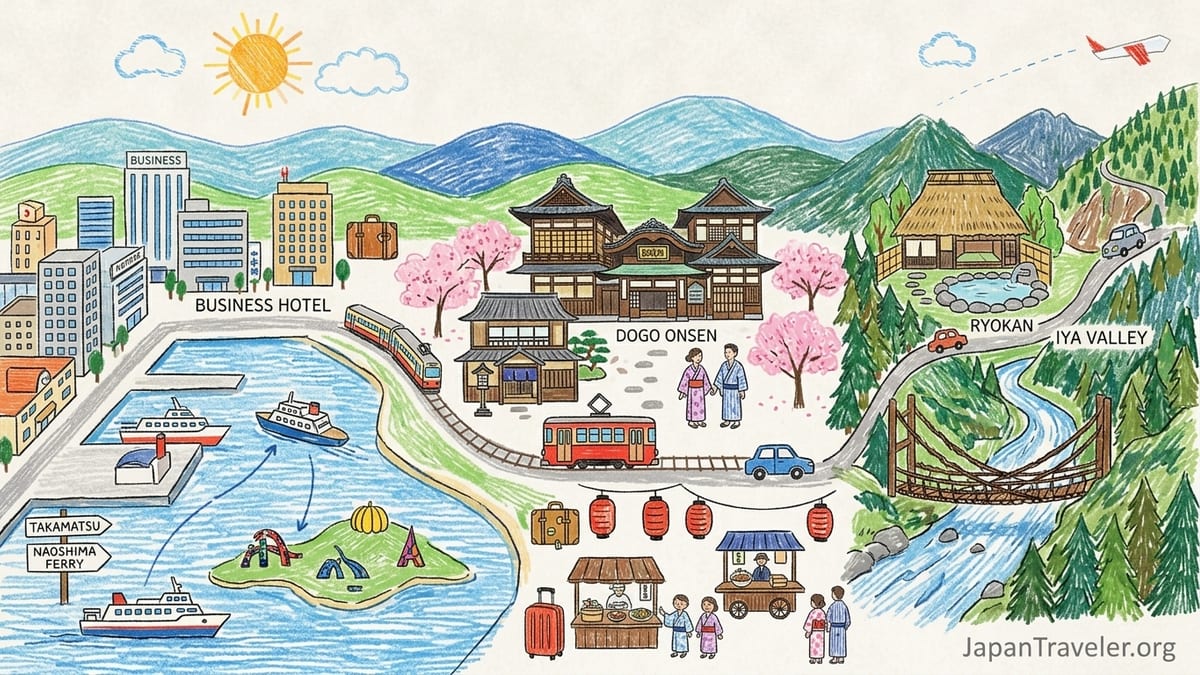
How to Choose Where to Stay in Shikoku
Unlike Tokyo or Osaka, where neighborhoods blur into each other, your choice of base on Shikoku will shape what you actually see. Takamatsu is ideal for ferries to Naoshima and other art islands as well as the Ritsurin garden. Matsuyama centers on Dogo Onsen and hilltop castles. Kochi is a laid-back seaside city with strong food culture, while Tokushima is the jumping-off point for the Iya Valley and the famous Awa Odori dance. Rural pockets such as the Iya Gorge or Cape Ashizuri offer classic onsen and countryside stays but require more planning and usually a rental car.
When comparing hotels, think first about how you will move. If you are traveling by train and ferry, station-front and port-side business hotels are worth the small premium because you can walk from platforms to check-in in a few minutes, even with luggage and in bad weather. Drivers, on the other hand, benefit from hotels that bundle parking or sit on main roads with easy access to expressways. Almost every city hotel offers coin laundry, luggage storage before check-in and after check-out, and simple Japanese or mixed breakfasts, so the real differentiators are room size, on-site public baths and how smoothly they fit your schedule for early departures or late arrivals.
Prices on Shikoku are generally softer than in Tokyo or Kyoto. On non-holiday weekdays, standard business hotels near major stations often start around the equivalent of a modest dinner for two, while mid-range city hotels and ryokan with dinner and breakfast trend higher, especially in onsen districts. Rural onsen ryokan in Iya or Dogo Onsen can run substantially more per person once multi-course kaiseki meals and private baths are included, but many travelers consider one night at a characterful property a highlight of the trip.
Because inventory is relatively small in the rural areas and around major festivals, it is wise to book early for popular periods such as cherry blossom season, the Obon holidays in August and long weekends. In the cities, last-minute deals are more common. Keep in mind that some traditional ryokan and onsen hotels still limit solo travelers or require phone reservations, especially in the Iya Valley. If you are traveling alone, check room occupancy rules carefully before you lock in a rural stay.
Takamatsu: Station Hotels and Ferry-Friendly Bases
Takamatsu has some of the richest hotel inventory on Shikoku, especially around JR Takamatsu Station and the port. This makes it an excellent base if you plan to day-trip to Naoshima, Teshima and other Seto Inland Sea islands or catch early morning ferries. The cluster of modern hotels within a short walk of the station and ferry terminal provides effortless transfers with wheeled luggage, and several properties specialize in business guests catching early limited express trains. Station-front hotels often allow you to drop bags from mid-morning so you can head straight to the pier or to Ritsurin Garden without waiting for check-in.
For station hotels, look for properties literally facing JR Takamatsu Station or in the blocks between the station and the port. Typical rooms are compact but efficient, with strong Wi-Fi, coin laundry and good soundproofing from passing trains. Many of these hotels offer simple Japanese and Western buffet breakfasts starting early enough for 7:00 a.m. departures, which is helpful if you intend to board a morning ferry to Naoshima or a limited express bound for Kochi or Tokushima. Public baths in city hotels are usually sento-style rather than full onsen, but they are welcome after days of walking and island cycling.
If you are driving, Takamatsu offers several mid-range hotels a short distance from the station core that emphasize parking. Some properties partner with multi-story parking garages, quoting daily caps rather than per-hour fees, and others maintain their own surface lots. It is common to park your car, handle check-in on foot and then explore the city by tram or on foot. Travelers report that parking fees in central Takamatsu are moderate by Japanese urban standards, and some hotels will validate or discount nearby car parks if their own spaces are full. Always confirm whether parking is first-come first-served, as lots can fill on holiday weekends.
Families often prefer slightly larger rooms near the shopping arcades or the waterfront, where it is easier to find casual restaurants and convenience stores. Quad rooms and connecting options are not universal, but many business hotels will provide extra futons on tatami corners or sofa beds for younger children. For those planning side-trips to nearby Kotohira Shrine or the Shodoshima ferries, Takamatsu’s central location and dense hotel stock make it particularly forgiving if you change plans at the last minute or arrive later than expected from Honshu.
Matsuyama and Dogo Onsen: Hot Springs and Family-Friendly Ryokan
Matsuyama is one of Shikoku’s most atmospheric cities, with its hilltop castle, tram lines and the historic Dogo Onsen district. Travelers typically split between staying near JR Matsuyama Station for train convenience and basing in Dogo Onsen for the full hot spring town experience. Station-area hotels tend to be modern business or mid-range properties with fast access to the Yosan Line and airport buses, while Dogo offers a tight cluster of ryokan and small hotels within a short walk of the three main public baths. This means you can check in, drop your bags and soak in thermal water within minutes, then stroll through the lantern-lit streets in yukata robes.
For many visitors, a night in Dogo Onsen is worth the extra cost. Ryokan and onsen hotels often include multi-course dinners featuring Ehime seafood and local citrus, plus breakfast with regional specialties. Many have large communal baths and sometimes reserveable private tubs for couples or families. Some Dogo properties do not have their own parking but instead direct drivers to nearby public car parks, validating or partially reimbursing fees. If you are arriving by train, a tram connects JR Matsuyama Station to Dogo Onsen in about 20 minutes, so station proximity is less critical than in Takamatsu. You can store luggage at your Dogo accommodation from late morning in most cases, then head up to Matsuyama Castle or wander the shopping arcades until check-in.
Families with young children often appreciate the walkability of the Dogo area. Side streets are largely traffic-calmed, and many hotels offer Japanese-style rooms with tatami and futon, which are forgiving for co-sleeping and early bedtimes. Breakfast buffets in the larger hotels usually mix Japanese standards such as grilled fish and miso soup with Western basics like eggs, cereal and pastries, so picky eaters are rarely a problem. Coin laundries are common in mid-range and larger properties, making Matsuyama a good location to reset laundry during a longer Shikoku loop, especially if you have been hiking or cycling.
If your priority is catching early or late trains, however, staying closer to JR Matsuyama Station still makes sense. Station hotels generally offer earlier breakfast start times and even simpler check-in and check-out processes, though you will give up the charm of sleeping right in the onsen district. Some travelers choose a compromise: one night in a Dogo ryokan followed by a lower-cost station hotel before a very early shinkansen connection via Okayama. This can make sense if you value both the onsen experience and a stress-free pre-dawn departure.
Kochi: Easy Parking and Laid-back City Stays
Kochi City has a relaxed coastal vibe and a hotel scene that caters heavily to drivers and domestic tourists. Many properties sit along wide avenues with on-site or adjacent parking, making the city an easy base for road trips to Katsurahama Beach, the Shimanto River or the dramatic capes along the Pacific coast. At the same time, there is a cluster of business and mid-range hotels around Kochi Station and the downtown tram lines, convenient if you are arriving by train from Takamatsu or Matsuyama. Because Kochi is less densely built up than Takamatsu, even central hotels may have surface lots, which are easier to navigate than tower parking garages when you are tired from a long drive.
City hotels in Kochi typically provide generous breakfast spreads emphasizing local products. Expect regional specialties such as bonito tataki, yuzu-flavored dishes and local vegetables alongside standard Japanese and Western items. This makes Kochi a particularly satisfying place to schedule a hotel with breakfast, especially before a long day of driving. Public baths in these hotels range from small rooftop tubs with city views to indoor communal baths sized for a dozen people or so. They may not have natural hot spring water, but the ritual of bathing remains the same and is welcome after exploring Kochi Castle or the Sunday market on foot.
Families find Kochi user-friendly because of its wide sidewalks, tram network and abundance of casual restaurants around the main shopping arcades. Many hotels offer triple rooms, tatami rooms or mixed Western-Japanese layouts that can handle two adults and one or two children on futons. Coin laundries, microwaves and vending machines are common. If you are considering day trips to the Shimanto River or out toward Cape Ashizuri, staying in central Kochi keeps dining and sightseeing simple while allowing early departures on national highways. It also reduces the risk of driving back to a remote inn on dark, twisting roads after dinner.
For train travelers, hotels within a short walk of JR Kochi Station are handy for early limited express services back toward Okayama or east to Tokushima. As in other Shikoku cities, front desks will usually store luggage before check-in and after check-out, allowing you to spend a last half-day at Kochi Castle or in the markets without dragging bags. If your itinerary involves an early-morning highway bus or flight, consider a hotel with good taxi access and clear pickup space at the entrance so you are not wrestling suitcases on narrow streets at dawn.
Tokushima and the Iya Gateway: Practical Bases for Mountain Trips
Tokushima City itself has a compact hotel zone near JR Tokushima Station, the bus terminal and the riverfront. This makes it a logical stop if you are arriving from Honshu over the Onaruto Bridge, joining Awa Odori festivities in August or transferring to buses and trains into the interior. Station hotels here follow a familiar pattern: modern, compact rooms, coin laundry, efficient check-in and breakfast that starts early enough for first departures into the mountains. Some properties have modest public baths, helpful if you have spent the day hiking or visiting pilgrimage temples in the surrounding countryside.
For travelers planning to explore the Iya Valley and Oboke Gorge, the key decision is whether to base in Tokushima (or another city) and day-trip, or to overnight in the valley itself. While it is technically possible to transit through with an early limited express train and bus links, the winding roads and limited service make same-day return trips long and often rushed. A night in or near the valley, whether in a traditional ryokan, onsen hotel or farmhouse stay, allows you to enjoy the scenery without clock-watching. Many of these accommodations offer dinner and breakfast packages and onsen baths with views of forested slopes and river gorges.
Access to rural hotels in the Iya area is easiest by car, with on-site parking at most properties and signage in both Japanese and basic English. Some of the more established onsen hotels run shuttle services from JR Oboke Station once or twice a day for overnight guests who reserve in advance, which is particularly useful if you do not drive. Because bus and shuttle times are limited, these valley stays are less suited to ultra-early departures. Travelers catching first trains toward Kochi or Takamatsu may prefer to return to a city base the night before to ensure smoother connections.
If you are following the Shikoku 88 Temple Pilgrimage route, Tokushima and nearby towns offer simple business hotels, guesthouses and minshuku that understand pilgrim needs such as early breakfasts, laundry and luggage forwarding. Prices are usually modest, and staff are accustomed to guests checking in early evening, washing clothes and leaving again just after dawn. Parking is common even at budget-level properties, reflecting the number of pilgrims traveling by car or rental vehicle rather than on foot.
Rural Shikoku: Onsen Ryokan, Farm Stays and Road-trip Hotels
Beyond the four main cities, Shikoku rewards travelers who can slow down and detour into the mountains or along the coast. The Iya Valley is the best-known rural cluster, with onsen hotels perched on slopes above the river, small ryokan near vine bridges and farm-style stays in traditional houses. These properties nearly always include dinner and breakfast in their core plans and emphasize scenery as much as hot water. Expect outdoor rotenburo baths facing the valley, tatami rooms with sliding doors that open onto balconies and kaiseki meals built around mountain vegetables, river fish and local beef. Parking is almost always free and on-site, as driving remains the main way to reach them.
Elsewhere in rural Shikoku, coastal onsen hotels around Cape Ashizuri, the Shimanto River basin and smaller fishing towns offer a similar rhythm: arrive mid-afternoon, soak before dinner, enjoy a long meal, soak again and then sleep to the sound of waves or rivers. These properties are tailored more to relaxation than to catching trains, so front desks may open breakfast slightly later than in city hotels, and public transport connections can be sparse. For road-trip travelers, though, the on-site parking, all-inclusive meals and generous check-out times make them ideal places to schedule between longer driving days. It is common to see tour buses in the lots on weekends and holidays, so booking ahead is advisable.
Farm stays and renovated kominka houses are becoming more prominent in rural Shikoku. They typically offer just a few rooms, shared bathrooms and simple home-style meals, but compensate with personal interaction and quiet surroundings. These stays suit travelers who are comfortable driving narrow local roads and do not need hotel-style services such as 24-hour front desks, full-size public baths or daily housekeeping. Breakfast might be served later than in business hotels, so if you need to reach a particular ferry or long-distance train, verify meal times and whether you can check out before breakfast if necessary.
When planning rural nights, always cross-check access in both directions. A hotel that is perfect after a leisurely drive into the mountains may be awkward if you need to be on a ferry in Takamatsu early the next morning. Consider pairing each rural stay with a following night in a city hotel closer to your departure point. Station-area properties in Takamatsu, Matsuyama or Kochi are far better suited to pre-dawn departures, with 24-hour front desks, easy taxi access and luggage storage if you want to squeeze in one last temple or seafood meal before leaving Shikoku.
Breakfasts, Baths and Early Departures: What Really Matters
Across Shikoku, breakfast, bathing and logistics are the details that make a hotel either forgettable or a trip highlight. City hotels and business chains almost always offer breakfast buffets featuring Japanese standards such as rice, miso soup, grilled fish and pickles, alongside Western items like eggs, sausages, toast and coffee. In Takamatsu and Kochi in particular, you will often see local specialties such as citrus juices, regional fish or yuzu-based condiments appear on the buffet line. Start times hover around 6:30 or 7:00 a.m., with last entry typically around 9:00 a.m., which works for most limited express departures.
Public baths in the cities are not always natural hot springs, but they remain a core amenity. Simple business hotels might offer a single-sex bath on a high floor or in the basement, sized for a handful of bathers at peak times. Mid-range properties could add outdoor tubs, sauna rooms or multiple pools. In onsen towns such as Dogo or rural Iya, baths become a central reason to stay, with larger rotenburo overlooking gardens or valleys. Some ryokan offer private open-air baths in a subset of guest rooms, at a premium, which can be appealing for couples or families who want to bathe together or who are nervous about public bathing etiquette.
For travelers with early trains, highway buses or ferries, confirming breakfast hours and check-out flexibility is crucial. Business and station hotels are most attuned to this need, often opening breakfast buffets by 6:30 a.m. and allowing very quick check-outs, sometimes by simply dropping keys in a box. Onsen ryokan, by contrast, often serve breakfast from around 7:30 or 8:00 a.m. to encourage leisurely mornings. If you must leave very early from a rural property, ask in advance whether they can provide a simpler, earlier meal or adjust your check-out; in some cases you may have to skip breakfast entirely or pay for a room-only plan.
Luggage storage is widely available across Shikoku’s hotel spectrum. Even small guesthouses usually allow you to leave bags for several hours on the day of check-in or check-out, which is invaluable for sightseeing in castle towns or onsen districts. In Takamatsu and Tokushima, this makes it easy to spend time at gardens or along rivers after you check out but before an afternoon ferry or train. At rural properties, storage is usually informal, with bags left in a side room or behind the front desk until your bus or shuttle arrives.
The Takeaway
Choosing where to stay in Shikoku is less about chasing a single “top” hotel and more about aligning your beds with your trains, ferries and roads. Takamatsu’s dense station and port hotel cluster is ideal for art island trips and early departures, with plentiful inventory and flexible booking. Matsuyama rewards those who splurge on a Dogo Onsen ryokan night, while still offering practical station hotels for rail connections. Kochi suits drivers and families with its easy parking, strong breakfasts and relaxed city center, and Tokushima works best as a functional gateway and a staging point for forays into the Iya Valley and beyond.
Rural stays in the Iya Valley, along remote coasts or on riverbanks can become the emotional high points of a Shikoku journey, especially when combined with hot springs and local cuisine. They require more planning, particularly around access without a car and around early or late transport, but repay the effort with quiet, starry nights and the feeling of being deep in the Japanese countryside. By mixing city bases with one or two carefully chosen rural nights, you can balance convenience and immersion and make the most of Shikoku’s 1,700 or so places to sleep.
In practical terms, think of each night less as a stand-alone booking and more as a link in your chain of movement. Before reserving, ask yourself how you will arrive, where you will eat dinner, whether you want to bathe in a public or private setting, how early you need to leave and whether you will be driving or relying on trains and buses. If you answer those questions clearly, Shikoku’s varied collection of station hotels, onsen ryokan, family-friendly city properties and scenic rural inns can easily support a smooth and memorable trip.
FAQ
Q1. Is it better to stay near the station or in an onsen area in Shikoku’s cities?
For pure convenience and early departures, station-area hotels are best. If you want atmosphere and hot springs, prioritize onsen districts such as Dogo in Matsuyama, then return to a station hotel before very early trains if needed.
Q2. Do most Shikoku hotels include free parking?
Rural and roadside hotels almost always offer free on-site parking. In city centers like Takamatsu or Kochi, parking is common but may be in paid partner garages, so check daily rates before booking.
Q3. Can I find family rooms easily in Takamatsu, Matsuyama, Kochi and Tokushima?
Yes, though options vary. Many city hotels offer triples, tatami rooms or sofa beds for children, but true quad rooms and interconnecting rooms are less common than in Western resorts, so book early.
Q4. How early do hotel breakfasts usually start in Shikoku?
Business and station hotels typically start breakfast between 6:30 and 7:00 a.m., which suits most early trains. Onsen ryokan and rural inns may start later, around 7:30 or 8:00 a.m., favoring relaxed mornings.
Q5. Are public baths in city hotels real onsen?
Not always. Many urban hotels have communal baths that feel like sento rather than natural hot springs. True onsen water is more common in places like Dogo Onsen, Iya and coastal resort areas.
Q6. Is it practical to visit the Iya Valley on a day trip from a city base?
It is possible but rushed, especially without a car. Public transport involves limited buses and winding roads, so most travelers find at least one night in or near the valley more enjoyable.
Q7. Do Shikoku hotels store luggage before check-in and after check-out?
Yes. Almost all business hotels, mid-range properties and many ryokan will store bags for several hours, which is very helpful for sightseeing days or when catching afternoon ferries.
Q8. How far in advance should I book rural onsen ryokan?
For weekends, holidays and popular seasons such as cherry blossom or autumn foliage, aim for several months in advance. On weekdays outside peak times, a few weeks can be enough, but availability is limited.
Q9. Are solo travelers welcome at traditional ryokan in Shikoku?
Many are, but some rural onsen ryokan, particularly in the Iya Valley, restrict single occupancy in high season. Check booking rules carefully and consider city-based ryokan or business hotels if you travel alone.
Q10. Is it necessary to rent a car to enjoy Shikoku’s hotels and scenery?
No, but a car expands your options dramatically, especially for rural stays. With patience, you can still experience main cities, Dogo Onsen and some valley areas using trains, trams, buses and occasional hotel shuttles.