


Planning a trip beyond Japan’s main island of Honshu and trying to choose between Shikoku and Kyushu is a good problem to have. Both islands offer rich culture, memorable food and striking landscapes, but they suit different travel styles. This guide compares them in practical, real-world terms so you can decide which fits your time, budget and interests.
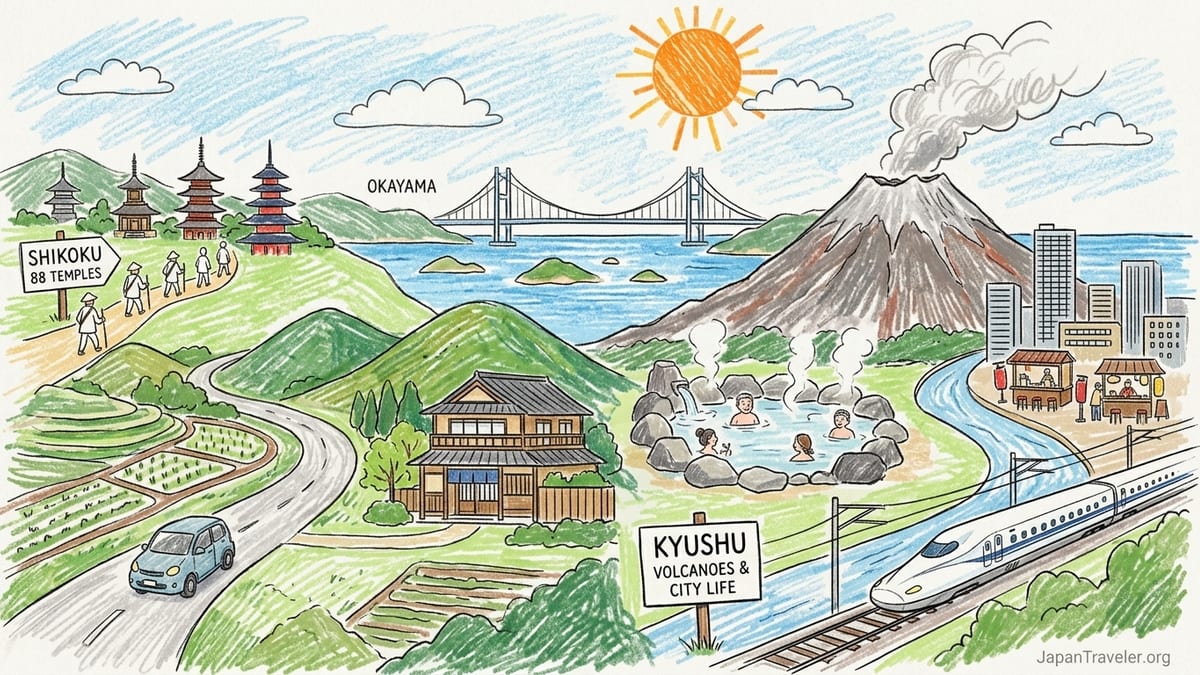
Overall Vibe: Compact Pilgrimage Island vs Big, Volcanic South
Shikoku feels like Japan in slow motion. It is smaller and less populated than Kyushu, with four modest regional cities, quiet coastal towns and a landscape threaded by the 88-temple pilgrimage route. You are more likely to spend an evening in a family-run ryokan in Matsuyama or a farmhouse stay in the Iya Valley than in a neon nightlife district. English is less widely spoken, and many visitors report more small personal encounters, such as a temple monk explaining how to stamp a pilgrimage book or a restaurant owner walking you to the bus stop.
Kyushu is bigger, busier and more varied. Fukuoka feels like a scaled-down Osaka, with shopping arcades and famous yatai food stalls, while Nagasaki layers port-city history over hillside neighborhoods. You can soak in steaming open-air baths in Beppu, hike on the rim of volcanic calderas near Aso, then be back in a major city by night using the Shinkansen. It is still far from Tokyo’s frenzy, but the island has a distinctly urban and dynamic edge compared with Shikoku’s rural calm.
If your ideal Japan trip involves temples, quiet onsen towns and long drives on empty country roads, Shikoku is often the better fit. If you want a mix of big-city energy, easy long-distance trains and headline sights like active volcanoes, Kyushu generally wins.
Getting There and Around: Trains vs Rental Cars
For most travelers coming from Honshu, Kyushu is easier to plug into an existing itinerary. The Kyushu Shinkansen links Hakata Station in Fukuoka with Kumamoto and Kagoshima, continuing from the San’yo Shinkansen that serves Hiroshima and Osaka. In practice, this means you can go from Hiroshima to Fukuoka in roughly an hour by direct bullet train, then be in Kumamoto or Kagoshima within another hour or two. Trains are frequent, reservations are straightforward at any JR ticket office, and rail passes often cover the line.
Shikoku has no Shinkansen. Access is via limited express trains over bridges from Okayama, buses from Osaka and Kobe, or domestic flights to airports like Matsuyama and Takamatsu. For example, reaching Matsuyama often involves taking the Shinkansen to Okayama then a 2.5 to 3 hour limited express train across the Seto Inland Sea. This is comfortable and scenic, but requires an extra connection and more planning. Once on Shikoku, intercity trains exist but are slower and less frequent than in Kyushu, and some interior regions, such as the Iya Valley, are only realistically accessible by car.
Car rental is possible on both islands, but on Shikoku it changes the trip dramatically. A 4 to 7 day loop from Takamatsu or Matsuyama in a rental car lets you visit several pilgrimage temples, cross mountain passes, detour to small coastal towns and reach trailheads that would be awkward by bus. Many visitors rent a compact car for about what a couple would pay in long-distance train tickets and gas for a week, parking at temples and onsen towns where daily parking fees are modest. On Kyushu, car rental is helpful for areas like Aso, Kirishima or the Satsuma Peninsula, but you can still see many highlights by rail and bus if you prefer not to drive.
How Much Time Each Island Really Needs
Because Kyushu is larger, you need to think carefully about scope. A common first-time Kyushu itinerary is 5 to 7 days focusing on the northern half: Fukuoka, Nagasaki, and one onsen region such as Beppu or Yufuin. This can be done largely by train and bus, with perhaps a day-trip rental car in the countryside. If you want to add Kagoshima, Sakurajima and the Aso region, 8 to 10 days is more realistic to avoid turning the trip into a series of long travel days.
Shikoku, despite being smaller, rewards a similar amount of time, but distances feel different. A 6 to 8 day Shikoku trip might include Takamatsu and Ritsurin Garden, Tokushima or the Naruto whirlpools, the Iya Valley, and Matsuyama with Dogo Onsen and nearby castles such as Matsuyama or Uwajima. Driving days are usually in the 2 to 3 hour range, with time for stops at roadside markets and minor pilgrimage temples. Because tourism is less structured, you may find yourself lingering longer in one region, such as spending two full days in the Iya Valley rather than rushing on.
The full 88-temple pilgrimage is a major time commitment. Walking the roughly 1,200 to 1,400 kilometer loop can take several weeks or more. Even with a car, visiting all 88 temples typically takes at least about 10 days and is treated as a dedicated trip. For most travelers, a “pilgrimage sample” of 3 to 10 temples near where they are already staying is more realistic, allowing them to experience the ritual of stamping a pilgrimage book and seeing white-clad pilgrims without restructuring their whole timetable.
Signature Experiences: Pilgrimage, Castles and Cycling vs Volcanoes, Cities and Onsen
Shikoku’s signature experiences are quieter but distinctive. The Shikoku 88-temple pilgrimage shapes the whole island, even if you are only visiting a handful of temples. In practice, this might look like renting a small car in Tokushima, driving to Ryozenji (Temple 1), buying a simple white pilgrimage stole and stamp book, and spending the day visiting the first three or four temples as you learn the basic rituals. Another archetypal Shikoku experience is soaking in Dogo Onsen in Matsuyama, one of Japan’s oldest hot spring areas, after an evening stroll past the tram lines and old wooden bathhouse facade.
The Iya Valley offers a different, more rugged highlight. Roads snake through steep gorges, with vine bridges and cliffside viewpoints. In real terms, reaching a farmhouse inn here often means a slow, hour-long drive from the nearest train station on narrow mountain roads, but the payoff is dinner made from local vegetables and river fish, followed by baths overlooking forested slopes. For those drawn to active travel, the Shimanami Kaido cycling route between Onomichi on Honshu and Imabari on Shikoku is a 70 kilometer class ride across islands and suspension bridges. Many visitors rent an electric-assist bike, start early in the morning, and take 6 to 8 hours including photo stops, café breaks and a simple seaside lunch.
Kyushu’s headline experiences are more dramatic. Visiting Mount Aso or the surrounding caldera area might involve taking a train from Kumamoto, then a bus or rental car into the highlands where you can walk to viewpoint ridges and see steaming vents. In Kagoshima, ferries cross to Sakurajima, an active volcano that often releases small plumes of ash, visible from the city’s waterfront promenade. Nagasaki’s appeal comes from its layered history: visiting the Atomic Bomb Museum and Peace Park, then climbing by tram or bus to a hillside viewpoint over the harbor at night, followed by a bowl of champon noodles or castella cake in the old districts.
Onsen culture is particularly strong in Kyushu, with Beppu’s cityscape of steam vents and Yufuin’s more boutique, rural-feeling streets lined with cafés and small galleries. Staying in a ryokan here often includes a multi-course kaiseki dinner featuring local ingredients, with private or shared hot-spring baths overlooking gardens or mountain views.
Food and Drink: Subtle Regional Flavors vs Big-Hitting Specialties
Both islands are excellent for food, but the character differs. On Shikoku, you encounter a web of smaller regional specialties. Kagawa is famous for Sanuki udon, often eaten standing at simple self-service shops for a few hundred yen a bowl, where you choose toppings like tempura or green onions and pay at the counter. Ehime’s coastal towns serve sea bream prepared in different local styles, such as sea bream over rice with a raw egg and soy-based sauce. In Tokushima, ramen is known for a rich broth and a topping of sliced pork and raw egg, while Kochi is renowned for lightly seared bonito tataki and a fondness for local sake breweries.
These foods are best found by wandering: a weekday lunch at a no-frills udon shop full of office workers, a roadside market selling citrus from local orchards, or a fish restaurant near a small harbor. English menus can be rare, so having photos or pointing at plastic food models is common practice. Prices are generally gentler than in major cities; a satisfying udon lunch and drink can be cheaper than a comparable meal in central Osaka.
Kyushu’s food scene is punchier and more concentrated in a few big-name dishes. Fukuoka is a hub for tonkotsu ramen, often eaten at small counters or late-night yatai along the river. A typical experience might be waiting in a short line outside a popular ramen-ya, ordering via vending machine, and slurping a rich, pork-based broth with thin noodles for a very reasonable price. Hakata-style motsunabe (offal hotpot) and mentaiko (spicy cod roe) are other local icons. In Kagoshima, kurobuta black pork and shochu spirits made from sweet potatoes feature heavily, while Nagasaki introduces dishes such as champon and sara-udon that reflect its Chinese and European trading past.
If food is at the center of your trip and you enjoy exploring backstreet izakaya and street-food stalls, Kyushu’s larger cities make it straightforward, with dense clusters of options within walking or tram distance of central hotels. Shikoku’s food is every bit as rewarding, but you work a little harder for it, often driving out to a recommended countryside restaurant or relying on your inn’s half-board dinners.
Nature and Outdoor Activities
Shikoku’s landscapes are on a more intimate scale. The interior is mountainous, cut by rivers that create deep gorges and terraced fields. Hiking here often means day-walks along sections of the pilgrimage route or short climbs to viewpoints behind temples. The Iya Valley’s attractions include vine bridges crossing rocky rivers and narrow roads leading to viewpoints like the famous statue of a boy urinating over a cliff. Coastal scenery ranges from the Seto Inland Sea’s calm, island-dotted views to the rougher Pacific beaches near Kochi, where surfers and sea turtles share the shore. The Shimanami Kaido ride is a manageable challenge for most reasonably active travelers, especially with e-bikes widely available, and can be stretched into a leisurely two-day trip with an overnight stay on one of the islands.
Kyushu’s nature feels more expansive and volcanic. The island hosts caldera landscapes, crater lakes, geothermal fields and lush subtropical forests, especially in the south. In practical terms, a day in the Aso region might include driving along the caldera rim road, stopping at grassy plateaus where horses graze, then walking to lookout points over the crater and surrounding farmland. In Beppu, short walks can take you past steaming ponds and geyser-like vents, while longer hikes near Kirishima or Kuju offer mountain trails with panoramic views.
For beach time, Kyushu’s southern coasts and offshore islands offer warmer waters, particularly in late spring through autumn. However, weather can be more humid and typhoon-prone in peak summer. Shikoku’s coastal climate can also be hot and humid in July and August, but its smaller scale makes it easier to escape into higher, cooler interior valleys for relief.
Onsen Culture and Bathing Experiences
Both islands are excellent for hot springs, but Kyushu has a stronger overall reputation. Beppu alone has multiple distinct hot-spring districts, with basic public baths, ryokan complexes and the famous “hells” area of colorful, steaming pools. Travelers can easily spend a whole day moving among baths of different mineral compositions, from milky-white waters to clear, gently alkaline pools. Yufuin offers a softer, boutique experience, with smaller ryokan, art museums and cafés in a walkable town framed by Mount Yufu.
Kagoshima Prefecture adds yet more variety, with sand baths in coastal resorts where attendants bury you in warm volcanic sand before you rinse off and soak in regular hot springs. Many visitors factor in one or two night stays in these onsen towns as the restorative core of a Kyushu itinerary, especially in cooler months from autumn to early spring when outdoor baths feel particularly appealing.
Shikoku’s onsen are quieter and fewer in number, but often atmospheric. Dogo Onsen in Matsuyama is the most famous, with its historic bathhouse building, modern annexes and hotels that pipe the same spring water into their own baths. A typical stay in Matsuyama might involve checking into a mid-range ryokan that offers a multi-course dinner, taking a tram to the old bathhouse for a communal soak, then walking back through lantern-lit streets. Elsewhere on Shikoku, smaller hot-spring inns in places like the Iya Valley or remote coastal areas offer simple but memorable baths with mountain or river views.
If you want a dense network of onsen towns to hop between, Kyushu is the clear choice. If you prefer a few carefully chosen, more contemplative bathing experiences embedded in a quieter itinerary, Shikoku works beautifully.
Combining Each Island With Osaka and Hiroshima
For travelers starting in Osaka or Kyoto, Kyushu is logistically straightforward. The San’yo Shinkansen runs west through Hiroshima and on to Hakata in Fukuoka. An itinerary might look like this in practice: three nights in Kyoto, two nights in Hiroshima and Miyajima, then a one-hour Shinkansen ride to Fukuoka for three nights using it as a base for day trips to Dazaifu, Kitakyushu or even Beppu. You simply reserve seats at any JR station and ride, with train frequency high enough that you rarely need to plan around a specific departure more than an hour or two in advance.
Shikoku requires a bit more intentional routing but rewards it with a sense of discovery. From Osaka, you might ride a limited express train or bus over the Akashi Kaikyo Bridge into Tokushima or Takamatsu, then circle the island by train and car. From Hiroshima, a popular pattern is to head to Onomichi, rent a bicycle and ride the Shimanami Kaido to Imabari, spending the night there before continuing by train or car deeper into Shikoku. Because services are less frequent than on the Shinkansen, you plan more around timetables. Missing a particular rural bus might mean waiting an hour or more, which encourages slower travel and fewer one-night stays.
If your Japan trip is short and you value spontaneity, Kyushu’s stronger rail backbone and easy extensions from Hiroshima make it less stressful. If you have a bit more time and do not mind building your days around a handful of key bus or train departures, Shikoku can feel like a satisfying off-the-beaten-path detour from an Osaka or Hiroshima base.
The Takeaway
When you strip away the romance of maps and names, the choice between Shikoku and Kyushu comes down to how you like to travel. Shikoku is compact, low-key and best appreciated at a walking or driving pace, with the 88-temple pilgrimage, Dogo Onsen, the Iya Valley and Shimanami Kaido cycling as its defining experiences. It is ideal if you are comfortable with car rental or do not mind slower trains and buses, and if your image of Japan leans more toward mountain valleys, historic bathhouses and conversations in small inns than big-city skylines.
Kyushu, in contrast, is larger, livelier and more plugged into Japan’s high-speed rail network. It offers major cities like Fukuoka and Nagasaki, dramatic volcanoes and caldera landscapes, some of the country’s densest clusters of onsen, and a food scene built around bold regional dishes. It works especially well if you want to build on an Osaka or Hiroshima itinerary with minimal logistical friction and prefer to rely primarily on trains rather than cars.
If you only have a week beyond Honshu and want straightforward access, Kyushu is usually the better first step. If you have a bit more time or are on a second or third trip to Japan and crave quieter roads, softer tourism infrastructure and the chance to dip into an ancient pilgrimage culture, Shikoku is a compelling choice. Either way, choosing one over the other is less about which is “better” and more about matching the right island to the way you genuinely like to move through a place.
FAQ
Q1. Is Shikoku or Kyushu easier to visit without renting a car?
Kyushu is generally easier without a car because the Shinkansen connects Fukuoka with other cities like Kumamoto and Kagoshima, and major onsen towns such as Beppu and Yufuin are reachable by train and bus. Shikoku has trains and buses, but services are less frequent and some highlights like the Iya Valley are much more convenient by car.
Q2. How many days do I need for a first-time visit to Shikoku?
A realistic first trip to Shikoku is around 6 to 8 days. That gives you time for at least one city such as Matsuyama or Takamatsu, a stay in the Iya Valley or another rural area, a taste of the 88-temple pilgrimage and possibly the Shimanami Kaido cycling route without rushing.
Q3. How many days do I need for a first-time visit to Kyushu?
For Kyushu, 5 to 7 days works well if you focus on the northern half of the island, such as Fukuoka, Nagasaki and one onsen area like Beppu or Yufuin. If you want to add Kagoshima, Sakurajima or Aso, consider 8 to 10 days to keep travel days comfortable.
Q4. Can I experience the Shikoku 88-temple pilgrimage in just a day or two?
Yes. Most travelers sample a short section. For example, you might visit the first few temples near Tokushima or a small cluster near Matsuyama in a single day, buying a pilgrimage stamp book and learning the basic rituals without attempting the full multi-week circuit.
Q5. Which island is better for onsen lovers?
Kyushu is usually better for onsen enthusiasts, with famous hot-spring regions such as Beppu, Yufuin and Kagoshima’s sand baths offering a wider range of bath types and town atmospheres. Shikoku has excellent onsen like Dogo and smaller rural springs, but they are more spread out.
Q6. Is the Shimanami Kaido cycling route suitable for casual cyclists?
For most reasonably active travelers, yes. The core route is around 70 kilometers, and many people rent electric-assist bikes to handle the bridge climbs more comfortably. Starting early and planning plenty of stops turns it into a full but manageable day, or you can split it over two days with an overnight stay on one of the islands.
Q7. Which island is better if I want nightlife and shopping?
Kyushu is better for nightlife and shopping, especially around Fukuoka, where you have large department stores, busy shopping arcades and late-night food stalls. Shikoku’s cities are much smaller and nightlife is usually limited to local bars and izakaya rather than big entertainment districts.
Q8. How easy is it to combine Shikoku or Kyushu with Osaka and Hiroshima?
Kyushu is easier to combine with Osaka and Hiroshima thanks to the continuous Shinkansen line. You can ride directly from Hiroshima or Osaka to Fukuoka and beyond. Shikoku requires limited express trains or buses over the Inland Sea bridges, or approaching via the Shimanami Kaido, so it involves more connections and planning but can be very rewarding.
Q9. Which island is better for hiking and nature?
Both are strong, but in different ways. Shikoku offers intimate mountain valleys, pilgrimage trails and coastal scenery on a smaller scale. Kyushu offers more dramatic volcanic landscapes, such as the Aso region and Kirishima, as well as geothermal areas and warmer southern coasts.
Q10. If this is my first trip to Japan beyond Honshu, which should I pick?
If you value convenience, big-city comfort and headline sights like volcanoes and famous onsen towns, start with Kyushu. If you are comfortable with a bit more logistical effort and are attracted to slower travel, pilgrimage culture and quieter rural scenery, Shikoku can be a deeply rewarding first step off the main tourist track.