


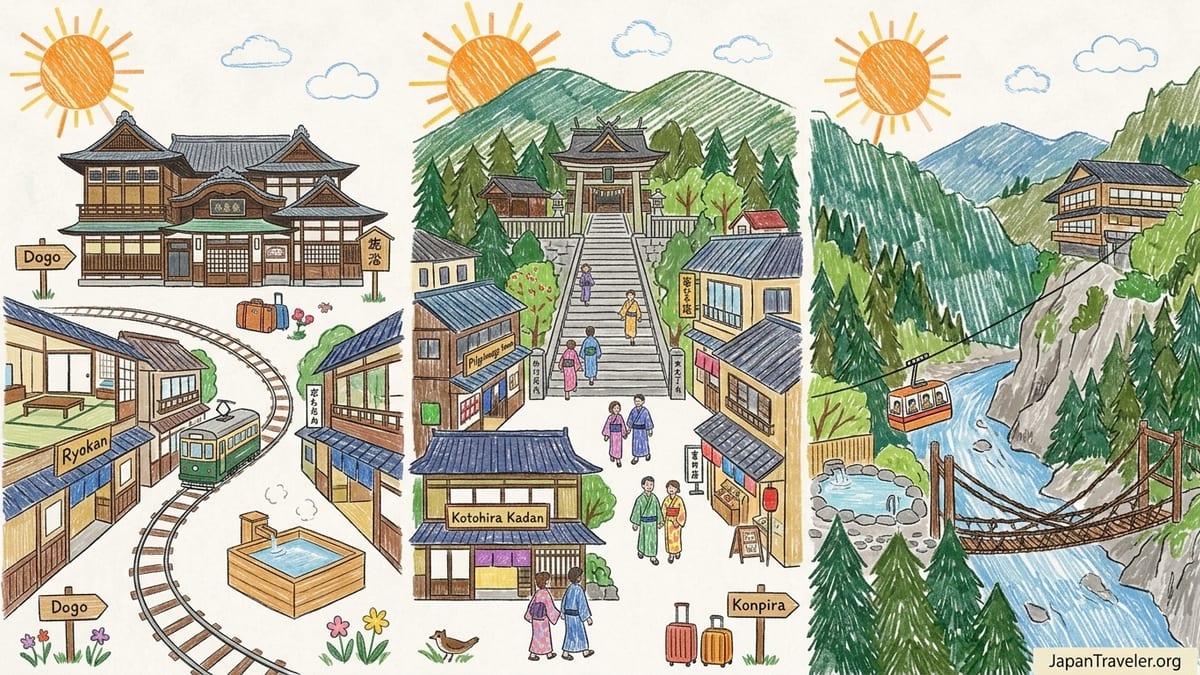
Shikoku quietly delivers some of Japan’s most rewarding hot spring experiences, especially if you are ready to slow down and spend a night in a traditional ryokan. The island’s big three onsen areas for visitors are Dogo Onsen in Matsuyama, Konpira Onsen in Kotohira and the steep, misty valleys of Iya in Tokushima. Each offers a different take on tatami rooms, steaming communal baths, kaiseki dinners and that unhurried rhythm that makes a Japanese hot spring stay memorable. This guide compares the main areas and highlights stand out ryokans to help you decide where to book and how long to stay.
Why Shikoku Is Worth Planning Around Its Hot Springs
Most travelers first hear about Shikoku in the context of art islands like Naoshima or the 88 Temple Pilgrimage, but hot springs are just as central to the island’s appeal. Unlike Hakone or Kusatsu, the onsen towns on Shikoku still feel human in scale, with relatively low-rise streets, local restaurants that cater more to Japanese visitors and quieter bathhouses where you are not queuing for every soak. For many itineraries, one or two nights in a ryokan become the emotional high point of a Shikoku trip.
The three clusters that work best for first time visitors are Dogo Onsen in Ehime Prefecture, Konpira Onsen in Kotohira in Kagawa and the onsen ryokans hidden in Tokushima’s Iya Valley. Dogo is a dense, walkable historic district attached directly to Matsuyama city. Kotohira wraps around the famous Kotohira gu shrine steps and feels like a small pilgrimage town with a ring of mid to large scale ryokans. Iya is the contrast point: a remote valley of switchback roads, vine bridges and inns perched over a river gorge, ideal if you want nature and don’t mind slower access.
Across Shikoku, booking platforms currently show dozens of ryokans with onsen facilities, with Matsuyama and Kotohira forming two of the largest clusters. That choice can be overwhelming. Rather than chasing the single “best” property, it makes more sense to choose an area that matches your priorities: easy transfers, strong sightseeing, child friendly facilities, private baths for the tattooed or shy, or a secluded soak where you can hear the river below your balcony.
A typical mid range stay with dinner and breakfast in a Shikoku ryokan usually starts somewhere around the equivalent of a few hundred US dollars per room per night for two guests, and climbs from there if you add in room open air baths, ocean or valley views and upgraded kaiseki menus. You rarely pay for onsen use separately, so once you have checked in it is normal to bathe, nap, eat and repeat without thinking about the bill until you check out.
Dogo Onsen: Classic Bathhouse Atmosphere in Matsuyama
Dogo Onsen is often described as Japan’s oldest hot spring area and it feels like a full on onsen district rather than a single ryokan. At its heart sits the multi level wooden Dogo Onsen Honkan, which has been partially under renovation in recent years but continues to operate sections of the historic bathhouse. Around it, you find a compact grid of streets with tram access, a covered shopping arcade, a handful of modern public baths and more than a dozen ryokan and onsen hotels within a short stroll.
If you want a traditional stay right in the district, properties such as Funaya and Dogo Onsen Yachiyo are good reference points. Funaya is a long established ryokan with a mix of Japanese and Western style rooms, gardens and extensive communal baths that draw from the Dogo spring. Rooms there illustrate the classic Dogo pattern: tatami floors, futon bedding prepared while you eat dinner, alcoves with local ceramics and in some categories private wooden tubs that use the hot spring water so you can soak without leaving your room. Yachiyo leans into the modern side, with suites that include open air or semi open air baths on balconies while still offering kaiseki dinners built around Setouchi seafood.
Because Dogo sits within the city of Matsuyama, access and sightseeing are straightforward. From Matsuyama Airport or JR Matsuyama Station, the ride to Dogo is typically under 30 minutes by tram or bus plus a short walk. Once you are checked in and have taken your first bath, it is easy to head back out in yukata to explore Dogo Park, ride the small Botchan train replica or taste mikan soft serve in the shopping arcade. This blend of classic bathhouse charm with urban convenience is what makes Dogo such a strong base for a first Shikoku onsen experience.
In terms of how long to stay, one night in Dogo is enough to experience the rhythm of a ryokan stay, soak in both the in house baths and the public bathhouse and fit in a quick visit to Matsuyama Castle the next morning. Two nights, however, let you slow down: you can reserve a private family bath slot at your ryokan, spend an afternoon at the castle and ropeway, and still have time for a tram ride to the harbor area or an excursion to Ishite ji temple. If onsen is the focus of your trip, Dogo is the one place on Shikoku where a multi night stay makes obvious sense.
Konpira Onsen in Kotohira: Pilgrimage Steps and Shrine Side Ryokans
Konpira Onsen sits at the base of Kotohira gu, the shrine known to most Japanese visitors as Konpira san. The town is essentially one long street of inns and shops leading to the stone staircase that climbs the mountain. Compared with Dogo, the atmosphere is more overtly “pilgrimage town” with wooden souvenir shops selling charms and local sweets and ryokans that have been hosting shrine visitors for generations.
Larger ryokans such as Kotohira Kadan and Kotosankaku anchor the onsen scene here. Kotohira Kadan is a historic property with roots back to the 17th century, set on a hillside overlooking the town. Its buildings combine classic tatami rooms with more modern terrace suites, and higher category rooms include private open air baths that use Konpira Onsen water. Public baths typically offer indoor and outdoor pools with views of the shrine mountains, and dinner focuses on Sanuki specialties from Kagawa, including local beef and seafood from the Seto Inland Sea. Kotosankaku, closer to the main street, offers a similar combination of large communal baths and a range of room types from standard tatami rooms to more contemporary Japanese Western hybrids.
In practical terms, Kotohira is one of the easiest onsen areas in Shikoku to reach without a car. JR Kotohira Station sits on the Dosan Line, and the private Kotoden railway also serves the town, putting it within direct reach of Takamatsu. From either station, most ryokans are a short taxi ride or a 10 to 15 minute walk, though the approach streets can be gently uphill. This makes Konpira Onsen a good choice if you want an onsen night slotted between days of train travel, without long bus transfers into the mountains.
Most travelers find that a single night in Kotohira is enough, especially if they arrive by early afternoon. You can check in, take a first soak, then stroll up part of the shrine staircase at sunset and enjoy your kaiseki dinner. The next morning, you can climb further up to the main hall, return for breakfast and still catch a late morning train onward. A second night may appeal if you want a very relaxed climb or to combine Kotohira with day trips to Ritsurin Garden in Takamatsu, but for itineraries that also include Dogo or Iya, Konpira Onsen usually fills the “one classic shrine side stay” slot.
Iya Valley: Remote Gorge Ryokans and Open Air Baths in Nature
Iya Valley is the wild counterpoint to the more built up districts of Dogo and Konpira. Here, steep forested slopes drop to a narrow river gorge, old vine bridges swing over the water and roads cling to the mountainsides. Onsen ryokans in Iya take advantage of this topography as much as possible, placing open air baths on terraces or down at river level to maximize the sense of seclusion.
Iya Onsen is the reference property many travelers consider first. Rooms range from simple tatami setups to suites with private open air baths that face directly onto the valley. The ryokan also runs a small cable car that trundles guests down to a riverside outdoor bath, where you soak a few meters from the water’s edge. Because of the limited flat land, facilities tend to be more compact than big town ryokans, but the feeling of bathing with mist hanging over the gorge is hard to match elsewhere in Shikoku.
Access is where Iya differs most. You typically travel to Oboke or Awa Ikeda by JR train then continue by local bus or ryokan shuttle along winding mountain roads. Door to door from Takamatsu, Kochi or Tokushima, you should allow several hours even when connections run smoothly. This added effort pays off in quiet evenings, starry skies and the ability to combine your onsen stay with hiking or visits to the vine bridges, but it does mean that arriving late in the day can feel like wasting your one night in the valley.
For many visitors, especially those without a rental car, one night in Iya Onsen or a similar valley ryokan is sufficient to enjoy the setting. However, if you are traveling from outside Shikoku or want to build in time for whitewater rafting on the nearby Yoshino River or for a long hike, two nights start to make sense. With an extra night you can arrive earlier, soak before dinner, spend a full day exploring and still have another bath and unhurried breakfast before departure.
Comparing Ryokan Stays: Rooms, Baths and Kaiseki Meals
The core elements of a Shikoku ryokan stay are similar across Dogo, Konpira and Iya, but the details vary in ways that can steer your choice. Room types tend to fall into three broad categories. First are classic Japanese rooms with full tatami floors and futon bedding. These are plentiful in older properties around Dogo’s back streets, in traditional wings of Kotohira Kadan and in Iya’s smaller inns. Second are Japanese Western hybrids, with beds on raised platforms, a sitting area with low table and often an attached modern bathroom. These are increasingly common in mid to upper range Dogo properties and make sense if you prefer not to sleep on futons. Third are special rooms with private onsen baths, usually in the form of a wooden or stone tub on a terrace or behind sliding doors, filled with hot spring water.
If a private bath is a priority, Dogo gives you the widest spread of options, from modestly priced rooms with small soaking tubs to full suites with open air baths. In Kotohira, you find private onsen rooms concentrated in the higher categories of a few large ryokans, which can raise the nightly rate but deliver the convenience of both your own tub and spacious communal baths downstairs. In Iya, private open air baths are more about the view than the size of the property, and some rooms with their own outdoor tubs can feel as much like a mountain lodge as a city onsen hotel.
Communal baths are where the regional character comes through. Dogo ryokans often have multiple indoor pools, sometimes with different water temperatures and attached saunas, plus an outdoor bath that may look into a small garden. Konpira baths tend to emphasize views back toward the shrine mountain or town, while many Iya baths are designed so that your eyeline hits trees and ravine rather than buildings. In all three areas it is normal for men’s and women’s baths to switch sides at some point during the day so guests can experience different layouts.
Kaiseki dinners are usually served in your room in smaller ryokans or in private or semi private dining rooms in larger ones. In Dogo, menus frequently highlight bream or other Setouchi fish, local citrus, and Ehime beef. Kotohira kaiseki might feature Sanuki udon in a refined form, Kagawa chicken and seafood from the same inland sea. In Iya, you are more likely to encounter river fish grilled whole, mountain vegetables and simple but hearty simmered dishes. If you have dietary restrictions, communication is key. Many properties can adapt menus for common allergies or to avoid certain meats, but strict vegetarian or vegan diners should reach out well before booking and select larger hotels, which are more likely to have flexible kitchens.
Tattoos, Families and Onsen Etiquette in Shikoku
Onsen etiquette in Shikoku follows national norms: you bathe nude in communal baths, wash thoroughly at the shower stations before entering the water, tie up long hair and keep towels out of the tub itself. For travelers with tattoos, policies are still varied. Some ryokans quietly accept small or covered tattoos in communal baths, while others may post signs discouraging visible ink. In practice, larger properties with a high proportion of international guests in Dogo and Kotohira are often more flexible than small rural bathhouses, but it remains wise to check policies before booking if you have extensive tattoos.
Booking a room with a private onsen is the most straightforward workaround. Whether in Dogo, Konpira or Iya, a private bath on your balcony or in a dedicated family bath room that you reserve by the hour lets you enjoy the hot spring without worrying about offending other bathers or being asked to cover up. In family oriented properties, these reservation based baths are also popular with parents who want to bathe together with young children of different genders once they are too old for opposite sex communal baths.
Families generally find Shikoku ryokans accommodating, though the atmosphere can be quieter than big resort hotels on Honshu. Many Dogo and Kotohira properties offer spacious corner rooms or Japanese Western combinations that work well for parents and one or two children, with futons laid out for kids while adults take the beds. In Iya, room counts are smaller, so it pays to book well ahead for family sized rooms, especially during domestic travel peaks like Golden Week or the autumn foliage season.
Noise awareness is important. Thin sliding doors and tatami walls mean that late night corridor chatter or children running laps can travel easily. Consider booking a standalone annex room or a corner room in a larger property if your group includes excited younger travelers. At the same time, taking children into the onsen can be a highlight of a Shikoku trip: many baths in Dogo and Kotohira have shallow sections, and staff are used to explaining etiquette gently to first timers.
Getting There, Getting Around and How Long to Stay
From a logistics point of view, Dogo Onsen is the simplest hub. Matsuyama is served by flights from major Japanese cities, long distance buses and JR rail, and from the station or airport it is a short hop on tram or bus to the onsen district. If you plan to combine hot spring time with general sightseeing, Dogo works well as a base for two or three nights, using one full day for castle and city exploration and another for a day trip across the Seto Inland Sea if you wish.
Kotohira fits naturally into rail based routes across northern Shikoku. You can arrive from Okayama over the Seto Ohashi Bridge, change in Tadotsu or Takamatsu, and find yourself walking up the main street toward the shrine within a relaxed travel day. Many travelers place their Konpira Onsen night between urban stays like Hiroshima or Okayama on one side and Takamatsu or Matsuyama on the other, using the shrine climb to break up train time with some steady exercise.
Iya Valley requires more deliberate planning. If you travel by train, your pivot points are typically Oboke or Awa Ikeda, after which you rely on buses operating a few times a day or on ryokan shuttles that must be reserved in advance. With a rental car, you gain flexibility but must be comfortable with narrow, winding roads and occasional blind curves. Weather can also play a role; heavy rain may affect visibility and timings in the valley more than in coastal towns, so building in margin and avoiding last tight evening arrivals is wise.
As a rule of thumb, travelers with a week on Shikoku might allocate two or three nights in Matsuyama with at least one ryokan night in Dogo, one night in Konpira Onsen tied to a Kotohira gu visit, and one or two nights in Iya Valley depending on appetite for slow travel. Shorter trips might focus on Dogo plus either Kotohira or Iya. With only one night to spare for a traditional stay, Dogo usually delivers the richest mix of baths, food and sightseeing with the least transfer friction.
The Takeaway
Choosing between Dogo Onsen, Konpira Onsen and Iya Valley is less about finding an objectively “best” hot spring and more about matching the mood of your trip. Dogo gives you an atmospheric historic bathhouse district wrapped into a medium sized city, with easy tram access, plenty of ryokan choice and enough non onsen attractions to fill several days. Konpira offers the romance of a shrine town where you can walk from your tatami room to the first stone steps at dawn, soak tired legs afterward and move on easily by train. Iya delivers drama and seclusion, at the cost of longer transfers and a narrower but very rewarding set of ryokan options.
Across all three, the essentials of a Shikoku onsen stay are consistent: rooms that open with the scent of tatami, steaming baths where you soak away train fatigue, and kaiseki dinners that reflect the island’s mix of sea and mountain. One carefully chosen night in any of these areas can anchor a wider itinerary, but adding a second night in your favorite spot lets you sink more fully into the unhurried rhythm that makes ryokan travel special. For many visitors, that slower pace, rather than any single standout bath, is what lingers in memory long after leaving Shikoku’s shores.
FAQ
Q1. Is one night at a Shikoku ryokan enough to experience onsen culture?
For most travelers, one night is enough to enjoy the core experience: arrive mid afternoon, bathe before dinner, sleep on tatami or beds, then take another soak after breakfast before checking out. If you want to add sightseeing without rushing, consider two nights in Dogo or Iya so you are not choosing between time in the baths and time exploring.
Q2. Which area is best for a first time onsen stay: Dogo, Kotohira or Iya?
Dogo Onsen is usually the most forgiving choice for a first onsen visit. It offers a dense district of ryokans, multiple public baths, straightforward access and the option to dip in and out of bathing between tram rides and castle visits. Kotohira suits those who like the idea of a shrine town with one focused onsen night, while Iya appeals to travelers already comfortable with rural travel and longer transfers.
Q3. How far in advance should I book a ryokan in Shikoku?
For weekend stays, public holidays and peak seasons like late March to early April and late October to mid November, try to book several months ahead, especially if you need a private onsen room or a larger family room. Midweek outside peak times, Dogo and Kotohira often have availability closer to the date, but Iya’s smaller properties can still fill up quickly.
Q4. Are tattoos accepted in Shikoku onsen?
Policies vary by property. Some ryokans in Dogo and Kotohira are relaxed about small or easily covered tattoos, while others request that guests with visible ink avoid communal baths. If you have larger tattoos, booking a room with private onsen or reserving a private family bath is the most reliable way to enjoy hot springs without concern. It is worth confirming policies by email before finalizing reservations.
Q5. What should I expect to pay for a ryokan night with kaiseki meals included?
Prices shift with season and room type, but a broad expectation for two adults sharing a room with dinner and breakfast included might start in the range of a few hundred US dollars per night at mid range properties. Rooms with private open air baths, sea or valley views and upgraded kaiseki courses will cost more, while simple stays without meals or in business style hotels near onsen districts will be cheaper.
Q6. Are Shikoku ryokans suitable for children and families?
Many ryokans in Dogo and Kotohira welcome families and can provide child sized yukata, kids’ meals and flexible sleeping arrangements using futons. In Iya, room numbers are smaller and facilities more compact, so options for larger families are more limited, but many properties still accommodate well behaved children. It is sensible to mention ages when booking and ask about child discounts and meal plans in advance.
Q7. Do I need a car to visit these onsen areas?
You do not need a car for Dogo or Kotohira, both of which are well connected by train, tram and local buses. Iya Valley is reachable by train plus bus or ryokan shuttle, but a rental car increases flexibility and makes side trips to viewpoints or vine bridges easier. If you are not confident driving narrow mountain roads, it is better to rely on public transport and plan around fixed timetables.
Q8. Can I visit the famous Dogo Onsen public bathhouse if I am not staying nearby?
Yes, day visitors are welcome at the main Dogo public baths, and many travelers staying elsewhere in Matsuyama or even passing through on day trips make a point of soaking there. Staying in a nearby ryokan or hotel simply makes it easier to visit early or late in the day when crowds are thinner and to combine the public bath with your own inn’s onsen.
Q9. What is the difference between a private onsen room and reservable family baths?
A private onsen room has its own dedicated hot spring bath attached, usually on a balcony or in an enclosed terrace, available to you at any time during your stay. Reservable family baths are shared facilities that you book by the hour, often for an extra fee, so your group has exclusive use during that slot. Both options work well for modest bathers, people with tattoos or families who want to soak together.
Q10. How strict are ryokans about check in and dinner times?
Ryokan schedules are tighter than typical city hotels because kaiseki dinners are freshly prepared and served in coordinated courses. You will usually be asked to arrive by early evening, often around 18:00 or 19:00 at the latest, if you have dinner included. If trains or buses make you run late, calling ahead is essential; in remote areas like Iya, arriving after the normal dinner window can mean a reduced meal or, in the worst case, no dinner service that night.