

Tokyo is surrounded by some of Japan’s most characterful hot spring towns, many of them close enough for an easy escape yet different enough that choosing one can feel overwhelming. Hakone is the default choice for first-time visitors, but classic Kanto names like Kusatsu, Ikaho, Kinugawa and Minakami each offer distinct spring waters, scenery and travel commitment. This guide compares the main options side by side so you can pick the onsen trip that fits your time, budget and appetite for adventure.
How to Choose a Kanto Onsen Escape from Tokyo
The first decision is how much travel time you want to spend compared with how “onsen-obsessed” you are. From central Tokyo, you can be soaking in Hakone in roughly 90 minutes if you use the Odakyu Romancecar limited express from Shinjuku to Hakone-Yumoto, then transfer to local transport into the hills. That speed and simplicity are why Hakone is constantly recommended as the most convenient hot spring side trip from the capital.
By contrast, Japan National Tourism Organization describes Kusatsu as one of the country’s leading onsen destinations, respected for the quality and volume of its water, but it takes around 3 to 3.5 hours one way using the Joetsu Shinkansen to Takasaki or Karuizawa followed by a highway bus into the mountains. Ikaho, Kinugawa and Minakami fall somewhere in between: they are reachable in 2 to 3 hours by a mix of shinkansen, limited express or private railway plus buses.
Cost and style of stay also differ. Hakone has everything from day-use onsen facilities charging the equivalent of about 1,500 to 2,500 yen for a few hours in large baths to luxury ryokan where a room with a private open-air bath can easily exceed the equivalent of 70,000 yen per night for two including elaborate kaiseki dinner and breakfast. Kusatsu and Minakami skew more toward traditional stays and ski or hiking lodges, while Ikaho and Kinugawa offer a lot of big hotels with half-board plans at more moderate prices.
Finally, think about what you want beyond the baths. If lakes, ropeways and art museums appeal, Hakone is an obvious choice. If you want snowy streets built around steaming hot water, Kusatsu is hard to beat in winter. For riverside gorge scenery that pairs well with Nikko’s temples, Kinugawa works well. Ikaho offers a nostalgic stone-step townscape, and Minakami delivers alpine air, rafting and ski runs.
Hakone: Tokyo’s Most Convenient All‑Rounder
Hakone is the archetypal Tokyo onsen escape because access is so straightforward and the sightseeing beyond the baths is dense. From Shinjuku, the Odakyu Romancecar runs directly to Hakone-Yumoto in about 85 minutes. Alternatively, you can ride the Tokaido Shinkansen from Tokyo to Odawara in around 35 minutes then switch to Hakone Tozan Railway or buses. Many visitors buy a Hakone Freepass, which covers the loop of trains, cable car, ropeway and pirate-style sightseeing boats on Lake Ashi.
Onsen-wise, Hakone’s strength is variety. You will find day-use hot springs such as Hakone Yuryo or Tenzan, which sell hourly access to private family baths alongside large communal pools, waterfalls and outdoor rotenburo set in forested ravines. There are also design-conscious ryokan like Hakone Ginyu, where every guest room has its own deck and open-air bath, and mid-range inns where you share communal baths but can reserve a 45- to 60-minute private slot for a fee. This makes Hakone ideal if someone in your group is tattooed or shy about shared bathing.
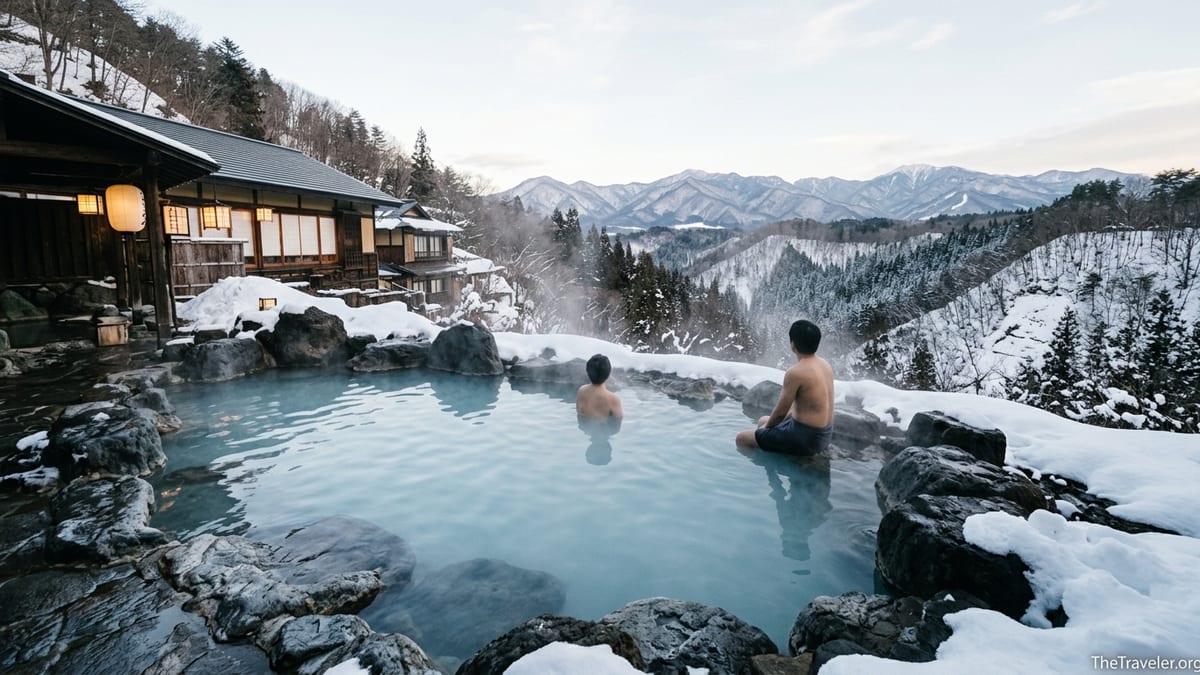
Snow is not guaranteed, but in January and February the hills around Gora and Sengoku can get dustings that make outdoor baths particularly atmospheric. Even without snow, steam rising from rock pools framed by maples or bamboo feels quintessentially Japanese. When you are done soaking, it is easy to visit the Hakone Open-Air Museum, the smaller but respected Pola Museum of Art, or cruise Lake Ashi with views of Mount Fuji on clear days, all using the same transport network.
As a day trip, Hakone works if you leave Tokyo early and keep ambitions realistic. A common pattern is to arrive by late morning, do part of the Hakone loop in the afternoon, then end at a day-use onsen before returning to the city in the evening. If you want a full ryokan experience, staying one night allows you to check in mid-afternoon, soak before and after a multi-course dinner, and still ride the cable cars or boats the next morning before heading back or onward to Kyoto.
Kusatsu: Onsen Purist’s Choice in the Mountains
Kusatsu, in Gunma Prefecture, is often cited by Japanese travel agents and the national tourism organization as one of the country’s top onsen resorts. The town sits at over 1,200 meters above sea level on the slopes of Mount Shirane, and its identity revolves almost entirely around its hot springs. The central Yubatake, a steaming hot water field where mineral-rich spring water is cooled as it cascades through wooden channels, sets the tone: steaming air, sulfur scent and ryokan lined up all around.
Reaching Kusatsu from Tokyo takes more effort than Hakone but is still fairly straightforward. One common route is to ride the Joetsu Shinkansen from Tokyo Station to Takasaki in about 50 minutes, then transfer to a local train or bus to Naganohara-Kusatsuguchi and finally the Kusatsu Onsen bus terminal, which is within walking distance of most inns. Another route uses the Hokuriku Shinkansen from Tokyo to Karuizawa followed by a highway bus. Total travel time is typically around 3 to 3.5 hours, so while an ambitious day trip is possible, Kusatsu rewards at least one or two nights.
The main appeal is water quality and atmosphere. Kusatsu’s springs are highly acidic and are believed locally to have strong cleansing properties. Many ryokan draw directly from the Yubatake, Bandaiko or other major sources, which gives baths a vivid character: milky or clear greenish hues, strong sulfur smell and noticeable tingling on the skin. Simple public baths, some free or very inexpensive, sit steps away from polished resorts such as Hotel Sakurai or Kusatsu Now Resort Hotel, giving you a spectrum from rustic to comfortable under the same plume of steam.
In winter, Kusatsu often gets deep snow, transforming the town into a white, steamy bowl ideal for nighttime soaks. Combine this with nearby ski areas such as Kusatsu Onsen Ski Resort and trails around Sainokawara Park, where outdoor baths nestle among rocks and trees, and you have a classic multi-day winter escape. In shoulder seasons, you can hike volcanic landscapes and still return to the Yubatake for evening yumomi performances in which staff in traditional dress cool the scalding water by stirring it with large wooden paddles.
Ikaho: Retro Stone Steps and Gentle Waters
Ikaho Onsen is another Gunma favorite, perched in the hills above Shibukawa. While smaller than Kusatsu, it has a strongly nostalgic feel centered on a long, straight flight of stone steps lined with ryokan, small restaurants, game arcades and traditional inns. Walking these steps in yukata and slippers after dinner is as much a part of the experience as the baths themselves.
Getting to Ikaho from Tokyo is relatively easy. Many travelers take the Joetsu Shinkansen from Tokyo to Takasaki in about an hour, then transfer to the JR Joetsu Line to Shibukawa, followed by a local bus that climbs to Ikaho in roughly 30 minutes. Total journey time from central Tokyo is around 2.5 hours, which makes Ikaho feasible as a long day trip, though an overnight stay gives you time to enjoy both late-night and early-morning baths without rushing.
Ikaho is known for two types of hot spring: the “golden” iron-rich waters that emerge a tea-brown color and gradually stain bath edges and pipes a deep orange, and “silver” clear springs. Many inns have communal baths featuring one or both, sometimes with small outdoor pools that look out over the surrounding hills. Compared with Hakone and Kusatsu, private in-room rotenburo are slightly less common at mid-range price points, but several newer inns and renovated hotels have begun adding them to compete for Tokyo weekenders.
Outside the baths, Ikaho offers relaxed sightseeing. You can detour to nearby Mount Haruna and its crater lake, visit small local museums, or simply graze on skewered snacks and onsen manju from shops along the stone steps. The town hosts a Hawaiian festival in summer, a nod to its historic connection with Hawaii’s 19th century envoy to Japan, which makes for a quirky contrast to traditional architecture.
Kinugawa: River Gorge Onsen Near Nikko
Kinugawa Onsen, in Tochigi Prefecture, stretches along a dramatic river gorge north of Tokyo. It developed as a resort for pilgrims visiting nearby Nikko and later grew into a major hot spring town dominated by large hotel complexes. Today, Kinugawa is a practical choice if you want to combine onsen time with World Heritage temples and shrines without traveling far off the main Tokyo to Nikko route.
Access is straightforward on Tobu Railway. From Asakusa, limited express trains such as the SPACIA service reach Kinugawa-Onsen Station in roughly 1 hour 50 minutes, with some requiring a transfer but keeping total time under 2.5 hours. There are also through services from Shinjuku and Ikebukuro that cooperate between JR and Tobu, taking a little over 2 hours. Highway buses from the Tokyo Station area provide another option of about 3 hours, but rail is usually more comfortable.
Most of the town’s accommodation consists of mid- to large-scale hotels offering plans that bundle buffet dinners, breakfast and access to multiple indoor and outdoor baths. Some, such as family-oriented resorts with water slides or seasonal illumination in their gardens, cater strongly to groups and children. Traditional ryokan with more intimate atmospheres do exist but are fewer than in Hakone or Kusatsu. Private onsen options include guest rooms with individual pools on balconies or rooftop charter baths bookable by the hour, particularly at the higher end of the market.
Beyond bathing, Kinugawa works well as a base to explore Tobu World Square, a quirky theme park with scale models of global landmarks, and Edo Wonderland, a historical theme village that recreates Edo period streets, stage performances and ninja shows. The river gorge itself offers boat rides in warm months and vivid foliage in autumn. If your priority is deep onsen culture, other towns might be stronger, but for families or anyone combining Nikko’s shrines with a single night of comfortable hot spring hotel life, Kinugawa is very convenient.
Minakami and Other Kanto Onsen for Nature Lovers
Minakami, in northern Gunma, is less known internationally but beloved by outdoor enthusiasts in the Kanto region. The area covers several onsen clusters along the upper Tone River and into the Tanigawa mountain range, including Takaragawa Onsen, Minakami Onsen and Sarugakyo. The appeal here is soaking in large riverside rotenburo or mountain-view baths after a day of rafting, canyoning, skiing or hiking.
From Tokyo, the most efficient route is the Joetsu Shinkansen from Tokyo Station to Jomo-Kogen, taking roughly 70 minutes, followed by buses or hotel shuttles into the various hot spring hamlets. For example, many ryokan advertise 30- to 40-minute bus rides from Jomo-Kogen to their door, giving a total travel time of about 2 to 2.5 hours. Some travelers also use local trains to Minakami Station for specific areas, but shinkansen plus bus is usually faster and easier with luggage.
Accommodation ranges from traditional ryokan with kaiseki meals to simple lodge-style pensions. Takaragawa Onsen is one of the most recognizable names, known for expansive mixed-gender outdoor pools along a river, with separate women-only areas and rented modesty garments. In winter, heavy snow blankets the rocks and surrounding forest, creating postcard scenes of people soaking in milky water while snow piles up around them. In summer, the same baths sit under dense greenery and the sound of rushing water.
If you want to prioritize outdoor activities, Minakami is one of the best Kanto options. Whitewater rafting on the Tone River, bungee jumping, canyoning, and ski resorts such as Minakami Kogen or Tanigawadake Ropeway area mean you can easily pair half a day of adrenaline with late afternoon to evening soaking. For travelers who have already done Hakone and are seeking a more rural, less developed feel within a few hours of Tokyo, Minakami is an excellent candidate.
Day Trip vs Overnight: Matching Destinations to Your Schedule
When time in Tokyo is limited, knowing which onsen towns truly work as day trips is crucial. Hakone is the clear winner for a same-day outing: with careful planning, you can leave Shinjuku around 8 a.m., spend the late morning and afternoon riding part of the Hakone loop and soaking in a day-use bath such as Hakone Yuryo, then be back in the city by evening. Ikaho and Kinugawa are also realistic day trips if you focus on the main sights and baths rather than trying to cover every museum or side excursion.
Kusatsu and Minakami are better treated as overnight or two-night stays. Kusatsu’s 3-plus-hour access means a there-and-back day trip would involve 6 to 7 hours of transport, leaving little time to wander Yubatake, watch yumomi shows, and sample different baths. By staying at least one night, you can enjoy late-night and early-morning soaks when the town is quiet, plus any skiing or hiking. Minakami can technically be done as a day trip using the shinkansen, but rafting tours and mountain treks are more relaxing if you are not racing back to Tokyo the same evening.
Budget plays into this decision. Day trips limit costs to transport and a single onsen entry fee plus meals, which might total the equivalent of 10,000 to 15,000 yen per person depending on train type and where you eat. Overnight stays introduce ryokan pricing, but they also bundle dinner, breakfast and extended bath access. A modest ryokan in Hakone or Ikaho can start around the equivalent of 25,000 to 35,000 yen for two with half-board on weekdays, while high-end properties in Hakone or Kusatsu can cost several times that, particularly on weekends and holidays.
Another factor is how important a private onsen is. If you only want one hour in a private bath, Hakone, Kinugawa and some Minakami inns make it easy to book a rentable family bath without needing a room with its own tub. If having your own rotenburo attached to the room is the dream, then you will want at least one night in a ryokan, which argues in favor of treating your chosen onsen town as a proper mini break rather than a quick excursion.
Hakone vs Kusatsu: Convenience or Commitment
For many travelers building a first Japan itinerary, the choice comes down to Hakone or Kusatsu because both are marquee names in the Kanto onsen world, yet they offer very different rhythms. Hakone fits neatly into a Tokyo to Kyoto route: you can ride the shinkansen to Odawara, spend a night or even just an afternoon and evening, and continue west. The transport network is tourist-friendly, signage in English is common, and there are many ryokan accustomed to hosting international guests, some with Western beds, flexible meal options and staff fluent in English or other languages.
Kusatsu, by contrast, feels more like a deliberate detour. Once you leave the shinkansen behind and transfer to bus, the landscape grows steadily more rural. On arrival, you find a town built almost entirely around hot springs, with the Yubatake steaming in the middle, ryokan clustered close by and narrow alleys leading to small public baths. International visitors are present but far fewer than in Hakone. For many, this is the appeal: you feel you have entered a Japanese onsen town first and a tourist destination second.
Water quality is one of Kusatsu’s trump cards. The springs gush enough volume that some hotels can refresh their baths constantly, and the acidity gives the water a sharp character that contrasts with the generally softer springs of Hakone. If your goal is to sample some of Japan’s most famous mineral waters, Kusatsu justifies the longer journey. Hakone, meanwhile, shines if you want to pair onsen with art museums, lake cruises, ropeways and easily accessible day-use facilities.
In short, choose Hakone if you are short on time, want simple logistics and prefer a blend of sightseeing and soaking. Opt for Kusatsu if you are willing to commit most of a day to getting there and back in exchange for a more immersive hot-spring town experience, especially in winter when snow and steam transform the streets into something out of a classic Japanese travel poster.
The Takeaway
Thinking of Kanto onsen as a spectrum helps clarify your decision. At one end, Hakone offers fast access, polished tourism infrastructure and a wide menu of things to do beyond bathing. At the other, Kusatsu represents the hot spring purist’s dream, where nearly every lane seems to lead to another bath and snow often frames the steam in colder months. Ikaho, Kinugawa and Minakami sit in between, each with its own niche: nostalgic steps and golden water, family-friendly river gorge hotels near Nikko, and mountain adventure paired with riverside rotenburo.
All of these destinations can be reached in under four hours from Tokyo by combining shinkansen, private railways and buses. The choice ultimately comes down to how much time you have, whether you want a simple day trip or a ryokan-centered overnight stay, and how important scenery, snow and specific spring qualities are to you. With realistic expectations about travel times and a clear idea of what matters most, your Kanto onsen escape is more likely to feel like a restorative pause than a rushed box to tick.
If you are planning a first visit and only have one or two extra days around Tokyo, Hakone is still the safest all-round recommendation. If you already know you love hot springs or are traveling in the depths of winter and can spare the time, Kusatsu or Minakami might become the highlight of your trip. Whatever you choose, remember that part of the onsen experience is slowing down: arrive early, soak often, wander in yukata and let the mountains, steam and silence do their work.
FAQ
Q1. Is Hakone or Kusatsu better for a first-time visitor to Japan?
Hakone is usually better for first-time visitors because access is simpler, English signage is widespread and you can combine onsen time with lake cruises, ropeways and museums. Kusatsu is more rewarding if you already love hot springs and want a town that lives and breathes onsen culture, but travel takes longer and the focus is almost entirely on bathing.
Q2. Which onsen town near Tokyo is best if I want snow around the baths?
Kusatsu and Minakami generally offer the most reliable snowy atmosphere in winter thanks to their higher elevation. Ikaho and some parts of Hakone can also see snow, but it is less dependable. If your dream is soaking in outdoor baths while snow piles on rocks and trees, aim for January or February in Kusatsu or a riverside onsen in the Minakami area.
Q3. Can I visit Hakone as a day trip and still enjoy an onsen?
Yes, Hakone works very well as a day trip if you leave Tokyo early. You can ride the Romancecar or shinkansen plus local transport, enjoy part of the Hakone loop, then finish at a day-use onsen such as a large public bathhouse or hotel facility that sells hourly access before returning to the city in the evening.
Q4. Is Kusatsu realistic as a day trip from Tokyo?
It is technically possible but not ideal. The one-way journey usually takes 3 to 3.5 hours, so a same-day return means 6 to 7 hours of travel and only a short time in the baths. Most travelers treat Kusatsu as at least a one-night stay so they can enjoy the Yubatake area, different public baths and any skiing or hiking nearby without feeling rushed.
Q5. Where can I find private onsen if I am shy or have tattoos?
Hakone is one of the easiest places to find private onsen, with many ryokan offering in-room baths and separate family baths bookable by the hour. Kinugawa and parts of Minakami also have hotels with private tubs on balconies or rooftop charter baths. Even in Kusatsu and Ikaho, several modern inns now provide at least one private bath option, though you may need to reserve in advance.
Q6. Which onsen town is best for combining hot springs with cultural sightseeing?
Hakone and Kinugawa are strongest for combining onsen with other sights. Hakone pairs baths with art museums, lake cruises and views of Mount Fuji, while Kinugawa sits close to Nikko’s World Heritage shrines and temples plus theme parks like Edo Wonderland. Kusatsu, Ikaho and Minakami are more focused on the springs and surrounding nature than formal cultural attractions.
Q7. Are there budget-friendly onsen options near Tokyo?
Yes. In Hakone, you can skip ryokan stays and visit day-use facilities that charge only an entry fee, then return to a business hotel in Tokyo at night. Ikaho and Kinugawa have many mid-range hotels that offer half-board packages at more moderate prices than luxury Hakone or Kusatsu properties, especially on weekdays outside peak holiday periods.
Q8. How far in advance should I book a ryokan with private onsen?
For popular periods such as weekends, public holidays and cherry blossom or autumn foliage seasons, aim to book several months ahead, especially in Hakone and Kusatsu. Midweek stays outside peak seasons are more flexible, but private onsen rooms are limited everywhere, so reserving at least a few weeks in advance is wise if your dates are fixed.
Q9. Which onsen town is best if I also want outdoor activities like rafting or skiing?
Minakami is the top choice for outdoor activities, with whitewater rafting, canyoning, bungee jumping and multiple ski resorts reachable from the same base. Kusatsu also has its own ski area and good winter terrain, while Hakone offers hiking and some smaller outdoor pursuits but is less of an adventure sports hub than Minakami.
Q10. Do I need to worry about language barriers at Kanto onsen towns?
In Hakone and Kinugawa, many hotels and transport services are accustomed to international visitors and provide English signs or basic English support. Kusatsu, Ikaho and Minakami may feel more Japanese in atmosphere, but simple English information is increasingly available at tourist offices and major inns. Learning key onsen etiquette phrases and gestures in advance helps smooth over any remaining gaps.