


Within two hours of central Tokyo, some of Japan’s most photographed flower landscapes unfold each season: wisteria tunnels in Tochigi, blue nemophila hills on the Ibaraki coast, shibazakura carpets in Saitama and seasonal gardens scattered around Tokyo and Chiba. With careful timing, you can build a flower-focused itinerary that follows the blooms month by month, using only regular trains and buses from the capital.
How Japan’s Kanto Flower Season Unfolds
Kanto’s flower calendar stretches almost year-round, but the most dramatic displays cluster between late March and early November. Cherry blossoms usually open in Tokyo around the last week of March, followed in quick succession by tulips, nemophila, wisteria, shibazakura, hydrangeas, sunflowers and finally the red kochia bushes that signal the start of autumn. Because temperatures and microclimates vary, the same flower can peak on different dates in different parks, which gives travelers some flexibility if they miss the first wave.
A useful rule of thumb is that coastal and higher-elevation areas bloom a little later than central Tokyo. For example, nemophila at Hitachi Seaside Park on the Ibaraki coast generally reach their best from mid to late April and can linger into early May, while wisteria at Ashikaga Flower Park in Tochigi tend to peak from late April into early May, roughly one to two weeks behind many wisteria spots in Tokyo. Shibazakura at Hitsujiyama Park in Saitama usually follow a similar late April to early May schedule, but cooler years can push the peak into the first half of May.
Because exact dates change slightly every year, it is worth checking recent photos and bloom “meters” on park websites and social media in the weeks before your visit. Many major sites, including Hitachi Seaside Park and Ashikaga Flower Park, publish frequent updates when their signature flowers approach full bloom. This helps you decide whether to keep your planned day trip or switch to a different park that is currently at its best.
When building a multi-day itinerary out of Tokyo, it can be helpful to combine one major flower destination with a secondary garden closer to the city. For instance, pairing Ashikaga’s wisteria with a half day at Shinjuku Gyoen or Showa Kinen Park, or visiting Hitachi Seaside Park in the morning before returning via Mito’s Kairakuen in plum season, lets you see two very different landscapes without adding too much transit time.
Month-by-Month Flower Calendar From Tokyo
From late February to March, plum blossoms in historic gardens like Kairakuen in Mito and various Tokyo parks open the spring season, followed by early tulips and narcissus. By late March and the first days of April, cherry blossoms dominate central Tokyo. During this period, larger urban gardens such as Shinjuku Gyoen and Ueno Park are usually at their busiest, and flower day trips from Tokyo are more about hanami than specialized flower parks.
April is when the dedicated flower parks near Tokyo start to shine. In early to mid-April, narcissus and tulips color Hitachi Seaside Park’s lower areas, while Ashikaga Flower Park begins its Great Wisteria Festival from mid-April. Late April into Golden Week often offers the highest concentration of highlights: nemophila turn Hitachi’s Miharashi Hill into a blue carpet, vast wisteria trees droop over Ashikaga’s ponds and paths, and shibazakura mosaics spread across Hitsujiyama Park in Chichibu. A well-timed week in late April can cover all three if you are willing to take multiple day trips.
May is a transition month. In early May, wisteria at Ashikaga and shibazakura at Hitsujiyama can still be excellent in many years, while the nemophila at Hitachi generally start to fade after the first half of the month. Later in May, roses come into their own at locations like Keisei Rose Garden in Chiba and Kyu-Furukawa Gardens in northern Tokyo, and poppies and other early summer flowers take over some fields at Hitachi and Showa Kinen Park. From June, hydrangeas and irises are the stars in many Kanto gardens, followed by sunflowers in July and August at various Chiba and Saitama farms and flower parks.
Autumn offers a second peak season. At Hitachi Seaside Park, the kochia bushes on Miharashi Hill gradually turn from summer green to intense red from late September to mid-October, often overlapping with pink cosmos flowers in surrounding fields. In Ashikaga and many Tokyo gardens, autumn roses and fall foliage take center stage from late October through November. Winter is quieter but still brings camellias and early plum blossoms in some parks, and illumination events at Ashikaga Flower Park and urban gardens provide a different reason to visit even when flowers are sparse.
Ashikaga Flower Park: Wisteria Capital of Kanto
Ashikaga Flower Park in Tochigi Prefecture is often described as one of Japan’s premier wisteria destinations, and the Japan National Tourism Organization regularly highlights it as a flagship flower spot in Kanto. The park is built around several monumental wisteria trees, including a giant central specimen whose branches are supported over a broad frame, forming a living ceiling of purple blossoms when in full bloom. There are also white, pale pink and yellow wisteria tunnels, along with seasonal beds of azaleas, roses and other flowers to extend interest beyond the main wisteria weeks.
The signature Great Wisteria Festival typically runs from mid-April to mid-May, with the best viewing usually from late April to the first week of May. Exact timing changes with the weather, and the park updates its official website and social channels with bloom conditions and nighttime illumination schedules. During the main season, entrance fees are set on a variable scale depending on how advanced the flowering is. On peak days, adults can expect to pay roughly the upper end of the posted range, which commonly reaches around 1,900 yen for daytime admission, with slightly different pricing for evening-only illumination tickets.
Access from Tokyo is straightforward by train. A common route is to take the JR Utsunomiya or Shinkansen services to Oyama, then transfer to the JR Ryomo Line for Ashikaga Flower Park Station, which sits just outside the entrance gates. Total travel time is usually around 90 minutes to two hours from central Tokyo stations, depending on connections. Some travelers also approach via Tobu Railway lines into Ashikaga City and then transfer to local trains or taxis. During the wisteria festival, it is wise to avoid arriving in the late morning, because both trains and pathways inside the park can become heavily congested.
For photography, early morning and late afternoon provide the softest light on the hanging blossoms and reflections in the ponds. Tripods may be restricted during busy hours, so a fast lens and image stabilization are useful. Many visitors aim to capture the iconic view of the massive wisteria tree reflected in the water, as well as close-up shots of individual flower clusters. The park also illuminates the trellises at night during the festival, creating a very different atmosphere with warm lighting and mirrored colors on the water. Crowds are thickest on weekends, public holidays and around Golden Week; visiting on a weekday and entering right after opening often yields a more relaxed experience.
Hitachi Seaside Park: Nemophila Seas and Kochia Hills
Hitachi Seaside Park in Ibaraki Prefecture is another Kanto flower giant often singled out by JNTO. Spread across coastal hills and fields, it is best known for two spectacles: the pale blue nemophila that cover Miharashi Hill in spring and the spherical kochia bushes that turn bright red in autumn. In between, the park cycles through narcissus, tulips, poppies, summer annuals and cosmos, making it a rewarding stop at almost any time from March to November.
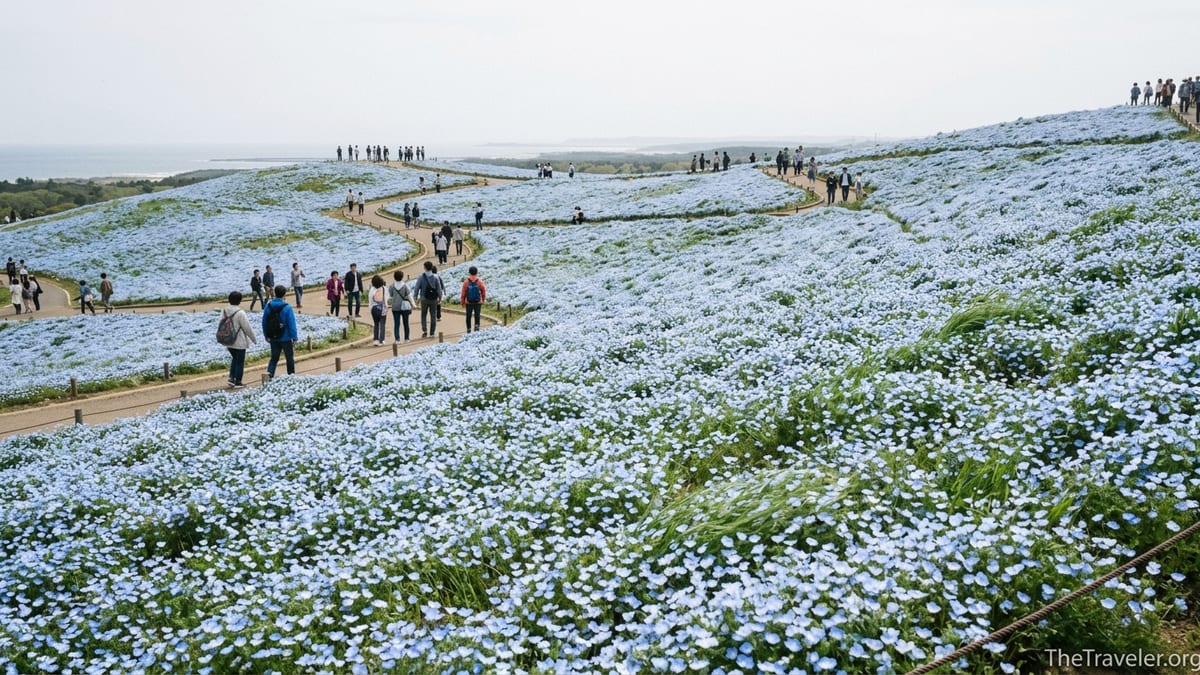
The nemophila “Harmony” period usually runs from mid-April to early May, with the absolute peak often falling in the second half of April. When conditions are right, more than five million tiny blue flowers create the illusion that the hill has merged with the sky, a scene that has become an icon of Japanese spring. In autumn, kochia bushes planted across the same hill shift through light green, then deeper tones, turning a vivid crimson around early to mid-October before fading to russet. The park publishes a flower calendar and updates on its official website, along with a color “meter” for kochia and other major blooms, which is an essential planning tool if you are targeting a specific hue.
From Tokyo or Ueno Station, travelers typically take the JR Joban Line limited express services, such as Hitachi or Tokiwa, to Katsuta Station, a journey of around 75 to 85 minutes. From Katsuta, local buses and occasional seasonal shuttle services run directly to Hitachi Seaside Park’s main entrances, and the total door-to-door travel time is usually around 1.5 to 2 hours each way. Entrance fees are modest, with standard adult tickets commonly around 450 yen on regular days and raised to around 800 yen during peak nemophila and kochia seasons. Inside, the park is expansive enough that renting a bicycle for a few hours is a practical way to reach the flower zones, particularly if you also want to visit the amusement area or coastal paths.
Crowds during nemophila and kochia peaks can be intense, especially on weekends and national holidays. Trains may run with increased frequency and buses can have long lines, so arriving on the first or second limited express of the morning from Tokyo is a wise strategy. Many photographers head straight up Miharashi Hill at opening time to capture the flowers before footpaths fill with visitors. Wide-angle lenses work well for showcasing the sweeping hills, while a mid-telephoto zoom helps isolate patches of color or visitors walking along the ridgeline. In windy weather the coast can feel cool even in spring, so packing layers is sensible.
Hitsujiyama Park: Shibazakura Carpets in Chichibu
Hitsujiyama Park in Chichibu, Saitama Prefecture, is famous for its shibazakura, or moss phlox, which form colorful carpets across gently sloping fields with mountain backdrops. While smaller than Ashikaga or Hitachi Seaside Park, it offers a distinctly local atmosphere and is a popular day trip from Tokyo for travelers who want to see shibazakura without traveling all the way to Yamanashi’s Fuji Shibazakura Festival near Mount Fuji.
The shibazakura hill at Hitsujiyama typically comes into bloom from mid-April, with full color often reached in late April and sometimes extending into early May in cooler years. Fields are planted in different shades of pink, magenta, white and pale purple, arranged in swirls and bands that are particularly photogenic from the upper viewpoints. The park also hosts food stalls and local product stands during the main festival period, so visitors can sample Chichibu specialties while strolling among the flowers.
Access from Tokyo generally starts with the Seibu Ikebukuro Line from Ikebukuro Station to Seibu-Chichibu Station, taking around 80 minutes on the faster limited express services or around 100 minutes on regular trains. From Seibu-Chichibu, the walk to Hitsujiyama Park is about 20 minutes, or you can use local buses or occasional shuttle services when the festival is running. Another option is to arrive at Ohanabatake Station on local lines, which is even closer to the park. Entrance fees for the shibazakura area are modest and collected only during the bloom period at small ticket booths near the paths.
For photography, the best perspectives usually come from mid-slope looking down across the fields with the Chichibu mountains in the distance. Early morning visits provide softer light and fewer people in the frame, while late afternoon can produce warm, low-angle light on clear days. Because the paths are relatively narrow and crowds can be dense during Golden Week, patience is needed to capture people-free compositions. Comfortable shoes are recommended, as some paths are unpaved and can be dusty or muddy depending on the weather.
Tokyo, Chiba and Saitama Gardens That Complement the Big Three
While Ashikaga, Hitachi Seaside Park and Hitsujiyama are the headline day trips, several closer gardens in Tokyo, Chiba and Saitama are ideal for filling gaps in your schedule or adding variety when a long train ride is not practical. In western Tokyo, Showa Kinen Park in Tachikawa is notable for its large tulip beds in April, poppies and other early summer flowers in May, and extensive autumn foliage. It is reachable in roughly 40 minutes from Shinjuku by JR Chuo Line followed by a short local ride, making it an easy half-day excursion.
Within central Tokyo, classic gardens such as Shinjuku Gyoen, Hama-rikyu Gardens, Koishikawa Korakuen and Rikugien offer a sequence of cherry blossoms, azaleas, irises, hydrangeas and autumn leaves. Although they do not feature single-flower carpets on the same scale as Hitachi or Ashikaga, they provide refined landscapes with ponds, teahouses and walking paths. Many of these gardens charge modest entrance fees, often in the range of a few hundred yen, and are accessible by short walks from major stations, which is especially convenient if you are staying in central districts.
In Chiba, Keisei Rose Garden is a standout for rose lovers, typically coming into peak bloom twice a year in late spring and autumn. It combines rose tunnels, pergolas and themed beds with an on-site café and garden shop. Access is usually via Keisei Line stations followed by a short bus or taxi ride, and it pairs well with a visit to nearby shopping centers for those who want a more relaxed day. In Saitama, smaller but charming spots like Omiya Hana no Oka and local hydrangea temples offer a quieter contrast to the major parks.
For travelers using Tokyo as a base, these closer gardens make excellent backup plans when the weather is unsettled or when long-distance trains are crowded around peak holiday periods. Because most are within an hour of central Tokyo, you can adjust plans in the morning based on flower reports, choosing between a big day trip to Hitachi or Ashikaga and a lower-commitment visit to an urban garden if conditions change.
Practicalities: Transport, Tickets, Crowds and Photography
Most Kanto flower parks are realistically reachable from Tokyo by regular trains and local buses, without the need for rental cars. For Ashikaga Flower Park, a JR train from Tokyo via Oyama is the standard route, while Hitachi Seaside Park is best accessed via the JR Joban Line limited express to Katsuta. Hitsujiyama Park relies on Seibu Railway services from Ikebukuro to Seibu-Chichibu. Travel times for each are broadly similar, usually around 1.5 to 2 hours one way, so it is sensible to leave early and plan on spending at least half a day at each park to justify the journey.
Entrance fees at major parks are generally modest by international standards but can vary seasonally. Hitachi Seaside Park’s adult ticket is commonly around 450 yen on standard days and rises to around 800 yen during nemophila and kochia peaks. Ashikaga Flower Park uses a flexible pricing system that increases during peak wisteria, and it is normal for top-season daytime tickets to be close to 1,900 yen for adults, with separate evening illumination tickets available on some days. Hitsujiyama’s shibazakura area uses simple festival pricing, usually collected at on-site booths, and Tokyo gardens often charge a few hundred yen per adult.
Crowd management is an important part of any flower trip during peak season. Golden Week, usually spanning late April to early May, is the busiest period of the year, and both trains and parks can feel very full. To mitigate this, consider visiting on a weekday if your schedule allows, arriving at or before opening time, and having a backup plan such as a different, less-famous garden if congestion at the main destination looks overwhelming. In some years, parks may implement timed entry, temporary extra trains or special buses, so checking the most current visitor information the week before your trip is wise.
For photography, early starts often provide the best combination of soft light and manageable crowds. A wide-angle lens is essential for capturing sweeping hills of nemophila or kochia, while a standard zoom helps frame wisteria trellises, shibazakura mosaics and close-ups of individual blooms. Many parks restrict drones and limit tripod use during crowded periods, so traveling light with handheld-friendly gear is recommended. Simple accessories such as a polarizing filter can deepen blue skies over Hitachi’s hills or cut reflections on Ashikaga’s ponds, and a small microfiber cloth is invaluable during spring pollen or light rain.
Do You Need a Guided Day Tour or Just a Train Ticket?
From Tokyo, most flower destinations in Kanto are designed for independent travelers. Trains to Ashikaga Flower Park Station, Katsuta Station for Hitachi Seaside Park and Seibu-Chichibu Station for Hitsujiyama are frequent, clearly signed and covered by major IC cards and rail passes. Stations and buses often provide at least basic English signage during peak flower seasons, and many parks offer English maps at the gate. For travelers already comfortable with Japanese rail systems, arranging your own day trip is usually straightforward and more flexible than joining a group tour.
That said, guided day tours can offer advantages in specific situations. During the nemophila or kochia peaks at Hitachi Seaside Park, some travel companies operate chartered buses from central Tokyo that go directly to the park without transfers. This removes the need to manage train connections or bus timetables, and sometimes includes reserved seating on the coach, which can be appealing for families with young children or older travelers. Similarly, certain seasonal tours combine Ashikaga Flower Park with other stops such as Nikko or nearby fruit-picking farms, bundling multiple attractions into a single long day.
When comparing costs, independent travel is often cheaper, especially if you use regional rail passes or discount tickets. A round-trip limited express ticket from Tokyo or Ueno to Katsuta, plus park admission, generally totals less than many fully guided tours. However, tours sometimes include extras such as bento lunches, short side visits or bilingual commentary that can add value if you prefer a more structured experience. The trade-off is less flexibility in timing; for example, some evening illumination tours at Ashikaga allow only a tightly scheduled 60 to 90 minutes inside the park, which can feel rushed if you enjoy slow photography.
For many visitors, a hybrid approach works best. You might book a guided bus tour for the most crowded or logistically complex day, such as a combo trip to Hitachi Seaside Park during nemophila peak and another coastal stop, while handling easier destinations like Shinjuku Gyoen, Showa Kinen Park or Keisei Rose Garden on your own by train. Regardless of approach, checking recent reviews and schedules, and confirming what is included in any tour price, helps ensure that the service matches your expectations and mobility needs.
FAQ
Q1. When is the best time of year to see flowers near Tokyo if I want to visit multiple parks?
The highest concentration of major displays usually falls between mid-April and early May, when nemophila at Hitachi Seaside Park, wisteria at Ashikaga Flower Park and shibazakura at Hitsujiyama Park often overlap. In many years, planning a trip for the last two weeks of April offers the best chance of seeing at least two of these at or near their peak.
Q2. How far in advance should I plan a flower-focused trip from Tokyo?
It is sensible to choose your travel window several months ahead based on typical bloom patterns, then finalize exact park visit dates one to two weeks before departure using each park’s official bloom updates and recent photos. Flexible daily plans help you adjust quickly if the season runs early or late.
Q3. Is it realistic to visit both Ashikaga Flower Park and Hitachi Seaside Park in one day from Tokyo?
In practical terms, trying to see both in a single day is not recommended. Each park deserves at least half a day, and they lie in different directions from Tokyo, so combining them would involve several hours of train and bus travel. Most travelers visit them on separate days and pair each with a nearby secondary stop or a relaxed evening in Tokyo.
Q4. Are flower parks near Tokyo suitable for children and older travelers?
Yes, but with some planning. Ashikaga and Hitachi Seaside Park both provide relatively flat main paths, rest areas and rental wheelchairs, though Miharashi Hill at Hitachi involves a gentle incline. Renting strollers or using lightweight travel buggies can help families with small children, and choosing weekdays to avoid peak crowds makes movement easier for older visitors.
Q5. What should I bring for a full flower day trip from Tokyo?
Comfortable walking shoes, sun protection, a light jacket for coastal wind at Hitachi, water and snacks are practical basics. For photography, a wide-angle lens, spare battery and a simple rain cover for your camera are useful. Because food options inside parks can be busy at midday, some visitors pack a simple picnic or buy items at station convenience stores before boarding.
Q6. How do I avoid the worst crowds during Golden Week?
Arriving at park opening on a weekday during Golden Week, or visiting just before or after the holiday, helps considerably. You can also check park calendars to avoid special event days, and consider nearby but less famous gardens if real-time photos show heavy congestion at marquee sites like Ashikaga or Hitachi.
Q7. Can I see flowers near Tokyo in summer or winter, or is it only a spring destination?
While spring offers the most famous displays, summer brings sunflowers, lilies and green kochia at various parks, and autumn features red kochia at Hitachi and extensive foliage in Tokyo gardens. Winter is quieter but still offers camellias, early plum blossoms and popular illumination events, particularly at Ashikaga Flower Park and Showa Kinen Park.
Q8. Are there any language barriers when visiting these parks independently?
Major parks such as Hitachi Seaside Park, Ashikaga Flower Park and Showa Kinen Park provide at least basic English signage and pamphlets, and ticket counters are accustomed to international visitors during peak seasons. Knowing a few simple Japanese phrases helps, but most travelers manage comfortably with station signs, pictograms and smartphone translation apps.
Q9. Do I need to buy tickets in advance for flower parks near Tokyo?
For most parks, tickets are purchased on the day at the entrance, with only special events or limited-time illuminations sometimes using online reservations. During extremely busy periods, parks may introduce temporary measures like timed entry or capped capacity, so checking the latest visitor information on the official website before you travel is important.
Q10. Which park should I prioritize if I only have time for one flower day trip from Tokyo?
If your visit falls in late April, many travelers prioritize Hitachi Seaside Park for the scale of the nemophila hills, or Ashikaga Flower Park for the atmosphere of the wisteria trellises. Your choice can depend on which bloom is closer to peak during your specific dates; checking the most recent photos and bloom updates for each park a few days before your planned trip is the best way to decide.