


Shikoku is Japan’s fourth-largest island, a place of quiet fishing ports, misty mountains and hot springs that still feel distinctly local even as tourism grows. For first-time visitors, it offers a slower, more contemplative side of Japan without sacrificing good transport, memorable food or standout sights. This guide introduces the four prefectures of Shikoku and shows how to weave Takamatsu, the Iya Valley, Kochi, Matsuyama, Dogo Onsen, Shodoshima, Naruto and the Shimanami Kaido into a rewarding, coherent itinerary.
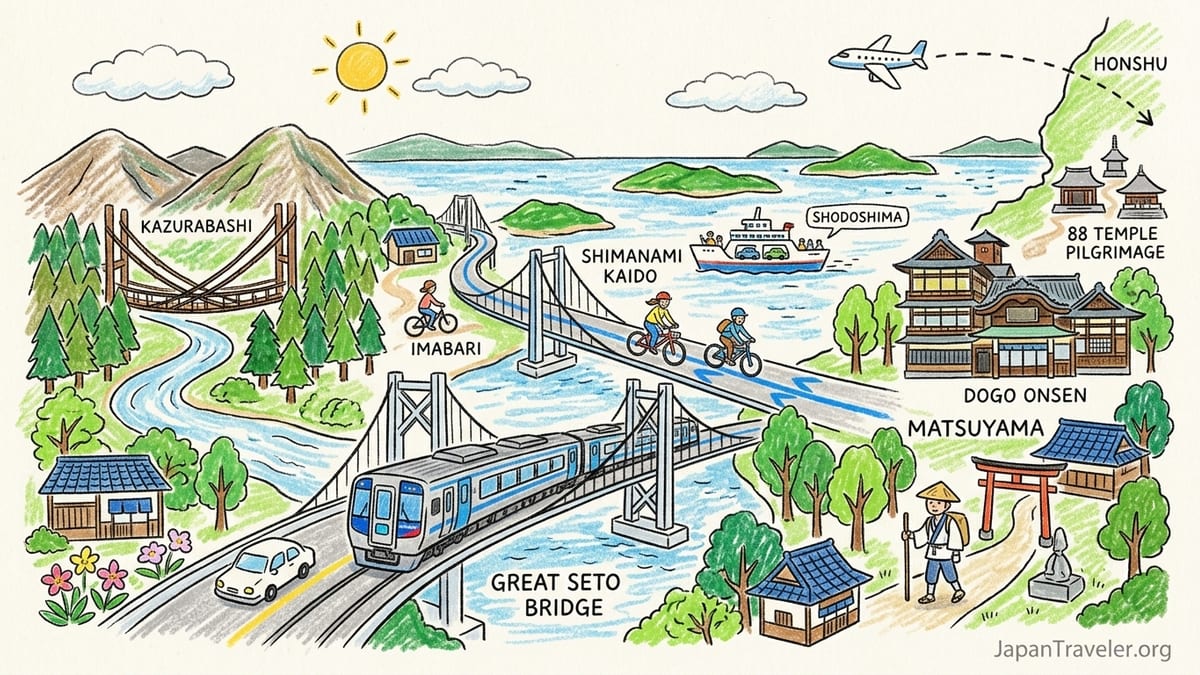
Understanding Shikoku and How It Fits Into a Japan Itinerary
Shikoku sits just south of Japan’s main island of Honshu, connected by three bridge systems across the Seto Inland Sea and by frequent ferries and flights. The four prefectures are Kagawa in the northeast, Tokushima in the east, Kochi along the Pacific south coast and Ehime in the northwest. Shikoku’s cities feel compact compared with Osaka or Fukuoka, but you will find reliable trains, regional airports and expressways tying them together, along with plenty of buses to reach valleys, gorges and remote onsen towns.
Many travelers first reach Shikoku from Kansai, Okayama or Hiroshima. For example, you can board the Marine Liner rapid train from Okayama to Takamatsu via the Great Seto Bridge in under an hour, or take highway buses from Osaka and Kobe directly to Tokushima, Kochi and Matsuyama. From Hiroshima and Onomichi, the Shimanami Kaido cycling route ends in Imabari in Ehime, making it natural to continue deeper into Shikoku rather than backtracking to Honshu. From Kyushu, ferries and flights connect ports such as Beppu and Oita with Matsuyama, making Shikoku an easy next step after a Kyushu road or rail trip.
Crucially, Shikoku works well as a core destination, not just a side excursion. A first-time visitor could easily spend 7 to 10 days there: two or three days around Takamatsu, Kotohira and Shodoshima, two or three in Tokushima and the Iya Valley, two in Kochi and the Shimanto River, and two in Matsuyama and along the Shimanami Kaido. Travelers with more time can add temple-hopping on the Shikoku 88 Temple Pilgrimage or linger in small towns along the Pacific coast.
Because Shikoku is less crowded than the big cities, it also suits travelers looking for a calmer pace after a week in Tokyo or Kyoto. You will still find modern hotels next to JR stations, convenience stores open late and English signage at major attractions, but the experience leans more toward local markets, family-run inns and uncrowded viewpoints instead of neon districts and shopping malls.
Kagawa: Takamatsu, Kotohira and the Islands
Kagawa is the smallest prefecture in Japan and one of the easiest gateways into Shikoku. The main city, Takamatsu, sits on the Seto Inland Sea and works as a practical base for ferries and day trips. From Okayama, the JR Marine Liner crosses the Great Seto Bridge to Takamatsu Station in roughly 55 minutes, which means you can leave Osaka or Kyoto in the morning and be at your hotel in Takamatsu by early afternoon. Once there, most sights, including the port, are a short tram or bus ride away.
Takamatsu is best known for Ritsurin Garden, one of Japan’s most elegant strolling gardens, and for its access to the art islands of the Setouchi region. Even if you are not visiting every art site, the port atmosphere and short ferry rides are part of the appeal. For example, ferries from Takamatsu to Shodoshima typically take about 60 to 70 minutes depending on the route and vessel type, with one-way fares for foot passengers generally in the low thousands of yen. On board, you can sit on deck as the Great Seto Bridge and scattered islands slide by, an experience that quickly sets a slower tone compared with bullet trains and subways.
Shodoshima itself combines olive groves, coastal scenery and dramatic granite gorges. Many visitors rent a car or scooter at Tonosho Port or Ikeda Port to circle the island, stopping at viewpoints over Kankakei Gorge or small beaches on the southern shore. Local buses connect major sights, but service is limited in the afternoon and evening, so checking the timetable at the port bus counter is important. For a concrete example, a one-day car rental for basic models often falls in the 7,000 to 10,000 yen range before fuel and insurance, a worthwhile cost if you want to see more than one section of the island in a single day.
Back on the mainland, Kotohira, known locally as Konpira-san, lies under an hour from Takamatsu by local or limited express train. The main draw is Kotohira-gu Shrine, reached by climbing more than a thousand stone steps past teahouses and souvenir shops. Many visitors stay in traditional ryokan at the foot of the mountain, where dinner set menus feature local Kagawa specialties and breakfast includes freshly made udon. Combining a Kotohira overnight with a Takamatsu base gives first-time visitors an accessible taste of both city and old pilgrimage town.
Tokushima: Naruto Whirlpools and the Iya Valley
Tokushima sits on Shikoku’s eastern edge and is best known for the Naruto whirlpools, the Iya Valley and Awa Odori, one of Japan’s liveliest dance festivals. The Naruto whirlpools form under the Onaruto Bridge as tidal currents rush between the Seto Inland Sea and the Pacific. Travelers can view them from sightseeing boats that depart near Naruto Park or from a glass-floored walkway beneath the bridge. Boat trips usually last around 30 minutes, and ticket prices are typically in the low to mid thousands of yen, varying slightly by operator and season.
Inland, the Iya Valley offers steep forested slopes, vine bridges and old farmhouses perched on hillsides. This area is reachable from Tokushima City or Takamatsu via express buses and limited express trains to Awa-Ikeda or Oboke stations, followed by local buses deeper into the valley. For instance, many visitors ride a limited express train to Oboke, then transfer to a bus to the Kazurabashi vine bridge area, where short walking trails and riverside restaurants make it easy to spend half a day before continuing to a minshuku or ryokan. Because bus services thin out in the late afternoon, it is common to time lunch or a coffee break around the bus timetable displayed at Oboke Station.
Driving is particularly rewarding in Iya. Road conditions are generally good, but mountain roads are narrow and winding. Travelers often rent a compact car in Tokushima City or at Awa-Ikeda Station for one or two days, returning it before heading onward by train. Gas stations can be sparse in some valleys, so planning to refuel near larger towns like Miyoshi rather than at the last minute is sensible. In return, you gain the flexibility to visit viewpoints like the “peeled off cliff” statues or tiny hamlets that buses pass without stopping.
Tokushima City itself is worth at least a night if your schedule allows, especially in mid-August when Awa Odori fills the streets with dancers and music. During festival days, hotel rates rise and rooms often sell out months ahead, so reserving early is essential. Even outside festival season, a visit to the Awa Odori Hall offers scheduled dance demonstrations and the chance to join a lesson, which can serve as a memorable cultural counterpoint to Shikoku’s quieter temple and onsen experiences.
Kochi: Pacific Coast, Castles and the Shimanto River
Kochi stretches along Shikoku’s south coast, opening onto the Pacific Ocean. The capital, Kochi City, is reachable by limited express train from Okayama via the inland Dosan Line or by direct highway buses from Osaka and Kobe. The journey from Okayama by rail typically takes a little over 3 hours, winding through forested mountains before emerging near the coast. First-time visitors often base themselves in Kochi City for two or three nights, combining urban sights with day trips along the coast or inland rivers.
One of Kochi City’s highlights is Kochi Castle, one of a handful of original castles in Japan where both the keep and main palace buildings date from the Edo period. Visitors climb steep wooden stairs to the top floor for views over tiled roofs and nearby mountains. Entry fees are modest, typically in the hundreds of yen, and the adjacent castle grounds double as a picnic spot in spring when cherry trees bloom. Nearby Hirome Market offers another concrete example of local life: a roofed food hall where stalls sell katsuo no tataki (seared bonito), local craft beer and snacks like yuzu-flavored sweets. It is common to see groups of friends sharing a platter of bonito and draft beer for around 2,000 yen in the early evening.
Beyond the city, the Shimanto River is often described as one of Japan’s clearest rivers. Buses and regional trains connect Kochi to Shimanto City and Nakamura Station, from where travelers can access river activities such as canoeing, traditional riverboat cruises and cycling along low-traffic riverside roads. Small guesthouses and camp-style accommodations line the river, making it a natural overnight stop for those who prefer nature to nightlife. In summer, families from other parts of Shikoku drive down for river swimming and barbecue spots, while in autumn the surrounding hills turn red and gold.
For drivers, the coastal route between Kochi City and Cape Ashizuri offers sea views and quiet fishing ports, but distances are longer than they appear on the map. A typical one-day loop that includes Katsurahama Beach, a section of the coastline and a Shimanto riverside viewpoint can easily add up to several hundred kilometers. This is why many road trippers plan two nights near Shimanto or in small towns like Sukumo, rather than treating the whole south coast as a single day’s outing from Kochi City.
Ehime: Matsuyama, Dogo Onsen and the Shimanami Kaido
Ehime occupies Shikoku’s northwest corner and offers one of the island’s most appealing city bases: Matsuyama. From Hiroshima and Onomichi, the Shimanami Kaido cycling route runs across a chain of bridges and islands to Imabari in Ehime, about 70 kilometers of signposted roads that many cyclists complete in one or two days. A common pattern is to start in Onomichi, rent a bike from the municipal rental system or a shop like Giant, ride across the islands and finish in Imabari before catching a local train to Matsuyama for the night.
Matsuyama itself combines a hilltop castle, a compact downtown and the historic hot spring district of Dogo Onsen. Trams connect Matsuyama Station, the city center and Dogo Onsen in about 15 to 20 minutes, and a one-day tram pass is often cheaper than buying multiple single tickets. At Dogo Onsen, visitors can soak in public baths that inspired scenes in Japanese literature and animation. While the main Dogo Onsen Honkan building has undergone restoration phases in recent years, facilities have remained available, and several ryokan and modern hotels within walking distance have their own hot spring baths fed by the same source.
The Shimanami Kaido itself is well set up for travelers without their own bikes. Publicly managed rental terminals across the route offer basic city and cross bikes, typically for a flat daily fee plus a small surcharge if you return the bike at a different terminal. For example, recent information suggests that day rental fees for standard bicycles commonly fall in the low thousands of yen, with electric-assisted and high-performance road bikes costing more. Helmets are normally included. Blue guide lines painted on the road, combined with distance markers, make navigation straightforward even if you are not an experienced cyclist.
Logistically, the Shimanami Kaido provides an elegant link between Honshu and Shikoku. One sample itinerary is to take a morning bullet train from Kyoto to Fukuyama, transfer to a local train to Onomichi, cycle to Imabari over one or two days, then continue by train to Matsuyama. From Matsuyama, travelers can ride ferries across the Seto Inland Sea to Hiroshima or farther to Kyushu, or head inland by train toward Iyotetsu lines that feed back into central Shikoku. In this way, the cycling route becomes a bridge in a longer journey, not just a standalone activity.
The Shikoku 88 Temple Pilgrimage and Cultural Highlights
The Shikoku 88 Temple Pilgrimage, or Shikoku Henro, is a circular route linking 88 Buddhist temples associated with the monk Kukai. The circuit spans all four prefectures, from Temple 1 in Tokushima to Temple 88 in Kagawa, and walking the entire route typically takes several weeks. Most first-time visitors do not attempt the full pilgrimage but instead visit a handful of temples near their chosen base. For instance, travelers staying in Kochi might visit a cluster of pilgrimage temples accessible by local train, while those in Matsuyama or Takamatsu can do short day trips to nearby temples without specialized gear.
At temple grounds, it is common to see pilgrims dressed in white jackets and conical hats, carrying walking sticks and stamp books. Even casual visitors can purchase a smaller stamp book and receive temple stamps for a modest fee at each site’s office, a concrete way to participate in the tradition. Some inns around Shikoku offer discounted rates or special meals for pilgrims, and highways and main roads feature rest shelters with water and benches specifically intended for henro walkers. Local tourism offices in cities like Tokushima, Kochi and Matsuyama provide English pamphlets explaining basic temple etiquette, such as bowing at the gate, rinsing hands at the basin and keeping photographs respectful during prayer.
Beyond the pilgrimage, Shikoku’s cultural life emerges through its festivals and everyday food. Awa Odori in Tokushima, the Yosakoi Festival in Kochi and seasonal events in Takamatsu and Matsuyama each fill streets with dancers, floats and music on summer evenings. Outside peak festival days, visitors can still taste regional specialties that grew out of local agriculture and fishing: sanuki udon in Kagawa, citrus fruits in Ehime, bonito and sea bream along the Kochi coast. Many train stations and service areas sell boxed lunches highlighting these ingredients, such as bento featuring seared bonito in Kochi or mikan-flavored sweets near Matsuyama.
Castles and historic districts round out the cultural landscape. In addition to Kochi Castle and Matsuyama Castle, smaller remains and reconstructed keeps appear in towns like Marugame and Imabari. These sites often host seasonal illumination events or local craft fairs. The scale is modest compared with Osaka Castle or Himeji, but that intimacy allows space to take photographs, read bilingual plaques and chat with staff without the crowds that dominate more famous sites.
Getting Around: Trains, Buses, Driving and Cycling
JR Shikoku operates the main intercity rail lines that connect Takamatsu, Tokushima, Kochi and Matsuyama with each other and with Okayama on Honshu. Limited express trains such as the Nanpu or Ishizuchi link major cities in a matter of hours, and reserved seats can be booked at JR ticket counters or via machines. A typical limited express fare between Takamatsu and Kochi or Matsuyama and Takamatsu often falls in the range of several thousand yen each way, depending on seat class and discounts. Local trains supplement these routes but are slower and less frequent, particularly in rural areas.
Highway buses play a significant role in Shikoku travel. They often provide direct links from Osaka, Kobe or Kyoto to cities like Tokushima, Kochi and Matsuyama, and they also serve routes that trains do not cover well, such as the Iya Valley or some Shimanto River townships. For example, travelers can ride an early morning highway bus from Osaka to Tokushima, arrive before lunchtime, and then transfer to a local bus or train for Naruto or the interior. Bus terminals typically have staffed counters where you can buy same-day tickets or confirm the correct platform, though booking in advance is recommended during holiday periods.
Renting a car becomes particularly valuable for reaching outlying areas such as the Iya Valley, remote pilgrimage temples or smaller coastal towns. Major rental companies have outlets near JR stations and airports in Takamatsu, Tokushima, Kochi and Matsuyama. Daily rates for compact cars often start in the mid thousands of yen before fuel, insurance and optional extras like English GPS. Expressways and major routes are well maintained, but many of Shikoku’s most scenic drives involve narrow mountain roads, so drivers should be comfortable with tight corners, oncoming traffic and occasional animal crossings. Parking fees in cities are usually lower than in Tokyo or Osaka, and many rural attractions offer free parking lots.
Cycling is another signature way to experience Shikoku, anchored by the Shimanami Kaido but extending to shorter routes along coastal roads and rivers. Travelers can combine public transport and cycling by renting bicycles near stations, riding for a day and then returning the bikes at the same terminal before boarding a train or bus. For instance, it is common to rent a bike at Imabari Station’s cycling terminal in the morning, ride a section of the Shimanami Kaido to the first or second island, then return by afternoon and catch a train to Matsuyama. Luggage forwarding services, often arranged through major courier companies at hotels or rental counters, allow cyclists to send large bags ahead to their next city while riding with a light daypack.
Food, Onsen and the Best Seasons to Visit
Shikoku’s food scene remains strongly tied to local ingredients. Kagawa is famous for sanuki udon, a firm, chewy style of wheat noodle typically served in simple broth or chilled with dipping sauce. In Takamatsu and around Kagawa, self-service udon shops let visitors choose their bowl size and toppings, often for under 1,000 yen per meal. Watching office workers and families move through the line, adding tempura pieces and green onions to their trays, gives a sense of everyday food culture rather than a curated tasting menu experience.
In Kochi, seared bonito is a musttry dish, often prepared over straw fires that impart a smoky flavor. Restaurants near Hirome Market or along the seafront serve platters of thickly sliced bonito with garlic, salt or ponzu sauce. Ehime leans into citrus, with mikan oranges appearing in juices, desserts and seasonal soft-serve ice cream. Tokushima is known for sudachi, a small green citrus fruit used to flavor grilled fish and noodles. Food markets and roadside stations around Shikoku offer samples, allowing travelers to compare varieties and buy small bags of fruit or preserves to take along on the journey.
Onsen culture is equally integral. Dogo Onsen in Matsuyama is the most famous, but hot spring baths also appear in mountain valleys and seaside towns across Shikoku. Many ryokan and business hotels advertise natural hot spring baths, sometimes separated by gender and sometimes bookable as private family baths. A practical example: a midrange hotel near Dogo Onsen mightinclude on-site baths for guests, while selling discounted entry tickets to the historic public bathhouse down the street. In rural areas, day-use onsen facilities let drivers and cyclists stop for an hour-long soak for a fee in the hundreds of yen range, often with outdoor tubs facing forests or rivers.
In terms of timing, spring and autumn are the most comfortable seasons for a first visit. From late March to April, cherry blossoms appear in Takamatsu’s parks, along Kochi’s riverbanks and near Matsuyama Castle, while temperatures are mild for walking and cycling. From late October into November, autumn foliage colors the Iya Valley and mountain roads above the Shimanto River, and daytime highs tend to favor light jackets over heavy coats. Summer brings festivals and lively beer gardens but also high humidity and strong sun, especially in Kochi and Tokushima. Winter sees fewer visitors and occasional light snow in the mountains, but cities and coastal areas remain largely accessible, and onsen visits feel particularly satisfying.
The Takeaway
For first-time visitors, Shikoku offers a balance of accessibility and discovery. The island is close enough to Kansai, Okayama, Hiroshima and even Kyushu that you can add it naturally to a broader Japan itinerary, yet distant enough in mood that arriving feels like stepping into a quieter chapter of the country. Cities such as Takamatsu, Kochi and Matsuyama provide the anchor points, while side trips to Kotohira, Shodoshima, the Iya Valley, Shimanto River and the Shimanami Kaido add variety in landscape and pace.
Whether you are cycling across sea bridges, tasting fresh udon in a self-service shop or soaking at Dogo Onsen after a day of temple visits, the experiences in Shikoku tend to be specific, grounded and memorable rather than generic. With a week or more, it can easily serve as the heart of a trip, not just a detour. And for many travelers, that first journey to Shikoku sparks the desire to return, to explore more valleys, more islands and more quiet corners that still feel distinctly their own.
FAQ
Q1. How many days should first-time visitors plan for Shikoku?
Most first-time visitors find that 7 to 10 days is a good starting point, allowing time for Takamatsu and Kagawa, Tokushima and the Iya Valley, Kochi and the Shimanto River, plus Matsuyama, Dogo Onsen and a section of the Shimanami Kaido without feeling rushed.
Q2. Is it possible to visit Shikoku without renting a car?
Yes. JR trains, private railways and highway buses link all major cities, and local buses reach many sights such as Naruto, parts of the Iya Valley and Dogo Onsen. However, a car is helpful for remote valleys, certain pilgrimage temples and small coastal towns where bus frequency is low.
Q3. When is the best season to cycle the Shimanami Kaido?
Spring and autumn are generally ideal, with milder temperatures and lower humidity than high summer. Many cyclists aim for late March to early May or October to mid-November. Summer rides are possible but require early starts, sun protection and more water breaks.
Q4. Can I experience the Shikoku 88 Temple Pilgrimage on a short trip?
Yes. Even on a short itinerary, you can visit a few temples near cities like Tokushima, Kochi, Matsuyama or Takamatsu, collect stamps in a small book and observe basic pilgrimage customs without walking the entire circuit.
Q5. How expensive are ferries between Takamatsu and Shodoshima?
Fares vary by operator and vessel, but as a general guideline, one-way tickets for foot passengers often cost in the low thousands of yen, with crossings taking around an hour. Additional charges apply if you bring a car, motorcycle or bicycle on board.
Q6. Do I need to book trains and buses in advance in Shikoku?
For most regular days, buying tickets on the day is sufficient, especially for local trains and buses. During major holidays or festival periods such as Golden Week, Obon or Awa Odori, reserving limited express train seats and longdistance highway buses in advance is strongly recommended.
Q7. Is Shikoku suitable for families with children?
Shikoku can work very well for families. Children often enjoy short ferry rides to islands, gentle sections of the Shimanami Kaido by rental bike, castle visits, riverboat cruises on the Shimanto River and simple foods like udon and citrus-flavored ice cream.
Q8. What should I pack for a trip that includes both cities and rural areas?
Comfortable walking shoes, a light rain jacket, a compact daypack and layers for changing temperatures are useful across the island. In rural areas, having a small flashlight or phone light, portable charger, basic medications and printed accommodation details can be practical where late-night shops and signage are limited.
Q9. Are there English signs and information in Shikoku?
Major train stations, tourist offices and well-known attractions such as castles, Dogo Onsen and parts of the Shimanami Kaido generally provide English signage and pamphlets. In more remote areas, English may be limited, but smartphone translation apps and simple Japanese phrases usually bridge the gap.
Q10. How can I include Shikoku in a trip that also covers Kansai or Kyushu?
A common approach is to travel from Kansai to Okayama, then cross by train to Takamatsu and circle Shikoku before exiting via Matsuyama and the Shimanami Kaido toward Hiroshima. From the south, travelers often ferry from Kyushu to Matsuyama, tour Shikoku clockwise or counterclockwise, then continue by rail back to Kansai or onward to Tokyo.