


I love the Japanese Alps for one simple reason: you can have a huge “mountain” day without being a mountaineer. One trip can include an easy riverside walk in Kamikochi, a sky-high ropeway ride in Okuhida, a soak in sulfur-scented onsen water, and then a serious hike that demands a headlamp and a weather obsession. This guide is organized by experience, not destination, because that’s how the Alps actually work. Your day hinges on effort level, conditions, and crowds more than a dot on the map.
Easy Alpine Walking That Still Feels Wild
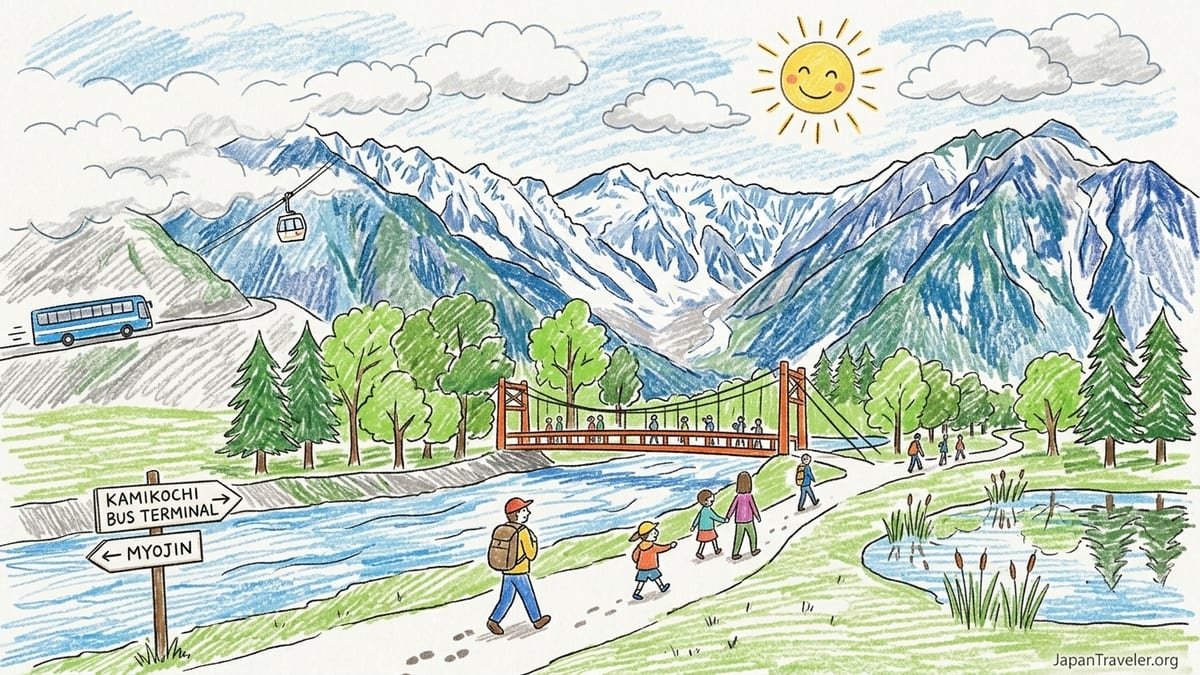
Experience: Kamikochi valley walking (Kappa Bridge to Myojin area and back, plus Taisho Pond detour). Exact location: Kamikochi, Matsumoto City, Nagano Prefecture, starting at Kamikochi Bus Terminal. Duration: 4 to 6 hours at a relaxed pace with stops for photos and snacks. Ticket/price paid: I paid about ¥3,100 one way for the Shin-Shimashima to Kamikochi route bus in the 2026 season and budgeted the same to return, because fares were revised in April 2026 and older printed fares were no longer valid. Physical effort: Easy, mostly flat gravel paths; comfortable sneakers were fine. Weather: On my best day, cool and clear in the morning with fast-changing cloud later. Crowd level: Busy around the bus terminal and Kappa Bridge, then noticeably calmer once I kept walking. Would I repeat? Yes, absolutely and I would start earlier next time.
My honest verdict: this is the Japanese Alps experience I’d recommend to almost anyone. The scenery arrives quickly, the walking is forgiving, and even if you never leave the valley floor you still feel surrounded by serious mountains. I also liked how logistical stress stays low: the Kamikochi Bus Terminal is a real hub with services, and it’s the kind of place where you can change your plan mid-day and still feel in control.
What sounded better than it turned out to be: the “famous viewpoint” moments can be fragile. One afternoon I walked toward a much-hyped photo angle expecting a dramatic mountain reveal and got a wall of cloud instead. I don’t regret going, but it reinforced my rule for Kamikochi: go for the river, the forest, and the walking itself. If peaks show up, it’s a bonus, not a guarantee.
Serious Mountain Hiking (Where Weather and Timing Decide Everything)
Experience: Mt. Yakedake day hike attempt from Kamikochi side (out-and-back toward the volcanic summit route). Exact location: Kamikochi, with the hiking route branching from the valley trail network toward Mt. Yakedake. Duration: I budgeted a full day and turned around earlier than planned due to conditions, finishing in about 6 to 7 hours including breaks. Ticket/price paid: No trail fee; I still paid the same Kamikochi transport costs (bus in and out). Physical effort: Moderate to hard depending on how far you go; sustained climbing once you leave the valley floor. Weather: Mixed, with periods of mist and wet rock that made me dial back ambitions. Crowd level: Noticeably thinner than the valley walks, but I still saw other hikers. Would I repeat? Yes, but only with a better forecast and an earlier start.
My verdict: Yakedake is the perfect “step up” from valley walking, but it punishes casual planning. The Kamikochi official guidance frames Yakedake as a day-hike option and emphasizes judgment and conditions, and that matches my experience. The climb gets real quickly, and the moment the rocks get slick or visibility drops, you need to decide whether you are hiking for the summit or hiking for a good day. I chose the good day.
What sounded better than it turned out to be: summiting a volcano sounds cinematic. In practice, low cloud can erase the payoff while still leaving you with all the fatigue. If your trip style is “scenery first,” I’d rather repeat a longer valley walk or do an alpine transport day than grind upward into a whiteout.
Ropeways Worth Paying For (Even When They’re Pricey)
Experience: Shinhotaka Ropeway to Nishihotakaguchi Station for high-alpine views without a long climb. Exact location: Shinhotaka Ropeway, Shinhotaka Onsen, Okuhida Onsengokyo, Takayama City, Gifu Prefecture. Duration: 2 to 3 hours on site if you ride up, spend time on the viewing areas, and walk around the upper station area at a relaxed pace. Ticket/price paid: About ¥2,900 for an adult round-trip ticket (I paid the standard round trip). Physical effort: Easy; short walks and stairs at altitude. Weather: This is where I learned the hard way that “fine in town” can still mean wind and cloud above. Crowd level: Moderate; lines moved steadily, but the upper platforms felt crowded at peak moments. Would I repeat? Yes, especially as a short trip paired with onsen.
My verdict: even when the ropeway feels expensive for a short time aloft, it can be worth it if your schedule is tight or your legs are not in hiking mode. Shinhotaka’s biggest value is how quickly it gives you a true alpine feel. If the upper station is socked in, I still found the ride itself fun, but I would not pretend it’s the same as a clear day. My repeat plan would be simple: go early, check the forecast, and treat the viewing as “weather-permitting.”
What sounded better than it turned out to be: I expected the famous views to be guaranteed. They aren’t. My “lesson day” was a classic: I paid full fare, rode into cloud, and got brief windows rather than a sustained panorama. It wasn’t a waste, but it was a reminder to keep ropeway expectations flexible.
Alpine-Route Transport That’s More Than Just a Transfer
Experience: Tateyama Kurobe Alpine Route as a transport-and-scenery day (not a hike day). Exact location: The through-route crossing between Toyama Prefecture and Nagano Prefecture via Tateyama Station, Murodo, Daikanbo, Kurobe Dam, and Ogizawa. Duration: A full day; my travel day ran roughly 8 to 10 hours door-to-door once you add connections and waiting. Ticket/price paid: I paid for a same-day ticket segment plan rather than an all-inclusive rail pass, and for budgeting I used the official fare tables current as of February 27, 2026. (Exact totals depend heavily on where you start and finish, and the route publishes different fare sets by section.) Physical effort: Easy to moderate; lots of walking between transport modes, but no technical hiking required. Weather: The day I went was bright at lower elevations but colder and windier around Murodo. Crowd level: High, especially in peak sightseeing times; this is a famous route and it felt like it. Would I repeat? Yes, but I’d pay extra attention to timing and reservations.
My verdict: this is the Japanese Alps for travelers who want drama without committing to a multi-day hike. The appeal is the variety: cable car, highland bus, dam walk, and constant altitude changes that make you feel like you’ve crossed a mountain range because you have. The downside is that it can feel like logistics and lines, especially if you hit it on a popular day. The Alpine Route’s own same-day ticket guidance is clear that advance web reservations are recommended, and after doing it once, I agree.
What sounded better than it turned out to be: I assumed “transport day” would be physically effortless. It isn’t hard in a fitness sense, but it is tiring. You are on your feet constantly, and if you don’t pack food and layers intelligently, the day can feel longer than it needs to. I’d still repeat it because the payoff is unique, but I’d treat it like a light hike day rather than a rest day.
Onsen Soaks That Actually Reset You
Experience: Hirayu Onsen day-use soak at Hirayu no Mori after a mountain day. Exact location: Hirayu no Mori, Hirayu Onsen, Okuhida Onsengokyo area, Takayama City, Gifu Prefecture. Duration: 60 to 120 minutes, depending on how long you linger between indoor and outdoor baths. Ticket/price paid: ¥700 for day-use bathing (adult). Physical effort: None, but it’s the perfect recovery tool after walking or hiking. Weather: Best when it’s cool outside; I went when the air felt crisp enough that the outdoor baths were genuinely satisfying. Crowd level: Moderate; not empty, not chaotic, and people rotated naturally. Would I repeat? Yes, this is a repeat-every-time kind of stop.
My verdict: Hirayu no Mori is the kind of onsen that makes you realize you were more tired than you thought. I liked it because it felt functional rather than fussy: you bathe, you recover, and you leave feeling like the next day is possible. If your Japanese Alps plan includes any uphill walking, I’d actively build an onsen stop into the schedule instead of treating it as optional.
What sounded better than it turned out to be: the idea of saving onsen for a fancy ryokan evening bath. I’ve done that too, but for practical trip planning, a day-use facility is often the more reliable win. You don’t need perfect timing, and you don’t have to rush a hike just to make a dinner seating.
Ryokan Stays and Mountain-Town Nights (Where the Trip Gains Texture)
Experience: Staying overnight in an onsen town in the Alps zone (Hirayu Onsen area style of stay) to break up transport and hiking days. Exact location: Okuhida and Hirayu Onsen area, Takayama City, Gifu Prefecture. Duration: One night, with an early start the next morning for ropeways or trailheads. Ticket/price paid: I am not listing a specific nightly room rate here because prices change quickly by season, day of week, meal plan, and room type, and I did not book a single fixed “standard” plan that would represent the current market. Physical effort: Low, but the value is strategic: it saves energy by reducing long morning transfers. Weather: Even rainy evenings felt worthwhile because the onsen component didn’t depend on views. Crowd level: Calm at night; mornings depended on bus departures. Would I repeat? Yes, because it makes the Alps feel like a trip rather than a day trip.
My verdict: if you only do the Japanese Alps as a series of day trips from a big base city, you can still have a great time, but you’ll spend too much time staring at bus timetables. One night in an onsen town changes the rhythm. You eat, soak, sleep, and wake up closer to the experience you came for. The repeat value is less about luxury and more about reducing friction.
What sounded better than it turned out to be: over-optimizing for “the perfect ryokan.” Unless your trip’s main goal is accommodation itself, the better strategy is to pick a location that shortens transit to your chosen activity level. A good-but-not-famous onsen stay in the right place can beat an iconic stay that adds two extra transfers.
The Takeaway
If you take one planning idea from this: choose Japanese Alps experiences by the type of day you want, not by the most famous place name. If your trip style is relaxed, repeat Kamikochi’s valley walking and pair it with an onsen soak. If you want a big “I crossed the mountains” day without technical hiking, build a Tateyama Kurobe Alpine Route day and treat it like a long, tiring outing that deserves good food afterward. If you want to spend money for altitude quickly, Shinhotaka Ropeway is a strong value on a clear morning, and still fun even when clouds steal the headline view.
The experiences I would not force on anyone are the ones that promise a single perfect viewpoint. In the Japanese Alps, weather is a co-author. The repeatable wins are the ones that feel good even when conditions shift: valley walking, onsen recovery, and transport experiences where the journey itself is the point.
FAQ
Q1. What’s the best Japanese Alps experience for beginners who still want big scenery?
Walking in Kamikochi from the bus terminal area out toward Myojin and back is scenic, flat, and forgiving even if the peaks hide in cloud.
Q2. Is the Shinhotaka Ropeway worth the price if I only have half a day?
Yes if you want quick altitude and don’t mind paying for convenience. It’s best on a clear morning, but even on mixed days the ride can be enjoyable.
Q3. How hard is the Tateyama Kurobe Alpine Route physically?
It’s not technical, but it is tiring. Expect lots of walking between transport modes, time on your feet, and colder wind at high points like Murodo.
Q4. Do I need to reserve buses to Kamikochi?
On key routes, reservations have become the norm. In the 2026 season, Alpico stated that buses between Matsumoto and Kamikochi require reservations for both outbound and return.
Q5. What’s the most reliable “bad weather” activity in the Japanese Alps?
Onsen. A day-use soak like Hirayu no Mori is satisfying even in rain, and it can rescue a day when visibility is poor up high.
Q6. Can I treat the Alpine Route as a relaxing rest day?
Not really. It’s scenic, but it’s a long day with lines and transfers. Treat it like a light hiking day in terms of energy and pacing.
Q7. What’s a good step up from Kamikochi walking without committing to a multi-day trek?
An attempt on Mt. Yakedake is a logical next step if the forecast is stable. Be ready to turn around if visibility or trail conditions deteriorate.
Q8. When is the best time of day for Kamikochi if I dislike crowds?
Arrive early. The busiest concentration is near Kappa Bridge and the bus terminal area, and it thins out once you walk farther into the valley.
Q9. Should I prioritize a famous viewpoint or a longer walk in Kamikochi?
I’d prioritize the longer walk. Viewpoints can be clouded in, but the river, forest, and mountainside atmosphere are rewarding in almost any conditions.
Q10. If I only do one paid “splurge” experience in the Alps, what should it be?
Pick based on your style: Shinhotaka Ropeway for quick altitude and views, or the Tateyama Kurobe Alpine Route for an all-day crossing experience.