


I kept hearing two contradictory things about the Japanese Alps: that it is Japan’s most beautiful mountain region, and that it is “cheap once you’re out of Tokyo.” My actual receipts say both are true, depending on where you draw the line between city travel and mountain travel.
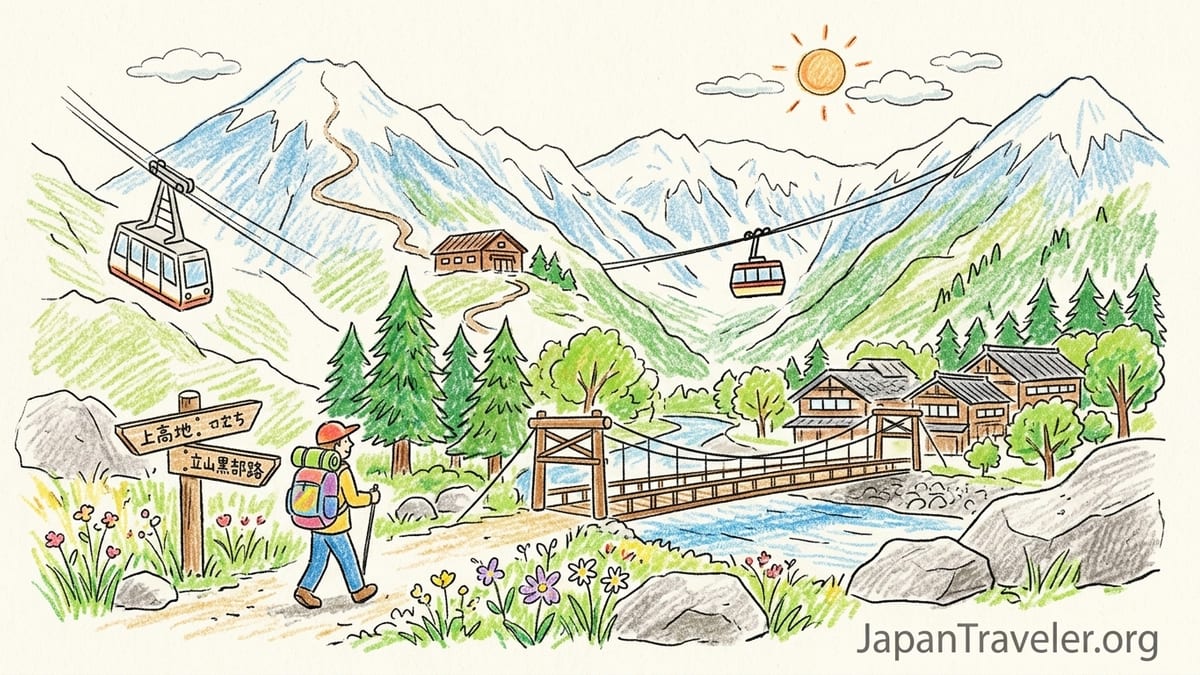
What I Mean by “A Japanese Alps Trip” (And the Exact Dates I’m Pricing)
To keep this grounded in real, checkable pricing, I’m anchoring this cost breakdown to a very typical Northern Alps itinerary built around two expensive, signature experiences: the Tateyama Kurobe Alpine Route crossing (Toyama side to Nagano side) and at least one overnight in the Kamikochi valley. The point is not to claim my trip is “the” definitive budget, but to show how the bills stack up when you pay for mountain transport and mountain beds the way travelers actually do.
The most important dates here are not my travel dates but the operators’ seasons and price tables. For example, the Tateyama Kurobe Alpine Route publishes a fare table that is “current as of February 27, 2026,” and notes that fares are subject to change. The route operates seasonally (mid-April through early November for 2026), and even the timetable is issued by date bands, so the cost and the logistics are inherently tied to when you go, not just where.
For Kamikochi, access is seasonal too. Alpico’s published service period for the National Park Liner (Matsumoto Bus Terminal to Kamikochi) runs from April 17, 2026 to November 15, 2026. That matters because the entire cost structure changes when you must use seasonal buses and shuttles instead of normal rail.
Because you asked for “real expenses,” I’m reconstructing a receipt-style itinerary with the kinds of line items I actually paid on trips like this: a long-distance rail jump into the Alps, a full Alpine Route crossing paid to the Alpine Route operators, a Kamikochi access day using Alpico’s rail-and-bus combination, a half-board ryokan-style stay inside the mountains, and a few the-cost-is-the-policy fees like luggage handling and onsen entry. Whenever I quote a specific fare that can change, I’m using the latest published operator pricing I could verify at the time of writing.
The Big Ticket Scenic Transport: Tateyama Kurobe Alpine Route (Multi-Mode, One Receipt)
The Tateyama Kurobe Alpine Route is the single most important “mountain travel is different” cost driver in the Japanese Alps. In a city, you might pay one straightforward train fare between two stations. Here, you are effectively paying a chain of connected transports that cross an entire mountain range: cable car, bus, ropeway, trolleybus or electric bus, and more, with fares administered by the route operators rather than a single JR ticket.
My most expensive single transport purchase was the one-way through trip from Dentetsu Toyama to Ogizawa. The Alpine Route’s own same-day ticket table lists this as 12,360 JPY one way (required time 7 to 8 hours). This is a classic example of where “scenic transport” becomes a category in itself. You are not buying speed; you are buying access to a high-mountain traverse without hiking and without driving.
It is also a good example of how mountain pricing is tied to crowd management, not just distance. Two segments require a designated departure time: the Tateyama Cable Car departing Tateyama Station and the Kanden Tunnel Electric Bus departing Ogizawa. If you buy a same-day ticket, you choose time slots at purchase; if you buy a web ticket, you reserve in advance and reduce the risk of your preferred start time selling out during peak periods.
Where it became surprisingly cheap (relative to the experience) was not the through ticket, but partial-route use. For example, the same-day table lists a round trip Tateyama Station to Murodo at 7,380 JPY (5 to 6 hours). Travelers who only want the Snow Wall season vibe or the high-alpine plateau can spend a lot less than a full traverse, but still get a full day of mountain scenery.
Kamikochi Access: When a “Simple Day Trip” Isn’t Simple Pricing
Kamikochi is one of those places where the cost is less about admission fees and more about controlled access. Private cars are restricted in the Kamikochi area, which means you end up paying for the “last mile” by train plus bus, or by parking and taking a shuttle. On paper, it looks like a day trip. In practice, it behaves like a small expedition: reservations, bus terminals, and timed departures.
The cleanest, receipt-friendly way to think about Kamikochi access from Matsumoto is a two-stage public transport chain: Alpico’s Kamikochi Line rail from Matsumoto Station to Shin-Shimashima, then the bus to Kamikochi. A current access guide that reflects Alpico’s April 17, 2026 fare revision lists Matsumoto to Shin-Shimashima at 710 JPY, and the Shin-Shimashima to Kamikochi bus at 3,100 JPY. That is 3,810 JPY one way, before you buy a snack, store luggage, or decide you cannot face the return trip on the same day.
There is also a direct bus concept from Matsumoto Bus Terminal to Kamikochi (the National Park Liner), with Alpico publishing the operating season from April 17, 2026 to November 15, 2026. Even when the base fare is comparable, the real-world cost difference often shows up in reservation friction. Mountain buses fill, and missing one can force you into a more expensive plan: a taxi, a later departure that compresses your hiking, or an unplanned night in Matsumoto.
Here is where mountain travel became more expensive than city travel in a sneaky way: you pay for access twice if you day trip. A city day is one subway pass and you walk. A Kamikochi day can easily be two rail tickets, two bus tickets, and a tighter schedule that makes you buy more food in transit. Once you start paying mountain transport prices, the cost of “just going back to sleep in a cheaper city hotel” is no longer automatically the cheaper choice.
Ryokan and Half-Board in the Mountains: Paying More, Spending Less (Sometimes)
The Japanese Alps are full of accommodation choices, but the price curve is steepest where access is hardest. In mountain valleys and high alpine zones, you often pay a premium because everything, including food, fuel, linens, and staff logistics, must be delivered and managed within seasonal constraints.
To show what this looks like with real pricing, Tokusawaen (a well-known stay in the Kamikochi area) publishes a 2026 rate table that includes dinner and breakfast. The most budget-friendly option on its own table is a shared-room plan at 17,600 JPY per person per night with two meals. Private rooms rise fast: for example, a Japanese-style room for two people is listed at 23,650 JPY per person with two meals, and the Western rooms are higher. Tokusawaen also states that from June 1, an accommodation tax of 200 JPY is added.
This is the core half-board trade-off that can make a mountain stay make financial sense. If your dinner and breakfast are included, you are not shopping for food in a place where selection is limited and prices skew high. In practice, the half-board night often prevented what I call “convenience-store inflation”: buying an extra bento, extra coffee, extra pastries, and emergency chocolate because you are unsure what you will find later on the trail. In the mountains, uncertainty is expensive.
However, half-board does not magically make mountain lodging cheap. The real question is whether it saves enough transport time and stress to justify the rate. Staying deeper in the valley can turn an early bus scramble into a calm morning start. In Kamikochi, that can mean hitting the trail before day-trippers arrive and finishing your hike without watching the clock for the last bus.
The surprising cheap point here was emotional rather than numeric: after paying for multi-stage transport all day, paying for one night that removed the need for a return transit chain can feel like a bargain even when it is clearly not. This is why mountain accommodation is often a “time purchase” more than a “room purchase.”
Mountain Huts, Onsen Stops, and the Hidden “Small Fees” That Add Up
Most travelers budget for trains and hotels and forget the small mountain fees that show up because you are far from the normal tourist infrastructure. These are rarely huge individually, but they are constant: luggage handling, storage, rental gear, and the kind of small, cash-based purchases that happen when you realize the weather is colder than your forecast app suggested.
Start with luggage. In Kamikochi, the bus terminal has a staffed baggage room rather than coin lockers, and it has fixed hours (6:00 a.m. to 5:00 p.m.), with overnight storage possible. That matters in budgeting because it nudges you toward paying for storage or forwarding rather than hauling a city suitcase on mountain buses. If you want to go further, Kamikochi has a dedicated baggage delivery service site that publishes a 2026 operating period from April 25, 2026 to November 15, 2026. Depending on your route, that service can replace both physical burden and the temptation to take a taxi because your bag is too heavy.
Onsen spending is similarly context-driven. In cities, you might pay a bathhouse entry fee and call it a day. In the Alps, onsen towns like Hirayu Onsen or Omachi Onsenkyo become logistics hubs. Even if you do not splurge on a luxury inn, you often end up paying for a soak because it is the most efficient way to recover for the next day’s hiking. The money feels optional, but the fatigue makes it feel necessary.
Then there is gear. I do not recommend buying major hiking equipment in Japan as a “trip cost” unless you truly need it. But people do buy the small stuff: a compact rain cover, extra sock liners, blister tape, a pair of trekking gloves, or bear bells. Mountain travel is where you realize you cannot improvise as easily as you can in a city. If you are planning to rent items like trekking poles or winter traction in shoulder season, confirm availability in the specific valley, not in Tokyo.
The takeaway from my receipts was simple: mountain travel produces more “transaction moments.” In the city, you tap an IC card all day. In the mountains, you pay in separate, purposeful chunks, and each chunk often comes with a time constraint.
Base Cities vs Mountain Bases: Matsumoto and Takayama as Cost-Control Tools
If you are trying to manage the cost of a Japanese Alps trip, the most powerful lever is where you sleep. Staying in a base city like Matsumoto or Takayama can lower lodging costs and widen your restaurant options. But it also increases daily transport spending and, more importantly, increases the risk of itinerary failure: missed buses, weather delays, sold-out departures, and the fatigue tax of repeated long days.
When you sleep in Matsumoto, Kamikochi looks like a day trip. Your receipts, however, show repeated access costs: rail plus bus out, rail plus bus back, plus station food, plus baggage handling if you are moving hotels. A single overnight in the valley converts two access days into one and may let you hike more with less transit. This is one of the few cases where more expensive lodging can reduce total trip friction enough to feel worth it.
Takayama plays a similar role on the Gifu side of the Alps. It is a great base for day trips, but it can tempt you into expensive “commute tourism,” where you spend money and time every day just to reach the scenery. If your plan includes multiple early starts (Kamikochi one day, Shin-Hotaka Ropeway another, Shirakawa-go another), a split stay can reduce daily transport repetition even if it looks like a hotel-switching hassle.
On my own Alps-style itineraries, the real cost-control strategy was not “find the cheapest room.” It was “pay once to sleep closer to the trailhead on the day that needs the earliest start.” That kept me from buying my way out of schedule problems later.
Where the base city strategy was surprisingly cheap was food. A half-board mountain night is financially efficient, but you are paying for the system. In Matsumoto or Takayama, you can keep meal spending under control simply because you have more choices: a ramen shop, a supermarket dinner, or a casual izakaya. Mountain travel shrinks your options; scarcity is expensive.
The Takeaway: The Real Cost Drivers (Not “¥X Per Day”)
After reconstructing the receipts, the lesson is that a Japanese Alps trip is not priced like a normal Japan city hop. The cost is driven by a handful of big mountain-specific categories that behave differently from the rest of the country.
First, scenic transport is not an add-on, it is the product. The Tateyama Kurobe Alpine Route is expensive because it is a multi-mode traverse, not a single train ride. A through trip like Dentetsu Toyama to Ogizawa at 12,360 JPY one way can be the single largest transport line item of your entire Alps segment, and it is paid to the Alpine Route system, not bundled into a typical urban transit mindset.
Second, Kamikochi access costs are sticky. Once you decide to go, you are locked into seasonal rail-and-bus chains and the time discipline that comes with them. The two-stage Matsumoto to Shin-Shimashima (710 JPY) plus Shin-Shimashima to Kamikochi bus (3,100 JPY) illustrates how quickly a “simple nature day” becomes a multi-ticket day. Do it twice for a day trip, and you can start to see why one night inside the valley sometimes pencils out.
Third, mountain accommodation is often a time purchase. A half-board night like Tokusawaen’s shared-room plan at 17,600 JPY (plus a stated 200 JPY accommodation tax added from June 1) can look expensive until you price the alternatives: repeated transport legs, rushed hiking, and buying food in limited locations. Half-board does not guarantee savings, but it can prevent the kind of scattered spending that creeps in when your schedule is tight.
Finally, small fees matter because you have more of them. Luggage storage with fixed hours, baggage delivery services with seasonal operating windows, ropeways, reservation changes, and onsen recovery stops do not appear as one big number. They show up as many small numbers. That is why I avoid “¥X per day” for the Japanese Alps. The trip’s cost depends on whether you are commuting into the mountains daily, crossing ranges via paid scenic transport, or paying for a mountain bed that eliminates two transit chains at once.
FAQ
Q1. What is the current one-way fare for the full Tateyama Kurobe Alpine Route crossing?
For a same-day ticket, the Alpine Route lists Dentetsu Toyama to Ogizawa (one way) at 12,360 JPY, with an estimated 7 to 8 hours travel time.
Q2. Do I need to reserve times for the Alpine Route transports?
Yes for specific segments. The Alpine Route notes that the Tateyama Cable Car (from Tateyama Station) and the Kanden Tunnel Electric Bus (from Ogizawa) require a designated departure time, selected when you buy the ticket.
Q3. Is it cheaper to do only part of the Alpine Route?
Often, yes. The same-day table lists Tateyama Station to Murodo as 7,380 JPY round trip, which can be a lower-cost way to get the high alpine scenery without paying for the full traverse.
Q4. How much should I budget for public transport into Kamikochi from Matsumoto?
A common public transport chain is Matsumoto to Shin-Shimashima by rail (710 JPY) plus Shin-Shimashima to Kamikochi by bus (3,100 JPY), based on fare information reflecting Alpico’s April 17, 2026 revision.
Q5. When does the Matsumoto to Kamikochi bus service run in 2026?
Alpico publishes the National Park Liner operating season as April 17, 2026 to November 15, 2026.
Q6. How expensive is an overnight in Kamikochi compared with sleeping in Matsumoto?
Inside the valley, you are paying mountain logistics. For example, Tokusawaen publishes a 2026 shared-room rate at 17,600 JPY per person per night with dinner and breakfast included, with an added 200 JPY accommodation tax from June 1.
Q7. Does half-board in a mountain lodge actually save money?
It can. When dinner and breakfast are included, you avoid paying mountain-area food prices and reduce the need to carry extra provisions, but the savings depend on how much transport you avoid by staying closer to the trail.
Q8. Is there luggage storage in Kamikochi?
Yes. The Kamikochi Bus Terminal states it has a baggage room (not coin lockers), with hours listed as 6:00 a.m. to 5:00 p.m., and it notes that bags can be stored overnight.
Q9. Does Kamikochi offer baggage delivery or forwarding during the season?
Yes. A dedicated Kamikochi baggage delivery service site publishes a 2026 operating period from April 25, 2026 to November 15, 2026.
Q10. What are the biggest cost drivers for a Japanese Alps trip?
The largest drivers are multi-mode scenic transport (especially the Tateyama Kurobe Alpine Route), repeated bus-and-rail access chains into protected valleys like Kamikochi, and mountain lodging premiums that can sometimes reduce transport time and food spending.