


I used to ask for the “best time” to visit the Japanese Alps as if the range had one reliable peak season. After multiple trips timed deliberately around heat, autumn colors, and hiking access, I stopped asking that question. The Japanese Alps are a patchwork of elevations and gateways, and the same week can feel like summer in Matsumoto, early fall in Kamikochi, and near-winter above 2,500 meters. The right timing depends less on the month printed on your calendar and more on where you plan to go, how high you plan to sleep, and whether your priority is scenery, serious hiking, or simply an easy day in the mountains.
Why There’s No Single “Japanese Alps Season”
The term “Japanese Alps” covers huge swaths of mountain terrain: the Northern Alps (around Tateyama, Hakuba, Kamikochi, Yari, Hotaka), the Central Alps, and the Southern Alps. Access roads, bus schedules, ropeways, and mountain hut operations do not switch on and off together. Elevation changes everything, too. A damp, warm valley day can coexist with icy wind and leftover snowfields just a couple of cable cars away.
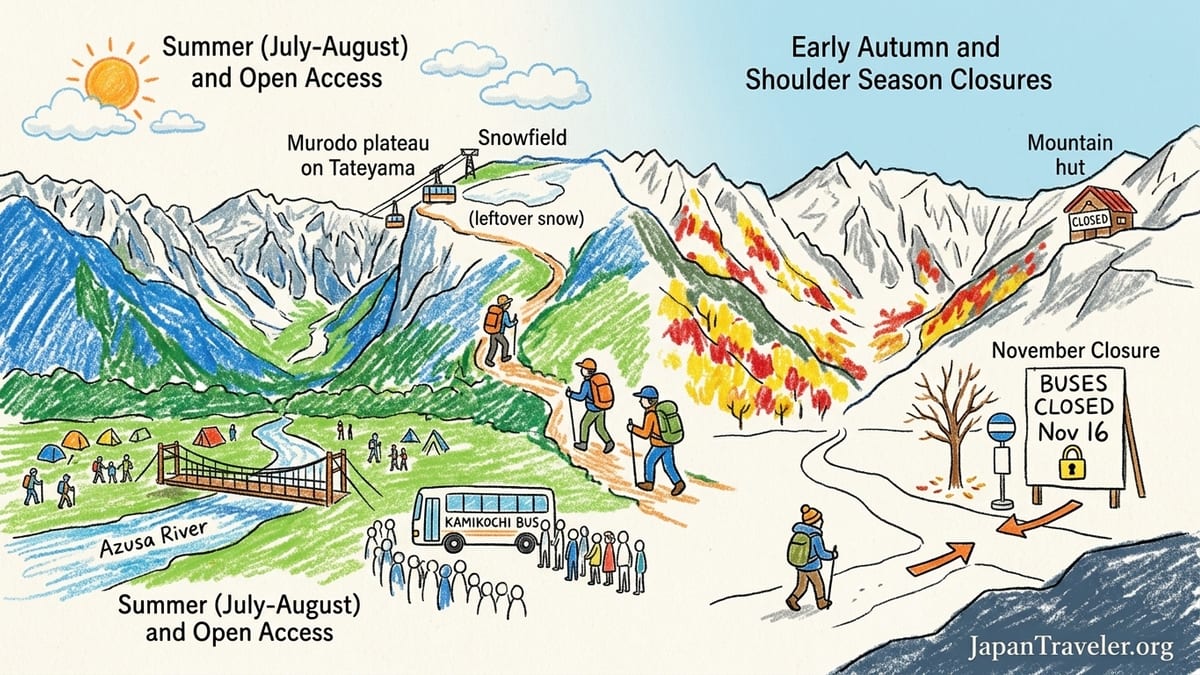
Two official calendars shape many itineraries, and they help explain why travelers experience wildly different conditions. The Tateyama Kurobe Alpine Route is a spring-through-late-autumn corridor only, operating April 15 through November 30 in 2026. Kamikochi’s conventional visitor season similarly runs from spring into mid-November, with bus services and many facilities staying open through November 15 and closing from November 16 onward. Those dates matter because if you arrive outside them, you are not just visiting in a “quiet season,” you may be locked out by closed roads and shuttered services.
There is also a safety window that casual hikers tend to underestimate. Japan’s national tourism guidance for Tateyama suggests a broad, safer general period for casual high-mountain hiking of roughly July through mid-October. That aligns with what I experienced on the ground: once you climb high enough, the limiting factors become not just temperatures but snow remnants, thunderstorm risk, mud, and whether huts and transport links are actually operating.
What I Experienced In Summer (Late July To August): Heat Below, Relief Above, But Crowds Everywhere
I’ve visited the Northern Alps in late July and August for hiking and high-elevation sightseeing, and the contrast between valley heat and alpine air was the headline. In the gateway cities, I remember the sticky feel of daytime heat that makes you drink more than you planned, then the instant relief when you gain elevation. At popular high points like Murodo on Tateyama or the Kamikochi valley floor, the air felt noticeably cooler, especially once the sun dipped and the shade reached the riverbanks.
But summer is also when the Alps feel least like a secret. In Kamikochi, the day can start with calm river views and end with a very real transportation crunch. On one peak-summer day, I arrived early because I had heard the morning bus lines could be rough, and even then the “line behavior” was its own travel skill: where to stand, how quickly a queue can balloon, and how fast the first buses fill. Later, heading out of the valley around late morning, I saw the return queue already growing long enough that people were checking watches and doing snack math.
Weather in summer was the other trade. The mountains looked stunning when visibility opened, but clouds built fast. I learned to judge the day by the first hour: crisp ridgelines early often meant a safer, more predictable outing than a morning that starts hazy and warm. I also learned why so many hikers follow the informal “early start, early finish” rhythm. Even without a dramatic storm right over my head, I watched dark clouds thicken over peaks and felt that subtle pressure shift that signals you should be descending rather than debating.
What I gained by timing a trip for late July and August was maximum access. Trails were generally in their “most walkable” phase, transport links were running, and the overall ecosystem of mountain travel was awake: more open huts, more services, and more chances to adapt mid-trip if you needed to change plans. What I lost was quiet. Scenic spots that look empty in photos can feel like a moving museum line in reality, especially near easy viewpoints and famous bridges.
What I Experienced In Early Autumn (Late September To Mid-October): Clearer Peaks, Cold Nights, And The First Taste Of Closure Risk
My favorite overall conditions for being in the Japanese Alps have been in early autumn, roughly late September into mid-October, when the air felt sharper and mountain outlines looked more defined. On mornings in the valleys, I needed a light layer I never touched in midsummer. At elevation, it was the kind of cold that makes you zip up while walking, not just when you stop for a photo. Nights were meaningfully colder than daytime, enough that I planned my packing around warmth after sunset rather than assuming “it’s still hiking season.”
Visibility was the payoff. When the weather cooperated, ridgelines looked like they had been traced with a clean pencil rather than softened by summer haze. That difference is hard to appreciate until you’ve seen both. In early autumn I also felt like my daily energy improved because I wasn’t fighting humidity on every climb, and my water consumption became more predictable.
The tradeoff was that the season’s edges start to show. As the calendar slides deeper into October, you are no longer choosing only between “hot” and “cool.” You’re also choosing between “fully open” and “partially winding down,” especially for mountain huts whose operating periods can end earlier than people assume. Even when the weather was perfect, the sense that the mountains were beginning to close for the year changed how I planned: I checked hut operating dates more carefully, and I became less casual about finishing hikes on time.
What I gained by timing early autumn was a more comfortable hiking rhythm and better peak visibility. What I lost was spontaneity. In summer you can often decide the night before to move your plan around. In early autumn, you can still do that sometimes, but you feel the pressure of limited operating windows, earlier sunsets, and colder nights that penalize “we’ll figure it out later” thinking.
What I Experienced In Shoulder Season (Early To Mid-November): Quiet Valleys, Crisp Air, And A Hard Stop On Services
I’ve visited the Alps region again as facilities approached their mid-November shutdown. This was the trip where the logistics, not the terrain, dictated the mood. In Kamikochi, the official season runs through November 15, with closures beginning November 16, and that reality is visible in the way travelers and staff talk. You can feel the countdown in the background: shorter service windows, fewer choices, and less tolerance for delays because everyone is preparing for winter closure.
The biggest change I noticed was crowding, or rather the lack of it. Places that felt like a conveyor belt in August felt calm enough to hear water and wind again. When the air is crisp and the foot traffic thins, the valley atmosphere becomes the attraction. I remember bundling up early and being grateful for gloves when I would have been in short sleeves just weeks earlier.
But shoulder season is not a gentle “discount version” of autumn. It’s a different product. If you are the kind of traveler who likes to wander until you are tired and then decide where to sleep, November is not friendly. The valley may still be accessible, but the overall number of open properties and services can drop, and the margin for missing the last bus or arriving too late to check in feels smaller.
What I gained in early to mid-November was space, quiet, and a more contemplative version of Kamikochi. What I lost was flexibility and the sense of safety that comes from knowing everything is running at full capacity. It was also the trip that made me promise myself to be more conservative with daylight, because once temperatures drop and services thin, small delays feel bigger.
Spring Snow And Deep Winter: What I Didn’t Personally Experience, And What Official Calendars Still Mean For Your Planning
I have not personally done a deep winter mountaineering trip or an early spring snow hike in the high Japanese Alps. That matters, because the most dramatic images people associate with “spring in Tateyama” often involve towering snow walls and a landscape that behaves more like winter than like a gentle April thaw. If you plan to visit for spring snow, you should treat it as a different category of travel than summer hiking.
Even without my own boots-on-snow experience in April, official operations tell you what is and is not realistically possible. The Tateyama Kurobe Alpine Route in 2026 operates from April 15 to November 30, which defines the feasible window for the classic cross-mountain sightseeing traverse. Spring access exists because the route is actively prepared and operated; outside the operating period, this corridor is not a casual option. Within the spring window, conditions can still be wintry at altitude, and your clothing choices should reflect that reality rather than the temperatures in Toyama or Nagano cities.
For Kamikochi, the conventional season runs from spring into mid-November, with bus services and facilities open through November 15 and closed from November 16 onward. In practice, that means “late autumn” in the valley is still a structured season with a fixed end date. If you want to see lingering fall atmosphere with fewer people, early November can work. If you want guaranteed services and maximum lodging choice, you are safer earlier.
One more piece of researched context that lines up with my lived experience in other seasons: national tourism guidance notes that the safest general period for casual high-mountain hiking around Tateyama is approximately July through mid-October. That does not mean other months are impossible. It means those other months can demand more skill, more equipment, and more conservative decision-making than many casual visitors anticipate.
What Specific Conditions Actually Changed My Days: Snow Patches, Mud, Visibility, Thunder, And Crowd Logistics
What made timing matter most on my trips were not abstract “average temperatures.” It was the daily friction and the daily gifts: whether I stepped over lingering snow patches on shaded sections, whether the trail turned into a boot-sucking mud ribbon after rain, whether the peaks stayed visible for more than an hour, and whether I spent my morning hiking or standing in a bus queue.
In summer, the big issues were heat at lower elevations and afternoon instability. I remember days where the morning was clear enough for postcard views and by early afternoon the mountains looked like they were being swallowed by a gray curtain. Even on days without a dramatic lightning show, the possibility of thunderstorms changed my pacing. I started earlier and I stopped earlier. Timing shaped not just what I saw, but how relaxed I felt while seeing it.
In early autumn, colder nights and cleaner air changed everything. Daytime hikes felt more efficient because I wasn’t constantly managing sweat and sun exposure. At the same time, once the sun dropped, the temperature drop was immediate and convincing. This was also when hut planning started to matter more. If you’re doing hut-to-hut routes in the Northern Alps, you cannot assume that every hut operates until “sometime in November.” Many huts run limited seasons that end in early to mid-October, and the practical result is simple: your dream route can be “still physically hikeable” but functionally off-limits if the huts you need are closed.
In November shoulder season around Kamikochi, the mountain visibility could still be beautiful on a good day, but the trip felt governed by clocks. The hard closure date means you travel with an awareness of last buses, closing ceremonies, and facilities winding down. That structure can be comforting if you like clear boundaries. It can also feel restrictive if you prefer improvisation.
Crowding was not just an annoyance; it changed what my photos looked like, how long I lingered at viewpoints, and even how I ate. In peak season, lunch can turn into a coordination puzzle: do you wait, do you move on hungry, or do you accept whatever is fastest? In quieter seasons, I could sit longer, hear the river, and feel like I was actually in a national park rather than passing through a popular attraction corridor.
The Takeaway
The best time to visit the Japanese Alps depends on the kind of trip you are trying to build, and it depends on altitude as much as it depends on the month. My own happiest balance came from timing for early autumn when conditions felt more stable and views were cleaner, but that timing also asked more of me: warmer layers at night, tighter planning around hut seasons, and less spontaneity.
For pure sightseeing on the Tateyama Kurobe Alpine Route, the defining fact is operational: it runs April 15 through November 30 in 2026. If your goal is to see high-elevation scenery without committing to strenuous hiking, that spring-to-late-autumn window is your canvas, and you can choose your day based on what you value most: lingering snow atmosphere early, greener landscapes in summer, or crisp air in autumn.
For casual high-mountain hiking around Tateyama, the broad safest-feeling window I would point most people toward aligns with official guidance: roughly July through mid-October. Based on my own July-to-November experiences, that window is where you are most likely to get open trails, open huts, and enough daylight and warmth to enjoy the day rather than merely manage it.
For autumn foliage, I would plan around late September through October depending on elevation and the specific valley or ridge you’re visiting, and I would accept that popularity comes with it. For skiing, your best strategy is not to force the hiking season to behave like winter; build a ski trip around ski towns and lift operations instead. For onsen, you have the widest flexibility: a cold evening after an autumn day in the mountains can feel perfect, and you can pair hot springs with almost any season as long as your access roads and lodging are operating.
FAQ
Q1. What is the best time to visit the Japanese Alps overall?
There is no single best time because elevation and destination change everything. For many travelers, July through mid-October offers the best mix of access, open facilities, and safer casual hiking conditions.
Q2. When is the Tateyama Kurobe Alpine Route open in 2026?
It operates from April 15 to November 30 in 2026, so any cross-route sightseeing plans need to fall inside those dates.
Q3. When does Kamikochi close for the winter season?
Kamikochi’s conventional visitor season runs into mid-November. Bus services and facilities remain open through November 15 and close from November 16 onward.
Q4. What did summer feel like in the Alps compared to the cities?
In late July and August, valley gateways felt hot and humid, while higher areas felt noticeably cooler. The tradeoff was heavier crowds and more weather volatility later in the day.
Q5. Is early October good for serious hiking?
It can be excellent for visibility and comfort, but it comes with colder nights and a higher risk of hut or route season endings. You need to confirm hut operating periods and be conservative with daylight.
Q6. What changes in early to mid-November around Kamikochi?
You can get quieter trails and crisp air, but services and lodging options narrow as the season approaches its November 15 endpoint, with closures starting November 16.
Q7. Do I need to worry about thunderstorms in the Japanese Alps?
In summer, afternoon weather can build quickly. Even without a direct storm overhead, the risk changes your pacing, and early starts tend to make the day feel safer.
Q8. How much do crowds affect the experience?
A lot. In peak summer, you may face bus queues into and out of Kamikochi and heavier foot traffic at classic viewpoints. In shoulder season, the same places can feel calm and spacious.
Q9. Is spring a good time to hike high routes in the Alps?
Spring access can exist, especially where official routes operate, but high elevations can still behave like winter. If you’re not experienced with snow travel, it’s safer to focus on sightseeing corridors and lower-elevation walks.
Q10. What timing is best for onsen trips paired with the Alps?
Autumn is especially satisfying because cool air makes hot baths feel even better, but onsen trips work in almost any season as long as your chosen access roads and lodging are open.