


I went to Japan’s Alps expecting the usual travel dilemma: rent a car for freedom, or rely on trains and buses for convenience. I ended up doing both on the same trip, partly by design and partly because the mountains forced my hand. I drove a rental car through the Matsumoto, Takayama, and Kiso Valley orbit of the Northern and Central Alps, then switched to buses and rail for places where private vehicles are restricted, booked-out, or simply pointless. What surprised me most was this: in the Japanese Alps, a car does not automatically buy better access. In some flagship valleys, you are legally required to park and ride a shuttle anyway, meaning your car can sit unused while you queue for the same bus as everyone else.
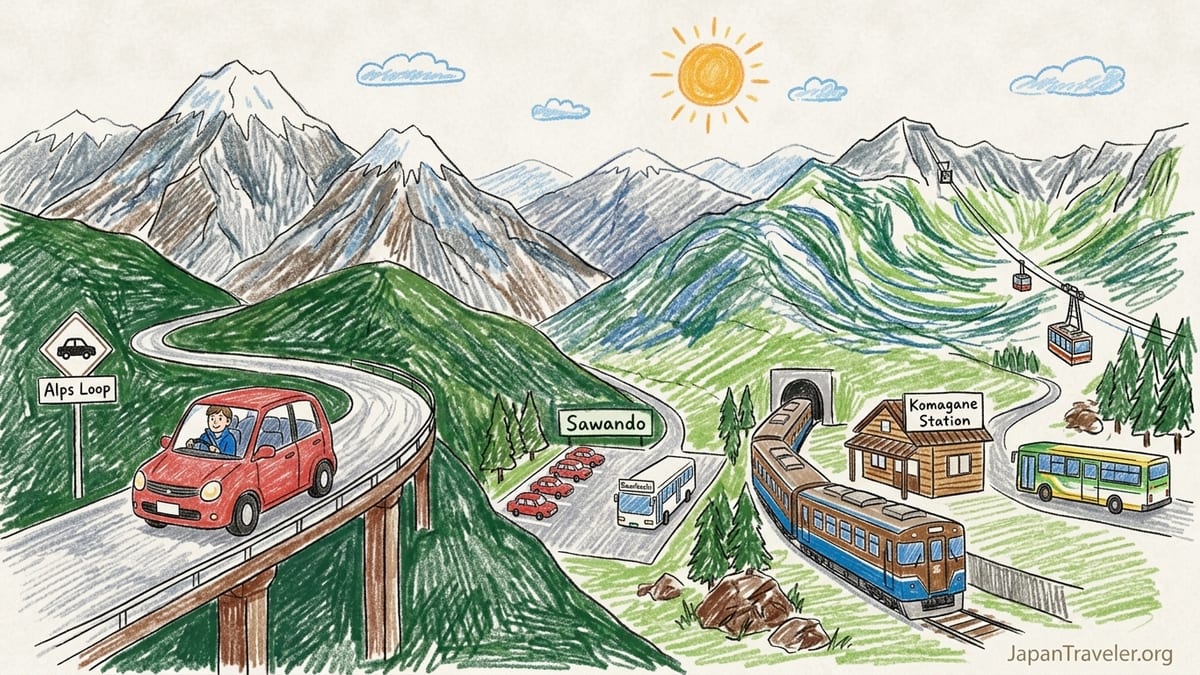
What I Actually Did: A Mixed Trip On Purpose (And Because The Alps Demand It)
I tested the car idea first by renting a compact car (the kind most agencies default to for foreign visitors) and picking it up in a midsize city base that made sense for mountain loops. At the counter, the paperwork was the usual: passport, credit card, and the driver credential Japan recognizes for short-term visitors. For many travelers, that is a 1949 Geneva Convention International Driving Permit obtained before arriving; for some license-issuing countries, Japan requires a Japanese translation instead. Either way, the key practical point is that you need the correct document in your hand at pickup, not on your phone, not as a plan, and not as “I’ll sort it out later.”
With the keys in my pocket, I built my days around what a car is genuinely good at in the Alps: short hops between rural towns, onsen villages, and less frequent corridors where bus departures thin out early. I drove ordinary national routes and mountain approaches, dealt with tunnels, rain, and narrow two-way sections that become one-lane-feeling when a tour bus comes the other way, and paid the kinds of fees people forget to budget for: toll roads, parking lots, and the small but constant drip of paid parking near popular trailheads.
Then I did the second half as a pure public transport exercise: rail to the nearest hub, then route buses into the valleys where the Alps most famously shine. I rode the reservation-required Kamikochi services out of the Matsumoto side, and I used the Takayama side route bus corridor where schedules are seasonal and weather-sensitive. The big takeaway from doing both is that the Alps reward flexibility. The best “mode” is often a combination, especially when private-car bans force a park-and-ride anyway.
Driving Firsthand: What Was Great, What Was Annoying, And What Was Non-Negotiable
The best part of driving was control over my day. In the Alps, that control is not just about leaving when you want. It is about arriving when you want. With a car, I could time check-in to a rural ryokan, stop for a roadside viewpoint, and detour to an onsen town without worrying about whether the last bus was at 4:30 p.m. That freedom matters in the shoulder seasons when daylight shrinks and bus frequency drops.
The annoyances were real and recurring. First, tolls: expressways in Japan are fast, but they are not free. You either pay at manned gates by cash or card, or you use ETC electronic toll collection if your rental includes an ETC card option. For visitors, the practical move is to request the ETC setup when you book or at pickup because some interchanges and “smart” gates are designed for ETC use and are simply easier with it. Even with ETC, you still need to budget for toll totals that can climb quickly if you are bouncing between prefectures rather than staying in one basin.
Second, mountain driving is not hard in the “I need off-road skills” sense, but it is mentally taxing. The road geometry changes constantly: tunnels, tight curves, short acceleration lanes, and sudden slowdowns where hikers cross or buses swing wide. In wet weather, the Alps also change the stakes. Rain and fog reduce sightlines, and in colder months you have to think about whether your rental has winter tires and what the agency’s policy is if conditions turn.
Third, parking becomes the hidden schedule. In busy gateways, the “time you save driving” can vanish while you circle for a spot or walk from a distant lot. This is especially true near famous entry points where private cars are funneled into designated lots. In other words: you can absolutely drive to the Alps, but you cannot always drive into the Alps.
The Kamikochi Reality Check: My Car Still Became A Parked Object
Kamikochi is the single best argument against assuming a car equals better access. The valley is explicitly car-free for private vehicles, including rentals and motorcycles. The rule is not a suggestion or a soft guideline; private cars are prohibited year-round. If you arrive by car, you stop at designated parking areas like Sawando (Matsumoto side) or Hirayu (Takayama side), park for the day, and transfer to a low-emission shuttle bus or a taxi for the final stretch.
This is where my “road trip” ego took a hit in a good way. I parked, locked the car, and still stood in the same bus line as everyone arriving by public transport. The only difference was that I had already paid for a rental day, and now the vehicle was sitting unused while I did the mandatory bus ride into the valley. That is not a reason to avoid a car entirely, but it is a reason to be honest about what the car does and does not buy you in the Northern Alps’ most famous spot.
Even the practical details reinforce the point. The official Kamikochi guidance notes that the parking lots near the entrance typically charge around ¥700 per day at Sawando and around ¥600 per day at Hirayu, and that the shuttle ride from those lots takes roughly 20 to 30 minutes. Official taxi prices are also published for common runs, such as Sawando Parking Area to the Kamikochi Bus Terminal at ¥5,200, or Hirayu Onsen Area to the Kamikochi Bus Terminal at ¥6,000. If you are traveling as a couple or small group and value speed, taxi math can sometimes make sense. If you are solo, the shuttle is the obvious play.
The other Kamikochi detail that changed how I planned: on the Matsumoto side, the bus system has moved into a reservation-required model for service between Matsumoto and Kamikochi. That shifts the experience from “show up and go” to “plan your seats,” which can be reassuring if you hate uncertainty, but constraining if you like spontaneous exits after a long hike.
Public Transport Firsthand: When Trains And Buses Felt Effortless (And When They Didn’t)
When public transport worked, it felt like Japan doing what it does best: predictable, clean, and legible once you accept that the Alps run on seasonal schedules. Rail got me quickly to the right gateways, and the mountain bus legs were straightforward when I traveled at sensible hours. For classic Alps sightseeing days, being able to sit, look out the window, and not worry about tight roads or sudden fog was a genuine relief after my driving days.
But buses in the Alps are not a metro system. They can be sold out, reduced, or simply not running outside the April-to-November season for certain corridors. Some services also require reservations now, and that changes the vibe. Instead of wandering and deciding later, you start thinking in fixed departure times: “Can I finish the loop hike and still make the 3 p.m. bus I booked?” If you miss it, your choices may be limited or expensive, especially in areas where taxis are available but not plentiful.
Another public-transport reality is that some of the most beautiful places are beautiful precisely because they are controlled. Kamikochi’s restrictions make the valley calmer and less polluted. You feel that the moment you step off the shuttle bus and the loudest thing is water and wind rather than traffic. In that sense, the “loss” of private-car access is also a gain in the experience.
From the Takayama side, I also appreciated how seasonal direct routes are spelled out. For example, one of the core corridors to Kamikochi from Takayama and Hirayu operates seasonally, with an official operating window listed as April 17, 2026 to November 15, 2026. That kind of date clarity is invaluable if you are building your trip around specific valleys and do not want to discover closures too late.
Central Alps Case Study: When A Car Helps, Even If You Still End Up On A Bus Or Ropeway
The Central Alps are a perfect example of “car helps, but it is not the whole solution.” To reach the high alpine zone around Senjojiki Circus via the Chuo Alps Komagatake Ropeway, you do not simply drive to the top. You drive (or arrive by train) to the Komagane area, then take a route bus to Shirabidaira Station, and then the ropeway itself climbs into the alpine landscape.
Doing this after driving in the region made the advantages of a car very specific: it made my morning easier if I was staying outside the town center, it let me keep luggage in the trunk rather than in station lockers, and it made it simpler to pivot after the ropeway to an onsen or a different valley without backtracking through rail hubs. But it did not remove the structured transport element. The ropeway access is an organized system, and the bus connection is part of that system.
Practical details here are refreshingly transparent. The ropeway operator publishes timetables and fare lookups, and the published fare examples make the cost structure easy to understand. One sample search result shows the route bus from in front of Komagane Station to Shirabidaira at about 45 minutes for ¥1,050, and the ropeway segment at 7 minutes for ¥1,370, with a displayed adult round-trip total of ¥4,640 for the combined experience in that example. When you have those numbers in front of you, it becomes easier to judge whether you are paying for convenience or paying for access you cannot get any other way.
The point is not that the Central Alps demand public transport. The point is that the best Central Alps days are usually hybrid by design. You drive to the gateway, then use the system that protects the high zone and moves people efficiently. That is not a failure of the car plan. It is the reality of how Japan manages fragile mountain environments and congestion.
Southern Alps Reality: Private-Car Limits, Designated Parking, And Shuttle Dependencies
The Southern Alps complicate the car-vs-transport debate because they include trailhead systems where private cars may be limited or managed, and you may be required to switch to buses or shuttles beyond certain points. In other words: even if you drive across prefectures to reach the range, your last-mile plan can still be a bus plan.
For this part of the comparison, I am labeling one side clearly: I did not personally drive deep into every Southern Alps restricted approach on this trip, because the access rules can change by season and by route and I prioritized the Northern and Central Alps for my firsthand testing. What I did do was research the current official restriction notices, because this is exactly where travelers get tripped up by assumptions.
Yamanashi Prefecture maintains an official page about Minami Alps private-car restrictions, and it was updated on October 9, 2026. That “updated yesterday” timestamp matters because it signals the rules are actively maintained and can change. If you are planning Southern Alps trailheads, you should treat access as a live detail, not a static guidebook paragraph. The broad pattern, though, aligns with what I experienced elsewhere: designated parking areas, controlled roads, and shuttle or bus segments that protect sensitive valleys and manage crowding.
In plain traveler terms, this is the trap: you rent a car expecting it will get you closer to trailheads, then discover the final road is restricted, and your car becomes a paid parking spot while you board a bus anyway. If you plan for that from the beginning, it is fine. If you do not, it can wreck your timing and your budget.
The Takeaway: Which Trips Favor A Car, Which Favor Trains And Buses, And When Combining Was Smartest
After trying both, I would not frame the decision as “car or no car.” I would frame it as “where do I need control, and where does the Alps infrastructure force shared transport?” If your trip is built around marquee valleys with private-car bans or controlled access, a rental car can become an expensive accessory. Kamikochi is the clearest example: you will park at Sawando or Hirayu and ride in, period. The car does not buy you entry.
Where a car genuinely won for me was in the connective tissue of the Alps: moving between rural onsen towns, reaching accommodations outside station areas, starting early for less frequent corridors, and making multi-stop days that would be awkward on bus timetables. If your goal is to stitch together small villages and quiet stays, a car can be the difference between “possible” and “pleasant.” It is also useful when you want to carry gear, stop for groceries, or avoid dragging luggage through transfers.
Where public transport won was in high-demand, high-control environments and on days when I valued mental rest. In valleys managed for conservation and congestion, the bus system is not a downgrade. It is the access method. Add in the realities of mountain weather, tight roads, and parking constraints, and the bus starts to feel like the calmer choice, especially for solo travelers or anyone nervous about driving on narrow mountain roads.
The smartest choice I made was combining the two. I treated the car as a regional connector and luggage locker, not as a magic key to every trailhead. Then I used buses and ropeways where they are compulsory or simply better designed for visitor flow. If you plan that way from the start, you get the best of both: the freedom of a road trip in the rural gaps, and the efficiency of Japan’s mountain transport where cars are restricted, impractical, or unwelcome.
FAQ
Q1. Can I drive a rental car into Kamikochi?
Private cars, including rentals and motorcycles, are prohibited from entering Kamikochi year-round, so you must park and take a shuttle bus or taxi.
Q2. Where do drivers park for Kamikochi, and how long is the shuttle ride?
Common parking gateways are Sawando (Matsumoto side) and Hirayu (Takayama side), and the shuttle ride is typically about 20 to 30 minutes.
Q3. About how much does Kamikochi parking cost?
Official guidance lists typical daily parking costs around ¥700 at Sawando and around ¥600 at Hirayu, though prices can change by season and facility.
Q4. Are taxis an alternative to the shuttle for Kamikochi?
Yes. Official taxi fares are published for common runs, such as Sawando to Kamikochi Bus Terminal at ¥5,200 and Hirayu to Kamikochi Bus Terminal at ¥6,000.
Q5. Do I need bus reservations to visit Kamikochi from Matsumoto?
On the Matsumoto corridor, reservations are required for buses between Matsumoto and Kamikochi, so you should plan your departure and return times ahead.
Q6. When do the Takayama to Kamikochi buses operate?
The Takayama and Hirayu route bus corridor is seasonal; one official operating window is listed as April 17, 2026 to November 15, 2026.
Q7. What driving document do most US visitors need to rent a car in Japan?
Most US visitors use a 1949 Geneva Convention International Driving Permit obtained before arrival and carry it with their home license and passport.
Q8. Is an ETC card worth getting with a rental car in the Japanese Alps?
If you plan to use expressways, an ETC card and onboard unit make toll gates smoother and can reduce stress, especially around ETC-focused interchanges.
Q9. Does a car make Southern Alps trailheads easier?
Not always. Some Southern Alps approaches have private-car restrictions and designated parking with shuttle or bus links, so you should check the current official access rules for your exact route.
Q10. What type of Japanese Alps trip benefits most from combining car and public transport?
Trips that mix rural onsen villages and small-town stays with restricted-access valleys like Kamikochi often work best with a car for the connectors and buses for the controlled zones.