


The JR West Sanyo-San'in Area Pass has quietly become one of the most powerful rail passes in Japan for travelers who want to cover the full breadth of western Honshu. Stretching from Kyoto and Osaka to Fukuoka, and from the Sanyo coast down by the Seto Inland Sea to the quieter San'in side on the Sea of Japan, it can turn an ambitious Chugoku itinerary into something surprisingly affordable. Used badly, it is just another sunk cost. Used well, it is the backbone of a multi-prefecture rail journey that would be prohibitively expensive at regular fares.
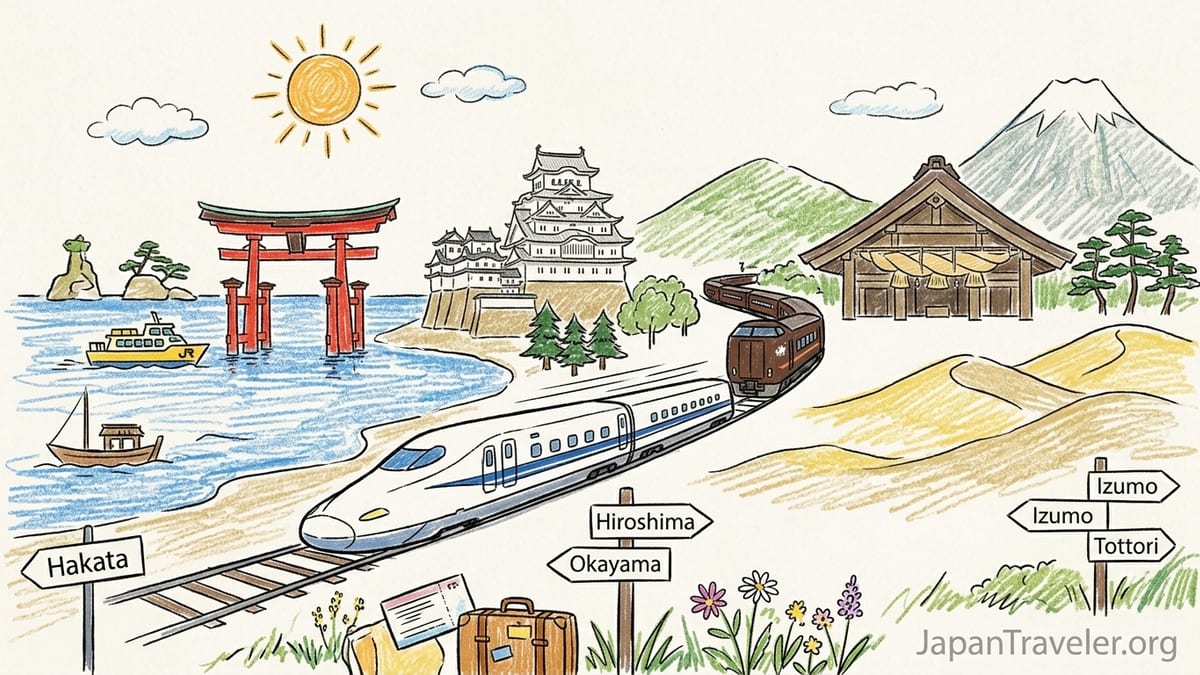
What the Sanyo-San'in Area Pass Actually Covers
JR West’s Sanyo-San'in Area Pass is a 7-day regional rail pass currently priced at about 23,000 yen for adults. It is sold only to short-term visitors and is designed as a full-region ticket for western Honshu, combining the busy Sanyo corridor with the more rural San'in side. At its core, the pass covers JR West trains in Okayama, Hiroshima, Yamaguchi, Tottori and Shimane prefectures, plus key parts of Kansai and northern Kyushu. That makes it a natural fit for travelers who want to link Kansai with Chugoku and finish around Fukuoka, or reverse the direction.
Most importantly, the pass includes non-reserved and reserved seats on the Sanyo Shinkansen between Shin-Osaka and Hakata, with the usual exceptions for premium Nozomi and Mizuho services. In practice that means you can ride Hikari and Sakura Shinkansen trains from Shin-Osaka through Himeji, Okayama, Hiroshima, Kokura and on to Hakata without paying anything extra during the validity period. For many itineraries, just one or two of these long Shinkansen segments already cover a large portion of the pass price.
On conventional lines, the Sanyo-San'in pass covers JR West limited express and local trains throughout the region. That includes the limited express Yakumo between Okayama and Izumo-shi, the Super Oki along parts of the San'in coast, and local lines such as the Kure Line tracing the Seto Inland Sea between Hiroshima and Mihara. Combined with the Shinkansen coverage, you can use the pass to connect large cities quickly, then slow down onto scenic local routes without constantly thinking about ticket machines.
Beyond rail, the pass usually covers the JR West Miyajima ferry between Miyajimaguchi and Miyajima, which turns the classic Hiroshima and Miyajima combination into a simple tap of the ticket gates. It may also include selected JR West buses within the valid area, though these are rarely the primary reason to buy the pass. The value lies overwhelmingly in how much high-speed and intercity rail travel you can fit into seven consecutive days.
Key Alternatives: Kansai-Hiroshima, Kansai-San'in, Setouchi and Okayama-Hiroshima-Yamaguchi
The Sanyo-San'in Area Pass is not the only JR West ticket competing for your itinerary. The most directly comparable products are the Kansai-Hiroshima Area Pass, the Kansai-San'in Area Pass, the Setouchi Area Pass and the narrower Okayama-Hiroshima-Yamaguchi Area Pass. All of these are aimed at visitors linking Kansai with parts of Chugoku, but each pulls the coverage map differently and trims the number of days to keep the price down.
The JR Kansai-Hiroshima Area Pass is a 5-day product priced at around 17,000 yen. It gives you Sanyo Shinkansen access as far as Hiroshima but not beyond, plus JR lines in Kansai including Osaka, Kyoto and Kobe. It is ideal for travelers who only want to reach Hiroshima and Miyajima from Kansai and then return, without venturing to the San'in coast or down to Fukuoka. A round trip by Shinkansen between Shin-Osaka and Hiroshima already gets very close to the cost of the pass, and local trains to Himeji, Osaka airport transfers on the Haruka limited express, and JR lines within Hiroshima tip it into good-value territory.
By contrast, the Kansai-San'in style passes focus on the Sea of Japan side, linking Kyoto, Osaka and sometimes Okayama with Tottori and Shimane but not extending to Hiroshima. They work well for itineraries built around Kinosaki Onsen, Tottori dunes, Matsue and Izumo Taisha, but they do not cover the high-speed Sanyo Shinkansen corridor. If you plan to include Hiroshima or Fukuoka, these passes will not be sufficient.
The Setouchi Area Pass typically offers 7 days of travel across JR West lines around the Seto Inland Sea, together with certain private ferries and connections into Shikoku. Priced slightly below the Sanyo-San'in pass, it includes Osaka, Okayama and Hiroshima and extends over parts of Shikoku via the Seto-Ohashi Bridge. However, it does not reach as far as the full San'in stretch or all the way to Fukuoka. For travelers who want to mix Honshu’s Sanyo coast with Shikoku islands such as Naoshima, Setouchi can be a smarter buy than Sanyo-San'in.
The Okayama-Hiroshima-Yamaguchi Area Pass is a 5-day product, usually around 17,000 yen, focused tightly on the Sanyo Shinkansen between Okayama and Shimonoseki and surrounding conventional lines. It does not include Kansai cities like Kyoto or Osaka and does not go as far as Fukuoka. This narrower pass is a good choice if you are already in Okayama or Hiroshima and want to explore westwards along the Sanyo coast without needing the extra coverage and days of the larger Sanyo-San'in or Setouchi passes.
When the Sanyo-San'in Area Pass Beats Single Tickets
To understand when the Sanyo-San'in Area Pass pays off, it helps to look at real point-to-point fares. A non-reserved one-way Shinkansen ride from Shin-Osaka to Hiroshima typically costs close to 10,000 yen. Shin-Osaka to Hakata is usually in the low to mid-teen thousands of yen one way, depending on the train and seat. Intercity limited express rides on lines like the Yakumo between Okayama and Izumo-shi commonly run into the 5,000 to 7,000 yen range one way for reserved seats.
Imagine you plan to travel from Kyoto to Hiroshima by Shinkansen, spend a day visiting Miyajima, then continue to Fukuoka and finally take the Yakumo limited express from Okayama up to Izumo Taisha before returning to Osaka. Bought as regular tickets, Kyoto to Hiroshima, Hiroshima to Hakata, Hakata back to Okayama, plus the Yakumo round-trip to Izumo and various local JR hops around Hiroshima, Fukuoka and Osaka would easily exceed 30,000 yen in base fares alone, even before adding seat reservations. In that context, spending 23,000 yen on a Sanyo-San'in pass produces a meaningful saving.
The pass becomes particularly attractive when your route zigzags across the region instead of following a simple one-way line. For example, a traveler flying into Kansai Airport might ride the Haruka limited express to Osaka, take the Shinkansen to Himeji for a day trip, continue on to Hiroshima, explore Miyajima, move on to Fukuoka, and then swing north to Tottori or Matsue before looping back to Kyoto. The cumulative cost of several Shinkansen legs, a limited express northbound, and scattered local trains over seven consecutive days will usually push past the pass price.
Where the Sanyo-San'in pass does not make sense is for travelers who only intend to ride one long Shinkansen trip and then stay put. If you were simply going from Osaka to Hiroshima for a three-night stay and back, or Kyoto to Fukuoka for a one-way relocation, a narrower 5-day pass like Kansai-Hiroshima or Okayama-Hiroshima-Yamaguchi, or even just individual tickets plus an IC card for urban travel, may cost less. As a rough rule, the Sanyo-San'in pass shines when your plan includes at least two long Shinkansen segments plus a significant limited express or coastal detour within a tight seven-day window.
Sample Itinerary 1: Kansai to Fukuoka with a San'in Detour
Consider a traveler arriving in Kyoto and departing from Fukuoka with seven full days in between. A realistic route might look like this: Kyoto to Himeji for a half-day castle stop, then onward to Hiroshima; a full day based in Hiroshima with an excursion to Miyajima; a Shinkansen hop to Hakata; then a long arc back through the San'in coast before ending in Fukuoka. Using the Sanyo-San'in Area Pass, this itinerary feels natural rather than expensive.
On day one, you take the JR Special Rapid from Kyoto to Himeji, covered by the pass, spend a few hours at Himeji Castle, then board a Sanyo Shinkansen Hikari or Sakura to Hiroshima, again included. Regular tickets for Kyoto to Himeji and then Himeji to Hiroshima would already account for a healthy slice of the 23,000 yen pass price. On day two, you ride local JR trains to Miyajimaguchi and the JR ferry to Miyajima and back. Without a pass, the combination of city trams, local JR lines and ferry fees starts to add up, especially for families.
Day three sees you board the Shinkansen from Hiroshima to Hakata, where you use local JR lines to explore Fukuoka or even take a quick side trip up to Mojiko Retro via Kokura. On days four and five, you might head back east but on the Sea of Japan side: Hiroshima to Okayama by Shinkansen, change to the Yakumo limited express for Matsue or Izumo-shi, then spend a night in a hot spring town like Tamatsukuri Onsen. On days six and seven, slow local trains along the San'in Line connect you through Tottori and back towards Himeji or Kyoto if you still need to position for a flight or onward journey. Every segment mentioned is within the Sanyo-San'in coverage, so each new side trip increases the value you extract from the pass.
Compared with regular tickets, you have used at least two major Shinkansen legs, a long limited express ride, several regional hops and a ferry. Line those up at station ticket counters and you are deep into the 30,000 to 40,000 yen range. With the pass locked in at around 23,000 yen, the difference can easily fund nicer accommodation or a splurge meal in Hiroshima or Fukuoka.
Sample Itinerary 2: Hiroshima and Setouchi vs a Narrower Pass
Now imagine a different traveler who is not as interested in Fukuoka or the far San'in coast. They are based in Osaka for several days, want to visit Himeji, Hiroshima and Miyajima, and maybe add Onomichi or Kurashiki as side trips, all within five days of intensive travel. Here, the Kansai-Hiroshima Area Pass or Setouchi Area Pass may beat the Sanyo-San'in pass on value, even though the latter has wider coverage.
Suppose the plan is: Osaka to Hiroshima by Shinkansen, two nights in Hiroshima with full use of local JR lines and a Miyajima day trip, then Shinkansen back to Shin-Osaka with a stop in Himeji, followed by a final day of JR travel around Kyoto and Nara. A Kansai-Hiroshima pass at about 17,000 yen covers all the Shinkansen legs between Shin-Osaka and Hiroshima, the JR Miyajima ferry, and the major JR lines in Kansai. A standalone round trip Shinkansen between Shin-Osaka and Hiroshima normally approaches the same price, which means everything else you do on those five days is effectively discounted.
If you added Shikoku islands such as Naoshima or Shodoshima into this plan, the Setouchi Area Pass becomes competitive. It typically allows Shinkansen travel between Shin-Osaka and Hiroshima, as well as JR connections and private ferries across the Seto Inland Sea. For travelers whose “Chugoku” trip is really about the inland sea and art islands rather than the full breadth of the San'in and Sanyo coasts, Setouchi offers more relevant coverage for slightly less than the Sanyo-San'in pass. In that context, paying extra for an untouched San'in and Fukuoka allowance does not improve your trip.
The key lesson from this itinerary is that wider coverage is only valuable if you actually use it. When your movement is confined between Kansai and Hiroshima with maybe one or two inland diversions, a narrower 5-day pass often provides the same rail experience at a lower price. The Sanyo-San'in pass is overkill if you never travel beyond Hiroshima or leave the Sanyo Shinkansen corridor.
Who Should Choose Which Pass
If your plan is a classic first-timer route focused on Osaka, Kyoto, Nara and a single side trip to Hiroshima and Miyajima, then the Kansai-Hiroshima Area Pass or even a Kansai-wide pass plus individual Shinkansen tickets may be a better match. These passes are built precisely for people who sleep mostly in Kansai and only dash to Hiroshima once. They cost less than the full Sanyo-San'in pass and you do not pay for places you will not see.
By contrast, if your itinerary mentions several of the following in a single week, then Sanyo-San'in becomes a serious contender: Fukuoka or Hakata, Kokura and Mojiko, Onomichi, Kurashiki, Himeji, the Sand Dunes in Tottori, the castle town of Matsue, Izumo Taisha, hot springs along the San'in line such as Kinosaki or Tamatsukuri, plus time in Osaka or Kyoto at one end. The more you crisscross between Sanyo and San'in, the more irreplaceable the broad coverage of Sanyo-San'in becomes.
The Okayama-Hiroshima-Yamaguchi Area Pass suits travelers who are already in western Honshu and do not need Kansai at all. For example, someone flying into Hiroshima or Okayama and spending five days doing day trips to Miyajima, Iwakuni, Yamaguchi and Onomichi would rarely need the Sanyo-San'in pass. Their entire world is inside the smaller pass map. In the same way, a Kansai-San'in pass works well for Kyoto-based trips that only dip up to Tottori and Shimane before returning to Kansai.
Finally, the Setouchi Area Pass stands out for travelers who care more about island-hopping and coastal scenery than about ticking every major city in Chugoku. Its mix of JR rail and key ferries around the Seto Inland Sea can make logistics much smoother for routes centered on Okayama, Hiroshima, Takamatsu and the art islands, while still providing enough Shinkansen access for one or two long jumps. If your notes are full of Naoshima, Shimanami Kaido cycling and seaside towns, Setouchi often provides better value than Sanyo-San'in.
Practical Tips for Using the Sanyo-San'in Pass
To get the most from a Sanyo-San'in Area Pass, anchor your seven valid days around your longest rail days. For example, if you plan slower city sightseeing in Kyoto at the beginning and Fukuoka at the end of your trip, use regular IC cards or simple local tickets on those low-travel days and activate the pass only when you are ready to start moving long distances. That way, all seven days are rich with intercity hops, rather than half of them disappearing into bus rides and short subway movements.
Seat reservations are usually included for eligible trains, though there may be a limit on the number of reserved seats you can book with a single pass. Even when non-reserved seating is available, booking a reserved seat on popular Shinkansen departures between Shin-Osaka and Hiroshima or Hakata is wise, particularly during peak seasons such as late April and early May, mid-August and New Year. You can make these reservations at JR West ticket counters, major station travel centers, or dedicated machines by inserting the pass and selecting your train.
Because the pass rides on JR West tracks only, remember that private railway lines and most city subways are not covered. In Osaka, Kyoto and Kobe, you will often use a mix of JR and private networks. Many travelers pair the Sanyo-San'in pass with an IC card for local buses and non-JR trains, topping up that card as needed while treating the regional pass as the backbone for moves between cities. This avoids surprise gaps where you expected a ride to be included but find the line is operated by a different company.
Finally, think about luggage and station layouts when planning long multi-leg days. Transferring between Shinkansen platforms and limited express trains at hubs like Okayama or Shin-Osaka is straightforward but can still take ten minutes if you are hauling a large suitcase. If your hotel is near a smaller station on a JR line, such as Kurashiki or Matsue, using the pass to take a direct limited express there once, instead of shuttling to and from a bigger hub each day, makes practical use of the coverage while simplifying your days on the ground.
The Takeaway
The Sanyo-San'in Area Pass is not the default choice for every trip through western Japan. It is a specialist tool built for travelers who want to experience multiple faces of the Chugoku region in a concentrated seven-day window: the castle towns and gardens of Okayama and Matsue, the atomic history and coastal beauty of Hiroshima and Miyajima, the hot springs and shrines of the San'in coast, and the urban energy of Osaka and Fukuoka. If that describes your ambitions, its wide coverage and inclusion of Sanyo Shinkansen services make it one of the strongest-value passes in the JR West lineup.
If, on the other hand, your travel map is limited to Kansai and a single out-and-back visit to Hiroshima, then smaller, cheaper alternatives like the Kansai-Hiroshima Area Pass or Setouchi pass are often better suited. The smartest way to choose is not to ask which pass is “best,” but to sketch your real train days, look up approximate Shinkansen and limited express fares, and only then compare the totals against each pass price. When you do that honestly, the cases where Sanyo-San'in wins stand out clearly.
FAQ
Q1. Does the Sanyo-San'in Area Pass include Shinkansen travel between Osaka and Fukuoka?
The pass includes Sanyo Shinkansen services between Shin-Osaka and Hakata on eligible trains such as Hikari and Sakura, but it does not cover premium Nozomi or Mizuho services. You simply board the covered trains within the valid area and show your pass at the gates or use automatic gates if available.
Q2. Can I use the Sanyo-San'in pass to travel into Tokyo?
No. The pass does not cover the Tokaido Shinkansen east of Shin-Osaka and cannot be used between Shin-Osaka and Tokyo. If Tokyo is part of your plan, you will need separate tickets or a different nationwide pass for that section and can then activate the Sanyo-San'in pass later for the western portion of your trip.
Q3. Is the pass good value if I only visit Hiroshima from Osaka?
Usually no. For a simple round trip between Osaka or Kyoto and Hiroshima with minimal additional long-distance travel, a 5-day Kansai-Hiroshima Area Pass often offers better value, or even regular Shinkansen tickets if your dates are fixed and you are not planning extra side trips by JR trains.
Q4. Does the Sanyo-San'in pass cover Miyajima Island access?
Yes, the pass typically includes the JR West Miyajima ferry between Miyajimaguchi and Miyajima. It also covers the JR local trains you will use from Hiroshima Station to reach Miyajimaguchi, so the entire journey from Hiroshima to Miyajima and back is normally included.
Q5. Can I travel on the San'in coast, such as to Tottori and Matsue, with this pass?
Yes. One of the main strengths of the Sanyo-San'in pass is that it covers JR West lines along the Sea of Japan side, including routes to Tottori, Yonago, Matsue and Izumo-shi. Limited express trains like the Yakumo between Okayama and Izumo are included within the validity area.
Q6. How should I time the activation of my Sanyo-San'in pass?
Activate the pass on the first day when you start making long-distance JR journeys, such as your initial Shinkansen departure from Kansai or Fukuoka. Use regular tickets or an IC card for earlier days that are mostly local city transport so that all seven pass days are filled with intercity travel.
Q7. Can I make seat reservations with the Sanyo-San'in pass?
Yes. The pass allows seat reservations on eligible Shinkansen and limited express trains within the coverage area, subject to any published limits on the number of reserved seats per pass. Reservations can be made at JR West ticket counters and machines by presenting or inserting your pass.
Q8. Is the Sanyo-San'in pass valid on private railways and city subways?
No. The pass is limited to JR West-operated trains and specified JR West buses and ferries. Private railways, city subways and non-JR buses require separate tickets or an IC card, even if they operate in the same cities as JR lines.
Q9. Should I choose the Sanyo-San'in pass or the Setouchi pass if I want to visit Naoshima?
If your itinerary centers on the Seto Inland Sea and islands such as Naoshima, and you are not planning to go as far as Fukuoka or deep into the San'in coast, the Setouchi Area Pass often aligns better with your routes and can cost slightly less. Sanyo-San'in is more suitable if your plans extend beyond the inland sea to places like Fukuoka, Tottori or Matsue.
Q10. Can I buy or exchange the Sanyo-San'in Area Pass after I arrive in Japan?
Yes. The pass can usually be purchased online before your trip through official channels and travel agents, or exchanged and bought at major JR West stations within the valid area once you arrive. Availability and exact procedures can change, so it is wise to confirm current purchase options shortly before your departure.