


I went to Japan expecting “the Alps” to be one thing. Instead, the Northern, Central, and Southern Japanese Alps felt like three different travel products with different learning curves, costs, transit friction, and payoffs. On my most recent trip, I based myself around the Northern Alps (with day trips into its famous gateways) and used the Central Alps for an easy high-alpine hit plus a classic Kiso Valley culture stop. For the Southern Alps, I did not visit on this trip; that section is researched, built from current access rules, bus seasons, and what you realistically need to plan to reach the major trailheads.
How I Framed The Comparison (Travel Product, Not Individual Peaks)
I didn’t judge these ranges by a single “best mountain.” I judged them by what it feels like to use each region as a traveler: how quickly you can get from a major station to scenery, how much effort it takes to reach trailheads, whether trails are forgiving for first-timers, and what your nights look like when you come down (food, baths, and bed choices).
I also treated public transport and season windows as part of the product. If a place is spectacular but only reachable during a narrow bus season or with multiple transfers, that changes who it works for. A first-time mountain traveler usually has two stress points: getting to the trailhead without a car and finding a safe, enjoyable route that still feels “Alpine.”
Finally, I kept it grounded in recognizable “trip shapes.” Think: a two-night stay in Matsumoto with a day in Kamikochi, or a one-night stop in Komagane for a ropeway-based alpine walk, or a longer, logistics-heavy push into the Southern Alps where a missed connection can cost you a summit day.
Northern Japanese Alps: The Broadest Mix, The Easiest Payoff (Firsthand)
If your Japan Alps image involves a famous river valley with boardwalks, mirror-still ponds, and big jagged ridgelines rising fast, the Northern Alps deliver that quickest. On my trip, the region felt like the most “plug-and-play” combination of iconic scenery and established infrastructure, especially around well-known gateways like Kamikochi, Tateyama, and Hakuba.
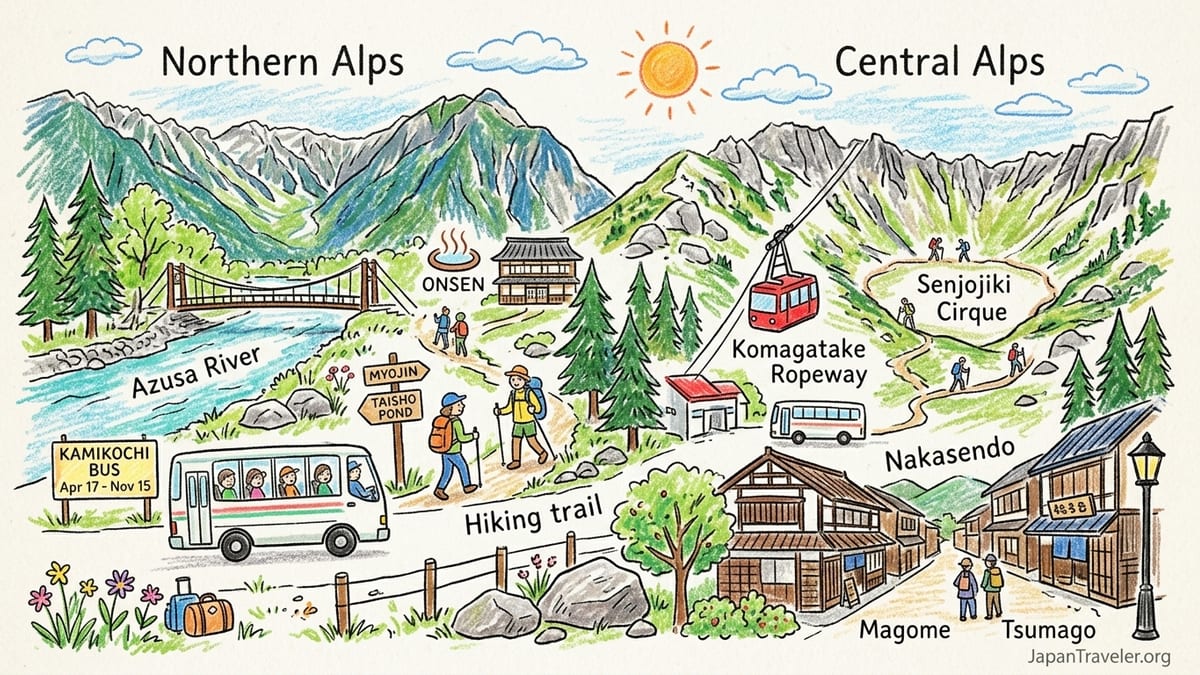
Kamikochi is the clearest example of why the Northern Alps work for first-timers. The valley is designed for people who want Alpine views without committing to a technical hike: you can walk wide, maintained paths near Kappa Bridge, continue toward Myojin, or start at Taisho Pond for a classic point-to-point day. The practical piece is that the 2026 bus operating season to Kamikochi runs from April 17 to November 15, with the park’s official opening to the public noted for April 27 in 2026. That clarity matters when you are planning flights and hotels around shoulder season.
Another Northern Alps advantage is “famous gateway density.” Tateyama’s cross-mountain route is not just a way to see peaks; it’s a sightseeing system with multiple transport modes and a defined operating period for 2026 from April 15 to November 30. For travelers who want big mountain atmosphere without committing to a multi-day hut itinerary, that kind of structured access feels like a cheat code.
Hakuba adds a completely different flavor: a resort valley with lodging depth, rental shops, and a ski identity that still works in green season for hiking and lifts. Even if you never clip into skis, Hakuba’s transport and service ecosystem feels built for travelers, not just climbers, and that changes how confident a first-timer feels navigating the mountains.
Central Japanese Alps: The Best “High Alpine in a Day” Plus Kiso Culture (Firsthand)
The Central Alps impressed me as the most efficient “high-alpine sampler.” If you want to stand above treeline quickly and do a short, scenic loop without a long approach hike, the Central Alps can feel like the best return on time, especially around the Komagatake Ropeway and Senjojiki Cirque.
The reason is simple: you ride a ropeway to serious elevation. Senjojiki Cirque sits in a dramatic bowl beneath sharp ridgelines, and the ropeway delivers you close to that environment without an all-day grind. The ropeway’s headline number travelers cite is reaching around 2,612 meters, and in practice that means cooler temps and fast-changing weather even in summer. On the ground, it felt like “instant alpine”: lingering snowfields in the shoulder seasons, crisp air, and a trail network that is short enough to manage as a half-day or day trip, assuming you respect the weather.
Transit was also more structured than I expected. The official ropeway timetable guidance emphasizes regular bus connections from JR Komagane Station to the ropeway area, and it’s the kind of system where you can plan your day around predictable departures rather than improvising with taxis. I found that matters when you are trying to avoid turning an alpine visit into an overnight commitment.
The other Central Alps win is how naturally it pairs with the Kiso side, where the trip shifts from high ridges to historic Nakasendo towns. On the same general corridor, you can go from an alpine cirque walk to an afternoon wandering post towns like Magome and Tsumago, where the “product” is cobbled lanes, old-style facades, and snack stops that feel like a different Japan entirely. For travelers who want mountains plus heritage without crossing half the country, Central Alps planning fits neatly into a wider itinerary.
Southern Japanese Alps: Wilder, More Complex, More Commitment (Researched)
I did not visit the Southern Japanese Alps on this trip; this section is researched. The consistent theme in official access information and current bus operations is that the Southern Alps feel more like a wilderness trip that happens to exist in Japan’s transit-rich landscape, rather than a seamless extension of it.
Minami Alps National Park spans Yamanashi, Shizuoka, and Nagano, and it includes major peaks like Kitadake. But the “product” differs from the Northern and Central Alps because trailheads can be far from rail hubs, and the last-mile access can be constrained by seasonal road rules and limited bus windows. For example, official 2026 guidance for the Hirogawara access (a key gateway for routes toward Kitadake) indicates the mountain bus and taxi service is scheduled to operate from June 26 to November 3. That’s a narrower and later-starting season than Kamikochi’s bus period, and it changes who can realistically plan a Southern Alps trip without a car.
There is also the practical matter of disruptions. Southern Alps planning often involves forest roads, controlled access corridors, and services that can change due to weather damage or maintenance. Even when routes are “open,” you may need to accept that a single closed road can force a full re-plan. That is not a dealbreaker, but it makes the range better for travelers who enjoy logistics and flexibility, not those who want an effortless mountain day between Tokyo and Kyoto.
When it works, the Southern Alps promise a different payoff: fewer people, longer approaches, and a more immersive backcountry feel. But the “wilder” experience is not just about scenery. It’s about committing to a plan where your trailhead day is part of the adventure, not a simple transfer you do half-asleep with a coffee in hand.
Accessibility and Public Transport: Where The Friction Shows Up
The Northern Alps are the easiest to use as a public-transport traveler because multiple hubs have clear, seasonal service patterns designed for visitors. For Kamikochi, the 2026 operating window for buses is clearly published as April 17 to November 15, and that kind of simple date range makes it straightforward to build an itinerary around a Matsumoto base. It also means that even if you’re not climbing peaks, you can still “do the Alps” as a day trip with minimal translation or guesswork.
For Tateyama, the key advantage is the formal, end-to-end sightseeing route across the range with a published 2026 season from April 15 to November 30. In practice, that feels like a curated alpine crossing you can execute even if you are not an experienced hiker, as long as you plan your start time and accept that the day is structured around transport connections.
The Central Alps sit in the middle for friction: easier than the Southern Alps, slightly more planning than the Northern Alps, but very efficient once you understand the ropeway-and-bus pipeline. From a traveler standpoint, the ropeway model is powerful: it compresses effort into a ticket purchase and a timetable, which is often exactly what first-timers want.
The Southern Alps show the most friction because the access product is seasonal and narrower. The researched details around Hirogawara services and limited operation periods underline the reality: you are planning around specific dates, not “anytime in summer,” and that reduces spontaneity. If your Japan trip is already tight, that friction can be the deciding factor.
Trails, Difficulty, Onsen Nights, Crowds, Skiing, and Culture Stops
For first-time mountain travelers, the Northern Alps offer the most forgiving trail menu. In Kamikochi, you can scale your day: a flat riverside stroll, a moderate out-and-back, or a longer linking walk that still keeps you on clear paths with plenty of other people around. That last point sounds unromantic, but it’s a safety feature for first-timers who are still learning pacing, weather judgment, and gear needs.
The Central Alps excel at “short but real” alpine walking. Around Senjojiki Cirque, the difficulty is less about technical trail and more about mountain conditions: temperature swings, wind, and visibility changes that can feel intense at elevation even on a short route. For beginners who want a dramatic mountain setting without committing to a long climb, it’s a sweet spot, but it rewards conservative decision-making and a willingness to turn around.
The Southern Alps, by reputation and by the access constraints, are more commitment-heavy. Longer approaches and fewer easy bailouts tend to raise the bar. That can be perfect if you are already comfortable with all-day hiking and route planning, but it’s not the most relaxing “my first Japan mountain trip” choice, especially if you are also juggling city travel, jet lag, and language fatigue.
For accommodation and onsen, the Northern Alps generally give you the deepest bench of choices because the gateways are established: you can combine mountain days with onsen towns and resort-style lodging, and you are less likely to face a “there are only two places to stay and one is full” scenario. The Central Alps can feel a touch more limited at the immediate ropeway base, but it pairs well with broader Nagano travel where you can sleep in a larger town and day-trip. The Southern Alps, meanwhile, often push you toward specific staging areas near access points, and that concentrates demand into fewer beds.
Crowds are the trade-off. The Northern Alps, especially Kamikochi in peak summer and autumn color season, can feel busy on the main paths. The Central Alps can bottleneck around ropeway timing because a lot of people arrive in pulses. The Southern Alps tend to be less crowded once you are past the access pinch points, but you pay for that solitude with planning complexity.
Skiing tilts strongly toward the Northern Alps for most travelers because places like Hakuba operate as international resort valleys, with transport guidance aimed at visitors and a full-service ecosystem of rentals, lessons, and après options. The Central Alps have winter appeal too, but the big, widely marketed “destination ski valley” feel is most obvious in the Northern Alps. The Southern Alps are not the go-to product for mainstream resort skiing in the way Hakuba is; they appeal more to people chasing wilderness and long mountain days.
For cultural stops, the Central Alps get a special mention because the Kiso Valley and Nakasendo towns are an easy thematic pairing with a mountain trip. If you want your itinerary to include a recognizable “historic Japan” segment without detouring far from the Alps corridor, the Central Alps plus Kiso is a natural combo.
The Takeaway
The Northern Japanese Alps worked best for my trip overall because they let me mix famous scenery, a wide range of hiking difficulty, and high-confidence public transport access in the same region. If you are traveling without a car and want the broadest menu of mountain experiences, the Northern Alps are the most flexible product, with Kamikochi for easy-to-moderate walking, Tateyama for a structured alpine crossing experience, and Hakuba for a resort base that transitions between hiking season and ski season.
The Central Japanese Alps are the best match for travelers who want high-alpine impact with limited time, plus an easy cultural pairing. If you like the idea of riding up to a serious mountain environment, doing a short, memorable walk, then shifting to heritage towns and regional food in the Kiso Valley, the Central Alps can be the most elegant fit.
The Southern Japanese Alps are best for travelers who prioritize wilderness and don’t mind logistics. If you enjoy planning around seasonal access windows, you’re comfortable with longer approaches, and you’re specifically seeking a quieter, more backcountry-oriented Japan Alps experience, the Southern Alps are the choice that rewards effort. They are not universally “better,” but they are better at one thing: feeling truly removed.
If you’re a first-time mountain traveler in Japan, my practical suggestion is to start in the Northern Alps to learn the rhythms of alpine weather, Japanese trail culture, and hut-and-onsen logistics. Then, if the mountains hook you, use the Central Alps as your efficient second chapter, and save the Southern Alps for when you want the trip to be about commitment, not convenience.
FAQ
Q1. Which Japanese Alps region is best for first-time mountain travelers?
For most first-timers, the Northern Japanese Alps are the easiest entry because gateways like Kamikochi are scenic, well-serviced, and straightforward by public transport during the main season.
Q2. When is Kamikochi open in 2026?
The 2026 bus operating season is published as April 17 to November 15, and the park’s official public opening is noted for April 27, 2026.
Q3. Is Tateyama doable without hiking experience?
Yes. The Tateyama Kurobe Alpine Route is a structured sightseeing corridor with multiple transport segments and a defined operating season, so you can experience high mountains without a strenuous hike.
Q4. What’s the Central Alps “signature” experience for a short trip?
Riding the Komagatake Ropeway to reach the Senjojiki Cirque area quickly, then doing a short alpine walk with big scenery and minimal approach time.
Q5. Can I combine the Central Alps with historic towns easily?
Yes. The Central Alps pair naturally with the Kiso Valley side trip, including classic Nakasendo post towns like Magome and Tsumago.
Q6. Why are the Southern Japanese Alps considered more wilderness-oriented?
They generally involve longer approaches, fewer easy-access gateways, and access that can depend on seasonal bus operations and forest road conditions, so the experience feels more backcountry.
Q7. What is the typical access window for Hirogawara in 2026?
Published 2026 information indicates the mountain bus and taxi service to Hirogawara is scheduled to operate from June 26 to November 3.
Q8. Which region is best for skiing as part of a mountains trip?
The Northern Alps, especially the Hakuba area, are typically the most straightforward for travelers seeking a resort-style ski base with extensive visitor services.
Q9. Which region has the most developed trail and visitor infrastructure overall?
The Northern Alps generally offer the broadest infrastructure mix, with multiple famous gateways, well-known trail networks, and a range of lodging styles around them.
Q10. If I only have two nights for an Alps side trip from Tokyo, what should I pick?
Most travelers will find the Northern Alps easiest to execute, often by using Matsumoto as a base and visiting Kamikochi during the published operating season.