

I spent eight days in Japan’s Alps in early October, arriving by train into Matsumoto and then leapfrogging by local rail and buses through Kamikochi, Takayama, Tateyama, and a short slice of Kiso. Before I showed up, I pictured a tidy, Swiss-like mountain holiday where you hop off a train, walk ten minutes, and you are instantly on a ridge with a perfect view. The reality was better and wilder, but also slower, wetter, and far more logistics-heavy than any Tokyo-Kyoto itinerary. I slept in a mix of business hotels near stations, a ryokan-style onsen stay, and a mountain-adjacent lodge where dinner started early and everything went quiet by nine. I did not rent a car; the trip was almost entirely train and bus, with one long day of high-altitude transport where the transit itself was the attraction.
What surprised me first: the Japanese Alps are not “one place”
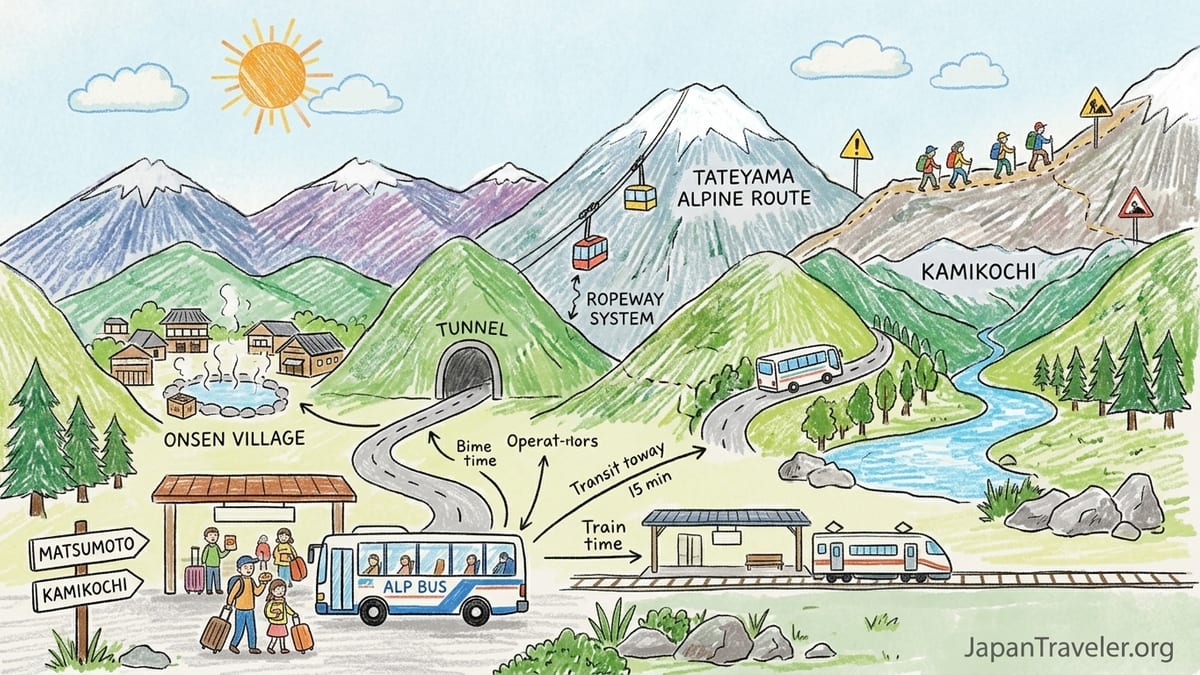
On my map, everything looked connected. In real life, the Japanese Alps are a web of valleys, basins, and gateways where you repeatedly drop down to transit nodes, switch operators, and accept that the “mountain shortcut” is often a tunnel, a bus transfer, or a timetable you must respect. I felt this immediately in Matsumoto, which looks like a simple launchpad but functions more like a dispatch center: luggage lockers, bus counters, early departures, and travelers buying snacks because they know convenience stores vanish as soon as the road climbs.
The biggest mental shift was realizing that the Alps here are experienced in layers. Gateway towns like Matsumoto and Takayama feel functional and well-served. Alpine valleys like Kamikochi feel curated and protected, with access controlled by shuttle systems. High-altitude transit corridors like Tateyama feel like a moving museum of weather and geology. Onsen villages feel like the recovery room. And the actual mountain trails feel like their own universe, where time stretches and minor mistakes multiply.
Even language familiarity changes by altitude. In towns, I could point, pay, and move on. Higher up, the signs became more about safety and conditions, and the conversations became more about timing: last buses, closing restaurants, whether a trail was open, whether fog was lifting, whether the next ridge was already under cloud.