


I didn’t “book the best hotel in the Japanese Alps.” I built a lodging strategy around trailheads, bus clocks, and bad-weather backup days, then adjusted in real time when forecasts and first/last departures made my original plan impractical. My final setup looked like this: three nights in Matsumoto as the rail-connected launchpad into the Northern Alps, two nights in Takayama for the western-side culture and bus links, two nights in Okuhida (Hirayu Onsen area) to cut door-to-trailhead time and make early starts realistic, and one night in a mountain hut to buy a sunrise and reduce risk on a long route. The wins were the bases that matched my transport reality, especially when a storm forced a same-day pivot; the failures were the nights that looked “closer to the mountains” on a map but stranded me behind a last-bus cutoff or a breakfast schedule that started too late.
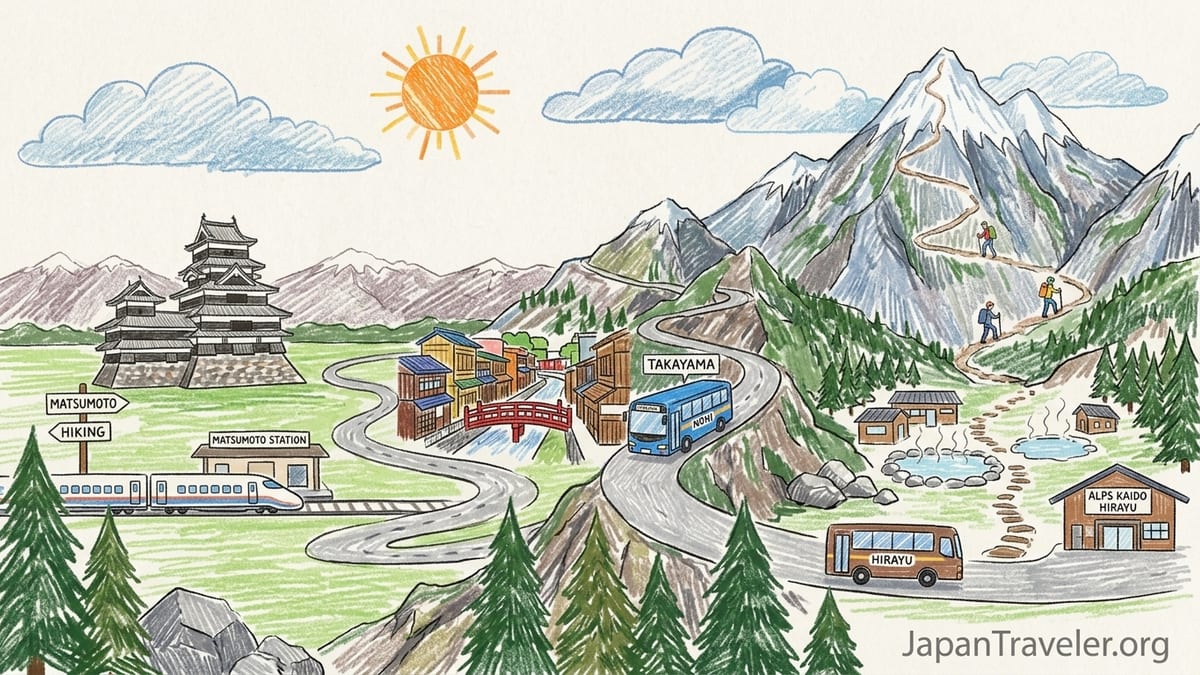
My Lodging Strategy, In Real Nights: What Worked, What Failed
I started with a simple rule: if I planned to hike more than two consecutive days, I needed a base that let me reach a trailhead without gambling on a single early bus and without returning so late that dinner and groceries were closed. That’s why my first block of nights went to Matsumoto. It’s a city base, yes, but it’s a productive city base: rail connections, early breakfasts, plenty of places to eat after you get back, and enough “non-hiking” value (castle, museums, neighborhoods) that a weather day wouldn’t feel wasted.
From there, I switched to Takayama. The idea wasn’t that Takayama is closer to every peak; it isn’t. The point was that Takayama functions as a second hub on the western side, with a bus center that makes some of the big Japanese Alps day-trip corridors workable. It was also my reset base: laundry, gear re-pack, and a place where late dinner was still an option after a long bus ride back from the mountains.
The step that changed everything, though, was moving “up-valley” to Okuhida for a couple nights. This is where the trip stopped being about heroic wake-up times and started being about consistent early starts. Hirayu Onsen, in particular, is a practical junction: seasonal buses run between Takayama and Kamikochi, and Hirayu sits on that corridor. The tradeoff is that you sacrifice urban convenience. If you run out of snacks, forget a charger, or miss a bus, your margin for error gets thin fast.
My only true “failure” night was one I originally chose because it looked convenient for an early hike. In practice, the property’s breakfast time didn’t align with the first bus, and dinner options nearby were limited if I arrived back late. That mismatch taught me a lesson I now consider non-negotiable in the Alps: your base is only as good as its morning schedule and its last-bus rescue plan.
Matsumoto: The Gateway Base That Saves Plans When Weather Turns
Matsumoto is one of the main gateways into the Northern Alps because it plugs into Japan’s intercity network, and that matters more than most hikers admit. If you’re coming from Tokyo, Nagoya, or Nagano, Matsumoto is the kind of place where you can arrive, store luggage, buy last-minute gear, eat well, and still be set up for an early departure the next day. It’s also the base that makes “Plan B” painless when forecasts collapse your hiking day.
For Kamikochi specifically, what makes Matsumoto powerful is the combination of local rail and bus. In-season, Alpico publishes a dedicated Kamikochi timetable that runs from April 17, 2026 through November 15, 2026, and the point isn’t just that buses exist; it’s that you can plan around exact departures and returns. The practical reality in Kamikochi is that you should treat the late-afternoon window as your hard cutoff. Kamikochi’s official guidance notes that the last bus leaves the Kamikochi Bus Terminal around 6 p.m. and warns travelers to double-check, which is code for “don’t assume you can linger.” If your day drifts and you miss that last departure, your base choice stops being a preference and becomes a problem.
Here’s what “door-to-trailhead” looked like for me when I used Matsumoto as a hiking launchpad: hotel to Matsumoto Station in a quick local transit hop or walk, then onward to the Kamikochi Line connection and bus corridor. On paper, that’s straightforward. In real life, the risk is the tail end of the day: an extra hour on the trail can snowball into a crowded bus terminal and a tight connection back to Matsumoto. One afternoon, a forecast update made me shorten a route and return earlier than planned. In Matsumoto, that wasn’t a defeat. It became a castle-and-coffee afternoon followed by a proper dinner, gear drying, and a reset for the next day.
Base selection takeaway: Matsumoto is best when you want car-free flexibility, easy station access, and a safety net for cancelled hikes. It is not the best when your goal is “first tracks at dawn” on popular trails, because you are still downstream from the earliest trailhead moments.
Takayama: The Western Hub For Culture, Buses, And Late-Night Food
Takayama works as a base because it’s a full-service town in the mountains, not just a stop. It’s also a different kind of gateway: instead of pulling you in from Tokyo by one main rail corridor, it positions you on the western side with bus routes that reach mountain access points and scenic corridors that don’t route naturally through Matsumoto.
The detail that matters for base selection is Takayama’s bus center. The Nohi Bus network publishes seasonal schedules for key routes, and for Kamikochi access specifically, it operates a line that runs from Takayama Nohi Bus Center to Kamikochi in season. For the 2026 season, Nohi’s English route page states operations from April 17, 2026 to November 15, 2026, and shows departures beginning early in the morning, including a 6:00 a.m. departure from Takayama. That single time is more than trivia. It defines what kind of hiking day you can have without paying for a closer valley base.
In practice, though, Takayama is where base selection becomes a question of rhythm. If you day-trip into Kamikochi from Takayama, you can have a real day there, but you still have to think backward from the last bus. Kamikochi’s official site repeatedly signals that last departures hover around the early evening and you should confirm, and the difference between “around 6 p.m.” and “I left the trailhead at 4:15 p.m.” is the difference between relaxed and panicked.
Takayama’s hidden strength is what happens when you get back late. In small onsen villages, your dining options can vanish after check-in time. In Takayama, you can miss your ideal bus, arrive back later than planned, and still find dinner. That matters because the Alps do not care about your itinerary. One day, unstable weather turned a hike into a “go in, go out” morning. Returning to Takayama meant I could salvage the day with a long lunch, a second attempt at sightseeing, and a gear shop stop to replace a small item I’d underestimated.
Base selection takeaway: Takayama is best if you want a lively town that can handle late returns, and you’re comfortable with day-tripping to trail areas on a published bus timetable. It’s less ideal if your priority is maximizing time on trail at sunrise or avoiding the daily bus-clock pressure.
Okuhida And Hirayu Onsen: The Sweet Spot Between Trail Access And Comfort
When people say “stay closer to the mountains,” they often mean “Kamikochi.” But in the Japanese Alps, the better question is: how close do you need to be to make your specific start time realistic, and what do you give up to get it? For me, Okuhida was the compromise that actually worked. You get a mountain-valley feel, dependable hot springs, and crucially, a transport junction that shortens the morning and de-risks the evening.
Hirayu Onsen is the practical anchor here. Alps Kaido Hirayu functions as a bus terminal for the area, and it’s not just a signpost; it’s a place with facilities and a clear transport role. The national highway-bus platform information for the Okuhida Onsengo Hirayu stop even notes that buses to Kamikochi depart in roughly 20 to 30 minute intervals during the peak seasonal window, and that the terminal sits within Alps Kaido Hirayu Onsen, a drive-in onsen facility. That kind of detail matters in real travel: it means you can arrive early, wait somewhere sheltered, and still salvage your day if you miss one departure.
Door-to-trailhead from Hirayu to Kamikochi is the biggest reason to use this base. Nohi’s route page shows Hirayu as an intermediate stop on the Takayama to Kamikochi line and emphasizes the seasonal operation period. Alpico also publishes information and timetables for Hirayu Onsen to Kamikochi. In simple terms, this corridor turns “a long day trip” into something closer to a commuter hop. That changes your hiking menu: earlier trail starts, more time for longer loops, and a more forgiving margin if a return bus is crowded or delayed.
The first and last bus problem doesn’t disappear in Okuhida; it changes shape. When you sleep in Hirayu, you’re less likely to miss the morning departure, but you become more dependent on limited evening dining and on your lodging’s rules. This is where I learned to ask base-selection questions that feel boring but save trips: What time is breakfast served, and can they do an early set? If I return after 6 p.m., will there be anywhere to eat? Is there a convenience store within walking distance, or should I buy dinner backup in Takayama before I head into the valley?
Base selection takeaway: Okuhida is worth paying extra for when your priority is trail time and recovery, and when an onsen soak is part of why you came. It’s less ideal if you need a lot of restaurants, nightlife, or last-minute shopping, because the valley closes early.
City Base Vs Valley Base Vs Sleeping In The Park: The Real Tradeoffs
Choosing a base in the Japanese Alps is really choosing what you want your mornings and evenings to look like. A city base like Matsumoto or Takayama buys you flexibility: restaurants, groceries, luggage logistics, and the ability to do something enjoyable if weather cancels your hike. A valley base like Hirayu buys you time on trail and easier dawn logistics, but you trade away late-night convenience. And sleeping inside the mountains or in a hut buys you something else entirely: weather margin and route design freedom.
Here’s how those tradeoffs played out when weather cancelled my original plan. On a stormy morning, the “right” base wasn’t the one closest to the trailhead. It was the one that let me pivot without paying for a taxi or burning half a day traveling to a new area. That’s where Matsumoto’s city-base advantage was obvious: I could keep the day productive without forcing a hike that didn’t make sense. The flip side is equally true: on a perfect forecast day, a city base can feel like a tax. You spend extra time in transit, and your hike begins after the valleys have already warmed and filled with day-trippers.
Sleeping closer to the mountains became worth paying extra the moment I had a hiking day that demanded a true early start. With a valley base, I could show up to the bus terminal early, get on a departure that actually made sense, and still return with enough buffer to handle lines, a slower pace, or a photo stop without missing the final ride out. That buffer is the difference between “fun tired” and “anxious tired.”
Sleeping inside the park or in a hut is the highest-cost move, but it can also be the most rational one, because it changes what’s possible. If your planned route includes a long ascent, or if you care about sunrise, or if you want to reduce exposure to afternoon thunderstorms, a hut night is not a luxury. It’s a route decision. I treated my one hut night as a tactical purchase: it let me start earlier than any bus could deliver me and reduced the chance that a single missed connection would implode the whole day.
Base selection takeaway: city bases are best for flexibility, valley bases are best for consistent early starts, and in-mountain nights are best when your route is the trip and you need weather and time margin more than comfort.
The Unsexy Logistics That Decide Whether A Base Is Actually Good
When you read “Matsumoto is a gateway” or “Okuhida is close to the mountains,” you still don’t know if a base will work for your actual days. The difference between a smooth trip and a stressful one is often found in logistics that don’t fit into glossy descriptions: luggage storage, breakfast hours, parking realities, and what happens when you’re forced to change plans at the last minute.
Luggage strategy is the first base decision most people skip. If you’re moving from city to valley and back, you do not want to drag your full suitcase onto buses meant for hikers. In Kamikochi itself, the official site notes there’s a baggage room on the first floor of the Kamikochi Bus Terminal and that there are no coin lockers. That single fact affects how you day-trip: a staffed baggage room has hours and a process, and “no coin lockers” means you can’t casually count on self-serve storage for a late return. In Matsumoto and Takayama, by contrast, station-area storage and hotel bag holds tend to be easier to integrate into a multi-base strategy.
Bus clocks are the second decision point. Kamikochi’s official guidance repeatedly flags that last departures are around the early evening and should be double-checked. Alpico’s 2026 timetable PDF for the Matsumoto and Shin-Shimashima corridor is concrete down to the minute during the April 17 to November 15 window. When you base in a city, you must plan your hike backward from those returns, not forward from your dream itinerary. If you base in a valley, you still plan backward, but the margin expands.
Parking and car-free travel are the third decision. Kamikochi markets itself as a car-less resort area, and official access guidance emphasizes that you park at Sawando or Hirayu and continue by low-pollution shuttle bus or taxi. If you have a rental car, a valley base can reduce complexity because you can park, shuttle, hike, and return without threading multiple city connections. But a car also adds a different pressure: you must match your return to shuttle windows and parking logistics, and you can’t simply “miss the last train” and call it a night in another town without extra cost.
Restaurants and breakfast hours are the final decision point. In city bases, you can get an early breakfast, a convenience-store backup, and a late dinner after a long day. In onsen villages, dinner can be tied to set seating times and kitchens can close earlier than you expect. My rule after one mismatched morning: I now choose a valley base only if it can support an early departure with either an early breakfast option or a grab-and-go solution that doesn’t force me to choose between eating and catching the first bus.
The Takeaway: My Rule For Choosing A Japanese Alps Base
I now choose a base in the Japanese Alps the way I choose a route: by eliminating the failure points first. Step one is transport reality. If I’m traveling car-free and hiking in Kamikochi or along corridors served by seasonal buses, I pick a base that gives me multiple morning departures and a realistic evening return before the “around 6 p.m.” cutoff becomes stressful. Step two is backup value. If the forecast is unstable, I prioritize Matsumoto or Takayama because a weather cancellation becomes a good day instead of a sunk cost.
Step three is the onsen and recovery question. If soaking is part of the reason I’m in the Alps, and I want to hike hard two days in a row, I pay for a valley base like Okuhida or Hirayu. The reduction in door-to-trailhead time is not just comfort; it’s safety margin. It makes it easier to start early, finish with daylight buffer, and return without sprinting for a last bus.
Step four is whether my itinerary is really a day-trip plan or an alpine plan. If the hike I care about is long, sunrise-dependent, or sensitive to afternoon weather, I stop pretending a city base will do it. That’s when a mountain hut or a closer in-park night becomes worth the money. Paying extra for proximity is rational when it replaces a fragile bus chain with a simple start.
In one sentence, my rule is this: I base in Matsumoto or Takayama for flexibility and car-free simplicity, I base in Okuhida for early trail access and onsen recovery, and I sleep in the mountains only when it meaningfully reduces risk or makes the route I want actually possible.
FAQ
Q1. Is Matsumoto or Takayama better as a first base for the Japanese Alps?
Choose Matsumoto if your hikes focus on the Northern Alps and you want strong rail access and easy backup days. Choose Takayama if you want a western-side hub with a lively town and seasonal buses toward Kamikochi and Okuhida.
Q2. What makes Okuhida a smart mountain base instead of just day-tripping from a city?
It shortens door-to-trailhead time and gives you more margin on early starts and last-bus returns, while also adding onsen recovery that’s hard to replicate in city bases.
Q3. How late can I leave Kamikochi and still get out safely by bus?
Treat late afternoon as your practical cutoff and confirm the day’s last departures. Kamikochi’s official guidance says the last bus is around 6 p.m., but it also warns you to double-check.
Q4. Are there coin lockers at Kamikochi Bus Terminal?
No. Kamikochi’s official FAQ says there is a baggage room on the first floor of the bus terminal, but no coin lockers.
Q5. When do seasonal buses to Kamikochi run in 2026?
Many key services publish a seasonal window from April 17, 2026 to November 15, 2026, and you should plan lodging around those dates if you want reliable car-free access.
Q6. What’s the biggest mistake people make when choosing an onsen village base?
Assuming dinner and breakfast timing will match hiking needs. If breakfast starts late or dinner requires early check-in, you can end up missing the first bus or returning to limited food options.
Q7. If I’m renting a car, should I still consider Matsumoto or Takayama?
Yes, especially if you want city conveniences and backup activities, but remember Kamikochi is car-restricted. You’ll still park at areas like Sawando or Hirayu and continue by shuttle or taxi.
Q8. Is it worth paying extra to sleep inside the mountains or in a hut?
It’s worth it when it changes what’s possible: sunrise starts, long routes, and reduced dependence on bus chains. If your hike is short and timetable-friendly, a valley or city base may be better value.
Q9. What should I check before booking any “perfect for hiking” base?
Check door-to-station access, first and last bus times for your trail corridor, luggage storage options, whether dinner is available if you return late, and whether breakfast can be early or packed.
Q10. What’s the simplest rule for a first-time visitor choosing a base?
If you want maximum flexibility, start in Matsumoto or Takayama. If you want maximum trail time and onsen recovery, add two nights in Okuhida. If your key hike needs a true alpine start, include one hut night.