


Planning a rail-heavy trip around Kyushu is no longer as simple as “just buy a pass.” Prices have risen, coverage maps are nuanced and the value you get now depends heavily on where, when and how far you travel. This guide walks you through the current JR Kyushu Rail Pass options, compares them directly with regular tickets on real-world itineraries, and highlights important exclusions such as the Sanyo Shinkansen between Hakata and Kokura so you can choose the most cost effective way to explore Japan’s southern island.
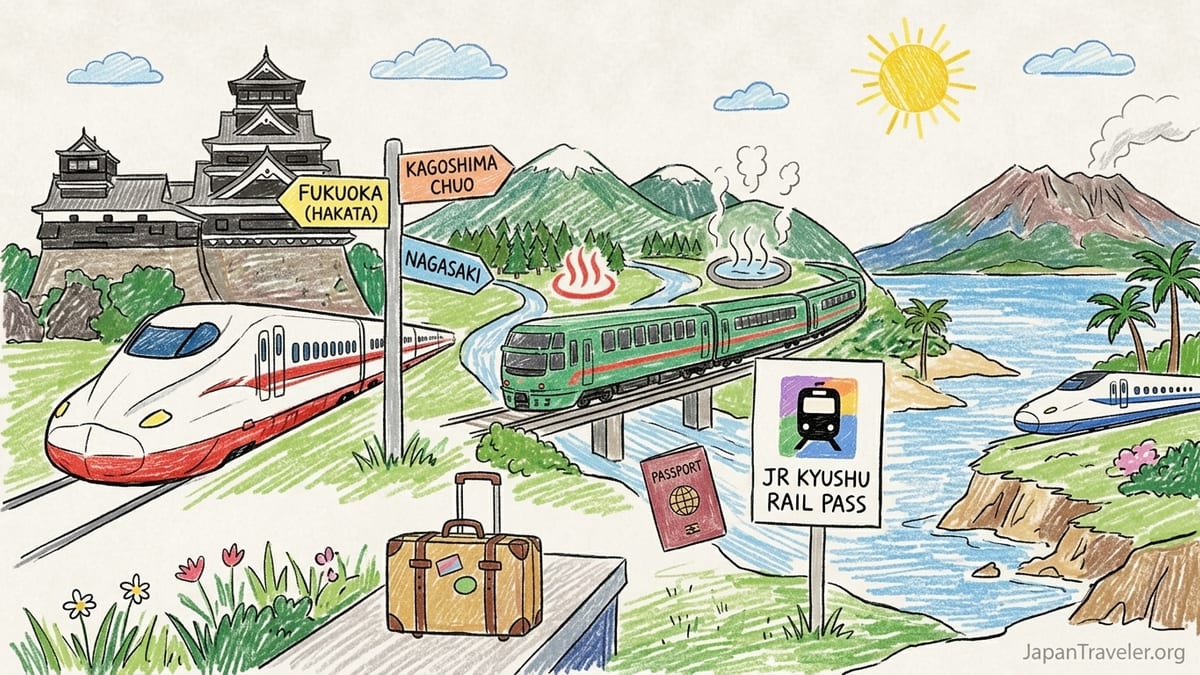
How the JR Kyushu Rail Pass Works Today
The JR Kyushu Rail Pass is a set of regional passes for international visitors that covers most JR Kyushu trains within Kyushu. There are three main versions: All Kyushu, Northern Kyushu and Southern Kyushu. All three are designed for short, intensive sightseeing trips rather than slow one week stays in a single city, and they are not interchangeable outside their defined areas. You must show your passport with temporary visitor status when using the pass.
As of September 2026, reference prices via standard sales channels such as JR Kyushu’s official booking site and major partner agencies are approximately ¥22,000, ¥24,000 and ¥26,000 for the 3, 5 and 7 day All Kyushu passes. The Northern Kyushu pass costs around ¥15,000 for 3 days and ¥17,000 for 5 days, while the 3 day Southern Kyushu pass is about ¥12,000. Exact prices can vary slightly by sales channel or occasional promotions, but these figures are a solid working baseline when you compare against individual tickets.
All Kyushu passes broadly cover JR trains across the entire island, including the Kyushu Shinkansen between Hakata and Kagoshima Chuo and most limited express services such as the Sonic, Kamome, Nichirin and Yufuin no Mori. Northern and Southern Kyushu passes cover similar train types but are geographically restricted, so where your overnight bases and day trips fall on the map is crucial. If you plan only a compact loop in the north or south, the targeted passes are often better value than the All Kyushu version.
A key feature of the JR Kyushu Rail Pass compared with simply buying tickets is the ability to ride multiple long distance limited express and Shinkansen trips within a short window without worrying about each individual fare. However, that convenience only pays off when the value of those hypothetical tickets meets or exceeds the pass price. For a few short hops, local buses or IC card tickets will almost always be cheaper.
Coverage Areas and Important Exclusions
The All Kyushu pass covers JR Kyushu lines across the island, including the Kyushu Shinkansen from Hakata to Kagoshima Chuo, the Nishi Kyushu Shinkansen to Nagasaki, and main limited express routes such as Sonic (Hakata to Oita and Beppu), Yufuin no Mori (Hakata to Yufuin and Beppu), Kamome (Hakata to Nagasaki via Takeo Onsen), and Nichirin and Kirishima services in eastern Kyushu. It is valid on both reserved and non reserved ordinary class seats, though advance seat reservations are strongly recommended on popular trains and around weekends and holidays.
The Northern Kyushu pass essentially covers JR lines in Fukuoka, Saga, Nagasaki, Kumamoto (north of the border with central Kyushu), Oita and surrounding areas. In practical terms, this means routes like Hakata to Nagasaki, Hakata to Beppu via Kokura and Oita, Hakata to Kumamoto, and scenic branches such as Beppu to Yufuin and Aso are included. It is not valid in southern areas such as Miyazaki or Kagoshima beyond certain boundary points, so you cannot, for example, ride from Fukuoka all the way to Kagoshima Chuo with only a Northern Kyushu pass.
The Southern Kyushu pass focuses on Kumamoto, Miyazaki and Kagoshima, generally south of the Kumamoto and Oita boundaries. Typical covered routes include Kumamoto to Kagoshima Chuo via the Kyushu Shinkansen, Kagoshima Chuo to Miyazaki on limited express and local trains, and local travel within these prefectures. It is aimed more at travelers flying directly into Kagoshima or Kumamoto, or those who build an itinerary that stays mostly in the south after an initial arrival.
One of the most important exclusions is the Sanyo Shinkansen between Hakata and Kokura. All JR Kyushu Rail Pass versions explicitly exclude this JR West operated bullet train sector, even though both stations are in Fukuoka Prefecture. If you need to travel quickly between Hakata and Kokura, you must either buy a separate Shinkansen ticket for that short leg or use the conventional Kagoshima Main Line instead, which is covered. The passes also do not cover subway systems such as Fukuoka City Subway, nor non JR private railways or most buses, so airport transfers or local metro rides will require separate payment.
All Kyushu Pass: When a Full Island Pass Makes Sense
The All Kyushu pass is aimed at travelers who want to crisscross the island, for example combining the volcanic landscapes of Aso, hot springs in Beppu and Yufuin, the port city of Nagasaki and the far south around Kagoshima, all within a few days. At ¥22,000 for 3 days, ¥24,000 for 5 days and ¥26,000 for 7 days, the incremental cost between durations is small, so the decision is less about price differences and more about how densely you will travel on rail each day.
Consider a 3 day “Kyushu highlights” loop starting and ending in Fukuoka: Day 1, Hakata to Nagasaki and back; Day 2, Hakata to Beppu and on to Kumamoto; Day 3, Kumamoto to Kagoshima Chuo and back to Hakata. If you buy separate tickets, each long limited express or Shinkansen leg quickly adds up. A single round trip from Hakata to Nagasaki on the Nishi Kyushu Shinkansen plus relay limited express can easily be around the ten thousand yen range. A Hakata to Beppu round trip on Sonic limited express is another high four digit to low five digit figure depending on seat type, and a Kumamoto to Kagoshima Chuo round trip on the Kyushu Shinkansen is similarly substantial. Once you stack three or four such long legs within three consecutive days, the cumulative total typically rivals or exceeds the 3 day All Kyushu pass price.
The 5 and 7 day All Kyushu passes become attractive when you want more breathing room between long moves, perhaps staying two nights in Nagasaki, two in Beppu or Yufuin and two in Kagoshima. Because the price jump from 3 to 7 days is only about ¥4,000, even a couple of extra medium distance trips, such as side excursions to Aso from Kumamoto or to Ibusuki from Kagoshima, can tip the scales in favor of the longer pass. However, if you only plan one or two intercity rides and spend most of the week inside a single region, the All Kyushu pass can end up more expensive than simply buying point to point tickets.
Northern Kyushu Pass vs Individual Tickets: Fukuoka–Nagasaki–Beppu–Kumamoto
For many visitors, the classic Kyushu route looks like a loop through the northern half of the island, connecting Fukuoka, Nagasaki, Beppu and Kumamoto. The Northern Kyushu pass was designed around exactly this pattern, so it is a good case study to test whether a pass beats regular tickets. We will assume a fairly active 3 day plan: Day 1, Fukuoka (Hakata) to Nagasaki; Day 2, Nagasaki to Beppu via Hakata or another connection; Day 3, Beppu to Kumamoto and then back to Fukuoka.
First, think about distance and train type. Hakata to Nagasaki involves the Nishi Kyushu Shinkansen combined with a relay limited express or other connecting service. Hakata to Beppu usually uses the Sonic limited express along the Nippō Main Line via Kokura and Oita. Beppu to Kumamoto can require a combination of limited express services and sometimes a connection around Beppu or Oita to head inland or around the island, and Kumamoto to Hakata commonly uses the Kyushu Shinkansen. Each of these segments is long enough that limited express or Shinkansen surcharges apply, so base fares plus express fees accumulate quickly compared with short suburban hops.
While exact yen amounts change over time and by seat choice, it is reasonable to expect that buying these four or five express segments separately will cost more than the 3 day Northern Kyushu rail pass price of around ¥15,000 if you consistently use limited express or Shinkansen services. Even if some segments are done on slightly slower but cheaper options, combining Hakata to Nagasaki, Hakata to Beppu, Beppu to Kumamoto and Kumamoto to Hakata over three consecutive days is usually sufficient to justify the pass. On the other hand, if you stretch this loop over a week and insert long non rail stays, like three nights in Nagasaki without long side trips, then the pass is less compelling and individual tickets or IC cards can make more financial sense.
Another factor favoring the Northern Kyushu pass on this itinerary is flexibility. For example, you might decide in Nagasaki to take a side trip to Huis Ten Bosch or Sasebo on limited express trains, or from Beppu you may want a quick visit to Yufuin on the Yufuin no Mori or another limited express. The pass allows you to add those impulse trips without recalculating your budget each time. If you know in advance that you will definitely stay still and take almost no side excursions, then a pass becomes more of a convenience purchase than a cost saving measure.
Southern Kyushu Pass and the Fukuoka–Kumamoto–Kagoshima Route
The Southern Kyushu pass is a tighter product: 3 days for roughly ¥12,000 with coverage focused on Kumamoto, Miyazaki and Kagoshima. It does not include Fukuoka or Hakata, so a common question is whether it helps with a Fukuoka–Kumamoto–Kagoshima trip. The answer is that you must treat the Hakata to Kumamoto segment separately and then let the Southern Kyushu pass cover Kumamoto, Kagoshima and any southern side trips during its validity period.
Imagine you start in Fukuoka, buy a normal Shinkansen or limited express ticket from Hakata to Kumamoto, then activate a 3 day Southern Kyushu pass from the day you leave Kumamoto for Kagoshima Chuo. On Day 1 of the pass you travel Kumamoto to Kagoshima Chuo on the Kyushu Shinkansen. On Day 2 you take a day trip from Kagoshima Chuo to Ibusuki for the sand baths and back, and on Day 3 you ride Kagoshima Chuo to Miyazaki and back or continue onward within the south. The regular cost of these Shinkansen and limited express trips, plus the Ibusuki or Miyazaki excursions, typically stacks up to a large fraction of the pass price, and in many realistic planning scenarios will slightly exceed it.
If instead your Fukuoka–Kumamoto–Kagoshima route is more relaxed, such as Hakata to Kumamoto, two or three nights in Kumamoto with only local trams and buses, then a single Shinkansen hop to Kagoshima Chuo and a flight out, the Southern Kyushu pass will not save money. In that case the better combination is a single limited express or Shinkansen ticket from Hakata to Kumamoto, a regular ticket from Kumamoto to Kagoshima Chuo, and perhaps a local day pass in Kagoshima for trams and buses. The Southern Kyushu pass starts to shine only when you chain several long rail legs in the south within three days.
For travelers whose entire trip is in the south, such as flying into Kagoshima, visiting Kirishima, Ibusuki and Miyazaki, then exiting from Miyazaki Airport, the Southern Kyushu pass can be an excellent value. It helps to map out every long rail day and sum approximate fares based on distance and train type. If you can identify at least three medium to long limited express or Shinkansen segments in three days, plus some flexibility for unplanned side trips, the pass is worth serious consideration.
Is a Kyushu Rail Pass Automatically Worth It?
The higher prices of regional rail passes across Japan mean you can no longer assume that any pass automatically saves money. For Kyushu specifically, the break even point depends on a few clear variables: the number of intercity days within the validity period, your preferred train types, and your tolerance for slower local routes. If you plan only one long rail day and otherwise stay in one city, a pass will nearly always be more expensive than individual tickets.
A simple rule of thumb is to imagine that any long limited express or Shinkansen ride in Kyushu is a substantial purchase, while short local hops are modest. If, during a 3 day period, you expect to take three or more long distance limited express or Shinkansen trips, then a 3 day Northern or Southern Kyushu pass usually pays for itself. If you expect four to six such legs spread across 5 to 7 days, the All Kyushu pass enters the conversation, especially if your route zigzags between north and south rather than staying in one half of the island.
On the other hand, travelers who use buses or low cost airlines for certain segments may find that a mix of modes beats an all rail strategy. For example, a flight between Fukuoka and Kagoshima or Miyazaki can sometimes be competitively priced compared with two or three Shinkansen legs, particularly when you are not adding many intermediate rail stops. In such scenarios, buying only the tickets you need and using IC cards for local JR segments, like Fukuoka to Kitakyushu on the Kagoshima Main Line, is more economical than buying an All Kyushu pass.
Personality also matters. If having the freedom to change plans every morning without recalculating fares is important to you, then even a small financial loss might be acceptable. A Northern Kyushu pass can make it psychologically easier to add a spontaneous day trip from Fukuoka to Beppu or Yufuin because you are not confronted with a fresh ticket price every time. Conversely, if you tend to lock in a detailed itinerary well in advance and do not deviate from it, you can often optimize individual tickets more cheaply.
Practical Booking Tips and Common Pitfalls
When comparing passes and individual tickets, remember that JR Kyushu Rail Passes are valid only on JR Kyushu operated lines inside Kyushu. They do not cover travel on the Sanyo Shinkansen between Hakata and Kokura, JR West lines on Honshu, private railways, subways or most buses. A common mistake is to assume that “all JR” trains between Osaka and Kyushu are covered, but a Kyushu specific pass will not cover any part of the Tokaido or Sanyo Shinkansen beyond its limited Kyushu scope. If you plan a broader journey from Tokyo or Kansai, you may need a different regional pass or separate long distance tickets for the Honshu portion.
Seat reservations are another key practical point. While JR Kyushu Rail Passes allow you to ride both reserved and unreserved ordinary class cars on many limited express and Shinkansen services, popular trains such as Yufuin no Mori, certain Kamome services to Nagasaki and some seasonal trains can book out. If your schedule is tight, it is wise to reserve seats as soon as you exchange or activate your pass. Some sales channels allow advance online reservations for pass holders; otherwise, you can book at major stations in Kyushu at Midori no Madoguchi ticket offices.
Timing also affects value. Because passes count consecutive calendar days rather than 24 hour blocks, it rarely makes sense to activate a pass late in the evening just for a short hop. Instead, align activation with your first full intercity rail day. For example, if you arrive in Fukuoka in the evening and only ride the subway to your hotel, wait until the next morning when you depart for Nagasaki or Beppu to begin your Northern Kyushu pass. Likewise, plan your last long ride, such as a return from Kagoshima Chuo to Hakata, to fall within the final validity day of your All Kyushu or Southern Kyushu pass.
Finally, respect the geographical boundaries of each pass. Northern Kyushu passes are not valid south of certain points in Oita and Kumamoto, and Southern Kyushu passes are not valid north of their defined limit stations. Attempting to ride beyond the covered area without paying a supplement can lead to awkward conversations at ticket checks. If you do need to cross from one zone to another, such as from a Northern Kyushu area into Southern Kyushu territory, be prepared to buy a separate ticket for the uncovered segment or choose an All Kyushu pass instead.
The Takeaway
The JR Kyushu Rail Pass family remains a powerful tool for exploring Japan’s southern island, but the higher modern prices mean you must align the pass choice carefully with your route. The All Kyushu pass works best for travelers who will string together several long limited express or Shinkansen journeys across both north and south within 3 to 7 days. In contrast, the Northern and Southern Kyushu passes are targeted options that reward tight itineraries concentrated in each half of the island.
For itineraries such as Fukuoka–Nagasaki–Beppu–Kumamoto over three rail intensive days, the Northern Kyushu pass typically outperforms individual tickets. For routes like Fukuoka–Kumamoto–Kagoshima, the Southern Kyushu pass only pays off if you build in additional southern side trips within its 3 day window and cover the Hakata to Kumamoto sector separately. There is no one size fits all answer; a short, simple itinerary may be cheaper with normal tickets and an IC card.
The most reliable approach is to sketch your day by day plan, count how many long distance limited express or Shinkansen trips fall within each 3, 5 or 7 day block, and compare their approximate cost to the relevant pass price. Keep coverage exclusions in mind, especially the Sanyo Shinkansen between Hakata and Kokura and any travel outside Kyushu. Once you have done that exercise, the right mix of passes and individual tickets usually becomes clear.
FAQ
Q1. Does the JR Kyushu Rail Pass cover the Sanyo Shinkansen between Hakata and Kokura?
The JR Kyushu Rail Pass does not cover the Sanyo Shinkansen between Hakata and Kokura. To travel on that route by Shinkansen you must buy a separate ticket, although you can use covered conventional JR lines between the two cities.
Q2. Is the Northern Kyushu pass enough for a Fukuoka–Nagasaki–Beppu–Kumamoto loop?
For a compact 3 day loop that includes Fukuoka–Nagasaki, Nagasaki–Beppu and Beppu–Kumamoto–Fukuoka using limited express and Shinkansen trains, the 3 day Northern Kyushu pass is usually good value and more flexible than buying individual tickets.
Q3. Can I use the Southern Kyushu pass to travel from Fukuoka to Kagoshima?
No, the Southern Kyushu pass does not cover Fukuoka or Hakata. You need a separate ticket from Hakata to Kumamoto or another boundary station, and you can then use the Southern Kyushu pass for travel within its southern coverage area such as Kumamoto to Kagoshima Chuo and beyond.
Q4. How many days do I need for the All Kyushu pass to be worthwhile?
The All Kyushu pass starts to be worthwhile when you plan at least three or four long distance limited express or Shinkansen rides within its 3, 5 or 7 day validity, especially if your itinerary spans both northern and southern Kyushu.
Q5. Are seat reservations included with JR Kyushu Rail Passes?
Yes, JR Kyushu Rail Passes allow you to make seat reservations on eligible limited express and Shinkansen trains at no additional basic fare, subject to availability and any reservation limits that may apply to specific pass types.
Q6. Do JR Kyushu Rail Passes cover local subways and buses in Fukuoka or Kagoshima?
No, the passes do not cover city subways such as the Fukuoka City Subway, nor most local buses or trams. You will need to pay separately with cash, IC cards or city transport passes.
Q7. Can I combine a JR Kyushu Rail Pass with other regional JR passes?
Yes, you can hold multiple regional JR passes, such as a JR West pass for travel on Honshu plus a JR Kyushu Rail Pass, but their coverage areas do not overlap in a way that allows stacking on a single ride. Each pass only covers its own region.
Q8. Is it better to buy the pass before arriving in Japan or after I land?
Pricing is often very similar between reputable online sellers and official sales points in Kyushu, so the choice usually comes down to convenience. Buying in advance can help you plan seat reservations earlier, while buying after arrival gives you flexibility if your itinerary is still uncertain.
Q9. What happens if I accidentally travel outside the pass coverage area?
If you travel beyond the valid area of your pass, you are required to pay the additional fare and any applicable express charges for the uncovered section. Station staff or conductors will calculate and collect this supplement when they check your ticket.
Q10. Are the JR Kyushu Rail Passes worth it for slow travelers who stay several days in each city?
For slow travelers who only make one or two long journeys in a week and rely mainly on local buses, trams and short train hops, JR Kyushu Rail Passes usually do not save money. In such cases, individual tickets and local passes are more economical.