

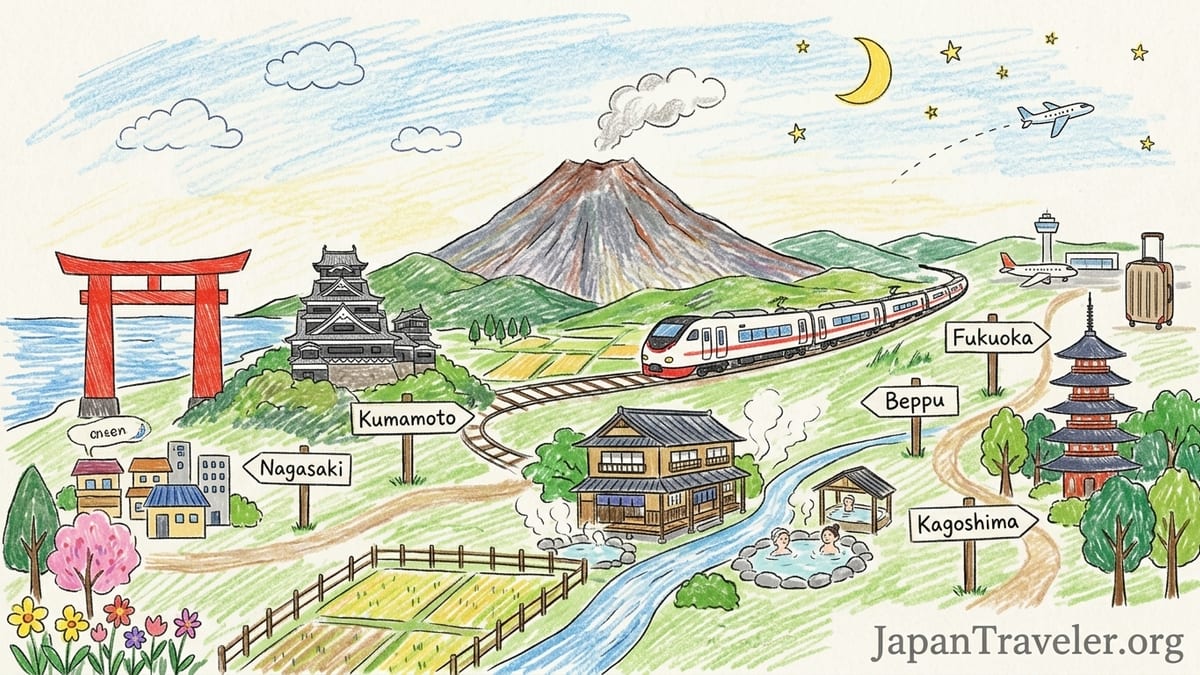
Kyushu rewards travelers who plan around distance and transport as much as sights. Its volcanic interiors, onsen towns and port cities are spread across long valleys, fast rail corridors and slow rural bus routes. Choosing a smart 5, 7 or 10 day itinerary is the difference between rushing from station to station and actually soaking in an open-air onsen with a view of Sakurajima at sunset.
How To Structure 5, 7 and 10 Days in Kyushu
In 2026, most serious Kyushu guides cluster around 5, 7 and 10 day routes because those time frames match how people actually move between Fukuoka, Nagasaki, Beppu, Aso and Kagoshima. Five days is ideal for one section of the island, such as a northern loop focusing on Fukuoka, Nagasaki and Beppu, or a compact southern trip around Kumamoto, Aso and Kagoshima. Seven days lets you connect two main bases by rail and add one rural area. Ten days gives you enough margin to detour to slower regions like Takachiho Gorge or Kurokawa Onsen, where buses and self-drive take over from shinkansen speeds.
The backbone for most visitors is the JR Kyushu rail network. The JR Kyushu Rail Pass still offers 3 and 5 day versions for areas such as Northern Kyushu and All Kyushu, with the 5 day All Kyushu pass priced around 24,000 yen for adults as of early 2025. That level of cost can make sense if you plan several medium or long-distance jumps, such as Fukuoka to Nagasaki, then Beppu, then back to Fukuoka or on toward Kumamoto. For a slower, more rural-heavy trip, the pass may not pay off and individual tickets or rental cars become more logical.
When planning, map your route on an actual timetable rather than just tracing lines on a map. For example, the limited express from Hakata Station in Fukuoka to Nagasaki takes around two hours, while the Sonic limited express from Hakata to Beppu is typically about two hours plus. By comparison, reaching Takachiho Gorge from Kumamoto can mean three or more hours by a combination of rail and infrequent buses, and Kurokawa Onsen is usually easiest by highway bus or rental car. Those differences matter when you only have five or seven nights.
Finally, think about your international flight. Many visitors fly into and out of Fukuoka Airport, which sits only a few metro stops from Hakata Station, making it a convenient anchor for all three itinerary lengths. Others arrive from Tokyo or Osaka on domestic flights to Kagoshima or Nagasaki, then work their way back north. Whichever you choose, aim to finish your trip with at least one night in your departure city so that weather, rail delays or road closures around volcanoes like Aso do not make you miss your flight.
A Focused 5 Day Kyushu Itinerary: Northern or Southern Core
A realistic five day trip should concentrate on one section of Kyushu rather than trying to tick every prefecture. For first-timers arriving in Fukuoka, a northern Kyushu route works very well: Day 1 Fukuoka, Day 2 Nagasaki, Days 3 and 4 Beppu and nearby Yufuin, and Day 5 back to Fukuoka. This pattern mirrors many current itineraries where travelers activate a Northern Kyushu Rail Pass, base near Hakata Station, then use limited express trains for day trips or one-night hops.
On such a 5 day northern loop, you might start in Fukuoka with canal-side shopping in Canal City Hakata, an evening at a yatai food stall under neon in Tenjin, and a bowl of Hakata ramen for around 900 to 1,200 yen. Next morning, board a mid-morning limited express to Nagasaki, drop your bags at a hotel near Nagasaki Station, then spend the afternoon at the Nagasaki Peace Park and Atomic Bomb Museum. In the evening, ride the ropeway or bus up Mount Inasa for one of Japan’s celebrated night views over the harbor.
Days 3 and 4 could be centered on Beppu and Yufuin in Oita Prefecture. From Nagasaki, expect to route back through Hakata to reach Beppu by Sonic limited express, typically taking around four hours including a cross-platform change in Fukuoka. In Beppu, many travelers purchase a combined ticket to the famous “Hells” hot spring attractions, then book a simple ryokan with on-site baths from around 10,000 to 15,000 yen per person including dinner and breakfast. A half-day side trip to Yufuin by local train gives you a softer, boutique onsen village feel with cafes, art shops and views of Mount Yufu.
If you prefer the south, a 5 day southern Kyushu plan might look like Day 1 and 2 in Kumamoto and Aso, then Days 3 and 4 in Kagoshima, finishing Day 5 with a relaxed morning and shinkansen back to Fukuoka or northbound connections. You could ride the Kyushu shinkansen from Hakata to Kumamoto in about 45 minutes, explore Kumamoto Castle and Suizenji Garden, then rent a car for a day around the Aso caldera to stop at viewpoints like Daikanbo. In Kagoshima, you might base near Kagoshima-Chuo Station, take the short ferry across the bay to Sakurajima for a bus circuit of its lava fields, and end the day in an oceanside onsen overlooking the active volcano.
Seven Day Routes: Linking Fukuoka, Nagasaki, Beppu and Aso
With a week, you can join two of Kyushu’s major clusters without constantly packing and unpacking. A practical rail-based 7 day itinerary might be Fukuoka, Nagasaki, Beppu or Yufuin, and Kumamoto or Aso before looping back to Fukuoka. Many recent no-car itineraries follow this pattern, using Hakata as a hub for the more distant legs while still allowing two-night stays in at least one onsen area.
One example: Day 1 Fukuoka, Day 2 Nagasaki, Days 3 and 4 Beppu and Yufuin, Day 5 Kumamoto, Day 6 Aso as a day trip from Kumamoto, and Day 7 return to Fukuoka. On Day 1, you settle into Fukuoka, perhaps visiting Ohori Park and the Fukuoka Art Museum before a late dinner at a yatai stall. On Day 2, you ride the early limited express to Nagasaki, check in near the station, walk through Dejima and the Dutch Slope, and try Nagasaki champon noodles for roughly 1,000 yen at a local shop.
On Day 3, you travel Nagasaki to Beppu by backtracking through Fukuoka. Many travelers take a late morning train to avoid rush hour, arriving in Beppu by mid-afternoon. That evening you might visit Takegawara Onsen, one of Beppu’s oldest public baths, where entry is just a few hundred yen, or prebook a sand bath experience in nearby Ibusuki if you plan to continue south later in your trip. Day 4 could be devoted to the Beppu Hells and a slow meal at a local izakaya trying toriten chicken tempura, a regional favourite.
Days 5 and 6 introduce Kumamoto and the Aso region. From Beppu, you head to Kumamoto by limited express and shinkansen, usually taking around three hours with a change at Kokura or Hakata. In Kumamoto, time your visit so that at least part of Kumamoto Castle is open and consider booking a hotel within walking distance of the castle area. For Aso, many visitors either join an organized day tour from Kumamoto or rent a car at Kumamoto Station so they can drive to the Kusasenri plateau, stop by farm stands selling fresh milk soft-serve, and check current restrictions on crater access, which can close due to volcanic gases.
If you would rather keep things simpler, another 7 day route stays mostly in northern Kyushu: two nights Fukuoka, two nights Nagasaki, two nights Beppu or Yufuin, and a final night back in Fukuoka. This pattern suits travelers who dislike one-night stays and want to keep heavy bags in lockers at Hakata Station while they move with just an overnight bag. It also aligns well with a Northern Kyushu Rail Pass, which can cover most of the intercity legs while you pay small supplements for local trams and buses.
Ten Day Kyushu Itinerary: Adding Kagoshima, Kurokawa or Takachiho
Ten days in Kyushu opens up deeper rural experiences that most one-week itineraries cannot include without becoming exhausting. At this length, you can string together Fukuoka, Nagasaki, Beppu or Yufuin, Aso or Kumamoto, and Kagoshima, then bolt on either Kurokawa Onsen in the Aso region or Takachiho Gorge on the border of Miyazaki Prefecture. The key trade-off is that these last two additions significantly change your transport plan.
A representative 10 day loop could look like this: Day 1 Fukuoka, Day 2 Nagasaki, Day 3 and 4 Beppu and Yufuin, Day 5 Kurokawa Onsen, Day 6 Aso and Kumamoto, Days 7 and 8 Kagoshima, Day 9 Fukuoka, Day 10 fly out. To reach Kurokawa on Day 5, you might put your large suitcase in storage at Beppu or Hakata Station and ride a highway bus directly into the mountains, arriving mid-afternoon at a ryokan with half-board. Many travelers book Kurokawa stays that include access to multiple outdoor baths, with per-person prices often starting around 20,000 yen including kaiseki-style dinners.
From Kurokawa to Aso and Kumamoto on Day 6, options include infrequent buses down to Aso Station or arranging a rental car pickup in Aso or Kumamoto, depending on availability. This is where self-drive becomes particularly valuable: a one-day car rental from Kumamoto might cost in the region of 8,000 to 12,000 yen plus fuel and tolls, but allows you to control your timing, reach viewpoints like Nabegataki Falls, and not worry if a bus connection is missed. After dropping the car back in Kumamoto, you can hop on a shinkansen to Kagoshima-Chuo in about an hour.
Takachiho Gorge is another classic 10 day addition, but it disrupts a pure rail itinerary even more than Kurokawa. Many visitors access Takachiho by renting a car either in Kumamoto, Nobeoka on the east coast, or even Miyazaki City, then driving two to three hours into the mountains. Buses exist, but they are limited and often require careful alignment with your arrival from larger hubs. If rowing a boat through the narrow basalt gorge and seeing the shrine complexes is a priority, it is best to allocate one night in Takachiho and accept the extra rental car day or long highway bus ride as the price of admission.
Finishing a 10 day trip in Kagoshima allows time for slower experiences. You can take a full day on Sakurajima, lingering at observatories and onsens like Magma Onsen that look directly at the volcano. Another day could be spent on a side trip to Ibusuki for a black sand bath, reachable in around an hour and a half by local train. Accommodation in Kagoshima ranges from business hotels near Kagoshima-Chuo Station starting around 7,000 yen per double room to sea-view ryokan on the bay that run significantly higher but often bundle in dinner and breakfast.
Transport Decisions: Rail Passes, Buses and When You Need a Car
Building a Kyushu itinerary in 2026 means paying close attention to which segments work best by rail and where coaches or cars are more realistic. The JR Kyushu Rail Pass is convenient along the main north-south spine from Hakata through Kumamoto to Kagoshima and across established tourist routes like Hakata to Nagasaki or Hakata to Beppu. For example, a 5 day All Kyushu pass can cover shinkansen hops between Fukuoka, Kumamoto and Kagoshima plus limited express trains to Nagasaki and Beppu, often undercutting the cost of individual long-distance tickets if you move most days.
However, that same pass does not cover key highway buses to places like Kurokawa Onsen or Takachiho, nor does it help with local trams in Nagasaki or Kumamoto. On a 5 day trip where you only plan two intercity moves, individual tickets might be cheaper and simpler. On a 7 or 10 day itinerary heavy on rail days, travelers often activate the pass for the middle stretch where they are covering the longest distances, then pay separately for the first and last city days, local buses and private rail lines.
Intercity buses remain an underappreciated tool. For instance, there are direct highway buses linking Fukuoka with Beppu and Yufuin, as well as buses from Beppu and Fukuoka into Kurokawa and Aso. A direct bus from Hakata Bus Terminal to Yufuin can take about two and a half hours and drops you near the town center, saving a transfer. Similarly, some buses from Kumamoto or Nobeoka go straight to Takachiho, which spares you the complexity of threading together several local trains. Bus fares are often comparable to discounted rail fares, and seat reservations are usually possible online or at major bus terminals.
Rental cars become attractive once you add Aso, Kurokawa, Takachiho or remote coastal areas. Many travelers choose to rent only for one or two days around Aso rather than for an entire trip, using shinkansen and limited express services to cover the long-haul sections and then picking up a car in Kumamoto or Oita. International licenses and advance booking are important, especially in high seasons such as Golden Week or autumn foliage. As a rule of thumb, if more than two or three days of your route involve places with one-bus-per-hour service or awkward transfers, adding a short car rental segment can actually simplify the trip rather than complicate it.
Realistic Combinations of Kyushu Bases
To make these time frames concrete, it helps to think in terms of realistic base combinations. For five days, the most practical pairings are Fukuoka and Nagasaki plus either a Beppu day trip or a single overnight in Beppu, or Fukuoka and Kagoshima with a brief swing through Kumamoto. Trying to visit all five major places in only five days almost always turns into a blur of check-ins and train platforms, leaving little room to actually enjoy an onsen or linger in a museum.
With seven days, you can plausibly connect three or four major bases. For instance, Fukuoka, Nagasaki, Beppu or Yufuin, and Kumamoto is a classic sequence that alternates city and onsen. Another popular 7 day combination in recent itineraries is Fukuoka, Beppu, Aso or Kurokawa, and Kagoshima, especially for travelers who prioritize landscape and hot springs over historical ports. In that scenario you might spend two nights in Beppu, one night in Kurokawa, two nights in Kagoshima and the remaining time split between Fukuoka and Aso day trips.
Ten days unlock even more possibilities. One route could be Fukuoka, Nagasaki, Beppu, Kurokawa, Kumamoto and Kagoshima, with one or two nights in each and extra time in the places that match your interests most. Another is to focus on the eastern and central spine of Kyushu, using Fukuoka, Beppu, Aso, Takachiho and Kumamoto as stepping stones. That second pattern suits travelers arriving from Honshu by shinkansen and continuing onward to Miyazaki or back toward Osaka after their Kyushu loop.
Choosing bases also affects your food experiences. Staying near Hakata Station makes it easy to sample Hakata ramen, mentaiko and yatai street food; basing in Nagasaki lets you try dishes like sara udon and castella sponge cake; nights in Kumamoto introduce specialties such as basashi horse sashimi and karashi renkon, a stuffed lotus root. In Beppu and Yufuin, ryokan dinners often highlight local seafood, Oita wagyu and vegetables cooked with geothermal steam, while Kagoshima offers black pork shabu-shabu and sweet potato shochu. Thinking through these anchors can make your 5, 7 or 10 day itinerary feel like a string of distinct culinary chapters rather than just a list of train rides.
When Takachiho and Kurokawa Change the Plan
Takachiho and Kurokawa are two of Kyushu’s most atmospheric stops, but adding either one forces you to rethink timing and transport. Takachiho Gorge, carved deep into volcanic basalt, is famous for its narrow river, rowboats and nearby shrines. Kurokawa Onsen is a compact hot spring village where wooden inns line a river and an onsen-hopping pass lets you visit multiple baths. Both are quite removed from the main shinkansen and limited express lines, relying on slower roads and limited buses.
On a 5 day trip, trying to include either Takachiho or Kurokawa is usually too ambitious unless you cut out almost everything else. You might manage Fukuoka, a direct highway bus to Kurokawa for two nights, and back again, but you would almost certainly need to skip Nagasaki, Beppu and Kagoshima. On a 7 day route, you can begin to make them work if you devote at least one night and accept a more intensive travel day. For example, Fukuoka to Beppu, on to Kurokawa for one night, then down to Kumamoto before continuing to Kagoshima is possible, but you must check bus schedules and give yourself buffer time.
On a 10 day itinerary, Takachiho and Kurokawa fit much more naturally. A common pattern is to rent a car in Kumamoto, drive to Aso for viewpoints and short walks, then continue either north to Kurokawa for a night of onsen-hopping or east to Takachiho for an overnight stay near the gorge. The next day you can backtrack to Aso or continue toward Miyazaki or Oita, depending on where your route leads. This loop uses the shinkansen for the big legs and the car for the mountain sections, trading a simple rail-only pass for more flexibility and access to quiet valleys that buses may only reach a few times per day.
In both destinations, luggage planning matters. Many travelers use coin lockers at Beppu, Hakata or Kumamoto stations to stash large suitcases while they carry only a small overnight bag to Takachiho or Kurokawa, where streets are hilly and ryokan rooms may not have generous storage. Additionally, weather and seasonal daylight affect how enjoyable these spots are. Autumn foliage season can be spectacular at Takachiho, but also busy, while winter stays in Kurokawa often mean soaking in steaming baths as snow falls on the cedars around you. Giving yourself enough days in Kyushu to include one of these atmospheric detours can be the difference between a pleasant trip and an unforgettable one.
FAQ
Q1. Is a 5 day Kyushu itinerary enough for first-time visitors?
Five days is enough if you focus on one region, such as Fukuoka and Nagasaki with a short Beppu or Kumamoto add-on, rather than trying to circle the entire island.
Q2. Should I buy a JR Kyushu Rail Pass for these itineraries?
A JR Kyushu Rail Pass can make sense for 7 and 10 day routes with frequent intercity moves, but for shorter or slower trips, individual tickets or buses may be cheaper.
Q3. Do I need to rent a car to visit Mount Aso?
You can reach Aso Station by train and bus, but renting a car in Kumamoto or Aso for a day gives more flexibility for viewpoints and weather changes around the caldera.
Q4. When is a rental car essential in Kyushu?
A rental car becomes very helpful or close to essential if you want to include Takachiho Gorge, Kurokawa Onsen or remote farm roads around Aso on a tight schedule.
Q5. Can I visit both Beppu and Yufuin in one day?
Yes, Beppu and Yufuin are linked by local trains and buses, and many travelers stay in one town while making a half-day visit to the other for onsen and cafes.
Q6. Is Kagoshima worth the extra travel time on a short trip?
Kagoshima is especially rewarding if you have at least 7 to 10 days and enjoy volcano scenery, ferries and seaside onsens; with only 5 days it may feel rushed.
Q7. How should I handle luggage when staying in small onsen towns?
Use coin lockers or luggage delivery from hubs like Fukuoka, Beppu or Kumamoto and carry a small overnight bag to compact ryokan in Kurokawa, Yufuin or Takachiho.
Q8. Are highway buses in Kyushu reliable for tourists?
Major highway buses between cities and popular onsen towns are generally punctual and comfortable, though reservations and checking current timetables are important.
Q9. What is the best season to follow these Kyushu itineraries?
Spring and autumn usually offer comfortable temperatures and clearer views of volcanoes, while summer can be hot and winter brings colder, sometimes snowy, mountain roads.
Q10. Can I combine a Kyushu itinerary with the classic Tokyo–Kyoto route?
Yes, many travelers add a 5 or 7 day Kyushu loop onto a main Honshu trip by flying into Fukuoka from Tokyo or riding the shinkansen via Hiroshima to Hakata.