


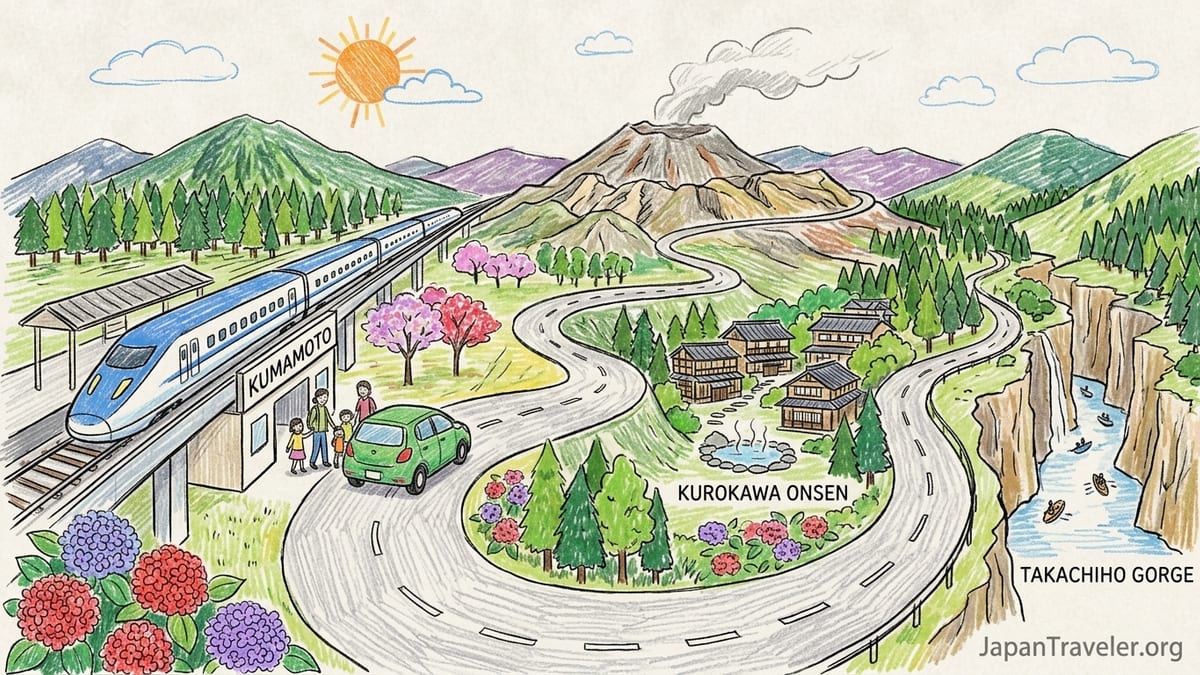
Kyushu is one of Japan’s best regions for a hybrid itinerary that mixes fast trains between major cities with a rental car for remote volcanoes, onsen towns and mountain gorges. Around Mount Aso, Kurokawa Onsen, Takachiho, Beppu, Yufuin, Kirishima and Kagoshima, having your own wheels turns awkward transfers and infrequent buses into scenic drives and relaxed stopovers. This guide explains how to build a realistic road trip route, when driving actually gives you an edge, and what to know about ETC cards, tolls, parking and winter conditions before picking up the keys.
Why Kyushu Is Perfect For A Hybrid Road Trip
Across Japan, the shinkansen and limited express trains are usually the fastest way to move between major cities. Kyushu is no exception: Fukuoka to Kumamoto or Kagoshima is straightforward by rail, and many visitors sensibly use JR Kyushu rail passes for that part of the journey. The equation changes as soon as you head into the central highlands around Mount Aso, the onsen valleys of Kurokawa and Yufuin, or the deep gorge at Takachiho. Here, public buses can run only a few times a day, often with limited English information, and connections between towns are rarely direct.
Travel planners such as Japan Guide recommend pairing rail for big-city hops with a rental car for rural segments in Kyushu, and this approach works very well in practice. For example, you might ride the shinkansen from Hakata to Kumamoto in about 40 minutes, then collect a rental car near Kumamoto Station or Airport for three or four days in the Aso and Takachiho region, before returning the car in Beppu and taking the Sonic limited express train back toward Fukuoka. This keeps one-way drop-off fees manageable and avoids city driving, while still giving you flexibility where it matters.
The key advantage of self-driving in Kyushu is not just speed but control over your stops. On the Yamanami Highway between Aso and Yufuin, there are viewpoints, farm shops and small walking trails that are hard to reach by bus. Around Kurokawa Onsen and Takachiho, having a car lets you time your arrival for evening shrine dances or early morning boat rides, without having to shape your entire day around one or two bus departures. For travelers with luggage, children or camera gear, that freedom can transform the trip.
At the same time, driving every leg, such as Fukuoka to Kagoshima entirely by car, is rarely necessary. Expressways can be busy, fuel and tolls add up, and city-center hotels often charge higher parking fees. This guide assumes that you are using rail for the long hauls between major cities, and focuses on the sections where a rental car genuinely improves the experience.
Building a Logical Route: From Fukuoka or Kumamoto Into the Highlands
Most visitors start in Fukuoka, Kyushu’s main air and rail hub, or in Kumamoto, which sits closer to the central mountains. A common pattern is to base in Fukuoka for one or two nights, using subways and local trains, then ride the shinkansen to Kumamoto and pick up a rental car there. From central Kumamoto it is roughly a 90 minute drive on local and regional roads to the Aso caldera area, depending on traffic and chosen route. If you prefer to skip city traffic entirely, consider renting from Kumamoto Airport, which sits closer to the highlands.
From Aso, you can loop north to Kurokawa Onsen, east toward Takachiho, or follow the Trans Kyushu route toward Yufuin and Beppu. One realistic three day loop begins in Kumamoto, climbs via Daikanbo viewpoint into the Aso caldera, continues along the Yamanami Highway to an overnight stay at Kurokawa, drops down the next day through the Kuju highlands to Yufuin or Beppu, then heads south and inland via Kuju and the milk-road style ridge routes to Takachiho before ending in Nobeoka or Miyazaki to return the car. Each driving segment is two to three hours without long stops, which leaves space for viewpoints and onsen visits.
Another pattern is to start in Oita or Beppu instead of Kumamoto. For example, you might ride the Sonic limited express from Hakata to Beppu, pick up a car near Beppu Station, spend a night in Yufuin, cross the Kuju range to Kurokawa and Aso, then end in Kumamoto. That route leverages good rail links on both sides and keeps mountain driving to daylight hours. Real trip reports from travelers who have driven from Beppu via Route 11 and 621 to Kurokawa, then on to Aso and Takachiho, highlight how scenic these connections are, with suspension bridges and rural waterfalls accessible only with a car.
When planning, assume that average speeds on mountain and rural roads are much lower than on expressways. A 70 kilometer stretch between Aso and Takachiho can easily take two hours or more once you factor in curves, photo stops and occasional roadworks. It is usually wise to limit yourself to no more than four hours of actual driving time per day, especially if you also plan to hike or soak in hot springs.
Key Stops: Mount Aso, Kurokawa, Takachiho, Beppu and Yufuin
Mount Aso is the centerpiece of many Kyushu road trips. You drive into one of the world’s largest volcanic calderas, a broad basin with farmland, small towns and a ring of peaks. The access road to the active Nakadake crater has its own toll gate and can close at short notice if volcanic gases are high or weather is poor, so many visitors focus instead on viewpoints such as Kusasenri plateau. Recent guidance from Aso City reminds rental car drivers that traffic can be heavy around midday and that parking areas may fill, so it makes sense to arrive either earlier in the morning or closer to late afternoon and check the latest closure information before driving up.
About an hour north of Aso on mountain roads, Kurokawa Onsen is a compact onsen village in the forest. The town is designed for strolling in yukata between ryokan baths, and parking is concentrated at small lots on the edge of the village or within each ryokan’s property. Many visitors buy a wooden onsen pass that allows entry to a set number of outdoor baths scattered through the valley. Here, a car is invaluable: public buses to Kurokawa are sparse and often timed for weekends, while drivers can arrive by the more scenic Yamanami Highway, pull into viewpoints over the Kuju range and still reach the village before dinner.
Takachiho, in northern Miyazaki Prefecture, is another place where self-driving pays off. There is no train line to the town, and bus routes from Kumamoto, Nobeoka or Miyazaki can require connections with limited departures. With a car, you can base near Takachiho Shrine, time a visit to the evening Kagura dance, and drive yourself to the gorge early the next morning for a boat ride before the day trip crowds arrive. Local maps highlight smaller attractions such as Amano Iwato Shrine and terraced rice fields a short drive outside town; these are awkward to combine in a single day without a vehicle.
Beppu and Yufuin, both in Oita Prefecture, are better connected by train and highway bus, but a car still enhances certain experiences. Around Beppu, some of the geothermal “hells” are grouped within walking distance, while others are dispersed along hillsides that are easier to string together by car. Yufuin, meanwhile, lies in a valley ringed by low peaks such as Mount Yufu. Drivers can visit lakes, small art museums and countryside cafes outside the main tourist streets, or detour up to the Kokonoe Yume suspension bridge and Kuju flower parks on the way in or out. A popular driving day links Beppu’s hot spring districts, Kokonoe bridge, a coffee stop along the Yamanami Highway and an evening arrival in Kurokawa.
Extending South: Kirishima and Kagoshima by Car
Further south, the area around Kirishima and Kagoshima rewards travelers who keep their rental car for an extra few days. Kirishima-Kinkowan National Park combines volcanic peaks, crater lakes and hot springs. Many trailheads and onsen lodges sit far from train stations, so relying solely on public buses can severely limit your options. Drivers can begin in Takachiho or Aso, follow scenic inland routes toward Maruo Falls and Kirishima Shrine, then spend a night in an onsen ryokan with ample parking before continuing to Kagoshima City.
Kagoshima itself, facing the smoking volcano of Sakurajima, does not require a car for its urban sights. Trams and buses cover the main waterfront, museums and shopping streets efficiently. However, a rental car is very useful if you want to circle the Sakurajima peninsula, stop at multiple lava field viewpoints and visit small roadside onsen with direct views of the volcano. Travelers who have driven from Kurokawa and Aso down to Kagoshima often mention detours to quiet gorges, small shrines and preserved rural stations such as Kareigawa, all of which are hard to combine in one day without the flexibility of a car.
When connecting Kagoshima back to Fukuoka or elsewhere, it usually makes sense to return the vehicle in Kagoshima and ride the Kyushu Shinkansen north. The fast train can bring you from Kagoshima-Chuo to Hakata in roughly 90 minutes, far quicker than retracing the expressway by car. Some itineraries start in Fukuoka, use rail to reach Kumamoto, drive the central circuit through Aso, Kurokawa, Yufuin and Takachiho, then head south via Kirishima, drop the car in Kagoshima and ride the train back north. This keeps the one-way rental reasonable while maximizing the benefit of self-driving.
If you are combining Kyushu with other regions of Japan, consider limiting your car use to these concentrated rural sections. For example, you could fly into Fukuoka, travel by train to Hiroshima or Kansai, and only rent a car once you are ready to explore Kyushu’s interior. Many major rental chains have offices near shinkansen stations precisely to support this style of hybrid trip.
Rental Cars, One Way Fees, ETC Cards and Tolls
Major nationwide brands such as Toyota Rent a Car, Nissan Rent a Car, Times, Nippon and ORIX operate branches across Kyushu, from Fukuoka Airport and Hakata Station down to Kumamoto, Beppu, Miyazaki and Kagoshima. For a compact car suitable for two adults with luggage, daily rental fees vary but often fall in the range of 7,000 to 10,000 yen before insurance, depending on season and booking channel. Full coverage packages that reduce or eliminate excess are popular with international visitors and can push the daily cost higher, but provide peace of mind on narrow mountain roads.
One way rentals are common, but drop-off fees vary based on distance between branches. Returning a car to a different office within the same city may incur little or no extra charge, while dropping in another prefecture, such as starting in Kumamoto and ending in Kagoshima, usually carries a noticeable surcharge. Some travelers report paying the equivalent of a few thousand yen for moderate distances, while others arranging long north to south traverses have seen higher one-way fees. It is worth using the estimation tools on rental sites to compare scenarios, including the alternative of breaking your trip into two separate rentals on either side of a long train ride.
Most expressways in Kyushu are tolled, including the main Kyushu Expressway corridor and many connector routes. You can pay tolls at manned booths with cash or credit card, but an ETC card and device in your rental car makes the process smoother. With ETC, you use dedicated purple or green lanes, and toll charges are recorded automatically and settled when you return the car. Visitors frequently report that managing frequent toll booths without ETC is tiresome, especially if you are the only adult in the car. Many rental agencies in Kyushu offer ETC cards for a small daily fee or deposit. Some also participate in the Kyushu Expressway Pass, a flat-rate package for foreign visitors that can be cost effective if you plan several long expressway days in a row.
To decide whether a pass or pay-as-you-go makes sense, look at your route in detail. A rough figure, based on recent traveler reports, suggests that a long open-jaw drive from Kagoshima to Fukuoka over about 11 days of mixed expressway and local roads might accumulate around 7,000 yen in tolls, while a shorter five day loop in northern Kyushu could total a few thousand yen if you mostly stick to scenic local highways. If your itinerary includes multiple long expressway runs, such as Fukuoka to Kagoshima and back or a fast dash from Beppu to Miyazaki, then a pass may pay for itself. Otherwise, paying tolls individually via ETC is usually simpler.
Parking, Navigation and Mountain Driving Conditions
In rural Kyushu, parking is generally straightforward, and many ryokan, guesthouses and pensions include free on-site parking. When booking accommodation around Aso, Kurokawa, Takachiho, Yufuin and Kirishima, check that “free parking” or an equivalent term is mentioned in the description or confirmation. This can save you several thousand yen over the course of a trip. In onsen towns like Kurokawa, where space is tight, properties often designate specific spots for each room and may request that you leave your keys at the front desk so staff can move cars if necessary.
In cities, parking is more constrained and usually paid. Hotel garages in central Fukuoka, Kumamoto or Kagoshima can charge around 1,000 to 2,000 yen per night, sometimes more for large vehicles. Coin parking lots near stations and shopping streets operate on hourly or daily caps. Because urban public transport is efficient, it often makes sense to avoid driving in cities entirely: return your car on arrival, then switch to trams or subways. This is in line with how many domestic and international travelers arrange their Kyushu trips, reserving self-driving for the highlands and rural coasts.
For navigation, most rental cars in Japan still provide built-in navigation systems that accept phone numbers or map codes as destinations. In Kyushu this works well for onsen ryokan, viewpoints and visitor centers that may not have obvious street addresses. Tourist offices and regional pamphlets often list map codes specifically for drivers. Many travelers also use smartphone apps for backup, but reception can be patchy in deep valleys, so downloading offline maps before departure is a prudent step.
Mountain roads around Aso, Kuju and Takachiho vary from broad two lane highways to narrow, winding local roads with limited guardrails. In summer and autumn the main challenge is staying alert on curves and watching for slow farm vehicles or cyclists. In winter, between roughly December and March, frost and occasional snowfall can affect higher passes, especially at night and in the early morning. Local tourism offices in Aso publish seasonal driving advice, emphasizing that even if snow has melted in the caldera, shaded sections of the pass roads can remain icy. Rental agencies in Kyushu typically fit winter tires by default during colder months, but if you are traveling in late winter or early spring, confirm this detail when booking and pick up your car during daylight so you can inspect tire condition yourself.
Seasonal Timing, Ryokans and Onsen Stays With Parking
Kyushu’s road trip season is long. Spring brings fresh greens and clear views over volcanic ridges, but also coincides with domestic travel peaks such as Golden Week, when accommodations and cars sell out. Summer is lush, with rice fields in full growth, though heat and humidity are high in the lowlands. Many visitors find early autumn, from late September to early November, ideal, as mountain temperatures are comfortable and foliage around Kuju and Aso turns red and gold. Winter can be beautiful on clear days, with snow-capped peaks on the horizon, but demands more caution on higher routes.
Ryokan stays are a highlight of any Kyushu road trip. Properties in Aso, Kurokawa, Yufuin and Kirishima often include half board with elaborate kaiseki dinners and breakfast. When driving, it is useful to choose ryokan with on-site parking that is either free or fixed fee. For example, some Aso-area lodges integrate parking into a grassy courtyard or gravel lot beside the main building, while Yufuin pensions may have a row of spaces directly in front of each room. Reviews frequently mention whether staff help guide you into tight spots or offer covered parking, which can be appreciated in winter or during Kyushu’s rainy season.
Because dinners at onsen ryokan are usually served at set times in the early evening, plan your driving days to arrive by 17:00 at the latest. This avoids having to navigate small lanes in the dark and means you can soak before dinner. On departure days, consider taking a short drive after check-out to a nearby viewpoint or farm shop to break up a longer leg. Many travelers, for example, leave Kurokawa late morning, stop at a roadside market or waterfall, then stroll in Yufuin’s old streets before checking in there, transforming what could have been a quick transfer into a leisurely day.
Booking ryokan with free cancellation or flexible dates can help if weather or volcanic activity forces last-minute route changes. In the Aso region, certain roads and crater access points occasionally close due to eruptions or heavy rain. With a car and flexible bookings, you can pivot to an alternate route such as deeper into the Kuju highlands or down toward coastal onsen without losing the entire day to logistics.
Sample Five to Seven Day Kyushu Driving Segment
To illustrate how a hybrid Kyushu itinerary works in practice, consider a six night trip focused on the central and eastern mountains. Arrive in Fukuoka and spend a night in the city, then ride the shinkansen to Kumamoto the next morning. Pick up a compact rental car near the station around midday and drive to the Aso region via a supermarket stop to stock up on snacks. Spend the afternoon exploring viewpoints in the caldera and checking in to a ryokan with parking. The next morning, depending on crater access, either drive part way toward the Nakadake area or focus on walking around Kusasenri before a relaxed lunch in Aso town.
On day three, continue along the Yamanami Highway, stopping at Daikanbo lookout, Kuju flower parks or Kokonoe Yume bridge, and arrive at Kurokawa Onsen mid-afternoon. Park at your ryokan or a designated lot, purchase an onsen pass if desired, and spend the rest of the day roaming between outdoor baths. Day four is a long but rewarding drive across the highlands and down into Takachiho. Leave Kurokawa after breakfast, pause at small waterfalls and rural viewpoints en route, then descend to Takachiho Gorge in time for an afternoon walk or boat ride. Park near Takachiho Shrine for the evening Kagura performance, staying in a local inn that provides parking.
Day five can link Takachiho back to the Oita side. Drivers comfortable with mountain passes can follow inland roads via Kuju and Yamanami Highway back toward Yufuin, reaching town by mid-afternoon, while those who prefer smoother highways may choose a route via Nobeoka and the Higashi Kyushu expressway before turning inland. After a night in Yufuin, day six is reserved for Beppu’s hot springs and viewpoints, reached by a short drive over a low pass. Finally, return the car in Beppu or Oita, then take the Sonic limited express back to Fukuoka or onward to Honshu. This pattern gives you four full days with a car in the mountains and onsen towns, framed by efficient rail journeys at each end.
Variations can stretch this to a week or more by adding an extra night in Aso for hiking, inserting a stay in Kirishima on the way south, or finishing in Kagoshima instead of looping back to Oita. The central idea remains: use the car to link remote, scenic locations that are awkward by public transport, but rely on trains for city to city legs and for the long haul back to your starting point.
FAQ
Q1. Do I need to drive for the entire Kyushu trip, or only some sections?
It is usually best to rent a car only for rural sections such as Mount Aso, Kurokawa, Takachiho, Yufuin or Kirishima, and use trains for major city journeys like Fukuoka to Kagoshima.
Q2. Is it realistic for a first time Japan visitor to drive around Aso and Takachiho?
Yes, many first time visitors drive in Kyushu, but you should be comfortable with left side driving, narrow rural roads and slower speeds on mountain passes, and avoid night driving where possible.
Q3. How much should I budget for tolls on a typical five day Kyushu driving loop?
Toll costs vary by route, but a compact five day loop using a mix of expressways and local roads might cost the equivalent of a few thousand yen, with more if you make long expressway runs.
Q4. Are ETC cards and the Kyushu Expressway Pass worth it?
An ETC card is highly convenient for all drivers, while the Kyushu Expressway Pass is most useful if your itinerary includes several long expressway days; otherwise ordinary ETC billing is usually fine.
Q5. What about winter driving conditions around Aso and Takachiho?
From roughly December to March, higher roads can have snow or ice, especially early and late in the day. Confirm that your rental has winter tires and check local road advisories before setting out.
Q6. Do onsen ryokan in places like Kurokawa and Yufuin usually have parking?
Most rural ryokan and pensions in Kyushu provide on-site parking, often free. In compact onsen villages, spaces can be tight, so staff may guide you or request keys to move cars.
Q7. Is one way rental between cities such as Kumamoto and Kagoshima possible?
Yes, major rental chains allow one way rentals across Kyushu, but they usually charge a drop-off fee that increases with distance, so compare costs before finalizing your route.
Q8. Can I reach Takachiho Gorge or Kurokawa Onsen without a car?
It is possible using buses, but services can be infrequent and transfers awkward. A car lets you combine the gorge, shrines and nearby viewpoints in a single flexible day.
Q9. Should I keep the car while staying in Fukuoka, Kumamoto or Kagoshima cities?
Often it is better to return the car before entering big cities, since parking there is paid and public transport is efficient. Many travelers only drive the rural segments.
Q10. Is navigation difficult if I cannot read Japanese road signs?
Most major signs on expressways and highways include English, rental car GPS units accept phone numbers or map codes, and using an offline map app as backup makes navigation manageable for most drivers.