

Kyushu is Japan’s warm, volcanic south: a region of coastal cities, steamy hot spring towns and one of the world’s largest active caldera volcanoes. With so many compelling stops clustered within a few hours of each other, the harder question is not what to see, but where to actually stay. This guide compares Kyushu’s headline destinations to help you decide which places deserve precious nights on the ground, and which work better as focused day trips, depending on your interests, budget and travel style.
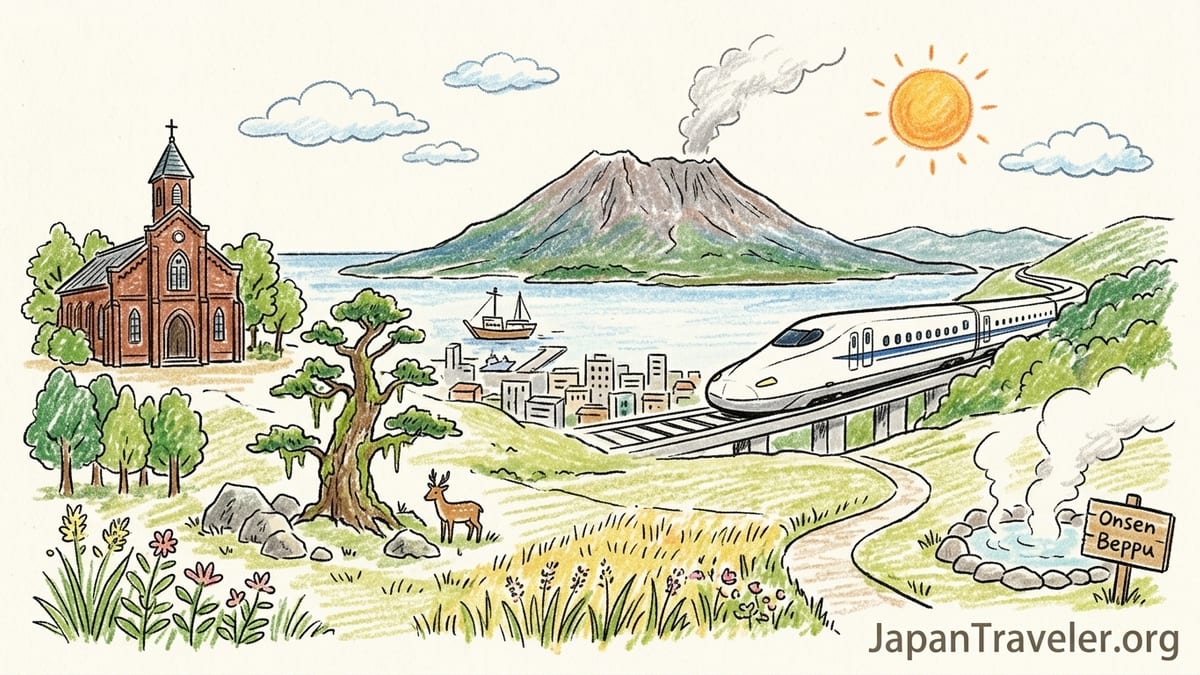
How to Think About Kyushu: Bases, Day Trips and Travel Style
Kyushu rewards travelers who choose a few strong bases rather than trying to sleep in every postcard town. Distances look short on the map, but winding mountain roads, train connections and ferry schedules quickly eat into sightseeing time. For many visitors, a loop of three to five bases works well, with cities such as Fukuoka, Nagasaki, Kumamoto or Kagoshima acting as hubs, and smaller hot spring or nature areas as one- or two-night detours.
Transport also shapes what makes sense as a base. For example, Fukuoka and Kagoshima enjoy bullet train access and frequent flights, while Yakushima requires a short flight or high-speed ferry and at least two nights to justify the effort. Kurokawa Onsen is only a two-hour drive from Kumamoto or around 75 minutes from Beppu by car, but bus frequencies are limited, so it is best treated as an overnight mountain escape rather than a rushed soak between trains. Thinking in terms of hubs and side trips keeps itineraries realistic, especially for families or first-time visitors to Japan.
Budget is another deciding factor. A simple public bath in Beppu can cost around 300 to 500 yen, while a classic ryokan with dinner and breakfast in Kurokawa or Yufuin typically starts from roughly 20,000 yen per person and climbs quickly for private outdoor baths or larger rooms. Choosing one or two splurge nights in an onsen village, paired with more affordable city hotels the rest of the time, lets you enjoy Kyushu’s hot spring culture without blowing the entire travel fund.
Finally, consider your tolerance for crowds and logistics. Beppu and Yufuin are extremely popular and can feel busy on weekends and holidays, but they are straightforward by train and bus. Yakushima and the Kirishima mountains feel wilder and quieter, but reward drivers and hikers more than museum-hoppers. Decide whether your Kyushu is primarily about food, history, hot springs or hiking, then use the following sections to match destinations to those priorities.
Fukuoka vs Nagasaki: Urban Bases for Food and History
For many travelers, Fukuoka is the natural gateway to Kyushu and the most practical base for a first trip. Hakata Station is a major bullet train stop, the airport is just a short subway ride from downtown, and the city itself is relaxed and easy to navigate. Food is Fukuoka’s main strength: steaming bowls of tonkotsu ramen, yatai food stalls lining the riverside at night, and casual izakaya that welcome families early in the evening. A typical bowl of ramen near Hakata Station might cost around 900 to 1,200 yen, and you can stroll between multiple shops in one night to compare flavors.
Fukuoka also works well for day trips. In about two hours by train you can reach Beppu’s hot springs, and in similar time Nagasaki is accessible via limited express services. This means that travelers who dislike changing hotels can sleep only in Fukuoka and sample other cities without hauling luggage. The trade-off is spending more time on trains and less time experiencing quiet evenings in smaller towns. For food lovers and nervous first-time visitors to Japan, Fukuoka merits at least two to three nights, potentially more if you plan multiple day trips.
Nagasaki, in contrast, is not as central for rail connections but is far richer in layered history. It was one of Japan’s earliest international trading ports, and its streets still show Chinese and European influences alongside sobering World War II sites. The Nagasaki Atomic Bomb Museum and Peace Park typically take half a day for thoughtful visits, while the Lantern Festival or views from Mount Inasa at night give a softer side to the city. Many travelers find two nights ideal: one full day for the peace-related sites, and another for Glover Garden, Dejima, Chinatown or a harbor cruise, without rushing.
Families and sensitive travelers should also note the emotional weight of Nagasaki’s war memorials. Pairing these sites with lighter experiences, such as sampling castella sponge cake in a local café or riding the tram through hilly neighborhoods, helps balance the day. If your Kyushu focus is food, nightlife and simple logistics, Fukuoka is the stronger base. If you value history and cultural depth, Nagasaki deserves dedicated nights rather than a compressed day trip from elsewhere.
Beppu, Yufuin and Kurokawa Onsen: Choosing Your Hot Spring Experience
Onsen culture is one of Kyushu’s defining draws, and Japan’s tourism authorities regularly spotlight Beppu’s hot spring power and distinctive steam-filled landscape. The city is built over eight separate hot spring areas, each with baths ranging from basic municipal facilities to large resort complexes. A local bath such as Takegawara Onsen might cost just a few hundred yen, while the famous “hells” geothermal pools charge individual entry fees and are best approached as a half-day sightseeing circuit rather than a traditional soak. Beppu is ideal if you want variety, budget-friendly baths and a slightly gritty, lived-in atmosphere with plenty of restaurants and supermarkets nearby.
Yufuin, less than an hour from Beppu by train or bus, feels very different despite sharing the same volcanic backbone. It is a compact resort town framed by Mount Yufu, with a main street lined by cafés, patisseries, galleries and boutique ryokan. Many visitors come on day trips to stroll to Lake Kinrin, browse small shops and stop for coffee or soft-serve ice cream made with local milk. Prices tend to be higher than in Beppu; a dessert in a stylish café can easily reach 800 to 1,000 yen, and ryokan stays often start higher than in more workaday Beppu. Yufuin suits travelers who enjoy a gentle, walkable resort setting and do not mind touristy touches in exchange for pretty scenery.
Kurokawa Onsen, tucked into the mountains of Kumamoto Prefecture, offers a third flavor of hot spring experience. The village is small, with around 30 traditional ryokan hugging a river valley, wooden bridges and billboards intentionally kept low-key to protect the rustic look. Many visitors buy an onsen-hopping pass that allows entry to three different outdoor baths for a fixed price, then wander between steaming rock pools and riverside rotenburo. Public transport is sparse, so most people arrive by car or on a direct highway bus from Fukuoka or Kumamoto. Because travel time is around two hours from major hubs and evenings are part of the charm, Kurokawa clearly deserves at least one overnight stay rather than a rushed visit.
In practical terms, Beppu works best as a base for budget travelers, onsen enthusiasts who want easy access without a car, and families who appreciate big hotels with game centers and buffet restaurants. Yufuin is a good choice for couples and small groups who like stylish cafés and slower walks, and who might be comfortable paying more for a private onsen room. Kurokawa is strongest for travelers willing to prioritize atmosphere over convenience and who want that archetypal mountain ryokan night with kaiseki dinner and yukata-clad strolls under lanterns. Many itineraries include one night in either Yufuin or Kurokawa, plus at least one night in Beppu to experience its sheer variety.
Kumamoto, Mount Aso and Takachiho: Volcano Landscapes for Adventurers
Central Kyushu is dominated by the enormous caldera of Mount Aso and the surrounding grasslands and peaks. The Aso area appeals most to travelers who enjoy scenic drives, hiking and close-up views of volcanic terrain. On clear days, the grassy plateau of Kusasenri provides sweeping views of the smoking crater area, and there are short walks suitable for families with school-age children. Access to the active crater rim itself changes depending on volcanic activity and safety restrictions, so travelers should build flexibility into their plans rather than banking on one specific viewpoint.
Kumamoto, an hour or so by train from Fukuoka, is the main urban gateway to Aso. The city is known for its reconstructed castle complex and photogenic Suizenji Jojuen garden, and it offers a good spread of business hotels and mid-range restaurants. Many visitors pair a night in Kumamoto with a rental car day to the Aso region, or use Kumamoto as the pick-up point for a multi-day drive that includes Kurokawa Onsen and Takachiho. Families may appreciate Kumamoto’s easier driving environment compared with larger cities, and its relatively compact tram network for getting around without a car.
Takachiho Gorge, technically over the border in Miyazaki Prefecture, is often woven into central Kyushu itineraries because it combines myth-laden shrines with a striking basalt gorge. In good weather, travelers rent rowboats to paddle beneath waterfalls, or walk the paved path along the cliff edge for viewpoints. Because public transport connections are slow and limited, Takachiho works best as a day trip by car from Aso or from the Nobeoka side, or as a one-night stay in a local ryokan if you want to attend the nightly kagura dance performance at Takachiho Shrine. For most visitors, its relatively compact size means a long day trip is sufficient.
In deciding how many nights to allocate, hikers and drivers might spend two to three nights in the Aso and Kurokawa region combined, with at least one full day devoted to scenic roads and farm cafés on the Yamanami Highway, and another for short hikes or horse riding around Kusasenri. Less outdoorsy travelers may prefer a single night in Aso or Kurokawa as a taste of volcanic Kyushu before returning to city bases. Kumamoto itself, outside of major festival periods, is often well-covered in one night, leaving more time for the highland landscapes that make central Kyushu unique.
Kagoshima, Sakurajima and Kirishima: Southern Kyushu’s Volcanic Coast
The south of Kyushu is anchored by Kagoshima, a coastal city looking directly across the bay at the very active Sakurajima volcano. Ferries run frequently between the city and the volcano’s port area, and the crossing takes only around 15 minutes, making Sakurajima one of the simplest large volcanoes to experience up close. Visitors often spend half a day circling Sakurajima by bus or rental car, stopping at lava fields, small observation decks and simple seaside foot baths with views of ash plumes on active days. Japan’s national tourism promotion regularly highlights Sakurajima as one of Kyushu’s defining experiences, and it is an excellent choice if you want a safe but dramatic volcano encounter without long hikes.
Kagoshima itself offers a relaxed but slightly gritty urban stay with a distinct food culture. Local specialties include kurobuta black pork, often served as shabu-shabu or on rice bowls, and shochu made from sweet potatoes. A simple black pork cutlet lunch set near Tenmonkan shopping arcade might cost around 1,500 yen, while atmospheric izakaya pour small glasses of regional shochu for roughly 500 to 700 yen. The city also serves as a transport hub, with highway buses to nearby sand bath experiences in Ibusuki and onward connections by train and boat to the Osumi Islands.
North of Kagoshima, the Kirishima mountain range offers highland plateaus, crater lakes and a mix of onsen resort areas. Trails such as the ascent of Mount Karakuni pass through otherworldly volcanic landscapes, and the area is attractive to hikers who want variety beyond Aso. Weather, including fog and rain, can quickly change conditions, so having one or two nights in a Kirishima onsen hotel gives more flexibility than a rushed day trip. For travelers less focused on hiking, a single overnight stay with a short nature walk and generous onsen time may be enough.
Given travel times, Kagoshima works well as a two- or three-night base for southern Kyushu, allowing one full day for Sakurajima and another for either Kirishima or Ibusuki. If you are fitting Kagoshima into a shorter Kyushu loop, two nights still allow time for Sakurajima plus a relaxed evening sampling local cuisine. Kirishima is more optional unless you specifically want its trail network or quieter hot spring environment. In that case, plan at least one night there instead of stretching it as a long day from Kagoshima.
Yakushima: When Kyushu Becomes a Rainforest Escape
Yakushima, a heavily forested island south of Kagoshima, feels like a different world from Kyushu’s cities and roadside onsen towns. The interior is threaded with ancient cedar forests, mossy ravines and trails that can take anything from a couple of hours to a full day. Famous routes such as the trek to Jomon Sugi or the walks in Shiratani Unsuikyo Gorge reward reasonably fit hikers willing to manage early starts, rain and slippery roots. Even coastal drives feel wild, with monkeys and deer sometimes appearing along the roadside loop that circles the island.
Reaching Yakushima requires either a short domestic flight from Kagoshima, typically around 40 minutes, or a high-speed boat that usually takes about two to three hours depending on the service and sea conditions. Slower car ferries also operate and take roughly four hours between Kagoshima and Miyanoura Port. Because of this travel time and the island’s changeable weather, visiting for fewer than two nights rarely makes sense. Three or four nights give a better chance of catching at least one clear day for a major hike, plus time for shorter walks and coastal hot springs.
Yakushima is strongest for travelers whose main Kyushu goal is nature and hiking. Accommodation ranges from simple guesthouses with shared kitchens to small lodges focused on trekking, and prices are often a bit higher than on the mainland due to shipping costs. Car rental is highly recommended because buses do not serve the entire coastal road, and some trailheads are otherwise difficult to reach. Families with active teenagers often enjoy Yakushima, while those with toddlers may find the logistics demanding and the trails too long.
In the context of a broader Kyushu trip, Yakushima is best treated as a dedicated segment rather than a small side trip. Many travelers route from Fukuoka down through Beppu, Aso and Kagoshima, then board a ferry or flight to Yakushima for three nights before looping back via Kagoshima. If your available time in Kyushu is under 10 days, adding Yakushima may force too many one-night stops elsewhere. With two weeks or more, it can become the highlight of the entire region, especially for hikers who have already seen Japan’s major cities on previous trips.
Families and First-Time Visitors: Matching Places to Comfort Levels
Families and first-time visitors to Japan often balance novelty with predictability in a different way from solo travelers. Fukuoka and Beppu generally offer the gentlest landings. Both have plenty of Western-style hotel rooms that can sleep families of three or four, chain restaurants with picture menus, and convenience stores on nearly every corner. Hotels near Hakata Station or Beppu Station make baggage forwarding and train travel simpler, and attractions such as aquariums, ropeways and short coastal walks keep younger children entertained without committing to full-day hikes.
Onsen etiquette can feel intimidating at first, so cities with a range of bath types can help nervous first-timers ease in. Beppu’s municipal baths are inexpensive entry points where you can practice basic routines such as washing before soaking and managing small towels in shared spaces, while larger hotels sometimes offer family baths that can be reserved by the hour for private use. Kurokawa and Yufuin ryokan often include private outdoor tubs on balconies, which suit couples or parents who want the hot spring experience without fully communal nudity.
More remote nature destinations require extra planning for families. Driving around Aso or to Takachiho Gorge gives flexibility to stop at roadside rest areas, cafés and farm stands, but also means navigating mountain roads and sometimes fog. Yakushima adds another layer of logistics with ferries and weather, so it is best suited to confident travelers or families with older children who can handle long days outdoors. When traveling with young kids or grandparents, aiming for three main bases such as Fukuoka, Beppu/Yufuin and Kagoshima or Nagasaki will usually feel more relaxed than trying to tick off every scenic valley.
First-time visitors to Japan who are already including Tokyo or Osaka may appreciate Kyushu as a calmer counterpart where cities are smaller, queues shorter and interactions with locals often more relaxed. Fukuoka plus one onsen town and either Nagasaki or Kagoshima make a well-rounded first Kyushu itinerary. Repeat visitors can then layer in Aso, Kurokawa, Kirishima and Yakushima on subsequent trips, targeting seasons and experiences that match their interests more precisely.
The Takeaway
Kyushu’s challenge is not a lack of highlights, but an abundance of them within a compact area. Fukuoka and Kagoshima stand out as practical bases with strong transport links and distinct food cultures. Nagasaki offers emotional and historical depth that rewards at least two nights. Beppu, Yufuin and Kurokawa cover a spectrum of hot spring experiences from budget-friendly city baths to quiet mountain ryokan. Central highlands around Aso and Takachiho supply the archetypal pasture-and-crater landscapes many travelers picture when they think of volcanic Japan, while Yakushima and Kirishima cater to hikers and nature-lovers willing to trade convenience for trails and forests.
Designing a satisfying Kyushu route means deciding what you care about most: long dinners and street food, quiet soaks under the stars, driving along caldera rims, or walking in ancient cedar forests. Then choose a handful of bases that support those priorities instead of chasing every famous name. With thoughtful pacing and a willingness to let some places wait until next time, Kyushu becomes not a frantic checklist, but an island you can return to again and again, each time peeling back another layer of its warm, volcanic personality.
FAQ
Q1. How many nights do I need in Kyushu for a first trip?
Most first-time visitors are satisfied with 7 to 10 nights in Kyushu, which allows two or three city bases plus one onsen or nature stay without constant packing.
Q2. Is it realistic to visit Yakushima on a one-week Kyushu itinerary?
It is technically possible but often not ideal. Because of the travel time and variable weather, Yakushima usually deserves at least two to three nights and fits better into trips of 10 days or longer.
Q3. Should I rent a car for Mount Aso, Kurokawa and Takachiho?
A car is not strictly required, but it greatly increases flexibility for viewpoints, small cafés and trailheads. Confident drivers usually find a short rental from Kumamoto or Beppu worthwhile in this region.
Q4. Which onsen town is best for a first experience of hot springs?
Beppu is the easiest for beginners thanks to its many simple public baths, while Yufuin and Kurokawa are better if you want a classic ryokan stay with included meals and more atmospheric surroundings.
Q5. Is Fukuoka or Nagasaki a better base for history and culture?
Nagasaki is stronger for layered history, including early international trade and World War II sites. Fukuoka excels more in food, shopping and transport convenience than in major historical attractions.
Q6. How child-friendly are Kyushu’s hot spring towns?
Most onsen areas welcome children, and many ryokan offer kids’ meals and smaller yukata. Families often choose hotels with private or family baths so younger children can relax without worrying about etiquette.
Q7. When is the best season to hike in Aso, Kirishima or Yakushima?
Spring and autumn are generally most comfortable, with milder temperatures and fewer typhoons. Summer can be hot and humid, while winter may bring snow or icy paths at higher elevations.
Q8. Can I visit Beppu and Yufuin as day trips from Fukuoka?
Yes. Limited express trains and highway buses make day trips possible, though you will spend several hours in transit. Many travelers still choose at least one overnight stay to enjoy evening onsen time.
Q9. Is Kagoshima worth visiting if I am not a serious hiker?
Yes. Even without long hikes, the ferry ride to Sakurajima, seaside hot springs, and local black pork and shochu culture make Kagoshima an appealing two-night stop in southern Kyushu.
Q10. How should I divide nights between cities and smaller towns?
A common balance is roughly two-thirds of nights in cities such as Fukuoka, Nagasaki, Kumamoto or Kagoshima, and one-third in onsen or nature bases such as Beppu, Yufuin, Kurokawa, Aso or Yakushima.