


People say “Ryukyu Islands road trip” as if you can point your hood south and just keep driving. You cannot. The Ryukyus are a chain of islands spread across a big swath of ocean, so what you actually do is a series of separate island drives: you pick up a rental car, learn the local rhythm, explore, then return it before you fly or ferry to the next island group and start over. I went in expecting one unified road trip mindset and came out with a much more practical lesson: in the Ryukyus, renting a car is less about “freedom” in the abstract and more about solving very specific logistics on each island, from narrow village lanes and beach parking to bridges that link islands into a single drivable playground.
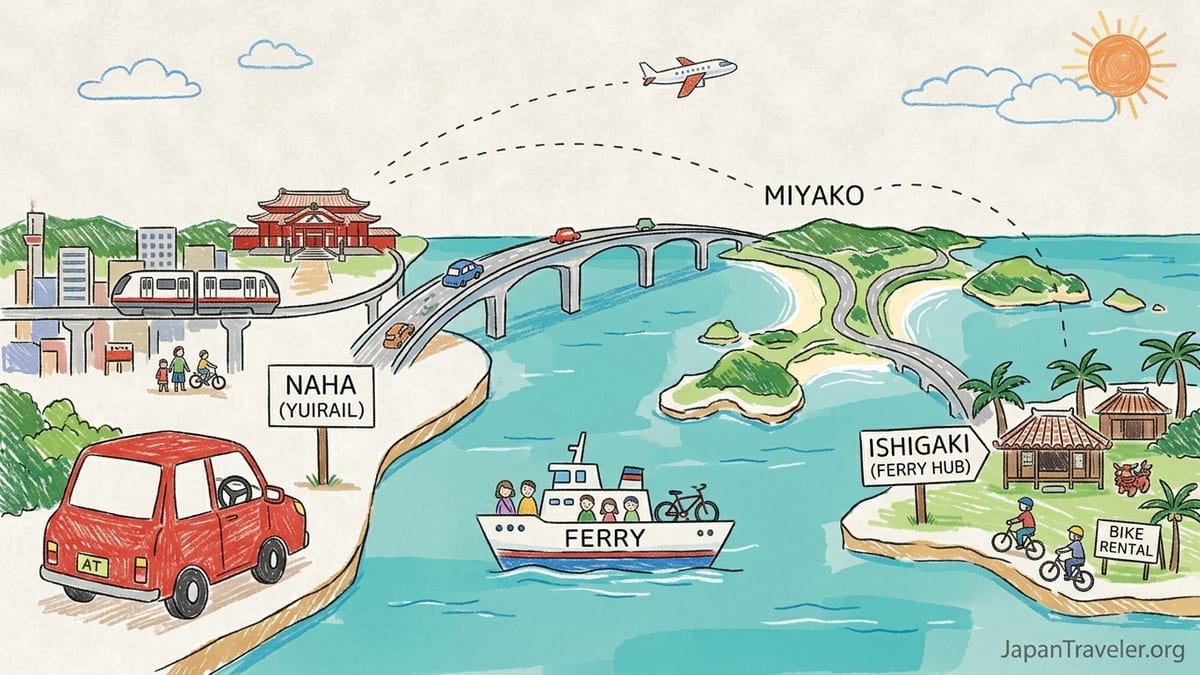
First: What “Driving the Ryukyus” Actually Means
The Ryukyu Islands are part of Japan’s Okinawa Prefecture, but from a driver’s perspective they behave like multiple destinations. You fly into one airport, rent a car for that island’s roads, and then you give the car back because the next island is reached by flight or ferry. Even when islands feel “close,” the practical reality is that car rental terms, ferry policies, and parking constraints push you toward short, self-contained driving chapters rather than one continuous journey.
That also changes how you plan. On Okinawa Main Island, for example, you can stay in Naha and rely on the Yui Rail in the city corridor, then rent a car only for a northbound day or two. On Miyako, a car can turn several islands into one seamless loop because of bridges. In Yaeyama, the ferry network makes it more logical to treat each island as its own mini-trip, often with a new rental vehicle or bicycle on arrival, rather than dragging the idea of “one car” through your whole itinerary.
Official tourism information for Okinawa is blunt about this: public transport exists and works in the urban core, but a rental car is highly recommended once you want to explore beyond Naha because service becomes infrequent in central and northern areas. That framing ended up matching my experience almost perfectly: the most “worth it” rentals were the ones that solved the island’s weak links, not the ones I booked out of habit.
What I Had To Adapt To: Japan Driving Rules, Paperwork, and Car Setup
The biggest mental adjustment was driving on the left. The steering wheel is on the right, turning rules feel reversed at first, and your instincts at intersections need a reset. The second adjustment is cultural rather than mechanical: Japanese driving is generally orderly, but the price of that order is that you must be precise. I found myself paying more attention to lane markings, turn arrows, and where I was allowed to stop than I usually do on vacation driving days.
If you are visiting Japan short-term and want to drive, the key document is an International Driving Permit that follows the 1949 Geneva Convention. U.S. government travel guidance specifically notes that short-term visitors driving in Japan must have an IDP, and Japan’s National Police Agency guidance lists a 1949 Convention IDP as one valid way to drive. I carried my IDP alongside my U.S. license and passport, and I treated that trio like my “rental counter kit.”
On the car side, the most practical relief was transmission. In many places, “automatic vs manual” is a serious planning question; in Japan it usually isn’t. Most mainstream rentals are automatic, and on Okinawa I repeatedly saw “AT” in the booking flow and on the key tag at pickup. That said, I still learned to confirm automatic transmission in writing, especially if I was booking a smaller class vehicle. If you want the least stressful version of the learning curve, get a small automatic, and do your first left-side driving minutes in a low-speed area before you head onto bigger roads.
Two more “adaptation” items mattered in real life. First, child seat rules: Japanese guidance aimed at visitors and rental companies highlights that children under six must use child seats, and rental desks take that seriously. Second, expressway tolls: Japan’s ETC system is designed for electronic tolling with an ETC card and in-vehicle unit, and whether you can rent an ETC card depends on the company. I used ETC where available and avoided ETC-only lanes when it wasn’t. That single detail can be the difference between a smooth expressway exit and a stressful moment with cars stacking behind you.
Okinawa Main Island: When I Skipped the Car, and When I Couldn’t
On Okinawa Main Island, the best surprise was how far I could get without a car in the Naha area. Naha Airport connects directly to the Yui Rail network, and the monorail covers the city corridor toward Shuri. For a first day or two focused on Naha, Kokusai-dori evenings, and a simple “arrive, decompress, and eat well” rhythm, I did not miss driving at all. I also liked not having to think about hotel parking charges or one-way streets in the densest part of the city.
Then the island’s scale kicked in. Official Okinawa travel guidance warns that many visitors underestimate the size of the main island and the limitations of public transport outside Naha, and I felt that the moment I tried to stitch together beaches, viewpoints, and cafes on my own schedule. Once I aimed for central and northern Okinawa, a car stopped being a “nice-to-have” and became the difference between seeing two places and seeing six.
Picking up the car around Naha is its own small system. At Naha Airport, rental cars commonly involve shuttle transfers to off-airport lots, and the airport’s own floor guides highlight a rental car shuttle bus area. I used a shuttle-style pickup and built an extra chunk of time into my arrival day because the transfer is simple but not instant, especially when multiple companies are running buses. If your flight lands late, check shuttle hours carefully and consider delaying pickup until the next morning if it reduces stress.
Driving on Okinawa Main Island felt like two different islands. Near Naha, the pressure comes from traffic density, frequent signals, and constant merging. Up north, the stress shifts to road width and speed control: lanes can feel narrower than U.S. drivers expect, and some scenic roads require patience behind slower vehicles. Parking varied wildly. In resort zones and major attractions, parking lots were straightforward. In beach access areas and smaller restaurants, I sometimes had to choose between tight informal spots or walking farther from a proper lot.
Miyako: The Islands Where a Rental Car Truly Transformed the Trip
Miyako is where renting a car went from “convenient” to “trip-defining.” The reason is geography: several islands in the Miyako group are connected by bridges, so you can create a true multi-island driving day without touching a ferry. The headline example is Irabu Bridge, a 3,540-metre, toll-free bridge connecting Miyako Island to Irabu Island. It is the kind of infrastructure that changes how you plan your entire stay because it turns what could have been a separate island day into a spontaneous detour.
In practical terms, my Miyako driving days had a different texture than Okinawa Main Island. The roads felt calmer, the vibe was more “beach hopping,” and the distances were short enough that I could keep the day flexible. One morning I drove out with no rigid plan beyond “hit the bridge early,” and that single choice created a full arc: bridge drive, coastal stops, a swim window, a late lunch, and a sunset viewpoint without feeling like I was racing the clock or waiting on transport.
Rental logistics in Miyako also taught me to read the fine print. Some airport rental counters act as counters rather than full lots, meaning you reserve in advance and then get directed to the pickup flow. I also saw rental stations that offer shuttle service between the airport and the rental location, which makes pickup easy but again adds a small time buffer. It’s not hard, but it’s different from the “walk out to the parking structure and pick your row” rhythm many travelers expect.
Here’s the “car transformed the trip” moment that stuck with me. With a rental car, I could treat the Miyako area like a set of connected neighborhoods. I drove Irabu Bridge for the experience of it, then kept moving because the car made it painless to jump between beaches and viewpoints. Without a car, you could still enjoy Miyako, but your day would become a sequence of taxis, limited local buses, or tours, and you’d end up choosing fewer stops. On Miyako, fewer stops can mean missing the very thing the islands do best: quick pivots between water colors, shorelines, and small local pockets.
Fuel, Parking, Road Width, Speed, and Navigation: The Reality Check
Fueling up in the Ryukyus is easy, but you need to adapt to two small routines: remembering which side the fuel door is on, and understanding station flow. Many stations are full-service or semi-assisted compared to typical U.S. self-serve habits, and the lanes can feel tight. I learned to refuel earlier than I normally would, especially on less urban stretches, simply because I didn’t want to start hunting for a station late in the day.
Parking is where islands differ sharply. In Naha, parking was the main reason I didn’t want a car full time. Lots exist, but you pay for convenience and you spend mental energy interpreting signs. In smaller towns, parking was simpler, but spaces were often narrower than U.S. drivers are used to. I was happiest in a compact car because it made tight beach lots and small restaurant spaces far less intimidating. If you are a confident driver at home but not used to narrow bays, downsizing your rental class can feel like upgrading your whole trip.
Road width and speed limits matter more than people expect. Some coastal routes feel wide and relaxed; some village lanes feel like they were built for scooters and kei cars. Speed limits can be lower than what Americans intuitively expect, and enforcement is not something I wanted to test. I built my days around “short hops” rather than long hauls, and that made the driving feel relaxing rather than like a commute.
Navigation worked well, with one caveat: you need a backup plan. In-car navigation is common, but the interface may feel unfamiliar, and not every system is equally friendly in English. I relied on phone navigation as my primary tool and treated the in-car system as a secondary aid when signal felt weaker. In dense areas, GPS remained accurate, but the challenge was sometimes lane choice and timing at complex intersections. My most reliable strategy was simple: start guidance before leaving the parking spot, zoom out early to understand the next two turns, and accept that a calm reroute is better than a sudden lane change.
Yaeyama: Why Ferry-Based Hopping Changes the Car Equation
Yaeyama travel revolves around Ishigaki as a hub and then ferries to smaller islands. The name “euglena-Ishigaki Ferry Terminal” is widely used for the Ishigaki Port Remote Island Terminal, and it is where the whole archipelago starts to feel like a menu: you choose your island for the day, buy a ticket, and let the sea decide the pace. In that environment, the idea of one rental car for the “Ryukyu road trip” becomes less practical.
Yes, you can rent a car on Ishigaki and drive the island itself, and that can be terrific if you want to reach beaches and viewpoints beyond the town core. But the moment you commit to day trips to islands like Taketomi, your car turns into a parking problem. You either pay to park near the terminal and return to it later, or you accept that the car is idle for big chunks of your trip. I preferred treating Yaeyama as “ferry chapters,” then choosing the right wheels per island.
Concrete example: Ishigaki to Taketomi is a classic short hop, and published ferry timetables show frequent daily departures in many seasons, with schedule periods listed month-by-month. In that kind of network, it often makes more sense to walk on as a passenger and then rent a bicycle or a small local vehicle on arrival if you need it, rather than hauling the responsibility of a full-size car for a day built around a ferry timetable.
On Taketomi, in particular, cycling or walking can be a better match for the island’s scale and atmosphere. And on other Yaeyama islands, the decision can change again: some are best with a scooter or small car, others with a guided shuttle, and some are best with no vehicle at all. The point isn’t that cars are bad in Yaeyama. The point is that ferries break the road trip into bite-size pieces, and each piece deserves its own transport choice.
The Takeaway
My biggest learning is simple: a “Ryukyu Islands road trip” is not one continuous drive. It’s a series of island drives with separate rental pickups and drop-offs, each shaped by how that island moves people. Okinawa Main Island can be partly car-free if you base yourself in Naha and use the Yui Rail and city transport, but once you want northern beaches and remote corners, a rental becomes the efficient choice and official Okinawa tourism guidance supports that logic.
Miyako is the group where I would rent a car again without hesitation because the bridges make multi-island exploration feel seamless. Driving across Irabu Bridge is not just a photo moment. It is a practical connector that turns your day into a loop rather than a logistics puzzle, and it expands what you can do between breakfast and sunset.
Yaeyama is where I would be selective. I would rent a car on Ishigaki if my plan focused on driving Ishigaki itself, but for island-hopping days I would go ferry-first and then choose bicycles or small rentals on each island as needed. That approach matched the reality of the network and kept me from paying for a car that mostly waited in a lot.
If I were planning the same trip again, I would do it this way: Okinawa Main Island with a short targeted rental for the north, Miyako with a car for most days, and Yaeyama with a car only when I was staying put on Ishigaki and not when my itinerary was built around ferries.
FAQ
Q1. Do you mean one continuous “Ryukyu road trip” by car?
No. It’s several separate island drives with separate rental pick-up and drop-off, because the island groups are separated by ocean.
Q2. Do U.S. travelers need an International Driving Permit in Japan?
Yes for short-term visits. Bring an IDP that follows the 1949 Geneva Convention, along with your U.S. license and passport.
Q3. Is it easy to rent an automatic car in Okinawa and the outer islands?
In my experience, yes. Automatic cars are common, but you should still confirm “AT” at booking and at the counter.
Q4. Is a car necessary on Okinawa Main Island if I stay in Naha?
Not always. Naha has the Yui Rail and city transport, but a car becomes far more useful once you want central and northern areas.
Q5. What’s the single most useful drive in the Miyako area?
Crossing Irabu Bridge. It is 3,540 metres long and links Miyako Island to Irabu Island, letting you explore multiple islands by car.
Q6. Are rental pickups at Naha Airport and Miyako airports straightforward?
Usually, but plan for shuttles. Many companies use shuttle buses from the terminal to an off-airport lot or rental station.
Q7. What was the hardest driving adjustment as an American?
Driving on the left and building new intersection habits. I had to slow down mentally and follow lane markings carefully.
Q8. Did navigation work well while driving in the Ryukyus?
Mostly yes. Phone navigation was my main tool. In-car navigation can vary by car, so I recommend having both options.
Q9. Is renting one car for Yaeyama island-hopping a good idea?
Often no. Because travel is ferry-based, it can be more practical to rent a bicycle or a new vehicle on each island instead.
Q10. Which island groups would you rent a car on again?
Miyako without hesitation, Okinawa Main Island for targeted exploration beyond Naha, and Yaeyama only when focusing on Ishigaki itself.