


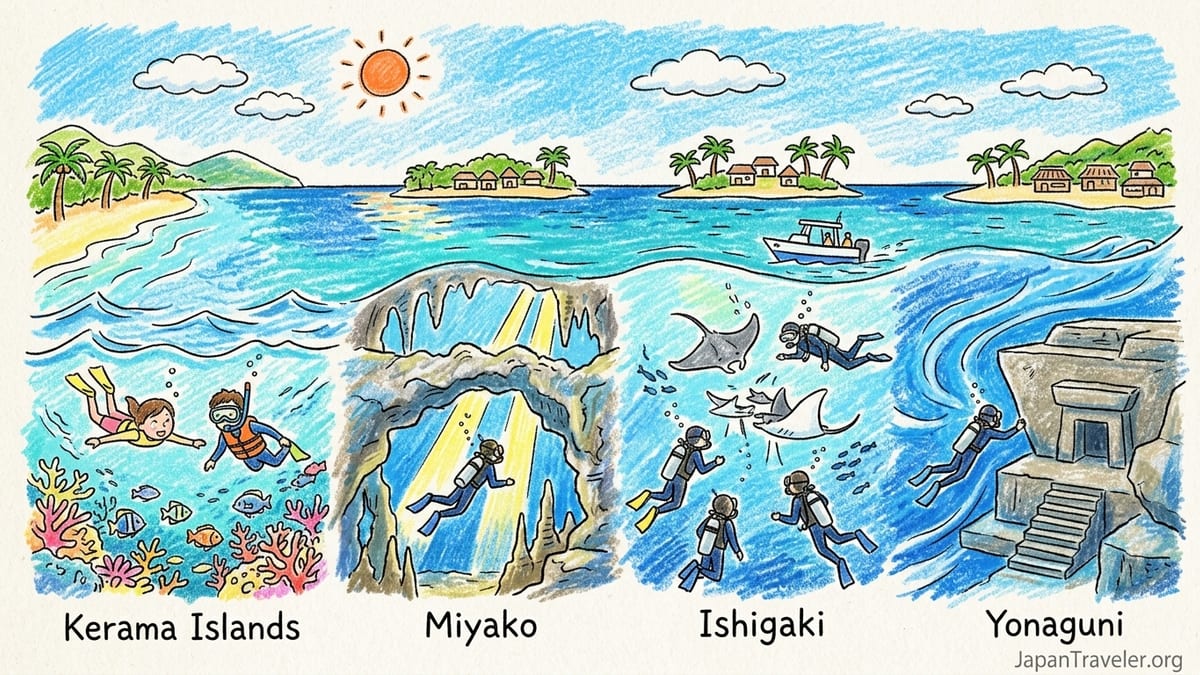
I came to the Ryukyu Islands expecting “Okinawa diving” to feel like one product: warm water, coral gardens, maybe a famous animal if luck cooperated. What I found instead was an archipelago that behaves like four different underwater countries stitched into one Japanese prefecture. The Keramas delivered the clearest, easiest reef time I logged in the chain. Miyako leaned hard into geology with swim-throughs, arches, and cave-like rooms that demanded calm buoyancy. Ishigaki was the most flexible for mixed groups, with operators running both snorkel and dive days and a menu that ranges from mellow reefs to currenty points. Yonaguni was the outlier, a drift-diving culture built around ocean movement, timing, and comfort in big water.
How I Planned Real Sessions (And What “Different Underwater Products” Means Here)
When you read the official and operator-facing descriptions for the Ryukyus, each island group sells a distinct underwater identity: the Keramas emphasize exceptionally clear reef diving and extraordinary coral variety; Miyako is tied to arches, caves, and caverns; Ishigaki is synonymous with manta-ray cleaning stations; Yonaguni is linked to hammerheads and unusual seafloor formations. The catch is that marketing describes potential, not what you will personally see on a given day. To keep my own sessions honest, I treated each island group like a separate trip: I picked one or two operators with clearly published menus and pricing, chose a session style (shore vs boat), and went in expecting reefs and fish first, and “headline animals” only if the ocean chose to cooperate.
I also planned around the practical realities that affect underwater outcomes more than hype: boat access, wind direction, swell, and current. In the Ryukyus, the most important question is often not “Which island is best?” but “Does this operator have the boat access and flexibility to move to sheltered points when the sea turns?” That is why I leaned on operators that publish how they run days and what is included, not just pretty photos.
Finally, I treated safety as live, checkable information rather than advice recycled from old guidebooks. In October 2026, the Ryukyus are in the tail end of typhoon season, and operators can and do cancel boats, change points at the dock, and shorten sessions. If your itinerary is tight, build slack into your plan: the islands reward people who can swap a dive day for a beach snorkel day without feeling like the trip is ruined.
Kerama Islands (Zamami, Aka, Tokashiki): Where Snorkeling Alone Can Be Enough
If you want the Ryukyus to feel easy, start in the Keramas. My most relaxed sessions in the archipelago were here because the whole experience is set up for people who are not trying to “conquer” anything. The reefs sit close to beaches, the water can be startlingly clear on good days, and you can build a full trip around snorkeling if you pick your beach and stay inside designated zones. Kerama’s appeal is that you do not need to be a strong diver to have a strong day.
For a guided snorkel day that still felt intimate, I looked at Zamami-based operator pricing that is explicit about what is included. Umi-asobi Toiro lists both private beach snorkeling and boat snorkeling, with prices that change depending on whether you are solo or sharing the guide. For two or more people, the listed rate is 10,000 yen per person for either the private beach snorkeling tour or the boat snorkeling tour, and the package includes mask, snorkel, fins, life vest, and wetsuit. Solo participation is priced higher at 15,000 yen. This is exactly the kind of pricing reality that matters in the Keramas: the water is accessible, but the cost per person shifts dramatically if you are traveling alone.
What did boat access add in the Keramas? In my experience across the islands, a boat excursion adds value in two ways: it expands your coral and fish variety, and it reduces the “are we allowed to swim here?” uncertainty that can crop up on popular beaches with protected or netted zones. The Keramas have plenty of shore-friendly snorkeling, but on crowded days you may find the best coral heads are not where most swimmers are concentrated. A small-boat drop to a quieter patch, with a guide keeping you oriented and away from shallow coral, can turn a decent snorkel into a memorable one.
Beginner verdict: the Keramas suited beginners best overall, including travelers who only want to snorkel. If you are new to the ocean, the simplest win is to stay close to shore at beaches such as Furuzamami or Ama and treat snorkeling as the main event. If you are traveling solo and the surcharge feels steep, look for shared boat snorkel departures or pair up with other travelers so the per-person cost stays closer to the two-person rate.
Miyako Islands (Miyakojima and Irabu): Caverns, Light Beams, And Why Calm Buoyancy Matters
Miyako’s signature is not a single fish or a single reef. It is the feeling of structure underwater: arches you can see from a distance, corridors that funnel you toward a bright opening, and cave-like rooms where light changes minute by minute. Even on introductory dives, you can sense that Miyako rewards divers who move slowly and keep their fins and hands off the bottom. In other words, the “product” is geometry and light, and your technique determines how much you enjoy it.
For the traveler who wants a published, bookable experience with clear pricing, Miyako has operators who list menu items down to fuel surcharges. Blue TABBY, a Miyakojima shop, posts a price table and also notes that from April 1, 2026, a fuel surcharge of 1,000 yen per person per day applies. That kind of detail matters on a multi-day dive plan because it can quietly add up. In the same pricing material, boat fun diving is listed at 13,200 yen for one dive, and the shop explicitly references the PADI diver medical participant check sheet as part of pre-trip preparation, which is a good reminder that Okinawa operators are increasingly strict about fitness and medical disclosure.
If you are building a mixed day that includes snorkeling, introductory diving, or a charter, Eco Guide Cafe advertises a structured “Blue Grotto” style menu and also publishes charter fees. The site lists a basic charter fee of 90,000 yen including tax for up to 20 people for three hours, and also shows per-person activity fees for snorkeling and introductory diving in certain course combinations. This is a practical option for families or groups who want to control the pace, reduce crowding, and keep beginners close to supervision while stronger swimmers explore farther within agreed limits.
Snorkeling versus diving in Miyako is not an either-or question. Snorkeling can absolutely be “enough” on calm days if your goal is color and fish over structure. But if you came specifically for the famous arches and cavern-like spaces, paying for a boat dive is where Miyako starts to separate itself from the rest of the Ryukyus. Those geological features tend to be accessed more reliably with boats and guides who know how swell direction and surge affect entry and exit. Experienced-diver verdict: Miyako rewarded divers who are comfortable with overhead-like environments without treating them as true cave dives. If you are prone to anxiety in enclosed spaces, stick to open reef sites and snorkel sessions and enjoy Miyako from the surface instead.
Ishigaki and the Yaeyama Base: Mixing Snorkelers and Divers Without Sacrificing Quality
Ishigaki is where the Ryukyus felt most like a “choose your own adventure” destination. It works for certified divers chasing points, for beginners doing introductory dives, and for snorkel-only travelers who want boat access without committing to a full dive course. It is also where operator transparency is easiest to find in English or bilingual pages, which reduces friction when you are trying to confirm what is included: tanks, weights, lunch, insurance, rental gear, and whether you are expected to bring your own computer or surface marker buoy.
For certified divers who want a straightforward day rate, Dive House Manta Ishigaki publishes a simple ladder: 11,000 yen for one dive (no lunch), 13,500 yen for two dives (lunch included), and 17,500 yen for three dives (lunch included). For travelers nervous about being rusty, that same price list includes a refresh option that adds 3,000 yen. This matters in Ishigaki because the best days often involve boat hopping and occasional current; being honest about your comfort level is safer than pretending you remember everything from a certification you did years ago.
For a higher-inclusion “guided day” feel, KAMANTA Diving Club lists 16,500 yen for two boat dives and 22,000 yen for three boat dives, including guide, tanks, weights, and lunch. The shop also lists Nitrox tank pricing per tank as an add-on, which is a subtle hint about how Ishigaki days can stack up: if you plan to do repeated deeper profiles or want extra conservatism on your computer, you may choose Nitrox where offered, but you should budget it as an extra rather than assuming it is included.
Visibility, current, and marine life in Ishigaki are highly day-dependent. The local tourism messaging is clear that manta season is usually described as roughly May through mid-October, but seasonality is not a guarantee of sightings. That is why I liked operators that write this plainly into their sales material. Diving Shop RYAAAN, for example, states that manta requests depend on sea conditions and cannot be guaranteed at booking, and publishes a 2026 price list where two dives are priced as a full-day schedule even if you only do two. This is the reality of Ishigaki logistics: once the boat is committed, the day rhythm is the day rhythm.
Beginner verdict: Ishigaki suited beginners who want to try introductory diving in a professionally packaged, boat-based format, especially if their travel group includes both snorkelers and divers. Snorkeling alone can be enough if your goal is reef fish and coral gardens, but boat excursions add meaningful value in Ishigaki because they let operators choose sheltered points and adjust plans to wind and wave direction, which can be the difference between a calm, clear session and a tiring surface swim.
Yonaguni: Drift-Diving Culture, Monument Snorkeling, And Who It’s Really For
Yonaguni is the island group I would not recommend as a casual add-on. The diving culture here is drift-first, and the underwater appeal is tied to movement: you are often letting current do the work, staying with your guide, and thinking about surface pickup, not just the reef in front of your mask. It can be thrilling, but it is not beginner-friendly in the way the Keramas are. If you arrive expecting a gentle, self-paced snorkel day, Yonaguni can feel intimidating.
What helped me understand Yonaguni quickly was how plainly some operators describe their product. Sou-Wes Yonaguni states that the diving style at Yonagunijima is drift diving and lists hammerhead season as winter months from September to March. It also publishes a clear price ladder: 11,900 yen for a one-day boat dive, 17,000 yen for a day with two boat dives, and 23,000 yen for three, with inclusions like guide, tank, insurance, drinks, and for two and three dives, lunch. For someone trying to budget a serious dive trip, those inclusions matter because the remoteness of Yonaguni makes “hidden add-ons” more annoying than on busier islands.
Yonaguni is also one of the few places in the Ryukyus where a snorkeling menu is explicitly positioned as a signature product rather than an afterthought. Sou-Wes lists snorkeling at the underwater monument with wetsuit, mask, and boots rental included, priced at 5,000 yen for adults. That is a compelling option for strong swimmers who do not want to dive but still want a guided, site-specific session where boat crew and local knowledge reduce risk. It is also a useful compromise for mixed groups where one person dives and the other does not.
Experienced-diver verdict: Yonaguni rewarded divers who are comfortable with drift procedures and who listen carefully. Even if you are certified, this is not the place to insist on your own plan. If you do not regularly dive in current, consider building experience in Ishigaki first, then stepping up to Yonaguni when you are comfortable with negative entries, staying close in blue water, and being picked up by boat without stress.
Entry Styles, Certification Requirements, And What I’d Book Again
Across the Ryukyus, “shore vs boat” is not just a convenience decision; it changes your entire underwater outcome. Shore entry is your friend when you want simplicity, low cost, and the ability to bail out instantly if conditions feel off. Boat entry is your friend when the island’s best product is offshore: the Keramas’ quiet patches, Miyako’s structure, Ishigaki’s point selection, and Yonaguni’s monument and drift lines. If you are traveling with non-divers, boats also allow everyone to share the day: snorkelers can drop in while divers do their profiles, and the group still has lunch and transit time together.
Certification requirements are also straightforward once you map them to session types. Introductory diving experiences are widely available in Okinawa and the outer islands for people without a certification, usually with age minimums set by the operator. Fun diving requires a certification card, and in practice, if you are going to the more current-exposed points, many shops will be happiest if you have recent experience and are honest about your logbook. Some shops also explicitly nudge divers toward refreshers if they have not been underwater recently, and that is money well spent in the Ryukyus because these are coral environments where poor buoyancy has real consequences.
If I had to choose one “best value” booking style per island group, it would be this: in the Keramas, I would book at least one guided boat snorkel or private beach snorkel day if traveling solo or if I wanted the best coral patches without guesswork. In Miyako, I would pay for a boat day with a shop that is explicit about surcharges and inclusions, because the geology is the point and boats access it more reliably. In Ishigaki, I would book a two- or three-dive day with published pricing that includes lunch, and I would treat manta sightings as a bonus rather than a purchase. In Yonaguni, I would only book if I had the time buffer and the experience level to accept drift conditions without trying to force the day.
The Takeaway
The Ryukyu Islands are not one snorkel-and-dive destination; they are a menu of different underwater experiences. The Keramas were the best match for beginners and snorkel-forward travelers because the reef payoff can be high without advanced skills, and guided tours help avoid the “restricted zone” confusion that sometimes comes with popular beaches. Miyako rewarded divers most because its identity is underwater architecture, and you feel that best on a controlled boat plan with guides who know how surge and swell change entry and exit. Ishigaki was the most versatile: it handled mixed groups and offered the widest spread of operator styles and price points, but it also demanded realistic expectations about “famous” animals. Yonaguni was the specialist: a drift-diving culture where the ocean decides, and where the best trip is the one booked by people who already know they like current.
If you want the simplest trip that still feels world-class, start with the Keramas and snorkel hard. If you want the most distinctive underwater terrain, take Miyako seriously and book for the structures. If you want a base that can do a bit of everything, Ishigaki is the easiest hub. If you want the most intense, story-worthy days and you are comfortable in moving water, save Yonaguni for when you can commit to it rather than squeezing it in.
FAQ
Q1. Which Ryukyu island group is best for beginners who only snorkel?
The Kerama Islands are the most beginner-friendly overall, because shore snorkeling can be rewarding and guided tours are readily available when you want safer access to better coral patches.
Q2. Where did paying for a boat excursion add the most value?
Miyako and Yonaguni benefited most from boat excursions, because Miyako’s signature arches and cavern-like spaces are accessed most reliably by boat, and Yonaguni’s monument and drift-style routes are fundamentally boat-based.
Q3. Can I do scuba in the Ryukyus without a certification?
Yes. Many operators offer introductory or trial dives for non-certified travelers, but you must follow the operator’s age limits, medical screening, and supervision rules.
Q4. What should a certified diver budget for a two-dive day in Ishigaki?
Published rates vary by shop and what is included, but real 2026 price lists show two-boat-dive days commonly priced in the mid-teens to high-teens in yen when lunch and guiding are included.
Q5. Is Yonaguni appropriate for newly certified divers?
Yonaguni is widely run as drift diving, so it is better for divers who are comfortable in current and can stay close to a guide. Newly certified divers should consider building experience first.
Q6. Is snorkeling alone “enough” in the Keramas?
Often, yes. Kerama shore snorkeling can be excellent on calm, clear days, and many travelers can build a full trip around beach sessions, adding a boat day for variety.
Q7. What extra costs should I watch for in Miyako?
Some shops publish fuel surcharges starting in 2026 and request marine conservation cooperation fees. Always read the operator’s latest price page before you book multiple days.
Q8. Do Ishigaki operators guarantee manta-ray sightings?
No. Some shops explicitly state they cannot guarantee mantas at booking because sea conditions and wildlife presence change daily.
Q9. Which island group most rewards experienced divers?
Yonaguni can be the most rewarding for experienced divers who enjoy drift procedures and big-ocean conditions, while Miyako rewards divers with solid buoyancy and comfort near overhead-like terrain.
Q10. What is the single most important safety habit across the Ryukyus?
Be flexible and conservative: accept cancellations, avoid pushing rough sea days, and choose operators who adjust sites to conditions rather than forcing a famous spot.