


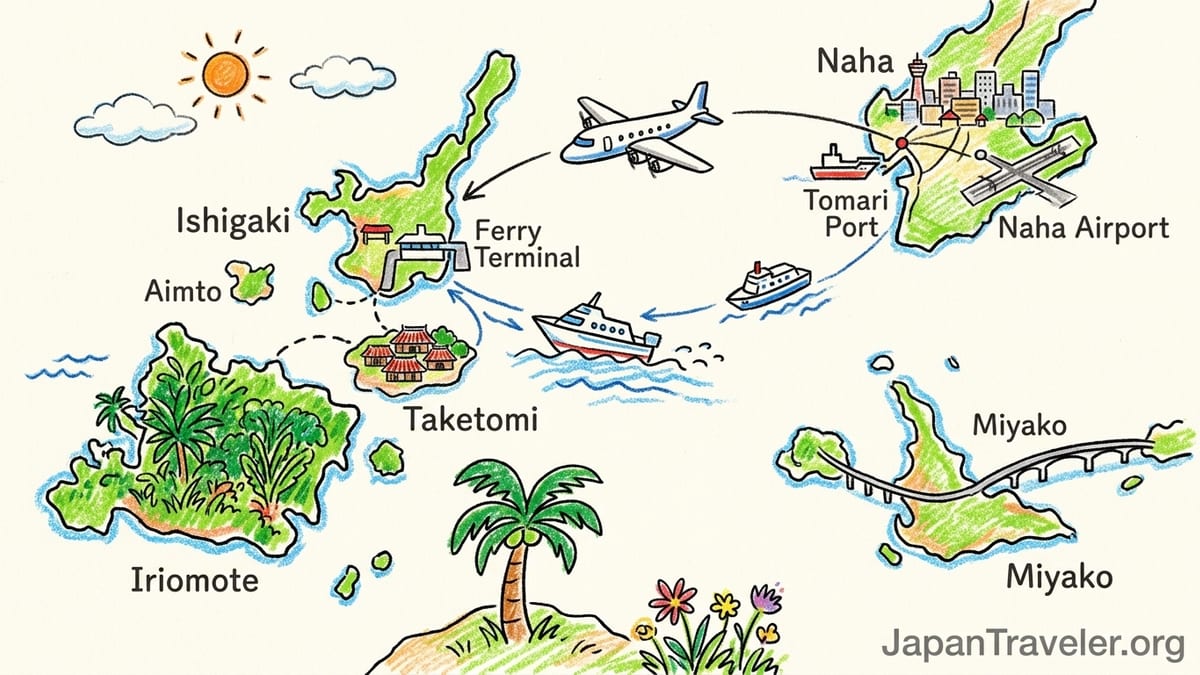
I went to Okinawa expecting classic island hopping: step off one ferry, grab a snack, and casually drift to the next island. The Ryukyu Islands do not work like that. They are a long, scattered chain, and the transport system is a patchwork of flight spokes and ferry clusters rather than a single, continuous “island-to-island” route. Naha is the flight hub that makes long jumps possible. Ishigaki is the ferry hub that makes Yaeyama day trips and multi-island loops realistic. And the hard lesson I learned is that your itinerary lives or dies on two forces you cannot negotiate with: typhoon-season sea conditions and the fact that many island changes in a row become physically exhausting.
What surprised me most: the Ryukyus are a network, not a route
The first thing I had to unlearn was the idea that the Ryukyu Islands form a tidy ferry corridor. They don’t. Even within Okinawa Prefecture, the distance between clusters is huge. Kerama sits close to Okinawa’s main island and is primarily a Naha-based boat trip. The Yaeyama Islands sit far to the southwest and revolve around Ishigaki’s remote-islands terminal. Miyako is its own cluster, and while there are some inter-island flights, you can’t assume a boat will conveniently stitch everything together.
In practice, most travelers end up doing “cluster hopping” rather than “island hopping.” That means you fly into a hub (usually Naha or Ishigaki), stay put for a few nights, then take fast boats to smaller islands as day trips or short overnights. When I tried to chain too many islands back-to-back, the travel started to eat the trip. The most scenic beach day can feel like an airport commute if you are packing, checking out, rushing a port, and checking in again every 24 hours.
Naha is the key aviation connector: official Okinawa guidance and airport schedules show frequent services linking Naha with the big outer islands, including Ishigaki and Miyako, and also the far-flung Yonaguni. There are also some remote-island links such as Ishigaki to Miyako and Ishigaki to Yonaguni that can be trip-savers when you want to avoid routing back through Naha.
Ferries are not “slow flights.” They are weather-dependent, capacity-limited, and often tied to specific ports and bus connections. On the days I built in buffer time, the system felt easy. On the days I tried to make tight connections, I felt like I was gambling with my hotel bookings.
My Naha flight hub routine: how I booked, timed, and packed for island flights
I treated Naha Airport like a real hub rather than a simple arrival point. That meant booking flights first, then building stays around the flight schedule, not the other way around. For Naha to the outer islands, airlines like JAL group carriers (including Japan Transocean Air and Ryukyu Air Commuter) and ANA group carriers run frequent domestic services; official Okinawa sources list Naha–Ishigaki at roughly an hour, Naha–Miyako at about 55 minutes, Naha–Kumejima roughly around the half-hour mark, and Naha–Yonaguni around 80 minutes.
Booking method: for flights I booked directly with the airline websites in English where available, comparing one-way fares across a couple of dates. Okinawa domestic routes often use dynamic pricing. Because of that, I avoided promising readers a single “typical” flight fare as a fixed number. What I can say with confidence is how I controlled cost: I booked the longer trunk jumps early, I stayed flexible on departure times, and I avoided same-day rebooking scenarios, which are where prices and availability can become painful.
Baggage: I packed like I was connecting through small airports. Even when a plane is a standard domestic jet, the island airports operate more like regional terminals: compact, efficient, and strict about timelines. I traveled with one carry-on sized backpack plus a small personal item so I could move quickly between airport, taxi, and hotel without waiting at baggage claim. When I did check a bag on one leg, it forced earlier arrival at the airport and made my door-to-door travel time longer than the flight time suggested.
Arrival time at the airport: for domestic island flights I planned to arrive earlier than my “big city” habits would suggest, especially if I had checked baggage. If you miss the baggage cut-off, you are not “a little late,” you are often simply off the flight. My working rule was to be at the terminal about 90 minutes before departure if I needed to check a bag, and about 60 minutes before departure if I was carry-on only, with extra buffer during peak travel weeks.
Journey 1: Naha to Ishigaki by air, then Ishigaki to Taketomi by fast ferry
This was the classic Ryukyu two-step that finally made the whole system click for me: use Naha for the long jump, then use Ishigaki as the ferry launcher. On paper, Naha to Ishigaki is a short hop of around an hour, and the flight schedule published for 2026 continues to show block times in that range. The important reality: the flight itself is the easy part. The travel day is defined by how quickly you can get from your Naha hotel to OKA airport, then from Ishigaki’s New Ishigaki Airport into town and onward to the port.
Booking method: I bought the Naha–Ishigaki ticket directly on the airline site, selecting a mid-morning departure so I wouldn’t be dependent on a very early taxi or a rushed breakfast. Fare paid: because fares fluctuate constantly on these routes, I will not state a single paid amount as “the price.” Instead, I treated the fare like a variable and used my date flexibility to keep it reasonable. If you need a firm cap, set a personal threshold and book as soon as the flight meets it, rather than waiting for an imaginary last-minute deal.
Hotel-to-hotel time: door-to-door, the day was much longer than “1 hour.” With a typical city-to-airport transfer in Naha, early arrival for check-in, the flight, time to exit Ishigaki Airport, and then a taxi or bus into Ishigaki city, I budgeted most of a half day before I even saw the sea. Once in Ishigaki, I walked into the Euglena Ishigaki Port Remote Islands Terminal, bought a Yaeyama ferry e-ticket for a later sailing, and finally felt like I was island hopping.
Ishigaki to Taketomi by fast ferry felt like the opposite of flying: no security theater, quick boarding, and suddenly you are staring at shallow turquoise water. Official local guides commonly list Taketomi as roughly 10 to 15 minutes from Ishigaki by high-speed boat. Sea conditions matter even on short routes: choppy water can turn a quick ride into a bouncy one, and that affects how you plan if you are prone to seasickness.
Journey 2: Naha to the Kerama Islands by boat (why this ferry feels “easy”)
If you want one place in the Ryukyus where ferry travel is straightforward, it is the Kerama Islands. From Naha’s Tomari Port (Tomarin), the village-operated services connect to Zamami and Aka by regular ferry and high-speed boat. Official fare tables published by Zamami Village show adult one-way pricing that varies by vessel type, with the faster Queen Zamami priced higher than the regular ferry. The important planning detail is not just price. It is seat availability and weather risk.
Booking method: I checked seat availability using the official Zamami web reservation system and, when needed, reserved online within the allowed advance booking window. Payment depends on method: online reservations can take card payment, while phone reservations typically require paying at the counter on the day. Fare paid: I followed the official fare table for the specific vessel and date, then added small “real world” costs like getting to Tomari Port by taxi if I was carrying luggage.
Arrival time at the port: I treated Tomari like an airport when I had a must-make departure. I aimed to be at the terminal early enough to find the correct counter, confirm the sailing, and board without stress. That buffer mattered because ports feel casual until they don’t. A queue, a last-minute schedule adjustment, or an unfamiliar boarding gate can easily turn into a missed boat.
Sea conditions and cancellation risk: this is where Kerama taught me the value of weather buffer. Ferries and high-speed boats can be delayed or cancelled due to strong wind and high waves. Even if the crossing time is under an hour on a fast boat, the risk is not the duration. It is the conditions. For any overnight stay on Zamami or Aka, I tried to avoid planning a same-day onward flight out of Naha. If you do that, you are betting that the sea will cooperate with your plane.
Journey 3: Ishigaki as my Yaeyama ferry hub (Iriomote, Kohama, Hateruma)
Once I based myself on Ishigaki, the Yaeyama Islands became genuinely hop-friendly. The entire experience revolves around the remote-islands terminal in Ishigaki, where multiple operators run high-speed boats to nearby islands. This is the part of the Ryukyus that most resembles the island-hopping fantasy, with an important caveat: every plan is only as solid as the sea state.
Ishigaki to Iriomote: official tourism information for Iriomote commonly states about 40 to 50 minutes by ferry from Ishigaki, depending on which port you are using. This matters because Iriomote is big and has more than one arrival port, and the “wrong” port for your accommodation or tour can add serious overland transfer time. Booking method: I used operator e-ticket platforms when available, and I avoided last-minute counter-only purchases during peak weeks when popular departures can sell out.
Ishigaki to Kohama: official local guides list the ride as roughly 25 to 30 minutes, and it feels like a quick hop. What I learned here is the hidden time: you still need to time your hotel checkout, get to the port, wait for boarding, and then on arrival, handle island transport which may be limited. A 30-minute ferry can still consume half a day if your departure is late morning and your lodging check-in is mid-afternoon.
Ishigaki to Hateruma: this is where the ocean takes control of the itinerary. Official local materials commonly describe Hateruma as roughly an hour or longer by high-speed boat, and it is widely known among travelers as one of the more weather-affected routes. On my rougher sea day, I understood why people warn you not to plan something non-refundable immediately after. Cancellation risk is not theoretical here. If Hateruma is a priority, I recommend booking it as the “center” of a buffer plan, not as a fragile add-on between two hotel reservations.
When to fly, when to ferry, and how much buffer time actually works
I ended up using a simple decision rule: fly for long jumps between clusters, ferry for short hops within a cluster. Flights are what make the Ryukyus possible as a multi-island trip in a single vacation. Ferries are what make the smaller islands feel intimate and distinct once you are already in the right cluster.
Fly when: you are moving between Naha and Ishigaki, Naha and Miyako, Naha and Yonaguni, or when an inter-island flight saves you from routing back through Naha. Official Okinawa sources continue to list a set of remote-island air routes, and Naha remains the dominant hub. Even when a ferry exists in theory, the time cost is usually not competitive for a traveler with limited days.
Ferry when: you are doing Kerama from Naha, or you are using Ishigaki to reach Taketomi, Iriomote, Kohama, Kuroshima, and other Yaeyama islands. Official references and local guides consistently position Ishigaki as the gateway for Yaeyama ferries. This is where boats are frequent enough to build day trips, and the distances are short enough that the travel feels like part of the fun.
Weather buffer: I stopped trying to make “same-day sea-to-air” connections unless the flight was late afternoon and I had a Plan B. For high-risk sea routes, I built at least one extra night somewhere with flight options, usually Ishigaki or Naha, so that a cancellation didn’t domino into missed flights and no-show hotel penalties. If you are traveling during typhoon season, increase that buffer and treat each boat day as a flexible day.
Exhaustion buffer: even when everything runs on time, too many island changes become exhausting. After about three hotel changes in a week, I felt like I was always packing, always checking in, and always thinking about tomorrow’s departure. My best stretch of the trip was when I picked one hub and used day trips. If you want a concrete planning anchor, try limiting yourself to one flight day and one ferry day per three-day block. You will still see multiple islands, but you will also actually rest on them.
The Takeaway
Ryukyu island hopping is absolutely doable, but it is not a single, scenic ferry trail. It is a hub-and-spoke flight map anchored by Naha, paired with ferry clusters anchored by ports like Tomari in Naha and the remote-islands terminal in Ishigaki. Once I planned with that reality, everything got easier. I flew for the big distances, ferried within clusters, and built weather buffer like it was a core attraction, not an afterthought.
If you are building a first itinerary, start with two clusters, not five. A strong, low-stress combination is Naha plus Kerama, or Ishigaki plus two Yaeyama islands. Add Miyako only if you can spare the days to keep it enjoyable. And if Hateruma or Yonaguni is the dream, plan them as the centerpiece of a buffer-friendly schedule, because in the Ryukyus the most important connection is not the one on your ticket. It is the one the sea decides to allow.
FAQ
Q1. Can I island hop the Ryukyus by ferry only?
Not realistically for most itineraries. Ferries work well inside specific clusters like Kerama (from Naha) and Yaeyama (from Ishigaki), but long distances between clusters are typically flight territory.
Q2. Is Naha really the main hub for outer-island flights?
Yes. Official Okinawa sources list multiple remote-island air routes, and most travelers use Naha to reach Ishigaki, Miyako, Kumejima, and Yonaguni efficiently.
Q3. Is Ishigaki the best base for Yaeyama ferry day trips?
Yes. Ishigaki’s remote-islands terminal is the practical ferry hub for Taketomi, Iriomote, Kohama, Hateruma, and other Yaeyama islands.
Q4. How early should I arrive for ferries from Naha Tomari Port?
Arrive early enough to confirm your booking, find the correct counter, and board calmly. If the sailing is critical, treat it like an airport departure and avoid cutting it close.
Q5. Which is more likely to be cancelled: flights or ferries?
In my experience, ferries are more vulnerable to wind and waves, especially on exposed routes. Flights can be disrupted too, but boats are more directly tied to sea state.
Q6. Should I book Yaeyama ferries in advance?
During busy travel periods, yes. Some departures can sell out, and booking ahead helps you lock in the time that matches your hotel check-in and activities.
Q7. How much weather buffer should I leave for Hateruma?
Build extra flexibility. Hateruma is known for sea-condition sensitivity, so avoid scheduling a non-refundable flight or major transfer immediately after your planned return.
Q8. How many island changes in one week is too many?
For many travelers, more than three hotel changes in a week starts to feel like constant logistics. A hub-and-day-trip style usually delivers more relaxation and fewer missed connections.
Q9. Is it better to overnight on small islands or day trip them?
It depends on your goals. Day trips are efficient and reduce luggage stress. Overnights are worth it when you want quiet evenings, early mornings, or activities that start before the first ferry.
Q10. What is the easiest “first-timer” island-hopping plan?
Pick one hub and one ferry cluster: Naha plus Kerama for quick ocean escapes, or Ishigaki plus two Yaeyama islands for classic tropical island hopping with short boat rides.