


I planned my first Ryukyu Islands trip the way many of us do: I opened a map, saw how close the island groups looked, and started stacking them like puzzle pieces. Okinawa Main Island. Then “just a quick hop” to Miyako. Then Ishigaki for the Yaeyama islands. On paper it was neat and efficient. In real life, it was a lot of airports, rental-car counters, packing and repacking, and checking ferry status instead of swimming. After doing it the hard way, I now plan Ryukyu itineraries around island groups, not individual islands, and I build in weather and ferry risk the same way I’d build in a layover buffer on an international flight.
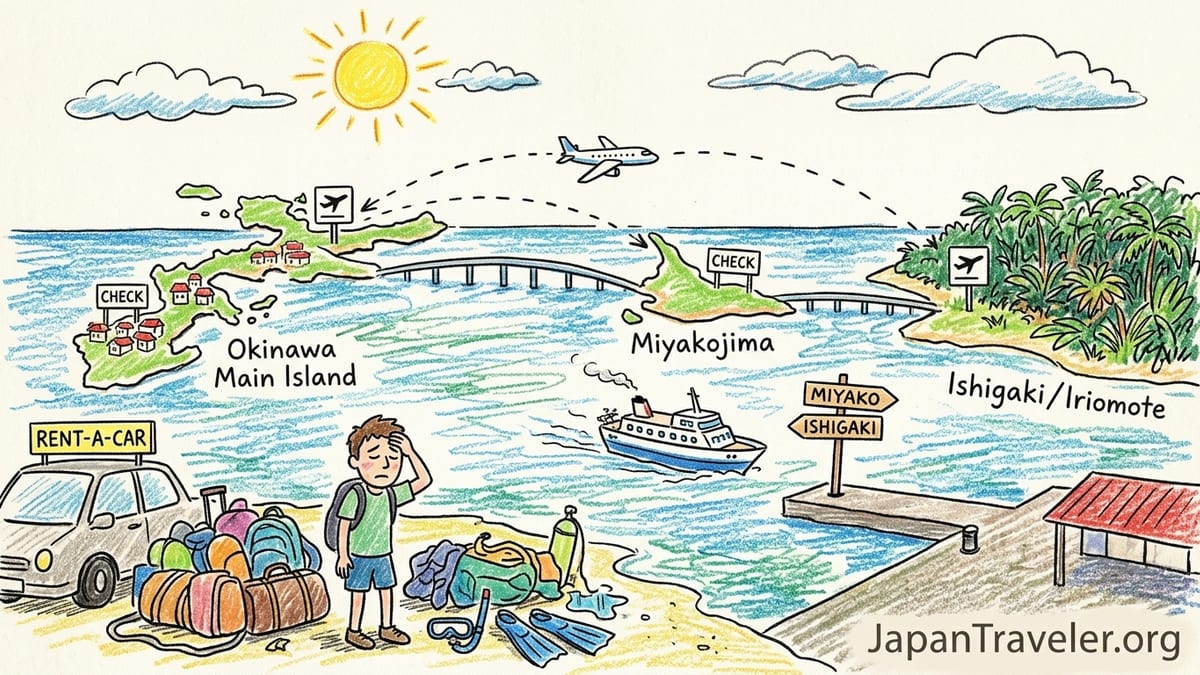
My actual island-hopping route (and what got tiring fast)
On my first serious Ryukyu run, I combined three distinct areas: Okinawa Main Island (Okinawa Honto), the Miyako Islands (Miyakojima and nearby bridges-islands), and the Yaeyama Islands based around Ishigaki (with side trips to places like Taketomi and Iriomote). I was chasing “variety” and bragging rights: different seas, different cultures, different landscapes. I got that. I also got a masterclass in friction costs.
The friction wasn’t just the flights themselves. It was the repeated cycle of checking out, getting to an airport early, returning one rental car and signing for another, buying snacks because you’re never sure what will be open when you land, and then losing the best daylight to logistics. Domestic flights in Japan are smooth compared with many places, but the time adds up when you do it multiple times inside one week.
I made multiple hotel changes: one base on Okinawa Main Island (Naha), then a base on Miyakojima, then a base on Ishigaki. Each move created a half-day that looked “empty” in the itinerary but felt exhausting in the body. Add in the mental load of baggage, wet gear, and weather dependent activities, and I realized I was touring transportation infrastructure as much as beaches.
The moment that convinced me to change my planning rule was a “simple” day built around a ferry connection. Even when the sea is calm, a ferry day is rarely just a quick hop. You still need to reach the port, buy or pick up tickets, find the right pier, and plan what to do with your luggage. When the sea is not calm, those plans can collapse.
Why “island groups” matter more than “islands” in Okinawa planning
The Ryukyus are not one destination, they are many destinations connected by short flights and ferries. Okinawa’s own official trip-planning material treats Okinawa Main Island, Miyako, and the Ishigaki–Taketomi–Iriomote area as separate multi-day itineraries, and that framing matches reality. For example, the official Okinawa travel guide publishes a three-day recommended trip for Okinawa’s Main Island, a separate three-day recommended trip focused on Miyako Island, and you’ll find multi-day planning content around the Yaeyama experience as its own trip identity rather than a casual add-on.
That distinction matters because each island group has its own “shape” of travel. Okinawa Main Island is a road-trip island where a rental car is often the difference between freedom and frustration, and it also has the easiest “quick hit” outer-island option via the Keramas from Naha’s Tomari Port. Miyako is also a drive-first destination, but the whole point is slow beach time punctuated by a few iconic bridges and viewpoints. Yaeyama, anchored by Ishigaki, is more like a hub-and-spoke archipelago: you combine a rental car on Ishigaki with ferry day trips or an overnight to Iriomote.
Once I started thinking in these buckets, itinerary choices became clearer. Instead of asking “Can I squeeze in Miyako?” I began asking “Do I have enough days for a second island group, including the flight day and weather buffers?” That question is what keeps a trip from becoming a checklist.
There is also a hidden advantage: island-group planning limits how often you have to relearn a destination. Every time you change islands, you reset your local knowledge. Where is the closest supermarket? What time does breakfast start? Where are the coin lockers? How long does it take to return the car? You can do that once or twice and still feel relaxed. Doing it every couple of days is what makes trips feel rushed even when you technically have time.
Seven days: what a week realistically forces you to choose between
If you only have seven days, the biggest decision is whether you want Okinawa Main Island plus a nearby add-on, or you want to skip the main island and commit to a southern island group (Miyako or Yaeyama) as the entire trip. What a week rarely supports, in a satisfying way, is Okinawa Main Island plus Miyako plus Yaeyama all in one run. It can be done, but it turns the trip into a series of “transit-and-recover” days and you will likely sacrifice the very experiences you flew south for: snorkeling days, boat tours, and unplanned beach time.
A week works much better with Okinawa Main Island plus the Kerama Islands, because the Keramas are a realistic extension of a Naha stay. High-speed ferries connect Naha’s Tomari Port with Tokashiki, Zamami, and Aka, and official tourism sources note that day trips are possible, especially to Tokashiki, for a taste of “Kerama Blue.” The catch is that “possible” is not the same as “deep.” A day trip can be spectacular, but you are still bound to the last boat home and you’re betting your best ocean day on the sea being cooperative.
If your seven-day priority is beaches and water color rather than urban convenience, another strong week-long choice is to base on Miyakojima and treat it as a drive-and-swim holiday. The official Okinawa travel guide’s three-day Miyako itinerary is built around a rental car and highlights the island’s classic rhythm: scenic coast drives, iconic viewpoints, and a dedicated day for water activities. In a seven-day trip, that three-day “model” becomes your core, and the extra days let you slow down and add weather wiggle room.
Alternatively, if you want jungle, mangroves, and classic island-hopping, a week based on Ishigaki can be more rewarding than doing Ishigaki as a rushed add-on. Ishigaki is the ferry hub for nearby islands, and Taketomi is close enough that it often functions as a half-day or day trip. Taketomi also asks visitors to buy a 300 yen entrance ticket intended to support preservation, purchased at ticket machines at the ferry terminals. That kind of detail seems small until you’re juggling a ferry departure, wet towels, and luggage storage on a tight schedule.
Ten days: two island groups can work if you respect connection time
Ten days is the first time the Ryukyus open up. With ten days, you can pick two substantial island groups and still travel like a human. “Two groups” might mean Okinawa Main Island plus Yaeyama, or Okinawa Main Island plus Miyako, or Miyako plus Yaeyama (skipping Okinawa Main Island entirely). The key is choosing combinations where the flight connections are straightforward and where you’re not forcing multiple hotel changes inside each group.
In practical terms, ten days is when I stop trying to do day trips that steal depth. For Yaeyama, for example, you can base on Ishigaki and still get meaningful time on Taketomi and Iriomote, but you should decide whether Iriomote is a day trip or an overnight early in the planning stage. A day trip is doable, but it tends to turn into a long “tour day” with pickup times and fixed schedules. An overnight gives you a different relationship with the island, including quieter evenings and less pressure to catch a specific return ferry.
Ten days also gives you room to handle the travel-day reality that many itineraries hide. If you fly into one island group and out of another, you will spend time at airports, and you should budget for baggage rules. Low-cost carriers and even some fare types on full-service airlines can charge for checked bags or have strict weight limits, and those costs show up quickly when you’re carrying snorkeling fins, reef shoes, and a larger suitcase for a multi-island trip. If you can’t confirm the exact baggage cost for your fare, it’s better to plan with a “checked-bag budget line” rather than pretending it’s free.
This is also the point where smart luggage handling can make the itinerary feel calmer. On Ishigaki, for instance, the airport publishes specific locker sizes and daily rates, and it also lists same-day baggage delivery and storage options through an on-site service counter. Even if you don’t use these services, knowing they exist changes how confidently you can plan a partial day on arrival or departure.
Fourteen days: three different experiences are possible, but weather still sets the rules
Fourteen days is when people get tempted to “do it all,” and it is the most dangerous time to over-plan. Two weeks can support three distinct experiences, but only if you accept that weather will sometimes decide for you. Okinawa’s typhoon season runs roughly from May to October, with the peak typically in July, August, and September, and official travel-planning resources emphasize this as the biggest seasonal risk. Even outside typhoon season, wind and waves can cancel ferries and marine tours.
So yes, two weeks can include Okinawa Main Island, Miyako, and Yaeyama. But the reason it works is not because you can sprint faster. It works because you can add buffers. A buffer day is not a wasted day. In the Ryukyus, a buffer day is what turns a cancelled snorkeling boat into a relaxed ramen-and-museum day instead of a trip-ruining domino effect.
This is also where I became stricter about “temptation islands.” Yonaguni, Kumejima, Hateruma, and other names start calling to you from the map, and you’ll hear fellow travelers say, “We added just one more island and it was the highlight.” Sometimes that’s true. But adding “just one more island” often forces one more hotel change, one more rental-car return, one more airport morning, and one more day where you can’t do water activities because you’re in transit.
With fourteen days, I prefer three experiences that are different in kind, not just different in geography. For example: culture-and-road-trip on Okinawa Main Island, beach-and-bridges on Miyako, and mangrove-and-ferry island-hopping based from Ishigaki. Those are distinct enough that each new base feels like a new chapter rather than a repeat of the last one with a different shade of blue.
Risk planning: typhoons, ferries, and the day your “ocean day” disappears
Ryukyu itinerary planning is weather planning. Typhoon season is the headline risk, but the more common frustration is simple wind and swell that cancels the exact thing you were most excited about: the ferry to a tiny island, the glass-bottom boat, the dive boat, the snorkeling tour, the stand-up paddle outing. You can do everything “right” and still lose a day to conditions.
The best countermeasure is to schedule your must-do marine activities early enough that you still have a second chance later in the trip. If your trip is seven days and you schedule your one snorkeling tour on day six, you’ve essentially decided it might not happen. Move it to day two or three and you gain flexibility. This matters especially for places like the Keramas, where your day depends not only on your tour operator but also on the sea conditions for the boat ride back to Naha.
Ferry risk is not just cancellation. It’s also the “last ferry” effect. Many itineraries look fine until you realize the last return sailing is earlier than you expected, and suddenly your island day becomes a half-day. That’s why I now treat ferry days as their own category: not as “free time,” but as constrained time with hard deadlines.
Finally, be honest about airport time. Even on a short domestic hop, the day’s shape changes when you need to return a rental car, refuel, repack wet gear, and arrive early enough to be calm. The more islands you add, the more these small time taxes eat into the hours you imagined spending in the water.
The Takeaway
After island-hopping the hard way, my revised rule is simple: count island groups and hotel bases, not islands. For seven days, I plan one island group and no more than two hotel bases, with Okinawa Main Island plus the Keramas as the “most realistic variety” option, or a single southern group (Miyako or Yaeyama) if beaches and water time are the priority. For ten days, I plan two island groups with two or three hotel bases total, and I choose connections that don’t force a stressful transit day in the middle. For fourteen days, I plan up to three island groups, but only with weather buffers and with the expectation that at least one marine plan may be cancelled or reshuffled.
That rule sounds conservative until you try the opposite. The Ryukyus reward depth: the second beach day on the same island, the unplanned dinner near your hotel, the ability to reroute when the sea turns rough. If you want your trip to feel like island time instead of airport time, give each group the multi-day attention that official Okinawa planning materials already assume it deserves.
FAQ
Q1. Can I do Okinawa Main Island, Miyako, and Yaeyama in 7 days?
It’s technically possible, but it usually feels rushed because you’ll spend multiple half-days on airports, hotel changes, and re-renting cars instead of being on the beach.
Q2. What’s the easiest “outer island” add-on from Naha for a first trip?
The Kerama Islands are the classic add-on because ferries and high-speed boats run from Tomari Port in Naha, making day trips or short overnights realistic in good weather.
Q3. Is a Kerama day trip enough, or should I stay overnight?
A day trip can deliver stunning water color, but an overnight is calmer because you’re not forced to plan everything around the last return boat and you have more flexibility if conditions change.
Q4. How many days do I need on Miyakojima to not feel rushed?
Three full days is a practical starting point if you want to drive the bridges, visit major beaches and viewpoints, and still have time for at least one dedicated ocean activity day.
Q5. If I base in Ishigaki, are day trips to Taketomi and Iriomote realistic?
Yes, but they create structured days with ferry deadlines. Taketomi is commonly a straightforward day trip, while Iriomote often feels more satisfying with an overnight if you want tours plus downtime.
Q6. What’s the small fee people mention when visiting Taketomi?
Taketomi asks visitors to purchase a 300 yen entrance ticket intended to support preservation, usually bought at ticket machines at ferry terminals.
Q7. When is typhoon season in Okinawa and why does it matter for itineraries?
Typhoon season is roughly May through October, with peak months typically in July, August, and September. It matters because ferries and marine tours can be cancelled for safety, sometimes for multiple days.
Q8. What’s the biggest mistake people make with Ryukyu island hopping?
Adding “just one more island” without accounting for baggage, airport time, extra rental cars, and the fact that each move can consume the best daylight hours.
Q9. How should I schedule snorkeling or diving days in a multi-island trip?
Put your must-do marine days earlier in each island stay so you have a second chance later if wind, waves, or storms cancel the first attempt.
Q10. What’s your final rule for 7, 10, and 14 days?
Seven days: one island group and two hotel bases max. Ten days: two island groups with two to three bases total. Fourteen days: up to three groups, but only with weather buffers and fewer hotel moves than you think you can handle.