


When I first decided to ride the Shimanami Kaido, I underestimated how much a 70 kilometer island hopping route could vary depending on pace, bicycle choice and weather. I have now completed the entire Onomichi to Imabari crossing twice: once in a single ambitious day on a standard cross bike, and once over two far more relaxed days on an electric assist bicycle with an overnight stay on the islands. What follows is a practical comparison based on those real rides, including timings, distances, fatigue, costs and what I actually managed to see along the way.
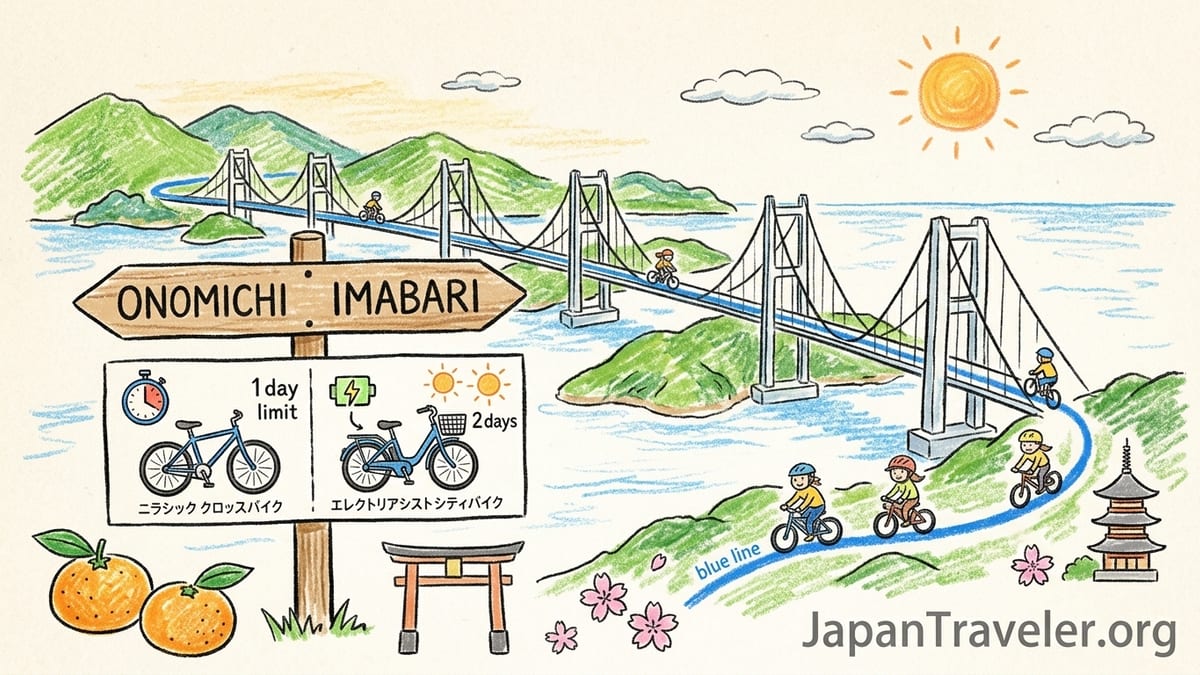
My Cycling Ability, Route Choices and Conditions on the Day
For context, I am a reasonably active but not elite cyclist in my 40s. In Japan I usually ride 20 to 40 kilometers on weekends and I am comfortable on gentle hills but not a strong climber. When I attempted the Shimanami Kaido in one day, I used a rental cross bike similar to a hybrid road bike with 700c wheels, flat handlebars and no electric assist. On my two day trip I intentionally switched to an electric assist city cycle to see how much difference the motor would make.
Both times I followed the classic Onomichi to Imabari direction, which many riders choose to avoid finishing in a smaller town with fewer late evening transport options. The official blue line distance between Onomichi and Imabari is about 70 kilometers, but with short detours for viewpoints, cafes and temples my actual GPS records showed close to 78 kilometers on the one day trip and roughly 82 kilometers spread over two days on the return visit.
On my one day ride I caught an early start, boarding the first small ferry from Onomichi Port to Mukaishima just after 7:30 in the morning. The weather was autumn clear with light wind from the southwest, around 18 to 23 degrees Celsius, which was about as kind as it gets. On the two day version I was less strict, leaving Onomichi around 9:30 in late spring. That second trip brought patchier weather: one warm, humid day with a mild headwind, followed by a cooler morning with hazy sunshine.
In both cases I stuck to the official Shimanami Kaido blue line, using the dedicated cycling ramps to each bridge, but I added extra distance by riding down into Setoda’s side streets, climbing a short local hill on Ikuchijima for a viewpoint, detouring through the streets around Oyamazumi Shrine on Omishima and exploring a few cafe lined waterfronts rather than simply following the most direct lines across each island.
One Day Onomichi to Imabari: Distance, Timing and How It Really Felt
My one day crossing was the more athletic attempt. From the moment I rolled off the ferry at Mukaishima just before 8:00, my main concern was simple: could I reach the rental terminal in Imabari before its late afternoon closing time, return the non electric bike without penalty and still have time for dinner before catching a limited express train onward from Imabari Station. That quiet time pressure shaped almost every decision I made during the day.
By my GPS record, the section from Onomichi to Setoda on Ikuchijima came to roughly 30 kilometers including a short detour into Innoshima’s coastal road. I reached Setoda around 11:00, so about three hours of riding with two short convenience store breaks and plenty of photo stops on the early bridges. My moving time for those 30 kilometers was about 2 hours and 15 minutes. At around the 20 kilometer mark just after crossing Innoshima Bridge, my legs still felt fresh, but I was already aware that the bridge approaches were not trivial. Each bridge demanded a climb on a spiral or zigzag ramp that lasted several minutes. None of them were impossibly steep but the repetition mattered.
From Setoda to the area around Oyamazumi Shrine on Omishima was my slowest stretch. This 20 kilometer segment included a roadside lunch stop at a popular cafe near the coast and a short wander through the shrine precinct. That meant about 1 hour and 50 minutes of moving time spread over nearly 3 hours total. By around the 40 kilometer point, which came on central Ikuchijima just before I crossed onto Omishima, my body was beginning to complain. My shoulders grew stiff from the flat handlebar position and my hands felt the minor road vibrations that had built over the morning. The route itself was still scenic, but mentally I was more focused on the kilometers remaining than the views.
The final stretch from Omishima to Imabari, around 28 to 30 kilometers depending on minor choices, felt the longest even though my actual moving time was close to 2 hours. After passing Hakatajima and onto Oshima in mid afternoon, the headwind strengthened. The blue line often ran on the exposed western side of the island, and the breeze forced me into lower gears on sections that would have been easy earlier in the day. At about the 60 kilometer mark, on the gentle climb to the last bridge before Imabari, I was firmly in the “just keep turning the pedals” phase. I was not exhausted, but my speed had dropped, my neck was tight and I had stopped taking so many photos.
I rolled into the rental terminal in Imabari, next to the main bridge approach, a little after 16:00. My total time door to door from Onomichi ferry to Imabari terminal was roughly eight hours, of which just over six hours was actual cycling. That was with favorable weather, minimal mechanical issues and no extended sightseeing beyond a quick look at Oyamazumi Shrine. It was very satisfying, but it absolutely felt like a full day’s work on the bike.
Two Day Version with Overnight on the Islands: E Bike Comfort and Sightseeing
On my second Shimanami trip I wanted to understand what the route felt like when time pressure was removed. This time I rented an electric assist bicycle in Onomichi, a typical Japanese city e bike with a comfortable saddle, upright position, basket and a moderate capacity battery. I planned to ride only about 40 to 45 kilometers on day one, stay overnight around Setoda on Ikuchijima, then complete the remaining 30 to 35 kilometers to Imabari the next morning.
We left Onomichi just after 9:30. Even with a later start and more relaxed pace, the e bike changed things immediately. On the first bridge ramps I used the “standard” assist mode, which cut the effort on climbs to about half of what I remembered on the non electric bike. The first 20 kilometers passed almost unnoticed. By the time we reached central Innoshima near midday, I felt like I had barely warmed up. Instead of pushing on towards Ikuchijima immediately, we took a side road down to a small fishing port for photos, then doubled back to rejoin the blue line.
The ride into Setoda in mid afternoon was the biggest contrast with my one day crossing. On the e bike, even around the 30 to 35 kilometer mark, there was no sense of grinding. We followed the coastal road past citrus orchards, took an extended break along Setoda’s Shiomachi shopping street and stopped for coffee at a local cafe near the waterfront. Because we were staying nearby, we could leave the bikes at our guesthouse and explore the area on foot in the late afternoon and early evening, including a slower visit to Kosanji Temple and its museum complex, which I had only rushed past on the first trip.
The next morning, we left Setoda just before 9:00 with only about 35 kilometers remaining to Imabari. After crossing onto Omishima, we detoured specifically to spend more time at Oyamazumi Shrine, wandering through the treasure hall with its collection of samurai armor and ancient weapons. On the one day ride I had only glanced around the main courtyard, concerned about the clock. With the two day schedule, we could spend more than an hour here and still comfortably reach Imabari well before the late afternoon rental return time.
The second day’s final 15 to 20 kilometers from Oshima to Imabari, including the last big bridge, were where I most appreciated not being deeply fatigued. Even with slightly stronger wind, the electric assist made the long gentle inclines feel like casual city riding. We still arrived at the Imabari rental terminal in early afternoon, but this time with enough energy left to take a bus into central Imabari, have a leisurely meal and stroll to the station for an evening train.
Bridge Climbs, Wind and Traffic: What the Route Really Feels Like
Because the Shimanami Kaido mostly follows the coast and uses separate cycling ramps and paths, it is easy to imagine it as an effortless seaside spin. In reality it is friendlier than many long distance routes, but the repeated ramps, wind and surface conditions do add up. This is important when deciding between a one or two day schedule.
Each major bridge crossing begins with a dedicated cycling approach that spirals or zigzags up to the deck. The gradients are generally moderate and suitable for casual riders, but the length matters. On my non electric one day ride, I found my breathing elevated and legs working steadily on every ramp from the second bridge onward. None of these climbs are individually intimidating, yet by the fourth or fifth ascent I was very conscious that each bridge meant another several minutes of low gear spinning.
Wind was the second factor I had underestimated. On both trips, once I hit the more open stretches on Oshima and the approaches to the final bridge toward Imabari, the breeze became a real consideration. On the one day ride, the afternoon headwind dropped my speed by several kilometers per hour over long exposed sections. On the e bike, by contrast, I could increase the assist level and maintain a relaxed pace without feeling like I was fighting the elements. That difference was critical in keeping the second day of the two day trip enjoyable instead of a relief when it ended.
In terms of traffic, the blue line keeps you mostly on quieter island roads or separated cycleways. That said, there are short segments where you share the road with local trucks and cars, especially near factory areas and on parts of Oshima. On my fast one day crossing I was less inclined to pull over when traffic picked up, simply because I was aiming for a deadline. When I had two days, I felt more comfortable pausing on the verge to let a cluster of vehicles pass, or choosing a parallel local road that ran closer to the water but added a few minutes to the ride.
Standard Bike vs E Bike: Real Rental Conditions and Costs
The choice between a standard bicycle and an electric assist model is often the most practical decision for Shimanami first timers. On my one day trip I rented a cross bike from a public Shimanami rental terminal in Onomichi. The daily rental cost was modest, and the bike was mechanically sound, but it had a fairly firm saddle and limited hand positions. Over six hours of riding I definitely felt the difference compared with my own multi position touring bike at home.
On the two day ride, I rented an electric assist city bike in Onomichi from a local operator that cooperates with the official network, then returned it in Imabari. The rental fee for one calendar day was significantly higher than a standard cycle, and the two day price doubled the bike cost of my first trip. There was also a modest one way return surcharge to drop the bicycle in Imabari instead of bringing it back to Onomichi, plus an additional small fee for an extra battery to ensure I had plenty of range for the 80 plus kilometers over two days.
These higher costs were not insignificant, but the comfort difference was dramatic. Where I had ground up the bridge ramps in low gear on the non electric cross bike, I could climb in a middle gear on the e bike with my heart rate barely rising. My shoulders and wrists were far less tired because of the upright riding position and wider saddle, and the motor assistance reduced the temptation to push hard into headwinds. I finished the two day trip feeling like I had enjoyed a scenic island tour, not pushed through an endurance test.
It is important for travelers to check current rental conditions when they plan their journeys, because operating hours, same day return deadlines and one way options can change. On my visits, both the Onomichi and Imabari terminals required bikes to be returned before late afternoon closing times, which meant that even with an e bike I would have been nervous if I had started late or faced mechanical delays on a single day schedule. With the two day plan, those same conditions felt very manageable.
What an Overnight Stay Adds: Temples, Streets, Cafes and Viewpoints
On my first Shimanami Kaido crossing, I told myself I would stop “briefly” at Kosanji Temple, Setoda’s backstreets and Oyamazumi Shrine. In practice, concern over time turned those into near drive by visits. I hopped off the bike to snap a photo at Kosanji’s entrance, rode slowly through one lane of Setoda’s Shiomachi shopping street, and spent less than fifteen minutes in the outer grounds of Oyamazumi Shrine before checking my watch and rolling away.
Staying overnight near Setoda completely changed that rhythm. After checking into a small guesthouse a few blocks from the waterfront, I walked back to Kosanji in the late afternoon, when most tour groups had gone. I spent nearly ninety minutes exploring the temple complex and its modern museum, then wandered through the hillside area behind it without thinking about bicycle parking or helmets. In the evening, Setoda’s streets felt like a small coastal town rather than a checkpoint on a long ride. There was time for a relaxed dinner and a quiet stroll along the seafront, watching local residents out for a walk or heading to neighborhood shops.
The next morning, without the pressure of covering 70 kilometers, we could aim for specific viewpoints and cafes we had marked on the map. On Omishima, we lingered at Oyamazumi Shrine long enough to visit the treasure hall, read some of the bilingual descriptions and appreciate why so many cyclists stop here. Later, on Hakatajima and Oshima, we detoured to small seaside cafes that would have felt like unjustifiable delays on a one day dash. The bridges themselves became locations to enjoy rather than obstacles to clear. We stopped on several decks to watch cargo ships slip through the channels below and to take more considered photographs of the islands around us.
The overnight stay also improved the simple logistics of meals and rest. On the one day crossing I relied mostly on convenience store food and one quick cafe lunch, because I did not want to wait for multi course meals or line up at popular restaurants. Over two days, we could choose a sit down lunch, mid afternoon cake and coffee at a harbor cafe, and a full dinner in Setoda without cutting into our riding time. That variety made the trip feel more like a holiday and less like a challenge ride.
One Day vs Two Days: Total Costs and Practical Trade offs
Looking back at both trips, the financial difference between a one day and two day Shimanami Kaido experience came down to four main elements: bicycle rental, accommodation, meals and onward transport schedules. My one day crossing involved a single day rental on a standard cross bike, ferry from Onomichi to Mukaishima, daytime snacks and a simple lunch, then train travel onward from Imabari the same evening. There was no accommodation cost on the islands and no luggage transfer, since I rode with a light daypack.
On the two day trip I paid for two calendar days of an electric assist bicycle, which significantly increased the bike cost compared with the single day cross bike rental. I also paid for an additional battery, an overnight stay at a small guesthouse in Setoda including breakfast, and more sit down meals and cafe stops. Because we did not need to rush for a same day long distance train from Imabari, we chose a cheaper evening departure and could consider overnighting in Imabari itself if we had wanted to explore further.
If I strip those experiences down to essentials, a budget conscious traveler who is fit, comfortable riding 70 plus kilometers in a day and content with shorter stops will usually spend less by making a single day crossing on a non electric rental bike and continuing directly by train from Imabari. However, the margin is not enormous once you factor in the possibility of a modest guesthouse, especially if you were already considering an overnight stay elsewhere in the region.
More important than the raw cost difference was the way money translated into time and comfort. The extra day of e bike rental and accommodation effectively purchased breathing space. It turned hard decisions into easy ones: whether to stop for another coffee, whether to climb a side road for a viewpoint, whether to spend an extra hour at Oyamazumi Shrine. If your travel budget allows for one extra night and a more comfortable bike, the two day option provides much better value in terms of experience per kilometer than the one day dash, especially for anyone not used to long cycles.
Direction, Weather and Who Should Choose Which Approach
Both of my rides went from Onomichi to Imabari, and if I were to ride the Shimanami Kaido again I would mostly likely choose the same direction. Starting in Onomichi allowed me to make last minute rental choices, spend an evening in a larger town before the ride and finish in Imabari with relatively straightforward rail connections. That said, some local riders prefer the reverse direction, arguing that certain gradients feel marginally easier and that arriving in Onomichi has more atmosphere. For me, the more decisive factors were rental availability, terminal opening hours and my onward connections.
Weather influenced my perception of difficulty more than direction. On the one day ride, mild temperatures and light winds until mid afternoon made the first 50 kilometers relatively kind. Only later did a strengthening headwind on Oshima add a sting to tired legs. On the two day trip, a warm, humid first day and a fresher second morning made the route feel varied but never harsh, and the e bike cushioned any weather related effort. If your schedule is flexible, building in a spare day to avoid heavy rain or strong winds will affect your enjoyment far more than starting from either Onomichi or Imabari.
For inexperienced cyclists, couples looking for a relaxed trip and families with older children, I would strongly recommend the two day version with at least one electric assist bicycle in the group. The ability to climb bridge approaches without strain, to take detours without worrying about distance and to arrive at your accommodation in mid afternoon rather than evening all make for a safer, more enjoyable introduction to long distance cycling.
Experienced road cyclists and travelers who see the Shimanami Kaido as a personal challenge may still prefer the single day crossing on a non electric machine. If you are accustomed to riding 80 to 100 kilometers in a day on mixed terrain, the 70 kilometer blue line distance, even with bridge ramps and wind, will feel like a solid but manageable outing. You will need to accept shorter sightseeing stops and keep one eye on the clock, but the satisfaction of cresting the last bridge and rolling into Imabari as the sun lowers across the Seto Inland Sea is real.
The Takeaway
After riding the Shimanami Kaido twice under very different conditions, I have come to see the choice between one day and two as less about physical ability and more about what you want from the journey. My one day Onomichi to Imabari crossing on a standard cross bike proved that a moderately fit rider can complete the full route within rental terminal hours, even with a few short sightseeing stops. It felt like an accomplishment, and I remember the final bridge in particular as a hard won reward.
Yet when I think about the temples I visited properly, the streets where I lingered and the cafes where I watched island life slide by, almost all of those memories belong to the slower two day trip with an e bike and an overnight stay near Setoda. That version transformed the Shimanami Kaido from a line on a map into a cluster of specific places: the quiet back lanes behind Kosanji Temple, the cool shade of Oyamazumi Shrine, the gentle hum of island traffic at dusk.
For inexperienced cyclists, couples and families, a two day itinerary with electric assist bicycles is the better choice. It offers more margin for weather, mechanical issues and energy dips, and it allows you to enjoy the islands as destinations rather than as checkpoints. Visitors who care more about sightseeing, photography and local food than about finishing in a certain time will also find far better value in spreading the ride over two days.
For experienced road cyclists who regularly ride long distances, and for travelers with very tight schedules or budgets, a one day crossing remains a compelling option. If you prepare for repeated bridge climbs, allow for wind, start early and keep your stops focused, you can experience the full sweep of the Shimanami Kaido in a single memorable day. For most others, however, giving the route two days and letting the pace of the islands set your rhythm will leave you with richer, more relaxed memories of one of Japan’s most satisfying cycling routes.
FAQ
Q1. Is it realistic for a beginner to ride the entire Shimanami Kaido in one day?
For a true beginner, 70 to 80 kilometers with repeated bridge climbs is a very long day, even on an e bike. Most first time riders will have a safer, more enjoyable experience by spreading the route over two days, especially if they are not used to spending several hours in the saddle.
Q2. How early should I start if I want to complete the route in one day?
Based on my one day ride, catching a ferry from Onomichi around 7:30 to 8:00 and rolling onto Mukaishima by about 8:15 gave enough margin to include short breaks and still reach Imabari before the late afternoon rental terminal closing time.
Q3. Does an electric assist bicycle make the Shimanami Kaido easy?
An e bike reduces the effort on bridge approaches and into wind, but it does not eliminate distance. You still sit on the saddle for many hours and need basic cycling balance and traffic awareness. It turns a demanding route into a comfortable one for many riders rather than making it effortless.
Q4. Where is the best place to stay if I split the ride into two days?
In my experience, staying around Setoda on Ikuchijima works well. It comes after roughly 30 to 40 kilometers from Onomichi, offers access to Kosanji Temple, local streets and the waterfront, and leaves about 30 to 35 kilometers for the second day to Imabari.
Q5. How much more does it cost to ride over two days instead of one?
On my trips, two days added the price of an extra day of bicycle rental, accommodation on the islands and more meals, so the total cost was clearly higher. The exact difference depends on bike type and lodging choice, but you should expect to spend noticeably more for the slower itinerary.
Q6. Do I need to book accommodation on the islands in advance?
Given the limited number of guesthouses and small hotels on islands like Ikuchijima and Omishima, advance reservations are strongly recommended, especially in popular seasons such as spring and autumn weekends, when many domestic cyclists visit.
Q7. Can I send my luggage separately so I do not have to carry it while riding?
It is possible to use luggage delivery services to send larger bags to accommodation or onward destinations, and I found traveling with only a daypack much more comfortable. You need to confirm timings and drop off locations with your chosen service before you ride.
Q8. Is the Shimanami Kaido safe for children?
The dedicated cycling paths and clear blue line markings make the route family friendly in many sections, but the full distance is long for younger children. Families often choose shorter segments or use a two day plan with plenty of breaks and at least one adult on an e bike for support.
Q9. Which direction is better, Onomichi to Imabari or the reverse?
I preferred riding from Onomichi to Imabari because it allowed a relaxed start in a larger town and a clear finish at the Imabari rental terminal. Some riders enjoy the opposite direction, but practical factors such as rental availability and onward trains matter more than minor differences in gradient.
Q10. What happens if I cannot return the rental bike before the terminal closes?
If you are delayed and miss the rental terminal’s closing time, you may face late fees or need to make special arrangements. This risk is one reason I felt more relaxed on the two day ride, where there was far more margin to handle slow sections, weather changes or unexpected stops.