


I planned my Ryukyu Islands trip the same way I plan most island-heavy itineraries: I chose bases first, hotels second. My goal was to minimize luggage pain while still waking up close to the experiences that make Okinawa feel like Okinawa, not like a checklist. In the end, I stayed across three island groups with four bases total, and that number is the reason the trip felt relaxed instead of frantic. I used Naha for exactly what it’s good for, ferries, food, and a soft landing, then I moved on. I slept on smaller islands where it genuinely changed my days, especially in the Keramas. And yes, repeated hotel changes got tiring the moment I tried to be too clever about “maximizing” islands. The strategy that worked was simple: fewer bases, longer stays, and only overnighting on small islands when the last boat back would otherwise cut the magic short.
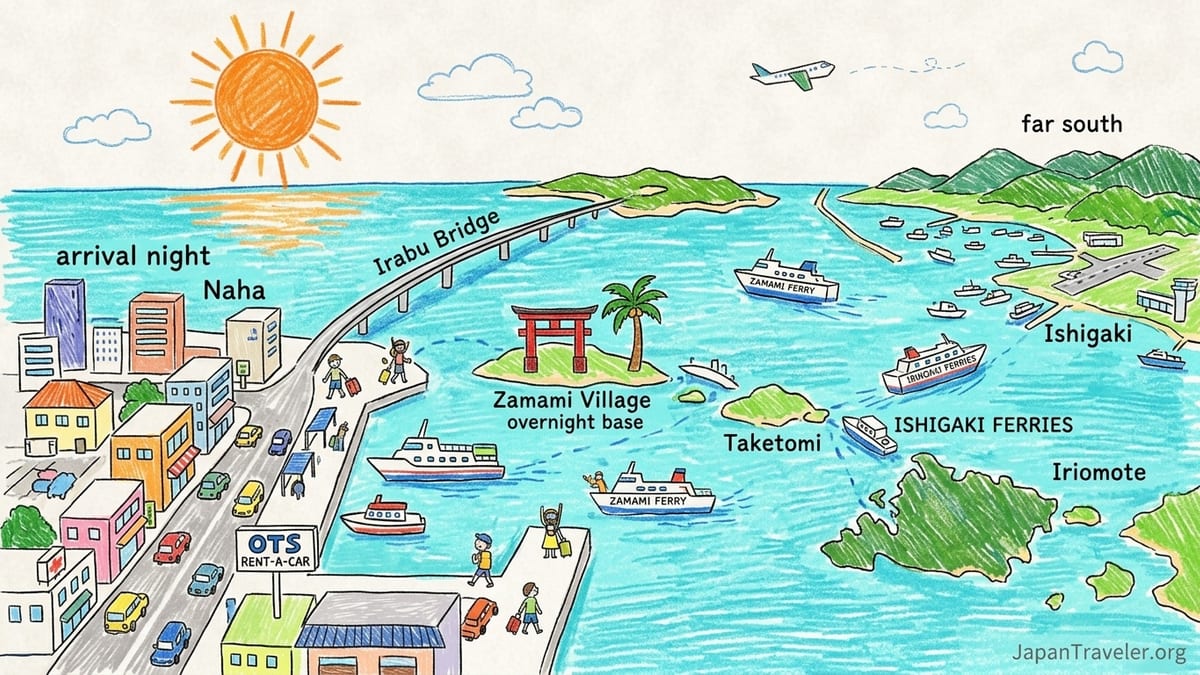
My Accommodation Strategy: The Bases That Made The Trip Work
I broke the Ryukyus into “systems” rather than islands: Okinawa Main Island (with Naha as the gateway), the Kerama Islands (best experienced beyond a day trip), and the far south chain where Miyako and Yaeyama each behave like their own little country. I did not try to sleep on every island I visited. Instead, I chose bases that reduced backtracking and made departures easy, then added day trips only when ferry timing and luggage logistics made sense.
In practice, that meant four bases across roughly two weeks: a short Naha stay, a Kerama island stay (Zamami Village area), a Miyakojima beach base, and an Ishigaki hub with one smaller Yaeyama island overnight. I experimented with a fifth micro base and immediately felt the downside: check-out times, wet gear, coin laundry, and the mental load of constantly re-packing. By the time you’ve done that twice with sandy shoes and snorkel gear, you stop romanticizing hotel hopping.
I also learned to separate “arrival nights” from “experience nights.” Naha is an arrival-night champion: you land, eat well, buy supplies, and sleep. But if you stay too long, you begin spending prime beach hours in traffic, parking lots, and urban errands. The best advice I can give is to treat Naha like a staging area, then commit to the kind of base that matches your trip’s main goal, whether that’s marine life, beaches, road trip scenery, or food.
How To Choose Your Island First (Before You Even Think About Hotels)
Island selection in the Ryukyus comes down to three practical questions: how you will arrive, how you will move around, and what you want your evenings to feel like. If your dream is sunrise swims and stargazing, you will be happier on a smaller island base where darkness and quiet are part of the experience. If your dream includes shopping streets, bars, and effortless dining variety, you will be happier in a hub like Naha or Ishigaki.
Then there’s the transport truth that shapes everything: the farther south you go, the more “air and ferry” becomes your daily reality. Ferries are not a background detail here. In the Keramas, high-speed and regular boats run from Tomari Port in Naha to islands like Tokashiki, Zamami, and Aka, and typical travel times are roughly 40 minutes to Tokashiki and around 50 to 70 minutes to Zamami on high-speed services, depending on the boat and sea conditions. That sounds easy until you realize that the last boat home can slice your day in half and that reservations can matter, especially during peak dates.
Finally, decide how much you can tolerate carrying your life in a suitcase. Small islands often mean small lodging, fewer taxis, and shorter business hours. That is wonderful for your soul and occasionally annoying for your logistics. I built my trip around a simple rule: I only moved bases when it bought me either a dramatically better beach day, a dramatically better marine experience, or a dramatically easier departure to the next island group.
Naha As An Urban Base: A Smart Hub, But Only For The Right Reasons
Naha works when you need connectivity more than coastline. It is the place to be if you want to use Tomari Port as your jump-off to the Keramas, or if you want to keep car rental optional. It is also where you can solve problems fast: replace a lost charger, grab reef-safe sunscreen, buy motion sickness tablets, or pick up cash if you are heading somewhere with limited ATMs.
For me, Naha was a one-to-two night base at the start and, depending on flight schedules, possibly one night at the end. I did not use it as a daily hub for beaches because the time cost adds up quickly. A “simple” beach run can become a day of driving and parking, particularly if you are targeting popular areas. Naha is strongest for food and city atmosphere, not for waking up steps from turquoise water.
Car rental in Naha is its own planning category. The biggest operational detail is that many rental companies operate via shuttle from the airport area rather than having you pick up a car inside the terminal. Times Car Rental, for example, notes shuttle service from Naha Airport to its shop, and also advises returning vehicles well before flight departure time. OTS Rent-a-car provides specific pickup instructions at the domestic terminal and lists business hours, which matters if you land late. If you are arriving in the evening, I strongly prefer sleeping in Naha first and collecting the car the next morning instead of turning your first night into a paperwork sprint.
Okinawa Main Island: Resort Base Versus Road-Trip Base
If you want the “big island” part of Okinawa to feel like a vacation rather than a commute, your base choice matters more than any single hotel. A resort base on Okinawa Main Island can be perfect for travelers who want pool time, easy beach access, and predictable on-site dining. The tradeoff is that you may still need a car for anything beyond your immediate area, and driving times can surprise first-time visitors.
A road-trip base, on the other hand, is about access. You pick a location that shortens the drives you plan to do most. This matters if your must-dos include long scenic loops, multiple beaches, or specific attractions spread across different areas. From a traveler comfort standpoint, the critical question is not whether you can drive, but whether you want to drive every day. If you do not, your base should be walkable to at least one beach, several restaurants, and a convenience store or supermarket.
What I watch for on Okinawa Main Island is evening atmosphere. Some resort zones are quiet after dinner, which can be exactly what you want. If you want a livelier feel, I recommend an area where you can step out for dessert, a casual drink, or a late convenience-store run without getting back in the car. Also consider laundry. When you mix beaches and boats, you will need it. The most relaxing bases are the ones where coin laundry or quick wash services are normal, not a scavenger hunt.
The Kerama Islands: Why An Overnight Stay Changes Everything
The Keramas are the classic example of a place that is “day-trip accessible” but dramatically better when you sleep there. Official tourism information emphasizes that you can reach the Kerama Islands from Naha and highlights the four inhabited islands, Tokashiki, Zamami, Aka, and Geruma. At the same time, local and national tourism guidance consistently points travelers toward deeper experiences when they base on the islands themselves, not just visit for a few hours.
Zamami Village’s own tourism guidance is unusually direct: it acknowledges that day trips are possible, but strongly recommends staying overnight to experience sunsets, a relaxed evening atmosphere, and star-filled night skies. It also flags a very real-world issue travelers forget: payment and cash access problems can happen, and on smaller islands you do not want to discover that after your last chance to solve it. That one paragraph alone shaped my planning. I treated my Kerama base as non-negotiable, not an optional add-on.
Logistically, the Keramas reward travelers who pack light and think in “boat days.” You will depart from Tomari Port in Naha, and schedules differ by island and season. For example, Japan’s national tourism information notes high-speed services from Tomari to Tokashiki (with multiple trips a day and around 40 minutes travel time), to Zamami (around 50 to 70 minutes), and to Aka (around 50 minutes, fewer departures). If you try to day-trip and the sea turns or the popular sailings sell out, you can lose the day. When you stay overnight, you can move your snorkeling, diving, or beach time to the calmer parts of the day and worry less about the “last boat problem.”
The other Kerama advantage is inter-island exploration. Official and semi-official guides describe the inter-island ferry that connects Zamami, Aka, and Geruma, which makes an overnight stay feel like multiple islands for the price of one check-in. On Aka, for instance, you can walk scenic routes like the bridge over to Geruma, and Japan’s national parks coverage highlights how island hopping unlocks beaches and viewpoints you will not rush through on a tight day-trip clock.
Miyakojima As A Beach Base: When You Want The Water To Be The Whole Point
Miyakojima is the base I choose when I want my trip to become beach-first, schedule-second. The island’s appeal is not only the sand and water, but the way the geography supports a “home beach” lifestyle. You can commit to one area and still reach multiple coastlines without feeling like you are crossing a continent.
One of the most useful concrete details for trip planning is that Miyako has bridge-connected neighbor islands that behave like extensions of the main island. Irabu Bridge, for example, is widely described as a 3,540-meter, toll-free marine bridge connecting Miyako Island and Irabu Island, opened in January 2015. In real travel terms, that means you can stay in one Miyakojima base and still get that satisfying “island hop” feeling without ferry tickets, luggage handling, or waiting at a port.
I prefer a Miyako beach base when I want early swims and simple evenings. Restaurant density can be lower than a big city hub, so I choose an area where I can reliably find dinner without driving far, and where there is a supermarket for easy breakfasts and beach snacks. Even if you plan to eat out, having a supermarket nearby changes your entire daily rhythm. It is the difference between feeling like you are on a flexible island holiday and feeling like every meal requires a mission.
Where Miyako can trip people up is the temptation to move bases between beaches. I do not recommend it. The island is best when you let the days breathe. Pick one base, rent a car if you want maximum freedom, and treat the rest as day loops. Miyako is where you minimize hotel changes and maximize water time.
Ishigaki As A Yaeyama Hub: Day Trips, Then One Small-Island Overnight
If Naha is the gateway hub of Okinawa, Ishigaki is the hub that makes the Yaeyama Islands feel possible without constant stress. It has the airport access, the restaurants, the supermarkets, and the tour infrastructure that turn “remote” into “manageable.” Most importantly, it has frequent ferry connections to islands like Taketomi and Iriomote, which lets you plan day trips based on weather and energy rather than locking everything in months ahead.
For a real-world example of how specific this can get, published ferry schedules show Ishigaki Port to Taketomi with frequent short crossings, and the posted schedule periods are updated by month or season. The practical lesson is that Ishigaki works as a base because you can wake up, walk or taxi to the remote island terminal, and be on another island quickly, then still return for dinner and a more lively evening scene.
My key rule in Yaeyama was to do most islands as day trips from Ishigaki, then choose one smaller island for an overnight to slow the pace. I did that because the difference between “we have to catch a boat” and “we can stay until the sky changes color” is the difference between seeing an island and feeling it. When you stay overnight on a smaller Yaeyama island, your evening becomes quieter, your morning becomes earlier, and your beach time becomes calmer. It can be a transformative shift, but only if you actually want quiet and can handle limited dining options.
Two details made Ishigaki easier for me. First, airport-to-town access has improved with clearer bus routing information, and services can change by season. Second, luggage logistics matter more here than almost anywhere else in the Ryukyus. If you plan an overnight on a smaller island, I recommend packing one night’s worth of clothing and leaving the rest at your Ishigaki accommodation when possible. That single habit can turn a potentially annoying ferry transfer into something that feels effortless.
As a caution, I avoid over-promising on exact ferry times or daily counts in an article like this because operators update timetables and weather can cancel routes. Instead, I plan my day trips around the concept of an early boat out and a late boat back, then I confirm the schedule close to travel. Ishigaki is the hub that makes that approach realistic because there are simply more departures and more fallback options than on smaller islands.
The Takeaway: Exactly How Many Bases I’d Use For 7, 10, Or 14 Days
For a 7-day Ryukyu trip, I would use two bases. I would do Naha for one or two nights to handle arrival, supplies, and ferry timing, then commit to one experience base: either a Kerama island if marine life is the priority, or Okinawa Main Island outside Naha if you want a mix of beaches and driving freedom. Two bases keeps luggage manageable and reduces the chance that a single weather day ruins your plans.
For a 10-day trip, I would use three bases. I would still keep Naha short, then add one smaller-island overnight that changes the feel of the trip, most often a Kerama base on Zamami, Aka, Tokashiki, or Geruma depending on your style and bookings. The third base would be either Miyakojima for pure beaches or Ishigaki for a hub-and-day-trip style. Ten days is the point where adding one flight south starts to feel worth it, but only if you keep the number of check-ins under control.
For a 14-day trip, I would use four bases, and I would copy my own winning formula: Naha as a short gateway base, one Kerama overnight base to go deeper than day trippers, one Miyakojima base for beach living, and one Ishigaki base for Yaeyama exploration plus one carefully chosen smaller-island overnight using a light pack. Four bases over two weeks is enough variety to feel expansive, but not so much movement that you spend your best mornings in transit lines.
FAQ
Q1. Should I use Naha as a hub for the whole trip?
It works for arrivals, dining, and ferry access, but it is not ideal as a daily beach hub. I prefer 1 to 2 nights in Naha, then moving to a closer-to-nature base.
Q2. Are the Kerama Islands really worth staying overnight?
Yes, if your goal is snorkeling, diving, whale watching season planning, or simply seeing sunsets and stars without racing the last boat. Local tourism guidance specifically recommends staying overnight for a fuller experience.
Q3. Which Kerama island should I base on, Tokashiki or Zamami?
Tokashiki can be great for a straightforward beach stay, while Zamami Village is excellent if you want access to multiple beaches and inter-island connections to Aka and Geruma. Your decision should follow ferry timing and what you want to do after dark.
Q4. When is a Kerama day trip sufficient?
A day trip can be enough if you only want a single beach session and you are comfortable structuring your entire day around boat departure and return times. It is less ideal if you want flexibility or multiple water sessions.
Q5. Do I need a rental car on Okinawa Main Island?
If you want to explore beyond Naha, a car is often the easiest way to reclaim your time. Many rental companies operate via airport-area shuttles, so plan pickup timing carefully.
Q6. Is Miyakojima better than Okinawa Main Island for beaches?
If beaches are your top priority, Miyakojima is often the more single-minded beach destination. Okinawa Main Island offers more variety, more urban options, and broader sightseeing.
Q7. Can I base on Miyakojima and still see other islands easily?
Yes. Bridge-connected islands like Irabu make it possible to “island hop” by car without ferry logistics, which is one reason Miyako works well as a single stable base.
Q8. Is Ishigaki the best base for the Yaeyama Islands?
For most travelers, yes. Ishigaki combines airport access, dining choice, supermarkets, and frequent ferries to nearby islands, making day trips practical.
Q9. When is an overnight stay on a smaller Yaeyama island worth it?
It is worth it when you want quiet evenings, early beach time, and a slower pace than a hub can offer. It is not worth it if limited dining, fewer services, and extra luggage handling will stress you out.
Q10. What is the biggest mistake people make when choosing where to stay in the Ryukyus?
Choosing hotels before choosing a base strategy. When you prioritize island selection and logistics first, the hotel choice becomes simple and the trip feels much easier.