

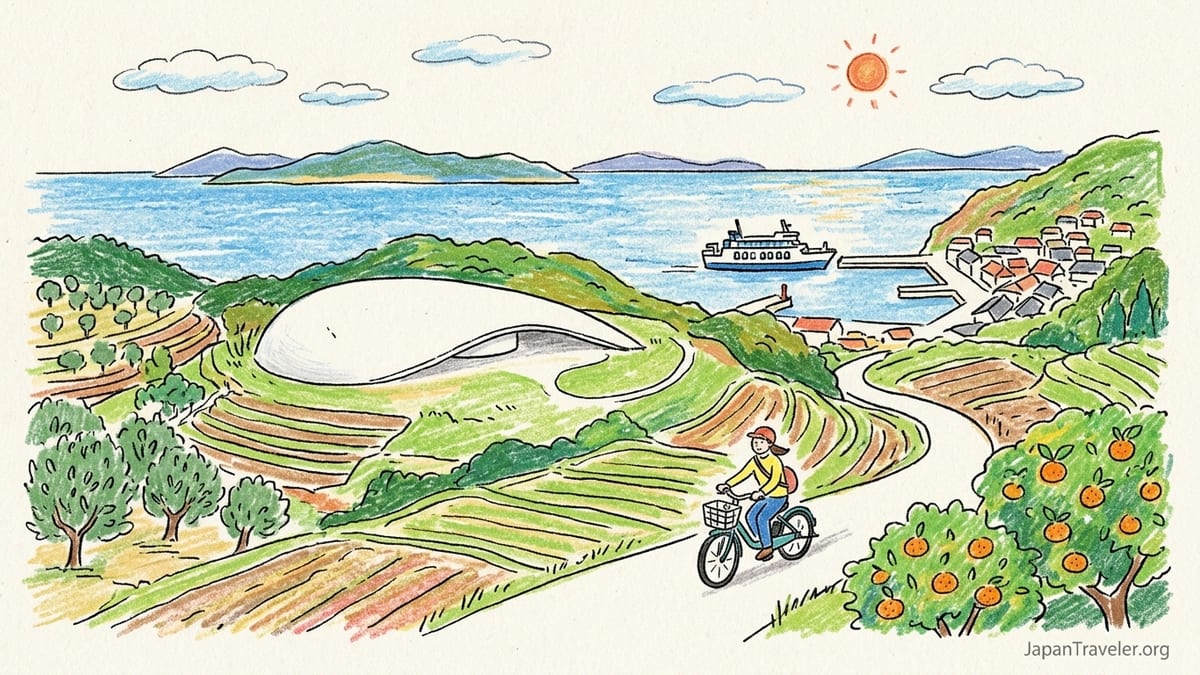
I first saw Teshima Art Museum in photographs that made it look almost unreal: a gleaming white shell sitting in a green hillside above the Seto Inland Sea. But what those images never conveyed was how it actually feels to reach this remote island by ferry, pedal along its steep country roads and then sit, silent, inside Rei Naito and Ryue Nishizawa’s extraordinary space while water slowly moves across the floor. This is the story of the day I spent getting there, cycling around Teshima and discovering that the journey is as powerful as the museum itself.
Getting to Teshima by Ferry and Planning Ahead
I based myself in Takamatsu, the small port city on Shikoku that acts as the main gateway to the art islands of the Seto Inland Sea. From the station it was a short walk to Takamatsu Port, where the Teshima Ferry operates the route to Teshima via Naoshima. On the morning I visited, I took a mid-morning passenger boat that stopped at Naoshima’s Honmura port before continuing to Teshima’s Ieura Port. The crossing from Takamatsu to Ieura, including the stop at Naoshima, took roughly an hour.
Fares on this route change occasionally, but in late 2026 the one-way adult fare from Takamatsu to Teshima Ieura was a little under 2,000 yen, with a small extra fee if you bring a bicycle. I bought my ticket at the Teshima / Naoshima counter in the terminal about 30 minutes before departure. Tickets are not reserved in advance in most cases, but boats can fill up on weekends and during the Setouchi Triennale, so arriving early is wise. The ferry timetable is also linked to the opening days of the island’s museums, which means there are fewer boats on days when key art sites, including Teshima Art Museum, are closed.
By contrast, admission for Teshima Art Museum must now be reserved online for a specific date and time. Since October 2024, Benesse Art Site Naoshima has shifted to timed tickets for all major facilities, including Teshima Art Museum, with sales handled through an official e-ticket system. At the time of my visit, a standard adult ticket purchased in advance cost just under 1,700 yen, with discounts available for students and local residents. When I booked, most midday slots were already gone several days ahead, which made it clear that securing a ticket should be the first step in planning, not an afterthought.
Because ferry times and museum slots need to line up, I chose a late-morning entry time at Teshima Art Museum that would allow for one full ferry from Takamatsu, an e-bike rental at Ieura and the ride across the island without rushing. With the ticket confirmation saved on my phone and a printed backup in my bag in case of poor signal, I boarded the boat in Takamatsu already committed to spending the better part of the day on Teshima rather than trying to squeeze it into a Naoshima whirlwind.
Arriving at Ieura Port and Renting an E‑Bike
Approaching Teshima from the sea, the first impression is of a low green shape rising from the water, dotted with terraced fields and the occasional house. The ferry eased into Ieura Port, one of the island’s main harbors, with a small village clustered up the slope. It felt immediately quieter than Naoshima, with only a handful of passengers disembarking and almost no car traffic on the pier.
Right outside the port area are a couple of rental shops offering standard bicycles and electric assist bikes. Given everything I had read about Teshima’s hills, I went directly to an e-bike counter. The staff asked for the time of my return ferry and suggested a rental duration that would allow for both the museum visit and a loop around part of the island. The price for an electric assist bicycle was in the region of 2,000 to 2,500 yen for a day, with a small additional fee if you return after the basic time window. A regular bicycle would have cost less, often around 1,000 to 1,500 yen, but the shop staff quietly pointed at the steep slope visible just beyond the harbor and recommended the e-bike without hesitation.
The rental process was quick. I filled out a basic form with my name and phone number, showed my passport, and paid in cash. They provided a simple map of Teshima in English, with suggested routes, museum locations, and steep sections clearly marked. The bike itself was a standard Japanese commuter-style model fitted with an electric assist system: upright posture, front basket for a daypack and a battery already charged to about 80 percent. Before I set off, the staff explained the three power modes and reminded me to park in designated areas at the museums and in the villages.
By the time I clipped my bag into the basket and rolled out of Ieura, I had spent roughly 2,000 yen on the ferry, another 2,300 yen on the e-bike and held an art museum ticket that had cost just under 1,700 yen. Add a few hundred yen for the train from Takamatsu Station to the port and I had crossed the 6,000 yen mark for transportation and admission before even ordering lunch. It is not a cheap day trip, but as soon as the harbor dropped away behind me and the road began climbing, I started to understand what that money was buying.
Cycling Through Olive Groves, Farmland and Coastal Roads
Leaving Ieura, the road towards Teshima Art Museum climbs sharply past old houses and vegetable plots before reaching a ridgeline that runs the length of the island. The first incline was steep enough that I immediately clicked the e-bike into its highest assist mode. Even then I was working, but it turned a strenuous push into a pleasant, steady pedal. Looking down, I could see fishing boats in the harbor and, beyond them, the wooded shapes of neighboring islands layered in pale blue.
The interior of Teshima feels largely agricultural. Once past the main cluster of houses at Ieura, the traffic thinned to the occasional local mini-truck and other cyclists. Terraced fields of rice and vegetables spread out on either side, dotted with plastic greenhouses and storage sheds. I passed small mandarin groves and several stands of olive trees, their silver-green leaves bright against the reddish soil. One farmhouse advertised local organic rice and vegetables for sale; another had crates of citrus fruit stacked by the road with a simple honesty box system.
Instead of heading directly to the museum, I first followed the ridge road in the opposite direction for a short detour toward the coastal views above Karato, Teshima’s other main port. This section rolled up and down significantly, and without electric assist it would have been punishing. With the motor on medium mode, I could focus on the changing views: the Seto Inland Sea opening out in front of me, dotted with islets and freighters, then closing back in as the road curved behind tree-covered hills. In several places the asphalt narrowed to a single lane, bordered by bamboo, wildflowers and low stone walls.
What impressed me most was the quiet. There was almost no engine noise beyond the occasional farm vehicle. Instead I heard insects in the grass, a rooster somewhere behind a house and the distant slap of water on the shore below. The combination of steep country roads, careful pacing to match ferry times and the need to watch the battery charge on my e-bike made the day feel more like a small self-managed expedition than a simple museum visit. Reaching the white shell of Teshima Art Museum after this series of climbs felt earned, not incidental.
Inside Teshima Art Museum: Light, Water and Silence
Teshima Art Museum sits above Karato, on a gentle slope planted with rice terraces and olive trees. From the small ticket building and café, a footpath leads up to the main structure, visible from a distance as a curved white form emerging from the hill. The building is a collaboration between artist Rei Naito and architect Ryue Nishizawa, and it houses a single permanent work, titled “Matrix.” Unlike many museums, there is no sequence of rooms or displays; the experience is about entering one continuous space and staying with it.
The museum staff asked everyone in my time slot to store bags in lockers, silence phones, and respect the strict no-photography policy inside. We entered in small groups, each person barefoot or in socks, which immediately changed the atmosphere. The transition from the bright, warm sunlight outside to the cool, shaded interior felt like stepping into a shallow cave or the underside of a wave. The structure itself is thin concrete shaped in an elongated droplet plan, with two large openings cut into the roof that frame the sky.
Inside, the floor is a polished, nearly seamless concrete plane that slopes gently in subtle ways that only become apparent over time. At first I noticed scattered points of water on the surface, tiny droplets bubbling up from minute holes in the floor. They gathered into beads, then threads, then small streams that slowly traveled across the space, merging and separating as they responded to the floor’s invisible contours and the faint air currents inside. People sat quietly along the edges, watching the water and the shifting ovals of sky above, where clouds and birds drifted past.
The no-photography rule made sense almost immediately. Without cameras raised, there was no clicking, no posing and no need to seek the “best angle.” Instead, the room settled into a shared silence broken only by the occasional shuffle of feet or a quiet breath. As the light shifted with the passing clouds, the entire space changed character. At one moment the interior felt evenly lit and soft; a few minutes later a shaft of direct sun turned one area into a glowing pool while leaving the rest in gentle shade. The artwork is not an object separate from the building; it is the interplay of light, air, water and time. Trying to capture it on a phone would have flattened it into a static image that tells you almost nothing about what it feels like to sit there for half an hour and watch droplets slowly rebuild their paths.
Beyond the Main Museum: Yokoo House, Les Archives du Cœur and Outdoor Works
It is tempting to visit Teshima Art Museum and immediately leave the island, but doing so would miss much of what makes Teshima special. After lingering inside “Matrix” for close to an hour, I collected my shoes, walked back down the hill to the bike parking area and pointed my e-bike toward Karato Port to visit Les Archives du Cœur. This work, by Christian Boltanski, is housed in a low building right by the water. Inside, recorded heartbeats from people around the world are preserved and played back in a dim room, accompanied by a soft light that pulses with the sound. Visitors can also choose to have their own heartbeat recorded for an additional fee. It is a simple concept, but combined with the setting at the edge of the sea, it felt unexpectedly intimate.
From Karato I retraced my route along the ridge and then descended back toward Ieura to visit Teshima Yokoo House. This small museum is a collaboration between artist Tadanori Yokoo and architect Yuko Nagayama, created by transforming an old private house facing the harbor. The building preserves elements of the original structure while introducing dramatic colored glass and mirrored interiors. In one room, a pool occupies the floor, reflecting vivid reds and blues from stained glass windows. Other spaces are lined with Yokoo’s graphic works. The open days and hours here are more limited than at Teshima Art Museum, often divided into morning and afternoon sessions, so it is important to check the current calendar and align it with ferry times.
Between these two indoor sites, I encountered several outdoor installations and small interventions embedded into Teshima’s landscape. Some were official works associated with Benesse Art Site, such as subtle architectural elements and signage that frame views of the sea. Others were more incidental: artworks visible through the windows of private homes, sculptures tucked into gardens or along minor side roads. These unscripted discoveries came only because I had the time and flexibility to wander beyond the direct line between Ieura and the main museum.
On the day I visited, the official art facilities were operating on a schedule where Teshima Art Museum and Teshima Yokoo House were open during standard daytime hours, while some other sites and cafes varied by day of the week and season. Because open days for individual facilities can change, and because there are occasional full-island closures related to maintenance or events, it is worth checking the latest combined calendar before you commit to a specific day. My experience underscored that Teshima is not a place where you can assume something will be open and simply drop in.
Lunch, Weather, Buses and the Risk of Missing a Ferry
By early afternoon, after visiting Les Archives du Cœur, I realized that food options on Teshima are more limited than on Naoshima. I headed to Shima Kitchen, a community restaurant and art project created with input from architect Ryo Abe and local residents. The building combines open wooden structures and indoor seating that blurs the boundary between restaurant and garden. On my visit, the menu focused on set lunches built around local ingredients: I chose a fish-based teishoku that came with grilled fish, rice, miso soup and small vegetable side dishes, for just under 2,000 yen. Other options, including a vegetarian-friendly plate, were priced in a similar range.
Given the limited number of restaurants on the island and their tendency to close once they sell out of lunch sets, I was glad I arrived around midday rather than later in the afternoon. Outside of peak periods like the Setouchi Triennale, you may find a few small cafes or snack stands operating close to the ports and museums, but their hours are not guaranteed. Bringing some snacks or a light backup lunch is a wise hedge against reduced opening days or unexpected closures.
The weather on my visit was characteristically changeable in the Seto Inland Sea style. The morning started overcast and humid, with low clouds filtering the sun and turning the sea milky blue. By midday the sky had cleared, and the sun was strong enough that I appreciated every patch of shade. In practical terms this meant a hat, sunscreen and a refillable water bottle were essential. Even with electric assist, the combination of hills and humidity was tiring, and there are long stretches of road without vending machines. In cooler seasons, wind can be more of an issue, particularly on exposed ridges and near the ports, so a light windproof layer is helpful.
There is a small local bus that runs between Ieura, Karato, and the area near Teshima Art Museum, but services are limited and are designed primarily for residents and for coordinating with a handful of specific ferries. On the day I went, the buses were timed to a couple of morning and afternoon boats, but did not cover every potential arrival or departure time. Because I wanted flexibility to stop at viewpoints and art sites, an e-bike suited me better. I treated the bus more as an emergency backup in case of a mechanical problem or sudden weather change.
The last structural consideration on Teshima is the risk of missing a ferry. Afternoon boats to both Naoshima and Takamatsu are relatively infrequent, and the final departures can be crowded on weekends. Several locals and fellow visitors emphasized that if you are aiming for the last or second-to-last boat, you should arrive at the port well in advance, ideally at least 30 to 60 minutes before departure. If the final boat is full or canceled due to weather, your fallback might be a detour via another island or, in the worst case, finding unexpected accommodation for the night. That small undercurrent of logistical risk added a little tension to the otherwise tranquil atmosphere and shaped how I paced the latter part of my day.
How Steep Are the Roads and Is an E‑Bike Necessary?
Before visiting, I had read descriptions of Teshima’s roads as “hilly” and “steep,” but those words can be subjective. Having now cycled a loop from Ieura to Karato, up to Teshima Art Museum and back, I can say that an electric bicycle made the difference between a contemplative day and a physical test. The key climbs are not mountain passes, but they are sustained and sometimes sharp, especially the stretches just out of the ports and up to the ridge. On a traditional single-speed or basic rental bicycle, many visitors would end up pushing their bikes uphill for extended sections.
On my e-bike, I used the highest assist mode for the main climbs and lower modes or no assist on the downhills and flats. Over the course of the day, which included detours to Les Archives du Cœur, Teshima Yokoo House and several viewpoints, my battery gauge dropped from about eight bars to three. That left me with a safe margin, but only because I was deliberate about when to use full power. Riders unfamiliar with electric bikes may be tempted to leave the assist on high at all times and then find themselves running low when they still have hills and a deadline to reach the last ferry.
If you are a very fit cyclist used to riding in hilly terrain, a regular bicycle is possible, but the heat and humidity common in much of the year will still make it demanding. I passed several visitors on standard bikes walking them calmly up the steeper sections, resigned but a little flushed. For most travelers, especially those planning to visit multiple art sites and enjoy the scenery without arriving everywhere soaked in sweat, an e-bike is not just a convenience, it is close to essential. The extra cost compared to a regular bike felt minor relative to the overall expense of ferries and museum tickets, and it multiplied what I could reasonably see and how I felt while doing it.
Descending the hills required its own care. Teshima’s roads are generally in good condition, but they are narrow, and there can be gravel, fallen leaves or damp patches in shaded corners. With the heavier weight of an e-bike and the occasional passing car, I made a point of keeping my speed modest and using both brakes gradually. The reward was a series of sweeping views down toward rice terraces and the glittering sea that I would not have appreciated if I had been intensely focused on climbing on a non-assisted bike.
The Takeaway
At the end of the afternoon, I rolled back into Ieura Port about an hour before my chosen ferry back to Takamatsu. I returned the e-bike, bought a cold drink from a vending machine and watched as a few remaining visitors coasted down the hill toward the harbor. My legs were pleasantly tired rather than exhausted, and I had the familiar post-exhibition feeling of still mentally inhabiting the main artwork I had seen. In this case, it was the memory of thin streams of water gliding across a concrete floor inside a white shell on a hillside.
What moved me most about Teshima was not only Teshima Art Museum itself, powerful as it is, but how the entire day formed a single experience. The combination of managing ferry times, pedaling up and down rural roads, glimpsing farm life and then entering a space that foregrounds water, light and gravity made the artwork feel grounded in the island rather than transplanted onto it. It is easy to see Teshima Art Museum as a destination for design lovers or as a striking photograph to share, but in reality its strength lies in how it slows you down and tunes you to subtle shifts in the environment.
Was the museum worth the ticket and the journey? For me, yes, without hesitation. The admission price felt fair for the depth of time I spent inside, provided you give yourself at least 30 to 60 minutes to simply sit and watch. The real cost is in the ferries and logistics, and that is where expectations matter. If your goal is to “check off” as many art sites as possible in a single day, you might find the travel effort outsized. If, however, you are willing to devote a full day to one island and treat the transit as part of the experience, Teshima rewards that commitment.
On a future visit, I would still rent an e-bike and book Teshima Art Museum, Les Archives du Cœur and Teshima Yokoo House. I might skip some of the minor detours I took in the early afternoon to allow even more unstructured time sitting on the seaside near Karato or lingering over coffee at the museum café. I would also pay closer attention to the latest seasonal calendars, as a slightly different choice of day could open or close entire sites. Above all, I would resist the temptation to pair Teshima and Naoshima in the same day unless I was prepared to make hard choices about what to skip.
For many travelers planning the Seto Inland Sea, Teshima appears on the map as a possible extension from Naoshima. My experience convinced me that it deserves more than that. The island’s steep roads, quiet villages, limited facilities and the unique collaboration between Rei Naito and Ryue Nishizawa at Teshima Art Museum all push you toward a slower, more attentive form of travel. Giving Teshima a full day, from that first ferry departure to the last hillside descent back to Ieura, turns what could be a hurried excursion into one of the most memorable days a traveler can spend in Japan.
FAQ
Q1. Do I really need to reserve Teshima Art Museum in advance?
Yes. Admission is now sold as timed tickets for specific dates, and popular slots can sell out several days ahead, especially in high season or during the Setouchi Triennale.
Q2. Is an electric bicycle essential for getting around Teshima?
For most visitors, yes. The island has several steep, sustained climbs between the ports, villages and museum areas, and an e-bike turns these into manageable rides rather than exhausting pushes.
Q3. Which port should I depart from to reach Teshima?
Most travelers without cars depart from Takamatsu Port on Shikoku or connect via Naoshima. The ferry I took ran from Takamatsu to Naoshima and then on to Teshima’s Ieura Port.
Q4. How much should I budget for a day trip to Teshima?
A reasonable estimate is at least 6,000 to 8,000 yen per person for ferries, an e-bike rental and Teshima Art Museum admission, plus another 1,500 to 2,500 yen for lunch and drinks.
Q5. Can I see Teshima and Naoshima in a single day?
It is technically possible but not recommended if you want to fully experience either island. Tight ferry connections and museum reservations leave little room for delays or lingering.
Q6. Are there buses on Teshima if I do not want to cycle?
There is a small local bus network linking Ieura, Karato and the area near Teshima Art Museum, but services are infrequent and aimed at residents and specific ferry times.
Q7. What happens if I miss the last ferry from Teshima?
If you miss the last boat to your intended destination, you may need to reroute via another island or, in the worst case, find last-minute accommodation and leave the next day.
Q8. Is there food available near Teshima Art Museum?
There is a café near the museum and Shima Kitchen offers set lunches on many days, but overall restaurant options are limited and some close early once lunch sets sell out.
Q9. Is photography allowed inside Teshima Art Museum?
No. Photography is strictly prohibited inside the main installation, which helps preserve the quiet, contemplative atmosphere and keeps attention on the experience itself.
Q10. What is the best season to visit Teshima?
Spring and autumn usually offer the most pleasant cycling weather, with milder temperatures and less humidity than summer, though it is important to check seasonal opening calendars.