


Shikoku is one of Japan’s most rewarding regions for slow travel: coastal towns, hot-spring cities, and mountain gorges all stitched together by a small but characterful rail network. The ALL SHIKOKU Rail Pass is designed to make exploring the island easier and cheaper for overseas visitors, but the fine print matters. With new changes arriving in 2026, including the removal of Iyotetsu from the coverage, knowing when this pass is a money saver and when regular tickets work better is essential trip planning.
What the ALL SHIKOKU Rail Pass Actually Covers in 2026
The ALL SHIKOKU Rail Pass is a regional rail pass for foreign passport holders that gives unlimited travel on most trains and some ferries and buses across Shikoku on consecutive days. It is issued by JR Shikoku in partnership with several private rail and tram operators on the island. As of 2026, the pass is available in 3, 4, 5 and 7 consecutive day versions when purchased overseas, and all four options share the same coverage area.
On the JR side, the pass covers almost all JR Shikoku lines across the island, including the Yosan Line along the north coast through Takamatsu and Matsuyama, the Dosan Line through the interior mountains between Takamatsu and Kochi, the Kōtoku Line between Takamatsu and Tokushima, and the Dosan and Nakamura lines toward the southwest. In practical terms, that means you can ride standard JR local trains and limited express services that link the main cities: Takamatsu, Tokushima, Kochi and Matsuyama, as well as many smaller onsen and temple towns in between.
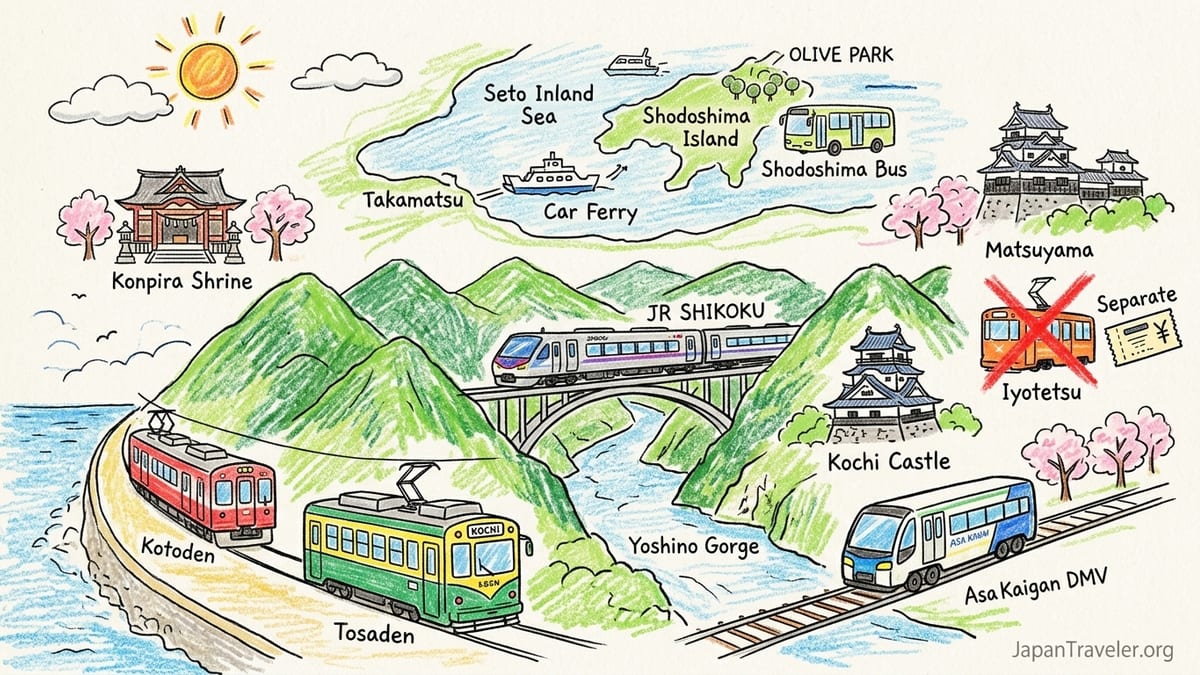
Beyond JR, the pass includes several important local operators that make it possible to hop on trams and private railways without thinking about individual fares. These include Kotoden (Takamatsu-Kotohira Electric Railroad) around Takamatsu and Kotohira, Tosaden Kotsu trams in Kochi, Tosa Kuroshio Railway on the Pacific coast in Kochi Prefecture, and the Asa Kaigan Railway in Tokushima. Where you will notice this in real life is when you, for example, connect from a JR limited express at Kochi Station to a Tosaden tram to reach the city center, or ride Kotoden from Takamatsu-Chikko to Kotoden-Kotohira to access Konpira Shrine without buying an extra ticket.
Historically, the pass also covered Iyotetsu (Iyo Railway) services in and around Matsuyama, as well as Shodoshima Ferry and Shodoshima Olive Bus on Shodoshima Island. That combination made it especially attractive for itineraries that mixed rail, tram, and island travel. However, this is where the 2026 changes start to matter, and travelers visiting after early March need to pay close attention before assuming everything they see in older guidebooks is still included.
The Key 2026 Change: Iyotetsu Excluded From March 7
JR Shikoku and its partner operators have announced that Iyotetsu will no longer be part of the ALL SHIKOKU Rail Pass coverage from March 7, 2026. Iyotetsu operates the tram network and several suburban rail lines in and around Matsuyama, as well as the line that connects central Matsuyama to Matsuyama-shi and the Dogo Onsen area. For years, pass holders could simply flash their ALL SHIKOKU Rail Pass on these services. From March 7, 2026 onward, you will need to buy separate tickets or use IC cards for Iyotetsu.
On the ground, this means that even though you can still reach Matsuyama with the pass on JR’s Yosan Line, transfers within the city will not be covered. For example, a traveler arriving on the limited express Ishizuchi from Takamatsu to Matsuyama can still ride that entire JR leg with the pass. But if they then want to take an Iyotetsu tram from Matsuyama City Station or JR Matsuyama Station to Dogo Onsen, that short city ride must be paid out of pocket. In 2026 prices, that kind of tram trip is typically only a few hundred yen each way, but it adds up if you use it multiple times a day.
For many visitors, the loss of Iyotetsu will not dramatically change the value calculation of the pass, because the biggest savings still come from longer limited express journeys between major cities. However, if your travel style involves many short hops around Matsuyama over several days, you can no longer treat the ALL SHIKOKU Rail Pass as a full “all inclusive” solution in that city. It becomes a backbone for intercity travel instead, and you pair it with separate Iyotetsu tickets, 1-day tram passes, or IC cards for local movements.
When planning, it is worth checking the exact dates of your Matsuyama stay against the March 7, 2026 change. Travelers visiting before that date on an existing pass can still enjoy included Iyotetsu rides under the old rules, while anyone arriving on or after March 7 must budget extra for Iyotetsu. This is especially important for itineraries built around repeated evening trips to Dogo Onsen or day trips out to the Iyotetsu suburban lines.
Prices, Pass Types and Where the Money Is Saved
When purchased overseas at current rates, the ALL SHIKOKU Rail Pass costs approximately 12,000 yen for 3 days, 15,000 yen for 4 days, 17,000 yen for 5 days, and 20,000 yen for 7 days. All versions must be used on consecutive calendar days, so a “3-day” pass might cover, for instance, travel from Friday to Sunday. Children’s versions exist at roughly half the adult price, but this guide focuses on adult travelers, who make up the majority of pass users.
To understand the value, it helps to compare these prices to typical limited express and local train fares on popular routes. A limited express journey in Shikoku usually consists of two parts: a base fare that depends on distance, and a limited express surcharge for riding the faster, more comfortable trains. Buying regular tickets for a one-way limited express between major cities such as Takamatsu and Kochi or Takamatsu and Matsuyama commonly lands in the 6,000 to 7,500 yen range for a standard reserved seat, with small variations depending on distance and season. Shorter hops, such as Takamatsu to Kotohira on JR, often cost around 1,000 yen for an unreserved limited express seat, or less on local trains.
If you string together just two or three of those city-to-city journeys within a few days, the pass quickly becomes competitive. For example, if you plan to go from Takamatsu to Kochi, Kochi to Matsuyama, and back to Takamatsu within a 3-day period, the regular tickets could easily approach or exceed the 12,000 yen cost of the 3-day pass. On top of that, the pass lets you add in spur trips on local JR lines or partner trams without paying each time, which is particularly handy around Takamatsu and Kochi.
The 7-day pass tends to work best for travelers who are committing most of a week to Shikoku and want the freedom to crisscross the island without thinking about cumulative fares. At 20,000 yen, it often pays off if you plan one substantial limited express ride almost every day, such as a circuit of Takamatsu, Tokushima, Kochi, Shimanto area, Uwajima, and Matsuyama before returning to Takamatsu. The 4- and 5-day versions sit in a flexible middle ground, appealing to travelers who may spend part of their Japan trip on Shikoku and reserve the rest for other regions.
Sample Route 1: Takamatsu – Kochi – Matsuyama With Real-World Costs
A classic rail loop that showcases the pass value is Takamatsu – Kochi – Matsuyama. Many visitors arrive in Takamatsu from Okayama or Osaka, then use Shikoku’s interior and coastal lines to circle the island before returning to Honshu. Suppose you are planning this 3-day arc: Day 1 Takamatsu to Kochi, Day 2 Kochi to Matsuyama, Day 3 Matsuyama back to Takamatsu.
On Day 1, you ride a JR Shikoku limited express such as the Nanpū or Shimanto from Takamatsu to Kochi via the Dosan Line. This is a scenic route that cuts through gorges and mountain valleys. Buying a normal ticket for this leg, including the base fare and limited express surcharge, is typically somewhere around 6,000 to 7,000 yen for an adult with a reserved seat, depending on exact train and season. With the ALL SHIKOKU Rail Pass, you simply board, sit in an unreserved car, and pay nothing extra for the ride itself.
On Day 2, the journey from Kochi to Matsuyama often involves traveling up the Dosan Line and then connecting to the Yosan Line, again typically using limited express services. Regular fares for this kind of cross-island limited express journey are usually in the same ballpark as Takamatsu to Kochi, so you might expect to pay a similar 6,000 to 7,000 yen if buying tickets individually for reserved seating. The pass, by contrast, again covers your unreserved seat at no extra cost.
On Day 3, returning from Matsuyama to Takamatsu along the Yosan Line by limited express can cost several thousand yen more if purchased as a standalone ticket. By the end of this 3-day loop, a traveler paying regular fares for three limited express legs could quite plausibly have spent around 18,000 to 20,000 yen in total. Lining that up against a 3-day ALL SHIKOKU Rail Pass at 12,000 yen makes the savings obvious. Even if you choose reserved seating for one or two segments by purchasing a separate set of reserved seat coupons, the total outlay with the pass is generally still lower than buying each journey from scratch.
Sample Route 2: Takamatsu – Kotohira – Oboke and How the Pass Works
The Takamatsu – Kotohira – Oboke route is shorter in distance but rich in variety, combining urban Takamatsu, temple town Kotohira, and the dramatic Oboke and Koboke gorges. Many travelers fit this into a 1- or 2-day side trip from Takamatsu, sometimes combining it with deeper travel into the Iya Valley. The way the ALL SHIKOKU Rail Pass works here is a good illustration of its flexibility on mixed JR and private lines.
From Takamatsu, you have two main rail options to reach Kotohira. You can ride JR Shikoku along the Dosan Line, or you can use Kotoden, the private Kotohira Line. Without a pass, the JR limited express from Takamatsu to Kotohira costs a modest amount, typically under 2,000 yen for an adult depending on seat type, while slower local trains cost less. Kotoden’s fares are usually a few hundred yen for the same journey. With the ALL SHIKOKU Rail Pass in hand, both JR and Kotoden services on this segment are included, so you can choose based on schedule or scenery rather than ticket price.
Continuing from Kotohira to Oboke, you must use JR’s Dosan Line, often on a limited express or a local train if the schedule fits your plans. Oboke is a small rural station that serves as a jumping-off point for river cruises and buses into the Iya Valley. Regular limited express fares from Kotohira to Oboke and from Oboke back toward Takamatsu add up quickly for what looks like a short hop on the map, because you still pay the limited express surcharge. It is not unusual for travelers making a round trip Kotohira – Oboke – Kotohira on limited express trains to spend several thousand yen per person on tickets, especially if they then continue back to Takamatsu the same day.
With a pass, the entire chain Takamatsu – Kotohira – Oboke – Takamatsu is covered in unreserved seating, so you are free to piece together an itinerary that changes trains multiple times without worrying about each individual fare. For example, you might ride Kotoden from Takamatsu-Chikko to Kotoden-Kotohira in the morning, take a JR limited express to Oboke late morning, then return via a different combination of JR local and limited express trains through the afternoon and evening. Travelers building a 3-day or 4-day pass around a focus on the Iya Valley often find that this flexibility encourages more spontaneous detours.
Limited Express Trains, Seat Reservations and Extra Fees
A crucial aspect of the ALL SHIKOKU Rail Pass is how it handles limited express trains. The pass covers unlimited rides in standard-class, non-reserved seats on JR Shikoku limited express services and on Tosa Kuroshio Railway limited express trains within Shikoku. That means you can simply board any eligible limited express, sit in the non-reserved cars, and show your pass when asked by staff. This is where a huge portion of the pass value lies, because limited express surcharges form a large slice of regular ticket prices.
If you prefer to sit in a reserved seat on limited express services, JR Shikoku sells a booklet of reserved seat tickets that can be used in conjunction with the ALL SHIKOKU Rail Pass. Each coupon in the booklet can be exchanged for one reserved seat on a limited express or local train on JR Shikoku or Tosa Kuroshio Railway lines. You buy this booklet separately at major stations or exchange counters when you activate your pass. While prices for the booklet can change, the important point is that even with the added cost of a few reserved seat coupons, your combined spending often remains below the sum of individually purchased limited express tickets.
The pass does not cover green car (first class) surcharges or sleeper surcharges, and it cannot be used on the Seto Sunrise overnight train that links Shikoku with Tokyo. It is also limited to standard trains and trams; it does not include highway buses aside from a specific discount on the Matsuyama – Kochi bus route, where pass holders are typically offered a reduced fare. Most travelers who choose the pass rely primarily on daytime limited express and local trains, which are frequent enough between the main cities to make it easy to put together flexible itineraries without needing overnight or special services.
In practice, many visitors find that non-reserved seating works smoothly in Shikoku because trains are rarely as crowded as the shinkansen corridors in central Japan. On busy holiday periods like Golden Week or New Year, it is wise to arrive a bit early at the platform to secure a good seat in the unreserved car. Outside peak times, boarding with the pass and finding a seat in a non-reserved car is usually straightforward, even on popular limited express trains such as the Nanpū, Shimanto, Ishizuchi and Uwakai.
Shodoshima Ferry and Bus Benefits: How Much They Matter
One of the distinctive features of the ALL SHIKOKU Rail Pass has been its inclusion of ferry and bus benefits for visiting Shodoshima, an island in the Seto Inland Sea accessible from Takamatsu Port. With an eligible pass, travelers could ride Shodoshima Ferry’s car ferries between Takamatsu and Tonosho Port on Shodoshima at no additional cost and then continue on Shodoshima Olive Bus services around the island. This effectively turned the ALL SHIKOKU Rail Pass into a combined rail and island-excursion ticket.
In real-world terms, a round-trip ferry ticket between Takamatsu and Shodoshima plus a full day of bus rides around the island can easily cost several thousand yen when purchased separately. For a traveler already using the rail pass to reach Takamatsu, being able to add a Shodoshima day trip without buying extra ferry and bus tickets significantly boosted the pass’s overall value, especially on the 4- and 5-day versions where an “extra” day on Shodoshima could be slotted into a broader circuit.
However, travelers should be aware that changes have been announced that will eventually remove Shodoshima ferry and bus coverage from newly sold passes starting in late 2026. During 2026 itself, especially in the first half of the year, many visitors will still be using passes that include Shodoshima benefits. If your travel dates fall near the transition period, double-check when and where you buy the pass and whether Shodoshima is still included for your specific pass type and purchase date.
Even when Shodoshima coverage is not available or is being phased out, the existence of separate products such as local Shodoshima bus and ferry passes makes it relatively easy to bolt an island excursion onto a rail-focused Shikoku trip. In that case, think of the ALL SHIKOKU Rail Pass as getting you to and from Takamatsu, and then pick up a dedicated Shodoshima pass or individual tickets at the port to cover your day on the island.
When Each Pass Length Makes Sense
Deciding between the 3-, 4-, 5- and 7-day versions of the ALL SHIKOKU Rail Pass ultimately comes down to how dense your Shikoku itinerary is and how heavily you rely on limited express trains. The 3-day pass at 12,000 yen often suits travelers making a quick but intensive loop: for instance, arriving in Takamatsu on the evening before activation, then spending three consecutive days riding limited expresses around the island before departing back to Honshu or flying onward from Matsuyama or Kochi.
The 4-day and 5-day passes at 15,000 and 17,000 yen respectively are attractive for itineraries that mix “heavy rail” days with slower days that still involve some train or tram hops. A traveler might, for example, spend Day 1 traveling from Okayama to Takamatsu and then on to Tokushima, Day 2 exploring the Naruto area and returning to Tokushima, Day 3 heading to Kochi via the limited express, Day 4 shifting to Matsuyama, and Day 5 returning toward Takamatsu or Tokushima. On this kind of plan, even if one or two days involve mainly local trains and trams, the cumulative limited express savings generally justify the pass price.
The 7-day pass at 20,000 yen is arguably the best fit for visitors devoting a week or more solely to Shikoku, particularly those exploring more remote corners such as Shimanto, Uwajima, or the deep interior of Kochi and Tokushima Prefectures. Over seven days, even a relaxed traveler is likely to clock up multiple long limited express segments. When you add in spontaneous side trips, such as a detour from Kochi to the Tosa Kuroshio Railway coastal towns or a day trip from Matsuyama along the Yosan Line, the 7-day pass can deliver substantial savings while removing the need to constantly budget individual tickets.
On the other hand, if your Shikoku time consists of only one or two major intercity journeys and several days staying mostly in one place, regular tickets paired with occasional local passes might be more economical. For instance, a traveler planning only a Takamatsu to Matsuyama round trip plus local sightseeing in Matsuyama and Takamatsu over a week could find that two limited express tickets plus local tram passes beat the 17,000 or 20,000 yen cost of a longer ALL SHIKOKU Rail Pass. As always with regional passes, sketching out your likely routes and checking approximate ticket prices before you commit is the surest way to avoid overpaying.
The Takeaway
By 2026, the ALL SHIKOKU Rail Pass remains one of the most practical tools for exploring Shikoku by public transport, particularly for travelers who expect to ride limited express trains several times in close succession. On itineraries such as Takamatsu – Kochi – Matsuyama, or Takamatsu – Kotohira – Oboke and onward into the Iya Valley, the pass often pays for itself after just a few long-distance journeys, while also removing the friction of having to buy separate tickets for each leg.
The most important changes for 2026 are the removal of Iyotetsu from coverage from March 7 and the gradual phasing out of some Shodoshima-related benefits later in the year. Neither of these changes destroys the core value of the pass, which still lies in JR and partner limited express coverage, but they do mean travelers can no longer treat the pass as a complete “all transport included” solution in Matsuyama and around Shodoshima. Instead, the pass is best thought of as a strong backbone for intercity rail travel, paired with separate local tickets where needed.
If you are planning a Shikoku trip in 2026, start by mapping out your likely long-distance train legs and then compare the cumulative cost of regular tickets with the appropriate pass length at its current overseas price. For travelers who plan a concentrated loop with two or more long limited express journeys, the ALL SHIKOKU Rail Pass usually comes out ahead, especially over 3 to 7 days. For those making only occasional hops, paying as you go can remain the smarter choice. Either way, understanding how the pass works before you arrive will let you focus on what really matters once you are there: savoring udon in Kagawa, soaking at Dogo Onsen, and watching the rivers and mountains of Shikoku slide by your train window.
FAQ
Q1. Who can use the ALL SHIKOKU Rail Pass in 2026?
Foreign passport holders visiting Japan on a temporary visitor status can use the pass. It is not intended for long-term residents of Japan or Japanese nationals.
Q2. Does the pass cover Iyotetsu trams and trains in Matsuyama after March 7, 2026?
No. From March 7, 2026 onward, Iyotetsu services are no longer included. You must buy separate Iyotetsu tickets or use an IC card for trams and suburban lines in Matsuyama.
Q3. Are seat reservations on limited express trains free with the pass?
The pass covers unlimited rides in non-reserved standard seats. If you want reserved seats, you need to buy a separate booklet of reserved seat coupons and use one coupon per reservation.
Q4. Does the pass include green car or sleeper services?
No. Green car and sleeper surcharges are not covered. You can still ride eligible trains in standard class non-reserved cars with the pass, but any upgrade must be paid separately.
Q5. Is the Shodoshima ferry still included, and if so, how should I plan?
Some passes in 2026 still include Shodoshima Ferry and Shodoshima Olive Bus, but this coverage is scheduled to end later in the year. Check the conditions for your specific purchase date and, if needed, plan to buy separate island passes or tickets at Takamatsu Port.
Q6. Can I use the ALL SHIKOKU Rail Pass for travel to or from Honshu?
The pass is mainly valid within Shikoku. It does not cover shinkansen travel or most rail beyond the island. You usually need separate tickets to reach Okayama or other Honshu cities, then start using the pass once on JR Shikoku lines.
Q7. How do the 3-, 4-, 5- and 7-day passes differ besides price?
All versions share the same coverage area and rules. The only difference is the number of consecutive days of validity and the total price. Choosing between them depends on how many days you will actively be riding trains in Shikoku.
Q8. Is the pass worth it if I mainly stay in one city like Matsuyama or Kochi?
Probably not. The pass delivers the most value when you make multiple long limited express journeys. If you mostly stay in one city with short local trips, individual tickets or city passes are usually cheaper.
Q9. Can I hop on and off trains freely during the day with the pass?
Yes. Within the validity period, you can get on and off eligible JR and partner trains as often as you like, as long as you stay within the covered network and use standard non-reserved seating.
Q10. Where can I buy or exchange the ALL SHIKOKU Rail Pass once in Japan?
You can typically exchange vouchers or purchase the pass at major JR Shikoku stations such as Takamatsu, Matsuyama, Tokushima and Kochi, as well as at select JR-affiliated travel centers. Exact sales points can vary, so confirm current locations shortly before your trip.