


Shikoku rewards the travelers who get just a little off the main line. Trains link Takamatsu, Matsuyama, Kochi and Tokushima efficiently, but many of the island’s gorges, rivers and temple routes are difficult or slow to reach without your own wheels. The sweet spot for most visitors is not renting a car for the entire trip, but combining rail passes for the cities with short, targeted car rentals from key airports and stations. This guide explains how to do exactly that, safely and cost‑effectively.
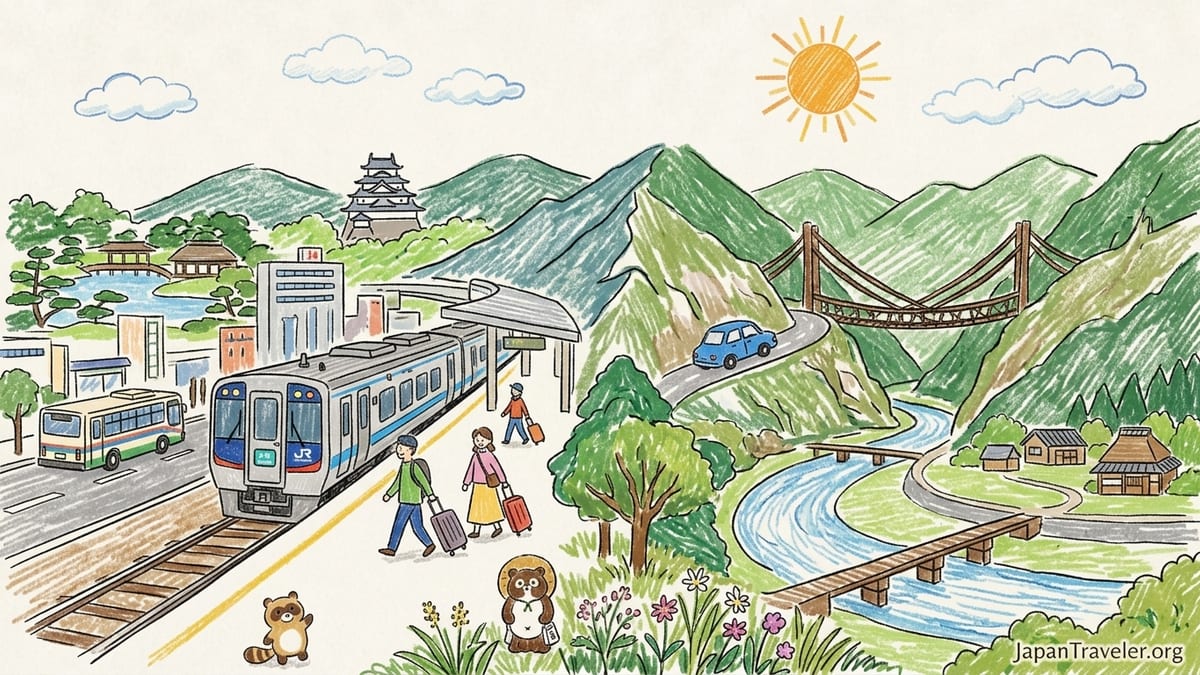
Do You Really Need a Car for Shikoku?
Shikoku looks compact on the map, yet the island’s mountains, rivers and coastlines mean that even moderate distances take longer than many visitors expect. Express trains run comfortably between Takamatsu, Matsuyama, Kochi and Tokushima, and bus networks cover most urban areas. For city sightseeing such as Ritsurin Garden in Takamatsu, Dogo Onsen in Matsuyama, Kochi Castle or Tokushima’s Awa Odori Kaikan, you can easily rely on trains, trams and local buses.
The challenge begins when you venture into places like the Iya Valley, Shimanto River, Cape Ashizuri or rural temple clusters on the Shikoku 88‑temple pilgrimage. Official tourism bodies and local information centers in these regions explicitly recommend rental cars because bus services are infrequent or non‑existent in the deeper valleys and uplands. In Oku‑Iya, for instance, some hamlets have just a handful of buses per day, and reaching a farmhouse inn can still require a 30 to 45 minute uphill walk from the nearest stop.
A hybrid strategy works best for most travelers: use rail or highway buses to move quickly between the four main cities, and rent a car only for the specific rural segments that truly benefit from private transport. That might mean three car‑free days in Matsuyama and Dogo Onsen, followed by a two‑day rental from Matsuyama Airport to drive the Shimanami Kaido or the Uchiko and Ozu countryside, then another short rental from Kochi Airport for Shimanto and Ashizuri. You avoid paying for a car while it sits unused in city hotel parking lots, yet gain full flexibility where it matters.
Think of Shikoku as two overlapping experiences. One is urban and rail‑friendly, linking museums, castles and food districts in compact downtowns. The other is rural and road‑based, where a modest rental car unlocks remote bridges, deep river bends and unnamed viewpoints that are almost impossible to reach efficiently with public transport alone.
Where to Rent: Airports and Stations in Takamatsu, Matsuyama, Kochi and Tokushima
The most convenient places to pick up a car in Shikoku are the four regional airports and the main JR stations. All four airports – Takamatsu, Matsuyama, Kochi Ryoma and Tokushima Awa Odori – host branches of the major chains such as Toyota Rent a Car, Nissan Rent a Car, Times Car Rental and Nippon Rent‑A‑Car, often with shuttle buses or counters directly in the terminal. Airport branches tend to have a better selection of compact and hybrid vehicles, plus staff used to foreign licenses and International Driving Permits.
Takamatsu is a natural gateway if you are arriving from Tokyo or Osaka and planning to explore the Iya Valley or Kagawa’s countryside. You might land at Takamatsu Airport in the morning, pick up a compact car, and head toward Oboke in Tokushima Prefecture for a one‑ or two‑night stay. Alternatively, if you intend to stay in central Takamatsu first, you can delay your rental and instead use Takamatsu Station’s Eki Rent‑a‑Car branch for the driving portion, reducing parking costs.
Matsuyama Airport is the best starting point for western Shikoku. A common pattern is to spend two nights car‑free around Dogo Onsen, moving by tram, then collect a car from the airport or JR Matsuyama Station on day three to explore Uchiko’s preserved merchant streets, the rice terraces around Seiyo, or the coastal road toward Yawatahama. Even a 24‑hour rental can transform what would otherwise be a slow chain of bus transfers into a relaxed loop with time for side roads and viewpoints.
In Kochi, travelers often combine urban sightseeing at Kochi Castle and the Sunday market with a rental for the Shimanto River and Cape Ashizuri area. Kochi Ryoma Airport branches let you land, drive out to Shimanto Town along the clear river, stay overnight at a riverside inn, then continue to Ashizuri Misaki before looping back. Tokushima Airport and Tokushima Station are the closest entry points for the Iya Valley from Kansai; many itineraries head straight from the airport to Awa‑Ikeda or Oboke, using a rental car to penetrate deeper into Oku‑Iya where buses are scarce.
The Hybrid Strategy: Trains for Cities, Cars for Iya, Shimanto, Ashizuri and Rural Temples
The central decision for your Shikoku itinerary is not whether to rent a car at all, but where and for how long. A full‑island drive might sound romantic, yet it locks you into paying daily rental, insurance and fuel even when a car adds little value. The more efficient alternative is to anchor your trip around the four cities by rail, then attach short driving “modules” for rural highlights like Iya, Shimanto and Ashizuri.
Consider a nine‑day loop: Start in Takamatsu without a car, using local trains and buses for Ritsurin Garden and Naoshima or Teshima ferries. On day three, take the JR Dosan Line to Oboke and pick up a rental for two days in the Iya Valley, crossing vine bridges, detouring to Oku‑Iya’s mountain hamlets and soaking in remote onsen. Return the car in Oboke or Awa‑Ikeda, ride the train onward to Kochi, and spend a car‑free evening exploring Hirome Market. Then rent again from Kochi Station or the airport for a two‑day Shimanto and Ashizuri loop before finishing by train to Matsuyama and flying out.
On another itinerary, you might base in Matsuyama and Tokushima. After a tram‑based stay in Matsuyama, including castle visits and Dogo Onsen, rent a compact from Matsuyama Station for a one‑ or two‑day countryside loop through Uchiko and Ozu, stopping at riverside parks and farm cafés that are unreachable by rail. Drop the car on your return, take the limited express across the island to Tokushima, and only rent again when you are ready to tackle the Iya Valley and Oboke gorges.
The same modular approach works beautifully for pilgrims on the Shikoku 88‑temple route who do not wish to walk the whole circuit. You can use trains and buses to visit clusters of temples around Takamatsu or Tokushima, then hire a car for one or two days to reach isolated mountain temples that might otherwise require two or three bus transfers and long uphill walks. When each rental is targeted to a specific rural cluster, the extra cost and responsibility of driving feel justified by the sheer increase in access and flexibility.
Licenses, International Driving Permits and Rental Requirements
To legally drive in Japan, most visitors need both their home country driving license and a valid International Driving Permit based on the 1949 Geneva Convention. In practice, this applies to travelers from North America, most of Europe, Australia, New Zealand and many parts of Asia. You must obtain the permit before departure from your national automobile association or licensing authority; Japanese rental counters cannot issue it on arrival. Always carry both documents when driving, as police checks in rural areas do occur, especially after accidents or during traffic campaigns.
Drivers from countries such as France, Germany, Switzerland, Belgium, Monaco and Taiwan follow a different system: instead of an IDP they must carry an official Japanese translation of their license issued by the Japan Automobile Federation or their embassy. Rental staff in Shikoku’s airport branches are used to these variations, but smaller outlets may see fewer foreign customers, so have a printed confirmation of the requirements for your nationality and book with a major chain where possible.
Most rental companies in Shikoku require that the main driver be at least 18 years old, occasionally 20, and some may ask for a credit card in the driver’s name for security. Prepaid bookings through large travel portals sometimes allow payment by other methods, but a card is still routinely requested for deposits or expressway toll adjustments. If you plan to share driving between two people, ensure all drivers are registered at pickup; unregistered drivers may invalidate insurance coverage even if they hold valid licenses.
Reservation systems usually display vehicle classes like “compact,” “wagon,” or “kei.” When booking from overseas, it is wise to sign up with an English‑language portal or the international pages of big brands, as these clearly explain license requirements and insurance options. During peak travel weeks such as Golden Week, Obon and New Year, rural branches near Iya or Shimanto can sell out of automatic cars altogether, so book well ahead if your dates fall in these periods.
Choosing a Car: Compact vs Kei, Fuel and One‑Way Rentals
For most Shikoku road trips, a small automatic car is ideal. Compact hatchbacks such as the Toyota Yaris or Honda Fit offer enough luggage space for two to three people while remaining narrow enough for single‑lane mountain roads and village streets. They also perform better on steep climbs and high‑speed expressways than kei cars, which are the smallest Japanese category with 660 cc engines and yellow license plates.
Kei cars like the Honda N‑Box or Suzuki Wagon R are popular with locals and usually the cheapest option, often just a little less per day than a compact. They sip fuel and are very easy to park. However, they can feel underpowered when accelerating onto expressways or overtaking, especially with three adults and luggage. On winding climbs in the Iya Valley or routes toward Ashizuri, you may find yourself frequently flooring the accelerator. For two people with light bags, a kei is fine; for families or those planning significant highway driving, a compact or small hybrid sedan is worth the modest extra cost.
Regarding fuel, most rental cars in Shikoku run on regular gasoline, and you return the car with a full tank. Prices fluctuate, but filling a compact from near‑empty typically costs less than a modest dinner for two. Many rural service stations close around early evening, so top up before night drives. Near airports and city peripheries, self‑service stations are common; staff can assist if you are unsure of the pump instructions. Keep the last fuel receipt in case the rental office asks to verify that you refueled just before return.
One‑way rentals are widely possible within Shikoku, though fees vary by company and distance. A typical example might be picking up a car at Matsuyama Airport and dropping at Kochi Ryoma Airport two days later, incurring an additional one‑way fee that is often comparable to a limited express train ticket. Within the same city or short distances a one‑way drop may be free, while cross‑island returns can add a noticeable surcharge. When comparing offers, always factor in this fee; sometimes it is cheaper overall to loop back to your original airport or station, especially if your rural route can be shaped into a circle.
Expressways, ETC Cards, Tolls and Realistic Driving Times
Shikoku is connected by a network of expressways, including the Takamatsu Expressway, Tokushima Expressway, Matsuyama Expressway and Kochi Expressway. For visitors, the key is understanding both tolls and travel times. Distances might look short, but mountain terrain and lower speed limits compared to North American or European highways mean that driving can be slower than expected. For example, the drive from near Takamatsu to Kochi via expressway is roughly one and a half hours, while Takamatsu to Matsuyama or Tokushima is closer to two hours or more in typical conditions.
Most rental agencies in Shikoku offer ETC cards or at least ETC‑equipped vehicles. ETC is Japan’s electronic toll collection system that allows you to pass through tollgates without stopping. With an ETC card inserted in the dashboard reader, you drive slowly through purple‑marked ETC lanes and tolls are charged automatically, later settled at the rental counter. Without ETC, you must enter “general” lanes, take paper tickets and pay cash or card at exit booths, which is slower and can be stressful for first‑time visitors.
For a multi‑day rural drive, an ETC card is highly recommended. It speeds up progress through multiple tollgates, especially if you are connecting city segments such as Kochi to Matsuyama before heading into countryside. Some regional passes occasionally offered by expressway operators provide discounted unlimited driving in Shikoku over several days when used with ETC, so check current promotions when planning. Even without a pass, tolls between major cities are usually tolerable for short itineraries, comparable to a few urban taxi fares.
When planning your days, build in time not just for distance but also for stops, slower local roads and occasional construction. A realistic Iya Valley loop from Oboke with several sightseeing stops might cover only 80 to 100 kilometers but easily consume a full day. Likewise, following the Shimanto River on its scenic lower reaches often means meandering along narrow, unguarded riverside lanes where 40 or 50 km can take hours, especially if you pause for photos or walk across traditional low “chinkabashi” bridges.
Insurance, Coverage and Safety on Mountain Roads
Japanese rental cars generally include basic compulsory insurance and liability coverage, but most companies strongly encourage optional collision damage waivers and personal accident add‑ons. In the context of Shikoku’s narrow mountain roads, these extras are worth considering. A typical collision damage waiver reduces or removes the amount you must pay out of pocket for damage to the rental car, while non‑operation charges and roadside assistance plans help cover towing and loss‑of‑use fees if the vehicle becomes undriveable.
The most common incidents in rural Shikoku are not high‑speed crashes but low‑speed scrapes on stone walls, encounters with open roadside gutters and minor bumps in tight hotel or onsen parking lots. In mountain areas, many roads are effectively single lane with passing bays. Local drivers are accustomed to this pattern; when you see an oncoming vehicle, slow down, pull into a bay or wider section, and use hazard lights briefly to signal. At night, visibility drops sharply, and deer or wild boar sometimes appear near forest edges, so it is wise to avoid long nighttime drives in rural sections.
Before leaving the rental office, walk around the car with staff and ensure any existing scratches are marked on the form. Test the headlights, hazard lights and wipers, and make sure you know how to switch from low to high beams for unlit mountain routes. Download offline maps or ensure your GPS is set to English where possible, but also pay attention to roadside signs indicating road closures, especially after heavy rain, landslides or winter snow. In some gorges and uplands, alternative routes may be long detours, so checking conditions with local tourist information centers on the day of travel is wise.
Seat belts are compulsory for all passengers, and child seats are legally required for young children. Most rental agencies can provide baby and child seats when reserved in advance. Alcohol limits for drivers are strict, and roadside checks are occasionally performed even in rural prefectures, so assign a non‑drinking driver when visiting countryside izakaya or staying at remote minshuku with dinner and drinks included.
Winter Driving, Studless Tires and Seasonal Considerations
Shikoku’s coastal cities enjoy relatively mild winters, but the interior mountains can receive snow and ice between roughly December and March. Roads to higher sections of the Iya Valley, mountain temples and certain passes near Ashizuri or western Kochi may be affected by snowfalls, and some smaller roads can close temporarily. Rental companies in Shikoku typically offer cars with studless winter tires during this season, but availability is not guaranteed for every vehicle type or branch, so you should specifically request winter tires when booking if you plan to drive at higher elevations.
Studless winter tires use a softer rubber and deeper tread pattern designed to grip cold, snowy or icy surfaces better than standard tires. They do not make you invincible, but they meaningfully improve safety when temperatures drop and shaded valley sections remain icy all day. Some major rental brands operating across western Japan allow you to tick an option for “studless tires” on booking pages for winter months, sometimes with a daily surcharge. For lowland routes that stick to coastal expressways and city streets, standard tires are often sufficient, but for Oku‑Iya or small mountain roads it is prudent to opt for winter rubber if your visit falls in mid‑winter.
If your travel dates are in late autumn or early spring, conditions vary year to year. In November and late March, many days are fully dry in the valleys, but sudden cold snaps can still produce slick patches on bridges and in shaded curves. Check forecasts just before each rural segment and ask rental staff about current conditions on your planned route. If snow is actively falling in the mountains, consider postponing deeper drives and focusing on lower‑altitude attractions, or switch to public transport for that day’s sightseeing.
Beyond tires, adjust your driving style to winter realities. Increase following distances, maintain gentle steering and braking inputs, and avoid sudden throttle on climbs. Keep an eye on fuel levels; in cold conditions and sparsely populated areas you do not want to run low while stuck behind an accident or temporary closure. Carry warm clothing and snacks in the car when venturing into higher areas, particularly if traveling with children or elderly passengers.
The Takeaway
Shikoku rewards thoughtful planning more than sheer mileage. You do not need a car to enjoy Takamatsu’s gardens, Matsuyama’s onsen streets or Kochi’s castle and markets. Trains, trams and buses handle those parts well, and walking keeps you close to local food and neighborhood detail. Where a rental car becomes almost transformative is in the deep valleys, river bends and temple backroads that make the island feel truly remote.
By building your itinerary around a hybrid strategy, you keep costs and stress manageable. Fly into Takamatsu, Matsuyama, Kochi or Tokushima, move between cities on rails, and bolt on one‑ to three‑day rentals from airport or station branches for Iya, Shimanto, Ashizuri and rural temple clusters. Choose a compact or small hybrid for power and comfort on winding roads, make use of ETC cards for smoother expressway travel, and invest in appropriate insurance so that a scraped bumper does not overshadow a dream trip.
With realistic driving times, seasonal awareness and the right paperwork in hand, Shikoku’s roads open up gently. Instead of rushing from city to city, you can linger by rivers, stop spontaneously at roadside shrines and viewpoints, and watch the landscape shift from inland gorges to open Pacific coast. The island becomes not just a sequence of destinations, but a continuous, scenic journey shaped by the flexibility that a well‑timed rental car provides.
FAQ
Q1. Do I need a rental car for my entire Shikoku trip?
For most travelers, no. It is usually more efficient to use trains and buses between Takamatsu, Matsuyama, Kochi and Tokushima, then rent a car only for rural segments such as the Iya Valley, Shimanto River, Cape Ashizuri or isolated temple clusters.
Q2. Where is the best place to pick up a rental car in Shikoku?
The most convenient pickup points are the four airports and main JR stations: Takamatsu Airport and Station, Matsuyama Airport and Station, Kochi Ryoma Airport and Kochi Station, and Tokushima Airport and Station. These branches have better vehicle selection and more experience with foreign visitors.
Q3. What kind of driving license and documents do I need?
Most visitors need a valid license from their home country plus an International Driving Permit based on the 1949 Geneva Convention, obtained before travel. Some nationalities instead require an official Japanese translation of their license. Always carry both your license and IDP or translation when driving.
Q4. Should I choose a compact car or a kei car?
For two people with light luggage, a kei car is economical and easy to park, but it can feel weak on expressways and steep hills. A compact hatchback or small hybrid offers more power and comfort for mountain driving and is usually a better choice for three or more travelers or longer highway stretches.
Q5. How do ETC cards and tolls work on Shikoku’s expressways?
Many rental cars come with ETC equipment, and some companies can provide an ETC card. With ETC, you pass slowly through ETC lanes and tolls are charged automatically, then settled at return. Without it, you use general lanes, collect tickets and pay cash or card at exits, which takes more time.
Q6. Is winter driving in Shikoku dangerous?
Coastal city roads are usually manageable, but interior mountains can see snow and ice from around December to March. Conditions vary, yet shaded curves and higher passes can be slippery. If you plan to drive in mountain areas during winter, request a car with studless winter tires and check road conditions locally.
Q7. Are one‑way rentals between Shikoku cities possible?
Yes, many companies allow one‑way rentals between branches such as Matsuyama, Kochi, Takamatsu and Tokushima, but they usually charge a one‑way fee that increases with distance. When comparing options, consider whether a loop route that returns to your pickup point might be more economical.
Q8. How expensive is fuel in Shikoku, and are gas stations common?
Fuel prices change over time but are broadly similar to other parts of Japan. Filling a compact car from near‑empty is typically a moderate expense. Gas stations are common in and around cities but less frequent in remote valleys, so refuel before long rural stretches and avoid driving with a nearly empty tank in the mountains.
Q9. Do I need special insurance for driving narrow mountain roads?
Basic insurance is included in rentals, but optional collision damage waivers and non‑operation coverage are strongly recommended. Shikoku’s rural roads are narrow and bordered by stone walls and open gutters, so even low‑speed scrapes can be costly without extra coverage.
Q10. Can I visit the Iya Valley or Shimanto River using only public transport?
You can reach gateway towns and some major spots by train and bus, but services in deeper areas are infrequent and time‑consuming. A rental car from Oboke, Awa‑Ikeda, Kochi or Nakamura makes it far easier to explore multiple viewpoints, bridges and riverside stops in a single day.