


Shikoku rewards travelers who slow down, but its spread-out sights make trip planning tricky. Rather than trying to see everything, the smartest approach is to choose one or two bases that match your interests and travel style, then build day trips around them. This guide compares Takamatsu, Iya Valley, Kochi, Matsuyama and the Shimanami Kaido area, plus key side trips such as Kotohira, Naruto, Shimanto River, Uchiko and Ozu. The focus is not a long attraction list but clear recommendations on where to go for traditional Japan, nature, cycling, food, castles, hot springs, pilgrimage experiences and car‑free travel.
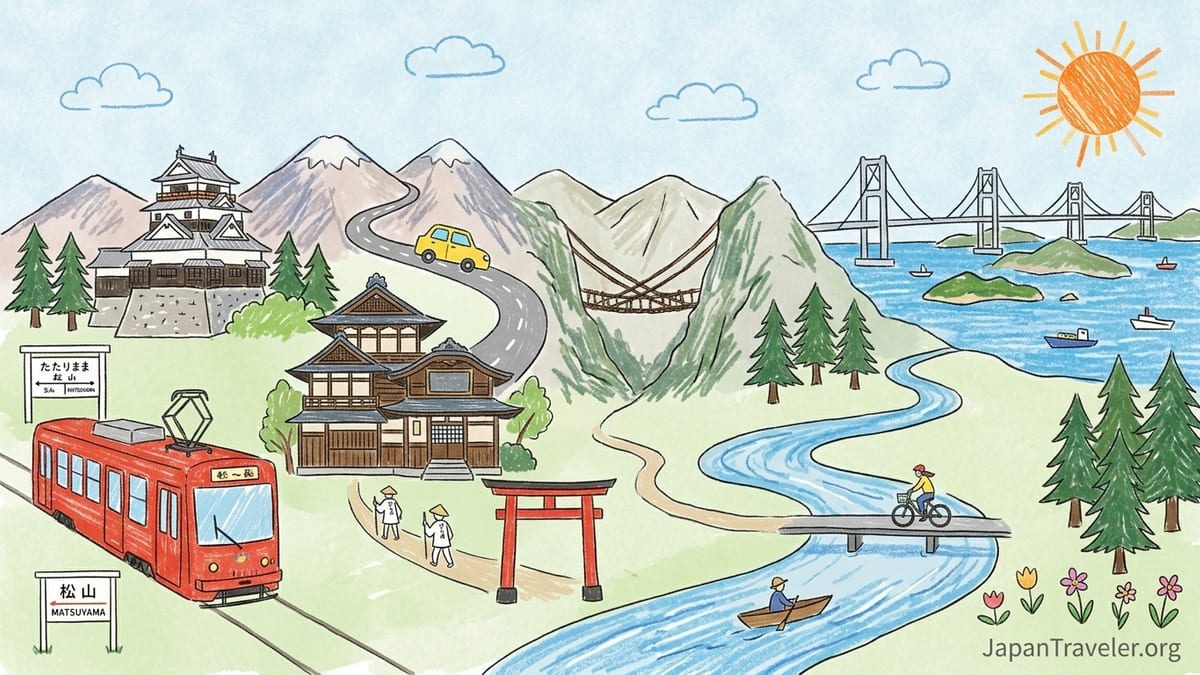
How to Think About Shikoku Trip Planning
Distances in Shikoku are deceptive. On a map, Takamatsu, Kochi and Matsuyama look close, but trains often follow mountainous valleys and coastlines, so a two-hour drive can easily become a three- or four-hour journey by local train. For example, the limited express train from Takamatsu to Kochi typically takes around two and a half hours, compared with roughly one and three-quarter hours by car in normal conditions. That gap becomes crucial if you are trying to squeeze too many bases into a short itinerary.
Public transport is reliable on the main north coast corridor between Okayama, Takamatsu and Matsuyama, but services thin out quickly once you head inland to the Iya Valley or southwest to the Shimanto River. Even where buses exist, they may run only every one to two hours, and transfers can eat into your day. If you prefer spontaneous side trips, a rental car picked up at a Shinkansen hub such as Okayama or at the airport in Takamatsu or Matsuyama can transform what is practical in a few days.
Instead of asking “What are all the famous places in Shikoku?”, it is more helpful to ask “What kind of Japan do I want to experience?”. If you want manicured gardens, traditional teahouses and a taste of pilgrimage culture without going deep into remote mountains, Takamatsu and nearby Kotohira work well. For dramatic gorges, vine bridges and steep farm hamlets, you prioritize the Iya Valley. For a castle-and-onsen city base with good food and easy public transport, Matsuyama is the logical choice. Cycling fans and people who love sea views should look very carefully at Imabari and the Shimanami Kaido.
For most first-time visitors with 5 to 7 days, choosing two contrasting bases works best: for example Takamatsu plus Matsuyama, or Matsuyama plus the Iya Valley for those comfortable with mountain driving. Travelers with 10 days or more can comfortably add a third center such as Kochi or a night on the Shimanto River or along the Shimanami Kaido, especially outside peak holiday periods when accommodation books up quickly.
Takamatsu & Ritsurin Garden: Best All-Round Base on Rail
Takamatsu is often the easiest entry point to Shikoku for rail travelers. From Okayama on the Sanyo Shinkansen, frequent limited express trains cross the Seto Ohashi Bridge to Takamatsu in about an hour, and the city’s compact center is walkable from the station. This makes it a natural first base for people coming directly from Tokyo, Osaka or Hiroshima without a car. Once you arrive, local Kotoden trams and buses connect the main sights, and Ritsurin Garden has its own station about a 10-minute walk from the main entrance, so you never need to drive to enjoy the city’s headline attraction.
Ritsurin Garden itself is one of Japan’s most celebrated daimyo gardens, and it works particularly well for travelers seeking “classic Japan” without the crowds of Kyoto. Paths wind around ponds framed by sculpted pines, with Mt Shiun as a backdrop. Wooden boats offer short rides on the South Pond, and a traditional teahouse inside the garden serves matcha and sweets at prices that are usually comparable to a mid-range café in Tokyo. Because opening hours start in the early morning and often extend into the evening for seasonal illuminations, you can visit at quieter times and still fit in day trips.
Food lovers are also well served in Takamatsu. The city is synonymous with Sanuki udon, and you can walk from the station to no-frills shops where a basic bowl with tempura sides often costs less than a typical sit-down lunch in larger cities. Many operate on a self-service model where you pick your noodles, choose a broth style and then grab toppings from a hot counter, which makes it easy to experiment without spending much. At night, the covered shopping arcades and alleys around Kawaramachi Station fill with izakaya serving local sake and Seto Inland Sea seafood, including seasonal oysters and small local fish done as tempura or sashimi.
Takamatsu is particularly strong for travelers who want a rail-based trip that still includes a sense of the Shikoku pilgrimage. The city is within reach of several temples on the 88-temple route, and even a half-day outing to one or two allows you to see white-clad pilgrims in straw hats, buy a pilgrimage stamp book and learn how people collect red stamps and calligraphy at each temple. For a first-time visitor who wants traditional aesthetics, good food, light pilgrimage flavor and easy onward connections, Takamatsu is often the most flexible base on Shikoku.
Kotohira & Naruto: Pilgrimage, Sea Whirlpools and Easy Side Trips
Kotohira, home of Kotohira-gu Shrine (often called Konpira-san), pairs naturally with a stay in Takamatsu and is an obvious choice for travelers curious about traditional pilgrimage culture but not ready for multi-day trekking. The shrine sits high on a forested hillside, reached by more than a thousand stone steps from the old merchant town below. Even if you stop at the main hall instead of climbing to the innermost sanctuaries, the combination of lantern-lined paths, wooden worship halls and views across the Sanuki Plain offers a powerful “old Japan” atmosphere.
For many visitors, the choice is whether to do Kotohira as a day trip by train from Takamatsu or spend a night in a local ryokan. The JR limited express takes roughly 45 minutes from Takamatsu Station, and local trains are slower but cheaper and still suitable for a simple day out. Staying overnight gives you time to bathe in onsen-style communal baths at a ryokan, wear yukata along the old main street in the evening and eat a multi-course kaiseki dinner featuring local seafood, chicken and seasonal vegetables. This can be appealing if you want one indulgent traditional stay without committing to a remote mountain inn.
Naruto, on the eastern tip of Shikoku, is best known for its tidal whirlpools beneath the Ohnaruto Bridge. These are impressive when timed with strong tides and are typically visited by sightseeing boat or by walking the enclosed walkway beneath the bridge. Access is somewhat more awkward than Kotohira, especially without a car. Many travelers take a highway bus from Kobe or Tokushima and then use local buses or taxis to the whirlpool area, which can take most of a day once connections are included. In practice, this makes Naruto more suitable as a stop if you are entering or leaving Shikoku via Tokushima, rather than a primary base of its own.
As a destination pair, Kotohira and Naruto are strong for travelers whose priorities are pilgrimage flavor and a single dramatic coastal experience. They are not ideal bases for reaching the deep interior of Shikoku, but if you have already booked Takamatsu and are looking for one or two contrasting day trips that work by train or bus, both spots fit neatly into a rail-only itinerary.
Iya Valley: Remote Nature and Pilgrimage Feel, Best With a Car
The Iya Valley, in Tokushima Prefecture, is the obvious choice if your image of Shikoku is misty gorges, vine bridges and steep hillside hamlets. It delivers the most dramatic nature on this list, but it also demands the most effort. Without a car, you typically take a limited express train to Oboke Station and then connect to infrequent buses that wind up the valley to onsen hotels, farm stays and the famous kazurabashi vine bridges. Even a simple move from one inn to a viewpoint can involve waiting an hour or more for the next bus, so you must plan carefully or accept a slow pace.
With a car, the picture changes completely. Winding but well-maintained mountain roads connect the main sights, and in a single day you can visit the Iya Kazurabashi, stop at roadside viewpoints over the Oboke Gorge and detour to tiny hamlets where farmhouses cling to slopes that feel almost vertical. Many travelers pick up a compact car at Tokushima or Takamatsu, drive into the valley for one or two nights, then return the vehicle in another city. Parking at onsen hotels and small guesthouses is usually free, and distances between highlights are modest even if driving times are longer than the map might suggest.
Iya is not a strong base for people who want urban food scenes or nightlife, but it is excellent for slow travel and a sense of pilgrimage without crowds. You might stay at a ryokan with outdoor baths looking down over the river, eat kaiseki dinners built around river fish and mountain vegetables and then see a handful of white-clad pilgrims pass the inn on their way to remote temples. This makes the valley particularly appealing to repeat visitors to Japan who have already done Kyoto and Tokyo and now want to spend days simply soaking in hot springs, reading on a terrace and doing short scenic drives and walks.
Given its remoteness and bus schedules, the Iya Valley is significantly easier with a car than by public transport. Confident drivers comfortable on narrow mountain roads get the most out of it. Travelers who prefer trains and buses can still visit, but should either book a hotel that offers station pickup and guided local tours or accept that they will see a smaller slice of the valley over a longer stay. For a first-time visitor with limited time, Iya is best as an optional “deep cut” rather than a mandatory stop.
Kochi & the Shimanto River: Laid-Back Coast and Classic River Scenery
Kochi City and the wider Kochi Prefecture suit travelers who want a more relaxed, coastal version of Shikoku with strong food culture and access to one of Japan’s most celebrated rivers. Kochi’s compact downtown is built around a hilltop castle and a lively market and entertainment district. The castle itself is one of a handful in Japan where both the main keep and the central palace buildings are original rather than reconstructions, which makes it a rewarding visit for history fans. Because the city is relatively flat, you can walk from most central hotels to the castle and to the open-air Sunday Market, where local farmers and craftspeople sell citrus, vegetables, knives and street snacks.
Food is one of Kochi’s strongest drawcards. The city is famous for katsuo no tataki, seared bonito served with garlic, green onions and citrus-based ponzu, and many casual restaurants let you watch chefs flame-sear whole fillets over straw fires before serving them. Prices tend to be lower than in larger Japanese cities; it is common to find generous set meals featuring katsuo tataki, rice and side dishes for amounts that would barely cover a single main dish in downtown Tokyo. Outdoor food courts such as Hirome Ichiba gather dozens of stalls and small counters around communal tables, making it easy for mixed groups to sample local seafood, Kochi sake and simple snacks in one place.
West of Kochi City, the Shimanto River region offers classic images of rural Japan: broad, clear water, low submersible bridges and small riverside villages. The Shimanto is often described as one of Japan’s last clean, free-flowing rivers, and it is a strong choice for travelers whose top priority is relaxed nature rather than mountain drama. With a car, you can drive between viewpoints, bridges and river access points at your own pace, stopping for short canoe or stand-up paddleboarding sessions and lazy lunches at small cafés or roadside facilities. Public transport is possible, usually by taking a train to Nakamura Station and then buses along the river, but services are relatively sparse and timetables need to be checked carefully.
Compared with the Iya Valley, Kochi and the Shimanto area give you softer landscapes and more options to mix nature with urban comforts. You might spend two nights in Kochi City and one or two nights along the river in a minshuku or simple hotel, alternating days of canoeing or cycling beside the water with evenings exploring food stalls back in town. Practical travelers should note that this region is significantly easier with a car, particularly if you want to visit several sections of the river or smaller coastal towns in one trip.
Matsuyama, Dogo Onsen, Uchiko & Ozu: Castles, Hot Springs and Classic Townscapes
Matsuyama in Ehime Prefecture is arguably the most rounded single base in Shikoku for first-time visitors who rely on public transport. It sits on the main JR line along the north coast, with direct limited express trains to Okayama and Takamatsu, and also has a small airport with flights to major Japanese cities. Within the city, a network of trams links Matsuyama Station, the castle area and the historic hot spring district of Dogo Onsen, so you can comfortably explore without renting a car or dealing with mountain roads.
Matsuyama Castle sits on a hill in the center of town and is reached by a short ropeway or chairlift ride followed by a walk. Like Kochi’s, its main keep is original, filled with wooden staircases and exhibits on samurai armor and weapons, and the hilltop views extend over the city to the Seto Inland Sea. Below the castle, shopping arcades and office districts make Matsuyama feel more like a working regional city than a purely touristic place, which many travelers find refreshing after the polished atmosphere of Kyoto or Tokyo’s central neighborhoods.
Dogo Onsen, a short tram ride from downtown, gives the city its most famous image. The atmospheric Dogo Onsen Honkan bathhouse, currently undergoing phased renovation, has long wooden corridors, tiled roofs and indoor communal baths filled with hot spring water. Even while parts of the complex are under refurbishment, visitors can usually still bathe in at least one section, and the surrounding streets have other modern onsen facilities, ryokan, cafés and small souvenir shops. Staying one or two nights in this district allows you to settle into a gentle routine of evening baths and relaxed strolls in yukata.
Uchiko and Ozu, both to the southwest of Matsuyama, round out the region for travelers interested in traditional townscapes and riverside scenery. Uchiko preserves streets of wooden houses from its days as a wax and paper-making town, while Ozu has a restored wooden castle on a hill above the Hiji River and a cluster of historic buildings in the old quarter. Trains from Matsuyama to these towns take roughly an hour to an hour and a half, and some visitors choose to stay overnight in renovated traditional inns to enjoy quiet evenings after day-trippers return to the city. As a package, Matsuyama, Dogo Onsen, Uchiko and Ozu are particularly strong for people who value castles, onsen, classic architecture and easy rail access over extreme nature or cycling.
Imabari & the Shimanami Kaido: Japan’s Premier Island-Hopping Cycle Route
Imabari, on the northern coast of Ehime, is the Shikoku gateway to the Shimanami Kaido, a series of bridges and island roads connecting the city with Onomichi on the Honshu side of the Seto Inland Sea. The route has become one of Japan’s most famous cycling experiences thanks to its combination of gently graded bridge ramps, quiet island roads and constant views over blue water dotted with fishing boats and small islands. Cyclists can ride all or part of the roughly 70-kilometer signed route, with rental outlets and rest areas spaced along the way.
For most visitors, the practical question is whether they can do the Shimanami Kaido without their own bike. The answer is yes: public rental systems in Imabari and Onomichi offer a range of basic bicycles, including some electric models, for daily fees that are usually comparable to renting a city bike in Tokyo or Osaka, plus a small one-way drop charge if you do not return the bike to the same outlet. More performance-oriented riders often rent from specialist shops such as branded road-bike stores near the start of the route. Many travelers choose to start in Imabari, ride island to island with photo stops and café breaks, then finish in Onomichi and return by bus or onward train.
Imabari itself is not as atmospheric as Matsuyama or Kochi, but it does make a practical overnight base before or after a ride. The city has business hotels near the station, a few onsen facilities and easy access to the first big bridge via local buses or short taxi rides. If you want to break the Shimanami journey into two relaxed days, you can reserve simple accommodation on one of the islands, often in guesthouses converted from old houses or in small inns near the water. This option works especially well in spring and autumn, when temperatures are mild and daylight is long enough to allow a late-morning start and plenty of photo stops.
In terms of trip style, the Shimanami Kaido is clearly the top choice in Shikoku for cycling and sea views. It is well marked and beginner-friendly, but it still rewards reasonably active travelers. Families with older children often rent electric bikes to smooth out the bridge climbs, while more serious cyclists bring their own road bikes by train. Because bike availability can tighten on weekends and holidays, especially for e-bikes, it is worth planning your ride for a weekday if possible or reserving well in advance if your schedule is fixed.
Matching Destinations to Interests and Transport Style
When you map these destinations against specific interests, patterns emerge. For traditional Japan, including gardens, castles and classic townscapes, Takamatsu with Ritsurin Garden, Kotohira, Matsuyama, Uchiko and Ozu all stand out. A traveler whose dream is wandering through beautiful grounds in kimono, visiting wooden bathhouses and staying in a ryokan would do well with an itinerary focused on Takamatsu, Kotohira and Matsuyama with a side trip to Dogo Onsen. By contrast, the Iya Valley and Shimanto River deliver a quieter, more rural kind of tradition in the form of hillside farms, riverside hamlets and unhurried local life.
For nature, the Iya Valley is the most intense, with deep gorges and vine bridges, while the Shimanto River offers gentler river scenery and water activities such as canoeing or stand-up paddleboarding. The Shimanami Kaido provides constant sea views and island landscapes from the saddle of a bike. If cycling is your priority, Imabari and the Shimanami route are the clear first choice, with the Shimanto region a secondary option for shorter river-side rides. Food-focused travelers will probably enjoy Takamatsu for Sanuki udon, Kochi for seared bonito and lively food halls and Matsuyama for an accessible mix of local seafood, sweets and casual izakaya.
Onsen fans have the strongest options in and around Matsuyama, especially at Dogo Onsen, and in the Iya Valley, where ryokan often feature open-air baths looking over mountainsides or river gorges. Kotohira and parts of Kochi Prefecture also have onsen facilities, but they are less concentrated in one iconic district. For castle enthusiasts, Kochi and Matsuyama, both with original wooden keeps, are the must-sees, while Ozu adds a smaller reconstructed castle in a riverside setting. Naruto does not add much in this area, but it can be a good complement if you want a single dramatic coastal experience.
Public transport versus car access is often the decisive factor. Takamatsu, Kotohira, Matsuyama, Dogo Onsen, Uchiko, Ozu, Imabari and the Shimanami Kaido are all reasonable to excellent by public transport for patient travelers, with frequent trains or trams linking most of them. In contrast, the Iya Valley, Naruto’s whirlpool area and the Shimanto River are all substantially easier with a car, particularly if you want to move between several viewpoints or stay in more remote inns. A first-time visitor who plans to rely only on trains and buses might therefore prioritize Takamatsu, Kotohira, Matsuyama, Dogo and the Shimanami Kaido, adding a single guided or pre-arranged trip into Iya or Shimanto if time and budget allow.
For people deciding where to go on a first visit to Shikoku, a useful rule of thumb is to pick two destinations that contrast in feel but align in logistics. For example, Takamatsu plus Matsuyama works well by rail and gives you gardens, castles and onsen, while Kochi plus the Shimanto River is ideal for drivers who want city food and river nature. More adventurous travelers comfortable with mountain driving or long bus rides might pair the Iya Valley with Matsuyama or Kochi, using the city as an entry and exit point and the valley as a retreat in the middle of the trip.
The Takeaway
Shikoku is not a place to rush. The distances, train schedules and mountain roads reward travelers who slow down and choose bases that fit both their interests and their preferred way of getting around. Takamatsu and Ritsurin Garden suit first timers who want an easy, rail-friendly introduction to Shikoku with strong food and a taste of pilgrimage, while Kotohira and Naruto add classic shrine steps and whirlpool drama without requiring a car. Matsuyama, Dogo Onsen, Uchiko and Ozu create a coherent cluster for castles, hot springs and historic townscapes that you can explore almost entirely by tram and train.
For more nature, the choice is between the dramatic mountain scenery of the Iya Valley and the gentler river and coastal landscapes of Kochi and the Shimanto River. Both are far easier with a car, and both reward longer stays where you can settle into a rhythm of scenic drives, short walks and hot spring soaks. If your dream is gliding from island to island by bicycle with constant sea views, then Imabari and the Shimanami Kaido are essential, and you can easily bolt them onto a Honshu itinerary or combine them with Matsuyama for a Shikoku-focused trip.
Above all, it helps to be realistic. Trying to see all of Takamatsu, Iya, Kochi, Shimanto, Matsuyama, Uchiko, Ozu and the Shimanami Kaido in one short trip will blur into a rush of trains, buses and check-ins. Choosing two or three bases and accepting that you will return another time will let you appreciate what makes each corner of Shikoku special: the quiet corners in a daimyo garden, the sound of a river under a submersible bridge, the hum of an onsen arcade at night and the steady rhythm of your own footsteps or pedals as you move through some of Japan’s most rewarding yet still under-visited landscapes.
FAQ
Q1. Is Shikoku a good choice for a first trip to Japan, or better for repeat visitors?
Shikoku works for both, but it suits thoughtful travelers more than box-tickers. If it is your first trip and you only have a week in Japan, it is usually better to combine a few days in Shikoku with more classic first-time stops such as Tokyo and Kyoto rather than trying to make Shikoku your only destination. Repeat visitors who have already seen the big sights often appreciate the slower pace and local feel even more.
Q2. Which Shikoku base is best if I want to rely entirely on trains and buses?
Matsuyama is the most rounded car-free base, thanks to its trams, castle, Dogo Onsen and rail links to Uchiko and Ozu. Takamatsu is a close second with easy access from Okayama, Ritsurin Garden and straightforward day trips to Kotohira. Both cities let you build rich itineraries without needing to drive.
Q3. Do I need to rent a car to visit the Iya Valley or Shimanto River?
You can reach both regions by train and bus, but a car makes a dramatic difference. In the Iya Valley, buses are infrequent and do not always connect smoothly to smaller attractions or trailheads, so many travelers either rent a car or book accommodation that offers station pick-up and local tours. Along the Shimanto River, a car lets you stop at multiple bridges and viewpoints in a single day rather than being limited to areas near train stations or bus stops.
Q4. How many days should I spend in Shikoku to make the trip worthwhile?
With three full days, you can enjoy a focused visit to a single base such as Matsuyama or Takamatsu with one or two nearby day trips. Five to seven days lets you combine two contrasting areas, for example Takamatsu and Matsuyama or Matsuyama and the Iya Valley. Ten days or more gives you time to add Kochi or the Shimanto River or to ride the full Shimanami Kaido without rushing.
Q5. Is the Shimanami Kaido suitable for beginners or families with children?
Yes, the Shimanami Kaido is designed as a relatively gentle cycling route with good signage, rest areas and rental bikes, including some electric models that help with bridge climbs. Families with active older children or beginners who are comfortable riding a bike for a few hours at a time usually find the route manageable if they allow plenty of time and take breaks. Very young children or people who rarely cycle may be more comfortable doing only a short section instead of the entire route.
Q6. Where should I go in Shikoku for the best onsen experience?
Dogo Onsen in Matsuyama is the classic choice, with its historic bathhouse and surrounding ryokan district, and it is very easy to reach by tram. The Iya Valley also offers excellent onsen experiences, often in ryokan with outdoor baths overlooking rivers or forested slopes. Kotohira, Kochi and other areas have onsen too, but they are more spread out and less atmospheric as a single district.
Q7. Which area is best for traditional ryokan stays with kaiseki dinners?
Kotohira, Dogo Onsen in Matsuyama and the Iya Valley are particularly strong for classic ryokan stays. In these places, it is common to find inns that include multi-course dinners featuring local seafood, river fish or mountain vegetables and breakfast served in-room or in small dining rooms. Kochi and some Shimanto River towns also have ryokan, though the style can be simpler and more mixed with modern hotel facilities.
Q8. What is the best time of year to visit Shikoku?
Spring and autumn are generally ideal, with comfortable temperatures and pleasant conditions for walking, cycling and onsen. Cherry blossom season and autumn foliage periods are popular around gardens like Ritsurin and castle parks in Matsuyama and Kochi. Summer can be hot and humid, which suits river and coastal areas like Shimanto or the Shimanami Kaido but makes urban sightseeing more tiring. Winter is quieter, with some snow in the mountains and crisp clear days on the coasts.
Q9. Are there language barriers for independent travelers in Shikoku compared with Tokyo and Kyoto?
English is less widely spoken in small towns and rural areas, but major train stations, tourist information centers and many hotels have at least some English signage and basic support. In practice, most independent travelers manage with a combination of simple phrases, translation apps and pointing to maps or timetables. Being patient and flexible helps, and in more remote places like the Iya Valley or Shimanto, it is worth choosing accommodation that clearly states it can support overseas guests.
Q10. How should I prioritize Takamatsu, Iya Valley, Kochi, Matsuyama and the Shimanami Kaido if I can only choose two?
If you are traveling mainly by rail and want a balance of tradition, food and hot springs, Takamatsu and Matsuyama make the most practical and satisfying pair. If you plan to rent a car and care more about nature and cycling, a combination of Matsuyama or Kochi with either the Iya Valley or the Shimanami Kaido gives you dramatic landscapes alongside at least one comfortable city base. The decision ultimately comes down to whether you care more about castles and onsen or about deep valleys, rivers and island roads.