


By the time my rental car curved into the Sumiyo River valley, Amami Oshima already felt entirely different from the resort gloss of Okinawa and the mossy cedar slopes of Yakushima. Here the mountains fall quietly into glassy brackish water, mangrove roots stitch the banks together and, once the sun drops, an endangered rabbit emerges from the dark. I had come to stay on Amami Oshima specifically to experience this subtropical nature up close, with a guided mangrove kayak excursion by day and a night wildlife tour in search of the Amami rabbit.
Arriving on Amami Oshima and Reaching the Mangroves
My trip began at Amami Airport on the northern coast, a compact terminal ringed by sugarcane fields and low hills. Public buses exist but are infrequent and can make it difficult to reach Sumiyo’s mangrove area in time for fixed departures, so I picked up a small rental car directly at the airport counter. Several national chains and local outfits operate here, and by booking ahead I secured a compact car with insurance for the equivalent of about 7,000 to 9,000 yen per day, which proved invaluable for shuttling between Naze, Sumiyo and my evening tour meeting points.
From the airport I drove south along National Route 58 toward Naze, the island’s main town, a journey of roughly 45 minutes when traffic is light. The road stays close to the sea for long stretches, giving fleeting glimpses of coral shallows and fishing boats. After checking into a business hotel in central Naze for my first night, I continued another 30 minutes the next morning toward Sumiyo, where the island’s second largest mangrove forest spreads across the lower reaches of the Sumiyo and Yakugachi rivers. Tourist maps produced by the local tourism board highlight this section as one of the island’s signature landscapes, with canoe icons clustered around Sumiyo’s roadside visitor area.
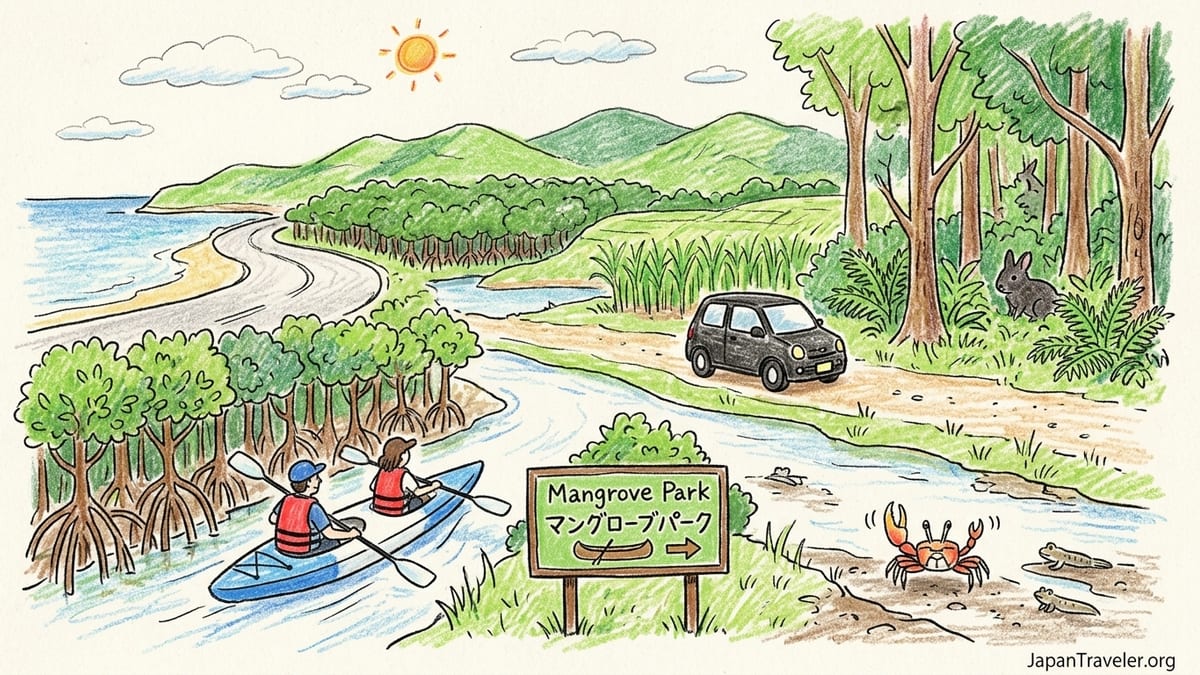
The final approach to the mangrove area is remarkably straightforward. Route 58 narrows and begins to follow the brown-green curves of the river, while signs in Japanese and English point toward “Mangrove Park” and “Canoe”. A broad parking lot appears on the riverside near Yakugachi in Sumiyo Town, with several tour huts, restrooms and vending machines. I arrived about 30 minutes before my scheduled tour to check in, change clothes and sort out rental equipment, which turned out to be just enough time without feeling rushed.
For travelers staying around Tatsugo on the northern coast, the drive to Sumiyo is a bit longer, roughly 60 to 70 minutes depending on exact location, but still very manageable with a rental car. Navigating by the town name “Sumiyo” and the mangrove park signs is simpler than relying on small street addresses, and mobile signal along the main road was stable enough for basic map guidance throughout my stay.
Choosing a Guided Mangrove Kayak Tour
To ensure a structured, informative experience, I pre-booked a guided mangrove tour operated by an NPO based in Sumiyo that specializes in nature experiences and school programs. Their office is located in Yakugachi, Sumiyo Town, right beside the river, and the same group handles inquiries through a dedicated email address and booking form. I contacted them a few weeks in advance in simple English, requested a half-day mangrove canoe course and asked specifically for a tour timed to high tide so we could paddle into the narrower channels.
The confirmation email laid out all the practical details very clearly. The standard mangrove canoe experience runs about 2 hours on the water, plus time for briefing and gear fitting, with departures often scheduled to coincide with favorable tides. At the time of my visit, prices for adults were in the range of roughly 5,000 to 6,000 yen per person, with slightly lower rates for children, including the use of canoes, paddles, life jackets and guide services. Payment was accepted on site in cash, and credit cards were available only with some operators, so I brought enough yen to cover both the mangrove tour and a later night excursion.
Group size was kept intentionally small. That morning, my group was limited to six participants in three double canoes, plus one guide leading in a single kayak. On busier holiday weekends, I was told they cap groups at around eight to ten guests per guide to keep traffic in the mangrove channels manageable. This arrangement meant the guide could easily paddle beside each canoe at different points, point out wildlife and adjust pacing based on ability, which proved important for a mixed group that included a couple with a child and an older pair of friends in their 60s.
While some travelers might be tempted to simply rent a canoe and go alone, the logistics of tides, channels and protected zones made a guided option a better choice. The operator handled all permits and ensured we stayed within routes compatible with current conservation rules. They emphasized that walking on the mudflats or breaking mangrove branches was strictly prohibited, and that the tour was designed around low-impact observation from the water rather than physical interaction with plants or animals.
High Tide, Low Tide and the Feel of Paddling the Mangrove Forest
We launched close to high tide, when the river had swollen enough to flood the maze-like side creeks. From the moment my canoe pushed off the wooden ramp, I noticed how stable it felt. These were broad, flat-bottomed plastic kayaks closer to sit-on-top touring models than tippy river racers. With my life jacket snug and a simple foot brace adjusted, lateral wobble was minimal, even when I twisted to look behind me or leaned to peer down at the roots below the surface.
Paddling itself was gentle rather than punishing. The route followed the main river for a few minutes to let us practice strokes in open water, then veered into a narrower channel where mangrove branches knitted together overhead. In these shaded corridors, the texture of the experience shifted constantly. When clouds passed over the sun, the water turned the color of strong tea, with the reflections of the prop roots and arching branches flickering like negative film. When the light broke through again, small fish flashed near the surface and the glossy leaves of Bruguiera and Kandelia species glowed a saturated green.
The guide encouraged us to pause paddling frequently, let the current spin us slowly and simply listen. Under the canopy there was almost no wind, and what I heard instead was the soft drip of water from leaves, the occasional plop of a fish and the distant call of a kingfisher. Crabs clung to the exposed roots just above the waterline, darting sideways when our paddles dipped too close. In places where the water ran shallower, I could see the tangled pneumatophores that mangroves send upward from the mud to gather oxygen in brackish conditions.
Because we were near high tide, many of the smaller feeder creeks were navigable. The guide steered us into one channel only a few meters wide, where our paddles sometimes brushed the banks on both sides. Here the intimacy of the mangrove forest felt total. We had to coordinate our strokes to avoid tangling in the roots, which added a playful challenge but never felt dangerous. The canoe remained steady, and even the family paddling with a primary school aged child seemed relaxed, the child in front peering up at tiny mudskippers clinging to the embankment when we paused.
When the Water Drops: Mudflats, Small Creatures and Ecology Lessons
On a second outing the following day, timed closer to low tide, the same river transformed into something entirely different. The operator had warned that during lower water levels we would not be able to penetrate as far into the narrowest channels, but that exposed mudflats would reveal more of the small creatures that depend on the mangroves. As we set off, the banks loomed higher, tree roots now standing several decimeters above the water. Bare patches of mud appeared like islands between lanes of water, dotted with snail trails and crab burrows.
At one wider bend, the guide asked us to raft our canoes together and rest our paddles while he talked about the brackish environment around us. He scooped up water in his hand and explained that this section of the river is a mixing zone where freshwater from the mountains meets seawater from the bay, and that the salinity fluctuates with tides and rainfall. Mangroves tolerate this stress through specialized roots and salt-excluding leaves. He pointed to the buttressed trunks and aerial roots of the trees lining the channel, describing how they stabilize sediment, slow down incoming waves and create nursery habitat for juvenile fish and crustaceans that later move out to the coral reefs.
With more of the mud exposed, fiddler crabs were everywhere. Males stood outside their burrows waving oversized claws like flags, then vanished at the slightest vibration from our paddles. We also saw mudskippers, amphibious gobies that gulped air and used their fins like tiny legs to hop across the wet surface before sliding back into shallow puddles. The guide emphasized that although these creatures seemed abundant, the entire ecosystem is sensitive to changes in water quality and land use upstream, part of the reason strict rules exist about staying in canoes and not walking on the mudflats.
The contrast between high and low tide highlighted two different experiences. At high tide the focus was on immersion under the green canopy, threading through secret corridors of water. At lower tide the scene opened up wider, exposing the structural underpinnings of the mangroves and the remarkable adaptations of small animals. If time allows, booking two sessions at different tide levels is very rewarding, but for most visitors a single tour that begins slightly before peak high tide offers the most photogenic paddling among overhanging branches.
Comfort, Fatigue and Family Suitability on the Water
From a physical standpoint, the mangrove canoeing felt accessible to most reasonably mobile travelers. Over roughly 90 minutes of actual paddling, the effort was intermittent and moderate. There were no rapids or open-sea swells, and the main challenge involved synchronizing strokes in the double canoe so that it tracked straight. Our guide encouraged slower, quieter paddling inside the narrow channels, which naturally limited exertion. By the end of the outing my shoulders knew they had done some work, but I was far from exhausted and did not experience soreness the next day.
Canoe stability is a common concern for beginners, especially those traveling with children. The outfitter had specifically chosen wide sit-on-top models with high buoyancy and a low center of gravity. Life jackets were compulsory for all ages. At one deliberate test, I rocked my hips from side to side to see how the boat reacted, and the hull resisted tipping strongly before quickly settling back to level. The guide mentioned that capsizes in the mangrove area were rare and usually the result of playful behavior rather than river conditions. Even then, the water was shallow enough in many sections that standing would be possible for adults, though the operator clearly discouraged entering the water to protect the habitat.
Young families appeared to be a core part of the clientele. On my first tour, the couple paddling with a young child sat the child in the front seat between an adult’s legs with a child-sized life jacket and a small paddle. The guide set them near the middle of our small convoy, kept an eye on their pace and regularly checked in. After the tour, the parents told me they felt comfortable throughout and appreciated that routes avoided strong currents or long crossings. For infants or very young toddlers, however, most operators set minimum age guidelines, often starting from roughly 3 to 4 years depending on water conditions and group composition, so checking in advance is important.
Environmental conditions can influence comfort. In summer, humidity and heat build in the sheltered channels and make a broad-brimmed hat, breathable long sleeves and hydration essential. I visited in a shoulder season with warm but not extreme temperatures, and while I sweated during sunny stretches, the time spent in shade kept it manageable. Mosquitoes and sand flies were present near the put-in and in windless patches; using insect repellent and wearing thin long sleeves and leggings made a noticeable difference. Rain does not automatically cancel tours, but heavy downpours and strong winds can lead to postponement or route changes, something the operator communicated clearly when confirming the booking.
Morning vs Afternoon Paddles, Weather and Photography
Experiencing the mangroves at different times of day revealed how strongly light and weather shape the mood. My high-tide tour departed in the late morning, under a soft overcast that occasionally broke into sun. This made photography fairly forgiving, with even lighting under the canopy and fewer harsh reflections on the water. Colors appeared slightly muted but accurate, and I could shoot hand-held from the canoe at relatively low ISO without worrying about extreme contrast between bright sky and dark roots.
The low-tide outing took place in the mid-afternoon, when the sun sat higher and punched light through gaps in the branches. Conditions were warmer and insects more active. On the other hand, shafts of sunlight spotlighted crabs and mudskippers and created dramatic layered reflections of branches in the rippled surface. For wide shots down the channels I found it helpful to expose for the highlights and then bring up shadows later, as dynamic range could challenge phone cameras in particular.
Guides generally recommend avoiding the absolute heat of midday in high summer for comfort reasons, and tying your choice more to tide timing than clock time. Morning tours can feel fresher, with fewer other groups on the river, while late afternoon sessions sometimes deliver warmer colors and the chance of returning to the dock as the hills begin to turn gold. Wind was not a major factor inside the sheltered mangrove creeks during my stay, though a brisk breeze on the main river required slightly stronger strokes on the return leg of one tour.
One unexpected constraint involved waterproofing gear. While dry bags were available to borrow for small items, serious photographers might want their own. I kept my camera in a small dry bag at my feet, lifting it out only in the calmest sections, and otherwise relied on a weather-sealed phone tucked into a lanyard pouch. Splash from paddles is minor but constant. The guide reminded us at the outset that they could not take responsibility for water-damaged electronics, and that focusing too much on shooting instead of steering is a common cause of close calls with roots and other boats.
Where I Stayed and Ate: Naze, Tatsugo and Sumiyo
Because I wanted both restaurant variety and relatively short drives to Sumiyo and night tour meeting points, I based myself primarily in and around Naze, officially part of Amami City. The town has several mid-range business hotels within walking distance of the harbor and main shopping streets, with typical nightly rates around 5,000 to 9,000 yen for a single or double room depending on season. These properties offered simple but reliable comforts: air conditioning, Wi-Fi, coin laundry and on-site or nearby parking, which made it easy to return late from a night tour and slip straight into bed.
For a change of scenery, I spent one night in Tatsugo on the northern coast, where small seaside resorts and guesthouses face sandy coves. One coastal hotel there, oriented toward snorkeling and beach relaxation, served elaborate set dinners built around local fish, island vegetables and pork, accompanied by kokuto shochu, the brown sugar spirit closely associated with Amami. Prices were higher than in Naze, as is often the case with coastal resort-style accommodations, but the atmosphere of waking up to the sound of waves and driving south through lush interior hills to the mangroves provided a satisfying variation.
Sumiyo itself is quieter and more limited in lodging, but there are a few small guesthouses and minshuku within short driving distance of the mangrove park. Staying here would minimize morning travel time for early tours and place you closer to some night wildlife meeting points. Dining options in Sumiyo are basic, so many travelers either eat early dinners in Naze before driving south for a night tour or bring simple convenience store meals and snacks along to eat before or after activities.
In Naze I gravitated toward small local restaurants that served keihan, the island’s signature chicken rice dish, along with sashimi, local vegetables and modestly priced teishoku meals. Counter seating made it easy to dine solo. Menus were usually only in Japanese, but pointing at plastic food models or photos and using simple phrases worked smoothly. For drivers planning to join evening wildlife tours, it is essential to avoid alcohol before night excursions, especially because narrow mountain roads and wildlife crossings require full attention.
Night in the Forest: Guided Search for the Amami Rabbit
If the mangroves are Amami Oshima’s most accessible daytime ecosystem, its interior forests become the stage for a rarer encounter after dark. On my second night, I joined a guided wildlife outing focused on the Amami rabbit, an endemic species considered a living fossil and designated as a special natural monument of Japan. To do this safely and legally, I booked with a registered night tour operator that holds an official eco-tour guide number and follows regulations for entering designated observation routes.
Several reputable companies operate such tours, some with English-speaking guides and others primarily in Japanese. I chose a small operator based in Sumiyo known for specializing in night tours and led by a guide with more than 18 years of experience. Their website clearly listed prices, with one representative Amami rabbit night course priced around 7,000 to 8,000 yen per person for roughly 70 to 120 minutes depending on the specific plan, and additional options for longer midnight sessions at higher rates. Meeting points were typically at a roadside parking area or small harbor in Sumiyo, easily reached by rental car from Naze in 30 to 40 minutes.
After a brief orientation, we climbed into a sturdy vehicle with elevated seating. The guide explained that the tour follows permitted forest roads where vehicle access is allowed for licensed operators who have made the necessary entry notifications. We were reminded that leaving the road, chasing animals on foot, using flash continuously or playing recorded calls is prohibited. Observation would be from the vehicle whenever possible, with any brief stops on foot occurring only after the guide confirmed safety and minimal disturbance.
The drive into the hills felt like stepping into a different world. With headlights dimmed and a handheld spotlight sweeping the roadside, tree trunks, ferns and vines emerged from the dark. The guide pointed out frogs on branches, including local endemic species, and once stopped to show us a habu snake coiled safely off the road verge. Information came in a mix of Japanese and simple English: how isolation and the absence of certain predators allowed such a unique assemblage of creatures to evolve here, and how road mortality and invasive mongooses have threatened them.
Our first Amami rabbit sighting was almost understated. The guide slowed the vehicle, angled the light and there it was, sitting at the edge of the road, stocky and dark, with short ears and a distinctive rounded silhouette. We observed quietly from inside the vehicle, windows open, voices low. After a minute or two the rabbit hopped back into the undergrowth and vanished. Later we saw another individual partially hidden beside a tree trunk, its coat absorbing the light. At no point were we allowed to approach, feed or attempt to touch the animals. The emphasis remained on quiet, respectful observation and on understanding that these rabbits belong entirely to the night forest, not to us.
Guides, Safety Standards and Booking Options for Night Tours
One of the most reassuring aspects of the night tour was the professionalism of the guide. The operator prominently displayed their Amami eco-tour guide registration number on promotional materials, and the local government website also lists registered guides alongside their specialties. My guide held that certification and emphasized both ecological interpretation and safety, from reviewing seat belt use and emergency procedures to carrying communication equipment in case of sudden weather changes or road issues.
Tour structure varies slightly between operators, but a common pattern involves hotel pick-up in Naze or Tatsugo for an additional fee, or direct rendezvous at a roadside meeting point near Sumiyo. Group sizes tend to be small, often capped around eight or nine people per vehicle to ensure everyone has a decent viewing angle and can hear explanations. The private night rabbit experience offered by another local company posted rates starting around 11,000 yen per adult with Naze pick-up, rising modestly if you choose a hotel pick-up from more distant areas or opt for a fully private charter for a couple or family.
Children are generally welcome on these night outings, often from around four years old and up, but operators stress that kids must be able to remain relatively quiet and seated in the vehicle for up to two or three hours. For families, some guides adapt commentary and focus more on easy-to-spot animals so that young participants stay engaged. Regardless of age, the dress code is similar to the mangrove tours: long sleeves, long trousers, closed shoes and a light jacket in cooler months. Even in the subtropics, temperatures in the hills can drop and wind can pick up at night.
Booking independently through operators’ websites or email often works well and allows you to combine different providers for day and night activities, as I did. Some companies and local travel agencies also sell full-day packages that bundle mangrove canoeing, sightseeing and a night wildlife tour into a single product. When I compared prices, those packages tended to be convenient but slightly more expensive than organizing separate tours directly, especially when traveling with two or more people and already having a rental car. For solo travelers who prefer not to drive, bundled options that include transport and multiple experiences may offer better overall value despite the higher sticker price.
The Takeaway
What surprised me most about Amami Oshima was how distinct its ecosystems felt compared with both Okinawa’s resort-oriented beaches and Yakushima’s ancient cedar forests. Paddling through Sumiyo’s mangroves, I realized that this island’s personality is written in the intricate tangle of roots and the subtle interplay of fresh and salt water, more than in dramatic peaks or endless white sand. The mangrove canoe excursion easily justified an entire morning, especially when timed to the high tide window that allowed us to slip under low branches and feel cocooned by living green on both sides.
The experiences were not without minor disappointments. Weather and tides limit flexibility, and on one afternoon tour a sudden shower blurred visibility and cut our time in the narrow channels shorter than I had hoped. Insect presence around the docks could also be distracting. At night, while we did see Amami rabbits and several other endemic creatures, the encounters were necessarily distant and brief, more about glimpsing silhouettes and patterns of behavior than obtaining close-up photographs. Yet these constraints are precisely what keep the environment from being loved to death, and they reinforce that Amami’s creatures are not performers but wild residents.
If I were planning a return trip, I would prioritize another guided mangrove paddle timed to a different season, perhaps during early summer when foliage is at its densest and certain migratory birds may be passing through. I would again insist on a qualified, conservation-minded night guide for rabbit viewing rather than exploring back roads alone. Between bundled tours and independent bookings, I found that reserving directly with specialized operators offered better value and more flexibility as long as I had a rental car. For those comfortable driving, this approach makes it easy to tailor each day around tides, weather and personal energy.
Ultimately, Amami Oshima rewards travelers who are willing to slow down, accept a few natural inconveniences and focus on the subtle. The island’s mangrove forests and night-time wildlife may not deliver the instant spectacle of a famous shrine or towering cliff, but they offer something rarer: the feeling of entering a living, breathing system where every root, ripple and rustle has a role. For anyone curious about Japan’s subtropical nature beyond beaches and cedar groves, a guided mangrove kayak excursion and a carefully conducted night rabbit tour on Amami Oshima deserve a place at the very top of the itinerary.
FAQ
Q1. Do I need a rental car to join mangrove and night tours on Amami Oshima?
While some operators offer hotel pick-up for night tours, having a rental car makes reaching Sumiyo’s mangrove area and meeting points far easier and cheaper, especially if you plan multiple activities.
Q2. How much does a guided mangrove kayak tour cost?
Recent prices for a 2-hour guided mangrove canoe experience in Sumiyo are generally around 5,000 to 6,000 yen per adult, including equipment and guide, with discounts for children depending on the operator.
Q3. Are the canoes stable enough for beginners and children?
Most outfitters use wide sit-on-top kayaks with high stability and require life jackets for all participants, making them suitable for first-timers and young families under guide supervision.
Q4. When is the best time of day for mangrove kayaking?
The most rewarding sessions usually coincide with high tide, which allows access into narrower channels; tour times are often scheduled around the tide rather than a fixed clock hour.
Q5. What should I wear and bring for the mangrove tour?
Lightweight long sleeves, shorts or leggings that can get wet, sandals or water shoes, insect repellent, sun protection and a small waterproof bag for valuables work well.
Q6. How much does an Amami rabbit night tour cost?
Standard shared-vehicle night tours typically cost between about 7,000 and 11,000 yen per adult depending on duration, group size and whether hotel pick-up is included.
Q7. Can I approach or feed the Amami rabbits during tours?
No. Ethical operators observe rabbits and other wildlife from vehicles or designated spots at a distance, without approaching, feeding or handling animals, in line with conservation rules.
Q8. Is the night tour suitable for children?
Many night tours accept children from roughly four years old if they can stay seated and relatively quiet; check age limits and tour length with your chosen operator before booking.
Q9. Should I book a combined full-day package or separate tours?
Combined packages are convenient and often include transport, but booking mangrove and night tours independently can offer better value if you already have a rental car and want flexibility.
Q10. How does Amami Oshima differ from Okinawa and Yakushima for nature travel?
Amami Oshima is defined by extensive mangroves, brackish rivers and unique island wildlife, offering a quieter, more low-key subtropical nature experience than Okinawa’s beach resorts or Yakushima’s mountain forests.