


On a map, the Goto Islands look like a scatter of pebbles flung west of Nagasaki into the East China Sea. In reality, they are something far stranger and more human: a network of fishing hamlets, terraced paddies and modest churches that tell how Christianity survived centuries of prohibition in Japan. I spent several nights based on Fukue Island, crossing by ferry to Naru and Hisaka, to understand how these island communities carried faith across the water and what it means to visit their churches respectfully today.
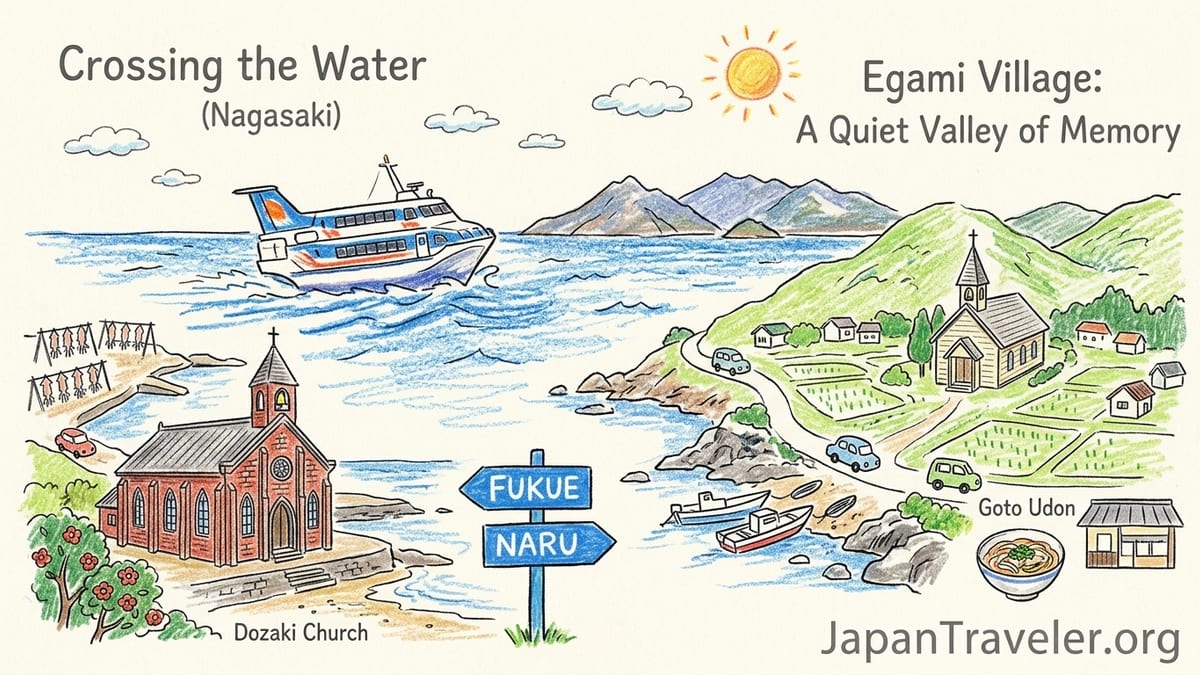
Crossing the Water: Getting to the Goto Islands
My journey began in Nagasaki, where the city’s own Christian landmarks set the tone before I ever saw an island. From Nagasaki Airport, the flight to Fukue’s Goto Tsubaki Airport is about 30 minutes. As of late 2026, one-way fares on low-demand days were often around 9,000 to 14,000 yen on regional carriers when booked a few weeks in advance, though they can climb higher in peak holiday periods. From Fukuoka Airport, the flight is longer and usually priced a little above the Nagasaki route, so Nagasaki tends to be the more practical jumping-off point if your focus is the Goto archipelago.
By sea, the journey feels closer to how villagers once moved between these islands. From Nagasaki Port, high-speed jetfoils operated by regional ferry companies reach Fukue Port in as little as about 1 hour 25 minutes, with recent online timetables listing one-way fares in the region of 8,000 to 9,000 yen for adults in standard class. Conventional ferries on the same route take roughly 3 hours 10 minutes and can cost closer to 5,000 to 6,000 yen one way, depending on the season and seat type, making them slower but more economical if time is flexible.
Coming from Fukuoka, there are also seasonal and regular ferries that connect through other islands, but they usually involve longer travel times and more complex transfers. For a focused church and heritage trip, Nagasaki felt like the most efficient gateway. I chose to arrive by jetfoil from Nagasaki and return later by plane, partly to experience both routes and partly to hedge against winter weather that can delay sea crossings.
By the time the jetfoil slowed into Fukue Port, I had logged not just travel times and ticket prices but my first lesson of the Goto Islands: people here gauge distance in terms of sailings and swells, not just kilometers. Every later decision, from which church to visit to where to sleep, was shaped by that relationship with the sea.
First Impressions of Fukue: Base Camp on the Edge of the Sea
Fukue is the largest and most developed of the Goto Islands, and it quickly proved the most practical base for several nights. Around the port and central city area there is a small but growing spread of business hotels, guesthouses and newer boutique-style accommodations. On recent searches in autumn 2026, basic business hotels near Fukue Port were often quoted between 7,000 and 11,000 yen per night for a single room, while simple guesthouses and minshuku in residential streets could still be found under 7,000 yen with shared bathrooms.
I settled into a modest guesthouse a short walk from the port, where the owner also operated a small rental car counter. That combination is not unusual in Fukue. Official tourism guides and local triathlon information sheets note that public transport on the island is limited, and even city-produced materials emphasize that cars are almost essential to explore beyond the immediate town. One local guesthouse explicitly describes Fukue as roughly 130 kilometers around and stresses that buses do not serve many church and coastal sites, a reality my own planning confirmed.
Car rental rates reflected small-island economics. A compact kei car from a local operator was typically advertised from around 5,000 to 6,000 yen per 24 hours before insurance, in line with published rate tables by Goto-based rental companies. That is somewhat higher than rock-bottom mainland promotions but still reasonable given the distances and the lack of alternatives. Fuel costs stay manageable because driving distances are relatively short; a full tank lasted me two full days of church visits and coastal detours.
Weather shaped every choice. In early autumn, Fukue offered days around 24 degrees Celsius, with soft marine haze in the morning and clearer blue in the afternoon. In winter, when northwesterly winds blow hard across the East China Sea, sea crossings can be canceled and driving conditions along coastal roads become more challenging. Plan with that in mind, especially if you intend to move between islands on fixed dates.
Dozaki Church: A Gothic Facade on a Tidal Shore
My first full day went north from Fukue City toward Dozaki Church, perhaps the best-known Christian site on the island. The drive took less than 30 minutes on quiet local roads, winding through bamboo groves and citrus orchards. Near the end, the road dips sharply to a tidal inlet where the red-brick church stands just above the water, facing the bay. Official city information describes Dozaki as the oldest church in the Goto Islands, with its original structure from the 1880s and the present building completed in 1908. It now houses the Dozaki Museum of Christian History inside the church itself.
The architecture is modest Gothic Revival rather than grand cathedral. Red brick walls rise above a simple stone foundation, with pointed-arch window openings and a small bell tower that feels almost domestic in scale. Stepping inside (after paying a modest admission fee, which recent visitors report as several hundred yen), the atmosphere changes from sea glare to filtered light. Stained glass panels cast colored reflections on wooden pews polished by generations of worshippers and visitors.
Exhibits within Dozaki trace the arc of Christianity in the islands, using rosaries, liturgical items and old photographs. Most significant for understanding these islands is the story of Kakure Kirishitan, the so-called Hidden Christians. After Japan’s early 17th-century bans on Christianity, persecution drove believers to either renounce their faith, practice in secret or flee to remote regions. The Goto Islands became one such refuge late in the Edo period, when domain authorities invited settlers to improve underpopulated islands. Among those arrivals were Christian families from coastal Nagasaki areas like Sotome, who brought with them prayers transmitted orally and altars disguised as Buddhist or folk-religious objects.
What struck me in Dozaki was how humble most artifacts were. There were no reliquaries of gold, only prayer books, icons and the memory of people who kept their rituals hidden in back rooms for more than two centuries. It set the context for visiting other churches later in the trip. These buildings are not just architectural sights; they are physical answers to a long, quiet question: what happens when a community emerges from hiding.
Mizunoura and Imochiura: Everyday Parish Life After the Ban
From Dozaki, I looped west toward Mizunoura Church, crossing low hills and passing hamlets where fishing nets and squid-drying racks shared space with vegetable plots. Documentation compiled by church and tourism groups records that Mizunoura’s first small church was built in 1879, with the present structure completed in 1938. The approach today passes ordinary houses and parked kei trucks, and then suddenly the church appears above a curve in the road, white walls set against forested slopes.
Mizunoura’s architecture is plainer than Dozaki’s. The church is rendered in simple plaster with gentle pointed windows and a tower that rises just above the roofline of neighboring homes. When I arrived, a parishioner was trimming shrubs in the garden and simply nodded a greeting, as one might to a visitor approaching any neighborhood hall. Inside, the pews are wooden, the altar modest, and the light bright enough to see that this is an active parish rather than a preserved monument. I asked permission before taking any photographs and limited myself to a few shots of the empty nave, mindful that this was more community space than museum.
Later that afternoon, I continued to Imochiura Church on a different part of Fukue. Sources on church history indicate that Imochiura’s parish dates back to the 19th century, with the current building reconstructed in 1988 and dedicated to Our Lady of Lourdes. Its modern exterior is less romantic than brick Gothic, but the site carries a distinct devotional atmosphere. Statues of Mary and child stand in a small outdoor grotto, and votive candles flicker under a canopy. The church grounds look out toward the sea, connecting Marian devotion with the maritime landscape that sustained local families.
What Mizunoura and Imochiura revealed, beyond architectural variety, was how quickly island Christians embraced open worship once the national ban was lifted in the late 19th century. These were not showpiece churches for visiting dignitaries. They were practical parish buildings serving fishing families, farmers and small traders who had spent generations hiding rituals in their homes. The structures tell a story of normalization, of faith coming out into daylight in forms that would have looked ordinary in Europe but felt radically open in the villages that built them.
From Hidden Villages to UNESCO: Egami and the Former Gorin Church
The next stage of the trip required more planning. Two of the most symbolically important sites in the Goto Islands, Egami Church on Naru and the Former Gorin Church on Hisaka, are part of the UNESCO World Heritage property known as “Hidden Christian Sites in the Nagasaki Region.” Egami Church and the surrounding Egami Village are specifically identified as a component that represents communities formed by former Hidden Christians who migrated to the islands and later constructed churches after the ban on Christianity was lifted.
Unlike most parish churches on Fukue, both Egami and the Former Gorin Church require advance reservation for interior visits. Official tourism materials from Goto City and dedicated Hidden Christian heritage resources emphasize that visitors must contact the appropriate information centers or parish offices before entering. Recent English-language guidance for Egami explains that individual visitors are expected to make online or telephone reservations, usually accepted from six months up to two days before the visit, and that the church is closed on Mondays and during Mass or other religious services.
Practical access also takes more effort. Reaching Naru Island from Fukue requires a local ferry, with sailings that can vary by season and day of the week. Schedules posted by regional ferry operators show several round-trip services on many days, but capacity and late-afternoon sailings can be tight, especially during local events or holiday periods. Fares for foot passengers in 2026 were in the range of a few thousand yen round trip between Fukue and Naru. For Hisaka and the Former Gorin Church, there are additional boat connections and, increasingly, guided boat tours that bundle multiple heritage sites in a single cruise from Fukue, some described in national park promotional materials as four-hour itineraries visiting both Egami and Former Gorin.
I chose to book a guided heritage tour rather than coordinate separate ferries and buses. The tour price, around 12,000 to 15,000 yen per person depending on season and inclusions, covered the boat from Fukue, on-island transfers, local guiding at Egami Village and the Former Gorin Church, and arranged church reservations. It was more than I would have paid by piecing together public ferries and perhaps renting an additional car on Naru or Hisaka, but it radically simplified logistics and, more importantly, ensured that my presence in active worship spaces would be mediated by people who understood local expectations.
Egami Village: A Quiet Valley of Memory
Approaching Egami by boat, the coastline first appears as a low green rim, then opens to a valley of rice paddies and scattered houses. UNESCO’s evaluation of the site notes that this landscape still holds traces of the Hidden Christians who migrated here, including fields they cultivated under agreements with local lords and sites of both persecution and post-ban church construction. During the ban period, these families practiced faith in secret, adapting rituals to survive without priests, churches or regular contact with Rome.
With our guide, we walked from the small port up a narrow asphalt road. Along the way were rice fields, persimmon trees and houses whose gardens hid small stone statues and family graves. At the edge of the settlement, Egami Church emerges between trees, a light-colored wooden church with a steep roof, pointed windows and a small belfry. Completed in the early 20th century, it embodies the series of churches re-established after the ban, but it remains small enough to feel like a village chapel.
Entry followed a routine that underscored the church’s status as a living parish. Our group removed hats, spoke quietly and refrained from photography inside, in accordance with posted signs and our guide’s instructions. The interior is wooden and intimate, with a simple nave and narrow side aisles. Light filters through frosted and colored glass, catching on carved details along the ceiling beams. There are few overt signs that this is a World Heritage component rather than any small rural church, and that is precisely the point: the site is protected not only for its architecture but for the continuity of a community that carried faith across centuries of restriction.
Our guide recounted how Egami’s ancestors came from the Sotome area near Nagasaki, invited by feudal authorities who needed settlers to develop new lands. They arrived as farmers and fishers, but they also brought clandestine Christian practices shaped by two centuries without clergy. After the ban was lifted and missionaries returned, some of these Hidden Christians rejoined the Catholic Church and helped build churches like Egami, while others chose to maintain older, independent traditions or left Christianity altogether. In Egami today, that layered history is condensed into an ordinary Sunday Mass schedule and a modest bell tower ringing across the paddies.
Former Gorin Church and Hisaka: Maritime Faith and Ruins
The Former Gorin Church stands on a more remote part of Hisaka Island, another component of the World Heritage group. Boats from Fukue curve between islets and sea cliffs before approaching a small inlet where the old church sits on a low rise not far from the water. From a distance, it looks almost like a stone barn, framed by a cemetery and sparse trees.
The building itself is deconsecrated, usually described in official materials as a former church hall rather than an active parish, but it still requires prior contact for interior visits. Our tour group’s reservation had been arranged in advance, and we arrived during the church’s designated visitor hours. Inside, the space is simple and largely empty, with wooden beams overhead and residual altar markings at one end. In contrast to Egami, photography rules were more flexible, but we were still asked to move quietly and avoid climbing or touching fragile areas.
Hisaka’s Christian history mirrors Egami’s in broad strokes. Former Hidden Christians migrated here in search of land and a measure of safety. They collaborated with or lived alongside Buddhist fishing communities, sharing coves and harbors while maintaining distinct religious practices. UNESCO documentation mentions features such as cooperative fishing grounds and graveyards that record these intertwined lives. Standing outside the former church, with fishing boats pulled up on the rocky shore below, it was easy to imagine how a maritime parish once revolved around the rhythms of tides and catch.
Unlike bustling Fukue, Hisaka today feels sparsely inhabited, with many younger residents having left for mainland work. The remaining population maintains fields and fishing grounds, and some families now welcome a slow trickle of heritage visitors. Our guide stressed that while World Heritage status brings new attention, infrastructure remains minimal. There are no large hotels, only small lodgings and day visitors. It would be challenging to explore Hisaka’s Christian sites independently without a charter boat or well-planned use of local ferries, especially if you hope to coordinate church access on a same-day schedule.
Life Between Churches: Fishing Boats, Goto Udon and Coastal Roads
It would be a mistake to reduce a Goto trip to a checklist of churches. Much of what I learned came in the spaces between them, on harbors and at dinner tables. In Fukue’s port area, late afternoon meant the return of small fishing boats, their decks wet with sea spray and seringas of squid lines coiled neatly. Watching crews unload plastic crates of mackerel and squid, I was reminded that the communities who preserved Christianity here always balanced religious life with the work of the sea.
Food expresses that same balance. Goto udon, the local signature noodle, is a thin wheat noodle stretched with camellia oil and served either chilled with dipping sauce or in hot broth. Several simple restaurants near Fukue Port and along the main road offer udon sets for roughly 800 to 1,200 yen, often paired with tempura fishcake or onigiri. At one family-run place, the owner explained how camellia oil production and udon-making both grew as side industries for farming and fishing households, filling gaps in the seasonal economy.
Seafood dinners during my stay drew almost entirely on local catch. Grilled flying fish, sashimi of assorted white fish and simmered shellfish appeared on menus from about 2,000 to 3,500 yen per person at casual izakaya-style restaurants. In one tiny bar, a retired fisherman described winter storms that still isolate outer islands, recalling times before fast ferries when a crossing to Nagasaki could take many hours in an open boat. His stories gave emotional weight to the idea that reaching church on another island, or maintaining contact with distant clergy, once required courage and faith as well as gasoline and tickets.
Driving coastal roads, I passed terraced fields, small shrines and neighborhood cemeteries where crosses and Buddhist gravestones sometimes shared the same hillside. That coexistence illustrates a key point often highlighted in studies of Hidden Christians: after centuries of secrecy, some communities merged Christian elements with local religious practices, creating forms of belief that did not always align neatly with mainstream Catholicism. Today’s church buildings, parish registers and Mass schedules show one path that emerged after the ban ended. The mixed graveyards and home altars hint at others.
Guided Heritage Tour or Independent Travel?
My days on Fukue alternated between independent exploration by rental car and guided travel to the UNESCO-listed sites on Naru and Hisaka. The contrast made the trade-offs clear. Renting a car on Fukue gave me freedom to linger at Dozaki’s shoreline, detour through small coastal villages and stop unplanned at roadside shrines. The costs were straightforward: roughly 5,500 yen per day for a kei car, a few thousand yen in fuel for the entire stay, and modest parking fees or donations at some sites.
The disadvantages appeared when I tried to map out visits to Egami and the Former Gorin Church without a tour. Ferry schedules between Fukue, Naru and Hisaka can change by season and are vulnerable to weather. Aligning those sailings with limited visitor slots at churches that require advance reservation is doable but stressful, especially if you do not speak Japanese or cannot make flexible day-to-day changes. In my case, the guided tour’s higher cost felt justified by the elimination of that logistical puzzle and by the benefit of a local guide explaining nuance that might not appear in English-language signage.
For travelers with time, language skills and a strong desire for independence, arranging ferries and rental cars independently is still possible. City and prefectural websites publish basic access information in English, and there are a handful of car rental outlets on Naru and other islands. Yet every local person I spoke with on Fukue, from guesthouse owners to parish staff, emphasized the importance of calling ahead and confirming arrangements, particularly for winter or shoulder seasons when service frequencies may drop.
There is also an ethical dimension. Guided heritage tours are more likely to respect community preferences about group size, interior behavior and photography. Independent travelers must shoulder that responsibility themselves. In small parishes where a handful of elderly residents still attend Mass, a sudden influx of visitors without prior coordination can feel intrusive. On this trip, I became convinced that for Egami and the Former Gorin Church, a locally organized tour is often the more respectful choice, even if it reduces a sense of adventure.
The Takeaway
When I left the Goto Islands, flying out from Goto Tsubaki Airport under a sky streaked with autumn clouds, my notebook was full of times, fares and reservations. But the most important entries were about people and landscapes rather than logistics. I learned that the story of Hidden Christians here is not only about heroic resistance to persecution; it is also about compromise, migration and the quiet work of weaving faith into everyday coastal life.
Of all the places I visited, Egami Village remains the most vivid in memory. Not because its church is more beautiful than Dozaki’s brick or more picturesque than Mizunoura’s white walls, but because of the way the entire valley seems to hold the memory of families who crossed from Sotome and rebuilt their lives around tide and liturgy. Standing on the path between rice paddies and the church, I felt a rare alignment between heritage designation and living community.
Were several islands worth the transport expense? For me, yes, but in a specific way. Fukue alone offers enough for two or three days: churches like Dozaki, Mizunoura and Imochiura, coastal drives, Goto udon and fishing ports. Adding Naru and Hisaka through a guided heritage itinerary increased my costs by roughly 15,000 yen but multiplied my understanding of how island geography and faith intertwined. Travelers on tighter budgets or schedules might choose to focus solely on Fukue’s churches while reading more deeply about Egami and Hisaka, yet if resources allow, visiting at least one outer island gives essential context.
If I return, I would plan a slower week rather than a compressed four days. I would spend at least three consecutive nights on Fukue again, but I would also try to stay one night on Naru, perhaps in a small guesthouse, instead of visiting Egami on a same-day loop. I would schedule more time simply to walk villages at dusk, when kitchen lights come on and the line between sacred and ordinary feels thinnest. Most of all, I would approach each church first as a guest in someone’s neighborhood and only second as a visitor to a cultural site. In the Goto Islands, that order of priorities makes all the difference.
FAQ
Q1. How many nights should I spend on the Goto Islands to visit the hidden Christian sites?
Most travelers interested in Christian heritage should plan at least three nights, using Fukue as a base. This allows one full day for Fukue churches, one for a guided tour or ferry trip to Naru and Hisaka, and some buffer time for weather disruptions or simply slowing down in fishing villages.
Q2. Is a rental car really necessary on Fukue Island?
For most visitors, yes. Public buses exist but are infrequent and do not reach all major churches or viewpoints. Local guesthouses and city information emphasize that a car is the most practical way to explore beyond the central town. Rental rates for small cars are usually around 5,000 to 6,000 yen per day, and driving distances are short.
Q3. How do I get from Nagasaki to Fukue Island?
You can fly from Nagasaki Airport to Goto Tsubaki Airport in about 30 minutes, or take a jetfoil or conventional ferry from Nagasaki Port to Fukue Port. Jetfoils are faster, around 1 hour 25 minutes, while conventional ferries take roughly 3 hours 10 minutes but are cheaper.
Q4. Do I need advance reservations to visit Egami Church and the Former Gorin Church?
Yes. Both Egami Church on Naru and the Former Gorin Church on Hisaka require advance arrangements for interior visits. Reservations are typically handled through official information centers, parish contacts or guided tour operators, and access may be restricted during religious services or on designated closed days.
Q5. Are photography and interior visits always allowed at the churches?
No. Photography rules vary by church, and some prohibit interior photos altogether to protect the atmosphere of worship. At World Heritage components like Egami Church, visitors are often asked to refrain from photography inside and to behave quietly. Always check posted signs and follow instructions from local staff or guides.
Q6. What is the difference between UNESCO-listed sites and other churches on the Goto Islands?
UNESCO-listed components such as Egami Village with Egami Church and the Former Gorin Church are recognized specifically for their outstanding testimony to the survival of Christianity during prohibition and the later building of churches. Other churches, like Dozaki, Mizunoura and Imochiura, may not be part of the World Heritage property but are historically significant parish churches that show how everyday Christian life developed after the ban.
Q7. Can I visit Naru and Hisaka independently without a guided tour?
It is possible but requires careful planning. You will need to coordinate local ferries, check seasonal timetables and arrange church reservations in advance, often in Japanese. Weather-related cancellations can also affect sailings. For many visitors, especially those short on time or language skills, a guided heritage tour from Fukue offers a more practical and respectful way to visit these islands.
Q8. What else is there to do on the Goto Islands besides visiting churches?
Beyond churches, the Goto Islands offer coastal scenery, hiking, swimming beaches in warmer months, lighthouse viewpoints, camellia forests and rich local food culture. Trying Goto udon, sampling fresh seafood in portside restaurants and watching fishing boats return at dusk are highlights that round out a heritage-focused trip.
Q9. When is the best season to visit the Goto Islands for church and heritage travel?
Spring and autumn are generally ideal, with mild temperatures and comparatively stable sea conditions. Summer offers swimming but can be hot and humid, and typhoons sometimes disrupt ferries. Winter has a stark beauty but stronger winds and higher chances of canceled sailings, which can complicate multi-island church itineraries.
Q10. How can I visit respectfully as a non-Christian traveler?
Dress modestly, speak quietly, and treat each church as an active place of worship rather than a museum. Follow all posted rules, avoid entering during services unless invited, ask permission before taking photos, and consider joining a guided tour for sensitive sites. Small donations at churches or local museums also directly support communities maintaining these buildings.