


The Ogasawara Islands sit 1,000 kilometers south of Tokyo yet remain part of the capital, a subtropical UNESCO World Natural Heritage site with no airport and no quick way in or out. Visiting in 2026 means committing to a 24‑hour sea voyage, a six‑day sailing rhythm and several days off the grid, rewarded by wild dolphin encounters, seasonal whale watching, pristine bays and forests found almost nowhere else in Japan.
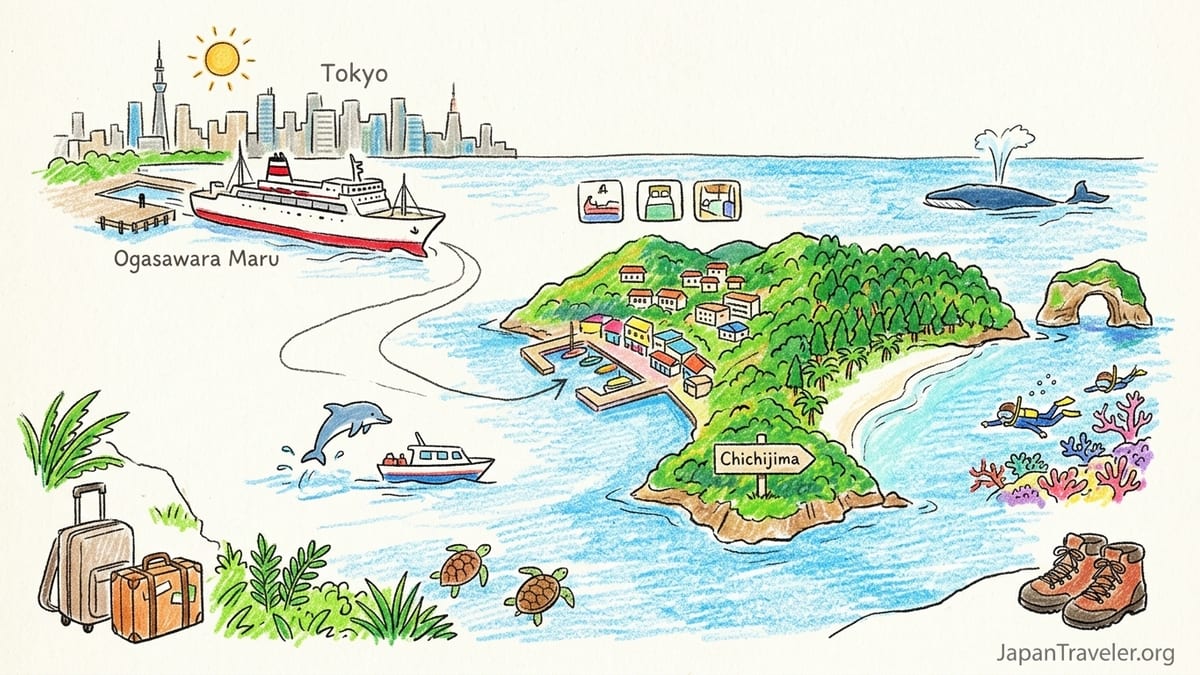
Understanding the Ogasawara Maru Ferry Adventure
Reaching the Ogasawara Islands hinges on a single lifeline: the Ogasawara Maru ferry operated by Ogasawara Kaiun from Tokyo’s Takeshiba Pier. There is currently no normal commercial passenger flight to Chichijima or Hahajima, and sightseeing flights from the mainland do not land on the islands. The large white ferry typically departs mid‑morning from central Tokyo and arrives at Futami Port on Chichijima around 24 to 25 hours later, depending on sea conditions. The crossing is long but comfortable, with restaurants, lounges, cabins and open deck space that make the journey part cruise, part essential logistics.
In 2026, Ogasawara Kaiun’s published schedules show the classic six‑day cycle that structures most trips. One day is spent outbound at sea, followed by roughly three full days on Chichijima, then a final day returning to Tokyo. That means a standard itinerary built around one ferry in and the next ferry out usually gives about four nights on Chichijima, allowing for three full sightseeing days plus several half‑days before and after the ship’s arrival. Some dates are extended to seven or eight days during peak periods, but the six‑day rhythm remains the core pattern.
Schedules and departure dates are released several months ahead. For example, an April 2026 schedule published by Ogasawara Kaiun shows a departure from Takeshiba at 11:00 on Day 1, arrival at Chichijima the following day around midday, three free days on the island, and a return departure on Day 5 that arrives back in Tokyo on Day 6. This pattern repeats with slight variations over the summer. Because sailings are infrequent and can sell out, travelers should choose their preferred departure first, then match accommodation and tours to those exact dates rather than the other way around.
The ferry’s six‑day cycle also shapes possible add‑ons. If you hope to visit Hahajima using the inter‑island Hahajima Maru, you will usually sacrifice one full day on Chichijima to fit the additional boat trip into the same overall window. Some tour packages marketed to overseas visitors explicitly label itineraries like “6 days / 3 nights Chichijima only” or “7 days / 4 nights including Hahajima,” making it clear how many nights you actually spend on land versus on the ship.
Cabins, Seats and What Ferry Class Really Buys You
Booking Ogasawara Maru passage is more like reserving a mini‑cruise than a simple commuter ferry. The company sells several accommodation classes, typically starting with basic second‑class open sleeping areas and rising through shared cabins to private rooms with beds. Recent fare tables for 2026 show a wide spread between the cheapest and most comfortable categories, with one‑way adult fares in second class generally in the low‑to‑mid 20,000 yen range and private cabins costing roughly double that or more, depending on the specific class and any fuel surcharges in effect.
In the open second‑class areas, you receive a numbered space on a carpeted floor or in reclining seats in a large shared room. It is sociable and cost‑effective but can be noisy and bright. Many repeat visitors bring lightweight sleeping bags, earplugs and eye masks. At the other end of the scale, cabin‑class options include two‑ and four‑berth rooms with real beds, storage, and sometimes private washbasins or bathrooms. An older English brochure for the previous Ogasawara Maru notes that single use of a twin cabin incurred an extra fee of around 6,000 yen; current ships and fares differ, but the principle remains that couples and friends sharing cabins spread the cost much more efficiently than solo travelers.
Over a six‑day round‑trip, the cost difference becomes clear. Two adults traveling in basic second class might pay on the order of 100,000 to 110,000 yen total for both directions combined, once fuel surcharges are included. The same couple booking a comfortable cabin both ways could see ferry costs reach around 180,000 to 220,000 yen or more, depending on class and season. In exchange they gain private space, quieter sleep and better rest before early‑morning tours. For travelers planning multiple days of diving or hiking, arriving well‑rested can be worth the extra outlay.
Regardless of class, passengers have access to shared onboard facilities. Recent ferry descriptions mention cafeterias with reasonably priced Japanese set meals, vending machines, public baths with sea views, and lounges where you can watch the ocean or read. The ship sells basic toiletries and snacks, but many regulars bring instant coffee, favorite drinks and simple picnic food from Tokyo to keep costs down. Seas can be rough, especially during winter fronts or late‑summer typhoons, so motion‑sickness medication, comfortable clothing and slip‑on shoes make the long crossing more manageable.
Where to Stay on Chichijima: From Minshuku to Sea‑View Lodges
Once you step off the ship at Futami Port, Chichijima itself is compact but offers a surprisingly varied range of accommodation. There are no international hotel chains, but you will find family‑run minshuku, small hotels, guesthouses and sea‑view pensions concentrated around Omura, Ogiura, Sakaiura and a few outlying bays. An English guidebook produced for Tokyo’s tourism authorities lists options such as Hotel Horizon, Chichijima View Hotel, Hotel Beach Comber, Island Resort Chichijima Nanpu and beachside guesthouses in the Sakaiura and Ogiura districts, alongside numerous minshuku that combine simple tatami rooms with home‑cooked dinners.
Minshuku are typically the most affordable and intimate choice. Rates for one night with two meals on remote Japanese islands of this type often fall around 9,000 to 13,000 yen per person, and Chichijima properties listed in recent Japanese‑language travel brochures appear to be in that broad range, though exact prices depend on room type and season. Expect futon bedding on tatami, shared bathrooms, hearty island dishes featuring local fish and vegetables, and hosts who may pick you up at the port by minivan if arranged in advance. English is not guaranteed, but many owners are used to international guests arriving on the Ogasawara Maru.
Small hotels and sea‑view lodges sit a notch higher in price but add comforts such as en‑suite bathrooms, Western‑style beds and sometimes ocean‑facing balconies. Online hotel search engines currently list places such as Chichijima View Hotel and Shanti Bungalows with nightly rates that, when converted, often land in the 10,000 to 20,000 yen per room range outside of peak holiday weeks, although these aggregator prices can differ from direct bookings. For couples seeking more privacy and predictable amenities, these properties strike a good balance between comfort and island character.
Package arrangements sold by Ogasawara Kaiun and specialist agencies in Japan combine ferry tickets with set nights in partner accommodations. A sample 6‑day / 3‑night package brochure for 2025 shows pricing tiers for stays at minshuku, pensions and hotels, typically bundling three nights on Chichijima with round‑trip ferry travel. Package rates sometimes undercut booking everything separately, especially during high season when individual rooms are scarce. However, they also lock you into specific properties and may be more difficult to arrange from overseas without Japanese language support. Independent travelers often book ferry tickets directly, then use the Ogasawara Village Tourism Association’s resources or Japanese hotel sites to secure their preferred lodging.
Whale Watching, Ethical Dolphin Tours and Minamijima Access
Ogasawara’s surrounding waters host seasonal humpback whales, sperm whales and resident pods of dolphins, making marine wildlife tours a highlight of almost any visit. Several local operators based on Chichijima, including members of the Ogasawara Whale Watching Association, run small‑boat trips that combine dolphin watching, snorkeling and, in season, whale observation. The association’s English summary notes that around 15 boats on Chichijima and one on Hahajima take part, typically carrying between 5 and 30 passengers each on full‑day trips that, in recent years, have been priced roughly in the 7,000 to 15,000 yen range per adult depending on duration and content.
More detailed current pricing can be seen in Japanese on individual operator sites. For example, Ogasawara Kanko, a long‑standing local company, lists half‑day dolphin and whale watching cruises at around 9,000 yen for adults and 7,000 yen for children under 12, with full‑day Chichijima coastal and dolphin tours at approximately 15,000 yen for adults and 9,000 yen for children. A shorter “short course” sits in between at about 11,000 yen for adults. Rental of snorkeling sets and wetsuits is typically around 500 yen per item, while rain gear may be loaned free of charge. These figures give a realistic idea of 2026 prices, though they remain subject to change and fuel adjustments.
Seasonality shapes what you are likely to see. According to Ogasawara Kanko’s own descriptions, humpback whales are usually observed from around December to May as they migrate through the area, while sperm whale watching runs from roughly May to November in offshore waters approximately 15 kilometers from land. Boats may need to travel 40 minutes or more into the open ocean to search for sperm whales, and departures are always dependent on sea conditions. Dolphins, including bottlenose and spinner species, can be encountered year‑round. The Ogasawara Village Tourism Association cautions that encounters with wild dolphins are never guaranteed and that tours follow strict guidelines about approach distances and the number of swimmers allowed in the water.
Minamijima, a small uninhabited island near Chichijima, epitomizes the area’s fragile beauty. Accessible only by licensed boats and accredited guides, it features a spectacular natural arch, white‑sand beach and interior sinkhole lagoon. Visitor numbers are strictly capped, and entry is often completely closed for several months in winter for ecosystem recovery. The tourism association specifies fixed opening and closure periods each year, along with rules that prohibit collecting shells, walking outside marked paths or entering certain dune areas. Many dolphin‑and‑Minamijima combination tours book out quickly on sailings that align with the open period, so travelers should reserve spots as soon as their ferry tickets are confirmed.
Snorkeling, Scuba Diving and Forest Hiking
Beyond whale and dolphin watching, the Ogasawara Islands offer some of Japan’s clearest waters for snorkeling and diving. Coral reefs, drop‑offs and submerged rock formations around Chichijima and its satellite islets host tropical fish, sea turtles and occasional pelagic visitors. Local scuba centers and eco‑resorts organize boat dives for certified divers and introductory dives for first‑timers. While individual shop prices vary, recent tour listings suggest that two‑tank boat dives commonly fall in the 18,000 to 25,000 yen range per day including tanks and weights, with full gear rental adding several thousand yen on top. Introductory “experience dives” for beginners are usually in the low‑to‑mid 20,000 yen range for a half‑day, including instruction and gear.
Snorkelers have more budget‑friendly choices. Full‑day snorkel and coastal tours similar to those offered by Ogasawara Kanko typically cost around 11,000 to 15,000 yen for adults, depending on whether they include a Minamijima landing permit, dolphin swim components or visits to designated marine parks like the Anijima sea area. Rental snorkeling sets and wetsuits at roughly 500 yen per item keep equipment costs reasonable. However, some operators state that guests over 70 or those using snorkel gear for the first time may be asked not to enter the water for safety reasons, even if they can still join the tour as observers on board.
On land, the islands’ forests are just as special. The Ogasawara archipelago’s endemic plants and land snails contributed to its UNESCO World Natural Heritage listing, and several interior areas are designated as protected zones where unguided access is restricted. Guided forest hikes from Chichijima lead to viewpoints such as Chuo‑zan, Kominato and the rugged eastern cliffs, as well as remnant World War II sites. Local eco‑tour operators and an eco‑tourism resort publish one‑day and half‑day hiking programs, often priced in the 8,000 to 12,000 yen range per adult for small groups, with discounts for children.
Access rules are strict in sensitive habitats. Some trails, such as those entering core protected zones, can only be visited with registered nature guides who hold permits from Ogasawara Village and Tokyo Metropolitan Government. Group size caps, designated rest points, requirements to brush off seeds from shoes, and “no off‑trail walking” policies are enforced to protect vulnerable flora. Travelers should treat guide fees as a conservation contribution rather than an optional luxury. Booking in advance is strongly recommended, because the number of accredited guides is limited and their schedules must align with the ferry cycle.
Seasonality, Weather, Typhoons and Sea Conditions
Planning an Ogasawara trip for 2026 means balancing wildlife seasons with Japan’s broader weather patterns. From roughly late December to April, cooler months bring migrant humpback whales and generally clearer air, with ocean temperatures that can feel brisk for long snorkeling sessions without a thick wetsuit. This period also overlaps with some school holidays, so ferry cabins and popular tours can sell out earlier than in shoulder seasons. Sea conditions can be windier during winter fronts, which occasionally leads to choppy crossings on the Ogasawara Maru, though outright cancellations are relatively rare.
Late spring through summer, from about May to September, sees warmer sea temperatures that favor snorkeling, scuba diving and beach time. Sperm whale watching off the outer drop‑offs is usually offered through these months, weather permitting. However, the broader Northwest Pacific typhoon season peaks between roughly August and October. A direct hit or nearby passage can delay or cancel ferry sailings, extend stays, or cut trips short if an earlier departure is substituted. Travelers booking in these months should build generous buffers into onward flights and have flexible hotel reservations on the mainland in case of disruption.
Shoulder seasons in May, June and November combine fewer crowds with relatively stable seas, though individual years vary widely. Regardless of month, no responsible operator will guarantee whale or dolphin sightings; reputable companies emphasize that tours are nature experiences, not theme‑park shows. Even in peak humpback months, some days produce dramatic breaches and tail slaps close to the boat, while others offer only distant blows on the horizon. Choosing operators affiliated with the Ogasawara Whale Watching Association or listed by the Ogasawara Village Tourism Association increases the likelihood that your skipper will prioritize animal welfare and safety over close approaches.
Whatever the season, pack for strong subtropical sun, variable rain showers and salt spray. Lightweight long sleeves, reef‑safe sunscreen, a wide‑brimmed hat and quick‑dry footwear make both boat trips and hikes more pleasant. During cooler crossings or winter whale trips, layers and a windproof jacket are essential on the ferry’s decks, where apparent temperatures can drop significantly once the ship is underway in open water.
Hahajima Side Trips and Protected‑Area Rules
Hahajima, located about two hours south of Chichijima by the smaller Hahajima Maru, offers a quieter, more remote feel, with fewer residents and a handful of lodgings. The inter‑island ferry operates on its own limited timetable that must dovetail with the Ogasawara Maru’s schedule; Ogasawara Kaiun explicitly notes that Chichijima‑Hahajima fares are not included in standard Tokyo–Chichijima packages, and travelers must confirm current times and prices separately. Recent Japanese brochures for 6‑ and 7‑day itineraries show versions that allocate two nights to Hahajima and just one or two to Chichijima, underscoring how tight the timing can be.
On Hahajima, hiking routes to viewpoints such as Sekimon Ridge and the southern cliffs allow you to experience endemic plant communities different from those on Chichijima. However, protected‑area access rules are at least as strict, and many trails can only be entered with authorized guides. With only one Ogasawara Whale Watching Association member boat based on Hahajima, spots on marine tours are limited, and pre‑booking is essential for travelers particularly interested in quieter whale watching away from the relatively busier Chichijima waters.
Both islands enforce conservation rules that may feel unusual to visitors accustomed to more relaxed beach destinations. These include prohibitions on bringing non‑native plants, animals or soil, bans on open fires in most outdoor areas, requirements to pack out all trash, and strong recommendations to clean footwear before and after hikes. Protected beaches where sea turtles nest may be off‑limits or heavily restricted at night. Minamijima’s rules are particularly strict, with fixed opening hours, one‑way walking routes and seasonal closure periods that have in the past stretched from early November to early February for ecosystem recovery.
Given the complexity of these regulations, a practical approach is to choose one or two reputable eco‑tour operators and let them manage the permits and logistics. The Ogasawara Village Tourism Association maintains updated lists of license‑holding guides and tour boats; booking through these channels ensures that your spending supports compliant businesses and minimizes inadvertent damage to the islands’ fragile habitats.
What to Arrange Before Leaving Tokyo
Because there are no airports, no alternative passenger ships and only one main departure point, Ogasawara travel demands more up‑front preparation than most domestic Japanese trips. The single most important task is reserving Ogasawara Maru tickets as early as possible. Ogasawara Kaiun accepts bookings through its own office and partner travel agencies, some of which cater to English‑speaking visitors. Peak periods such as Golden Week, Japanese school holidays and year‑end New Year sailings can sell out weeks or months in advance, especially for private cabins.
Accommodation should be secured as soon as your ferry dates are fixed. Many minshuku and guesthouses on Chichijima do not list all their rooms on global booking engines, and some still rely on email or phone reservations. The Ogasawara Village Tourism Association’s accommodation directory, or the English Chichijima guidebook produced by Tokyo’s tourism bureau, provides contact details for a broad range of properties. When booking, confirm whether rates include breakfast and dinner, whether port transfers are available, and how late you can check in if the ferry’s arrival is delayed.
Tours are the third pillar to lock in before departure. Whale‑watching and dolphin‑swim trips, Minamijima excursions, guided forest hikes and multi‑day dive packages all need to align with the precise days you will actually be on the island. Some operators offer small discounts for advance reservations before the Ogasawara Maru arrives, as noted by Ogasawara Kanko’s 10 percent pre‑arrival discount for direct phone bookings. At busy times, waiting to arrange tours on arrival can mean missing out on Minamijima landings or full‑day marine trips entirely.
Travel insurance with explicit coverage for missed connections and weather‑related delays is highly advisable. While outright cancellation of sailings is not common, typhoons and strong fronts do sometimes force the Ogasawara Maru to alter timetables. Visitors who have non‑refundable international flights the day after their planned return risk expensive complications. Similarly, bring all prescription medication needed for at least several extra days in case you cannot leave as scheduled. Chichijima has basic medical facilities and shops, but not the wide range of pharmacies found in Tokyo.
Finally, think about money and connectivity. There are ATMs on Chichijima, including post office machines, but they may not always accept every foreign card and could have limited hours. Some smaller minshuku, dive shops and tour boats still operate on a cash‑only basis. Bringing a comfortable cash buffer from Tokyo helps avoid stress. Mobile coverage exists in populated areas, but signals can weaken in remote bays and on offshore boats. Download offline maps, ferry schedules and key email confirmations before sailing, and share your itinerary with a trusted contact at home, in case you are temporarily out of reach.
Cost Snapshot: A Six‑Day Trip for Two Adults
To understand how the numbers add up in 2026, consider a realistic six‑day itinerary for two adults traveling together in mid‑season, spending four nights on Chichijima and focusing on wildlife and snorkeling rather than intensive diving. All figures below are approximate and based on recent publicly available prices from ferry operators, tour companies and typical island accommodations, converted into rounded amounts for clarity.
First, ferry costs. Two adults booking round‑trip in second‑class open accommodation might together pay in the vicinity of 100,000 to 110,000 yen, including fuel surcharges. Upgrading to a shared private cabin with beds both ways could lift this to roughly 180,000 to 220,000 yen in total, depending on the exact class and season. Choosing cabin class therefore adds perhaps 80,000 to 110,000 yen to the trip budget for two but significantly improves sleep and privacy during two nights at sea.
Next, accommodation on Chichijima. Four nights at a mid‑range minshuku including breakfast and dinner, at a representative rate of around 11,000 yen per person per night, would total roughly 88,000 yen for two. Opting instead for a small hotel with en‑suite rooms and breakfast only, at say 16,000 yen per room per night, might come to about 64,000 yen plus additional spending on restaurant dinners. In practice, many visitors mix styles, perhaps starting in a minshuku for home‑cooked meals and then moving to a sea‑view lodge for more privacy.
Tours are usually the next largest component. Suppose this couple books one full‑day dolphin and snorkel tour including a Minamijima landing for roughly 15,000 yen per person, and one additional full‑day coastal and snorkeling tour at a similar price, plus a half‑day humpback or sperm whale watching outing at 9,000 yen per person. That would produce a total tour bill of about 78,000 yen for two adults. Adding a guided forest hike at 10,000 yen per person would increase that to around 98,000 yen. Divers could easily spend more, with two or three days of boat diving adding another 40,000 to 70,000 yen per person depending on package and rental gear.
Daily expenses on the island, including lunches, drinks, local buses, occasional taxis and small souvenirs, are more flexible. Budgeting around 4,000 to 5,000 yen per person per day gives a cushion for café lunches, cold drinks after hikes and basic incidentals, totaling perhaps 32,000 to 40,000 yen for two over four days. Altogether, a six‑day, four‑night Chichijima trip for two adults in 2026, traveling in second‑class ferry accommodation, staying in a mid‑range minshuku and joining several ocean and forest tours, could plausibly land in the 320,000 to 360,000 yen range before any international flights. Upgrading to cabin class and adding extra diving or a side trip to Hahajima would push the total higher.
Who Ogasawara Suits Best: Divers, Couples, Families and Photographers
The Ogasawara Islands reward travelers who value nature, quiet and time over convenience. For divers, the combination of clear water, offshore pelagic encounters and relatively uncrowded sites is the main draw. Dedicated dive trips that structure each day around two or three boat dives work best when based at accommodations with flexible meal times and gear‑drying space. Cabin‑class ferry travel is strongly recommended for divers arriving with heavy equipment, as better sleep and private storage on the ship make the 24‑hour crossing considerably easier.
Couples often find Ogasawara an unexpectedly romantic destination, precisely because there is so little urban distraction. Evening walks under exceptionally dark skies, quiet verandas overlooking Futami Bay and shared boat rides to hidden coves create a sense of being far from everyday life. A small sea‑view hotel or cottage‑style lodge works well here, and splurging on a private cabin on the Ogasawara Maru can turn the long voyage into a mini cruise. That said, couples who dislike long sea journeys or who are highly sensitive to motion may find the commitment challenging, especially during rougher seasons.
Wildlife enthusiasts and photographers arguably gain the most from the logistical effort. Humpback tail flukes against a deep‑blue horizon, spinner dolphins leaping beside the bow, endemic birds in twisted pandanus forests and Minamijima’s impossibly white sands all provide world‑class subjects. Telephoto lenses in the 300 to 400 millimeter range are useful for whales, while wide‑angle lenses excel on Minamijima and at coastal viewpoints. Salt spray is constant, so weather‑sealed gear or protective covers are essential. Ethically minded visitors should choose tour operators who respect approach limits, avoid crowding animals and follow the Ogasawara Whale Watching Association’s code of conduct.
Families can also thrive on Ogasawara, but success depends greatly on children’s ages and comfort with long ferry trips. Many operators accept school‑aged children on dolphin and snorkeling cruises, with reduced child fares and life jackets provided. However, safety rules are strict; for instance, one major operator explicitly bars guests over 70 or first‑time snorkel users from entering the water, and similar caution applies to children who are not confident swimmers. Parents should plan additional low‑key days on beaches near town or short forest walks to balance full‑day boat tours. For very young children or anyone prone to severe seasickness, closer Japanese islands with shorter ferry times may be more suitable.
The Takeaway
Traveling to the Ogasawara Islands in 2026 remains one of Japan’s most demanding but rewarding journeys. With no normal commercial passenger flights, your only way in or out is the approximately 24‑hour Ogasawara Maru crossing, operating on a six‑day cycle that dictates how long you can stay. This constraint, combined with limited accommodation and tour capacity, shapes every decision, from when to book cabins and minshuku to how many wildlife and hiking excursions can realistically fit into four nights on Chichijima.
Yet for those willing to plan ahead and accept the possibility of weather‑related delays, Ogasawara offers a rare blend of remote subtropical landscapes, rich marine life and tightly managed ecotourism. Whale watching, ethical dolphin observation, Minamijima landings, snorkeling, scuba diving and guided forest hikes provide multiple layers of experience, all underpinned by strict conservation rules that protect fragile habitats. Thoughtful preparation in Tokyo, realistic budgeting, and a flexible mindset on the islands themselves turn the ferry’s limitations into part of the adventure.
FAQ
Q1. Is there any way to fly to the Ogasawara Islands instead of taking the ferry?
There are currently no normal commercial passenger flights to Chichijima or Hahajima. Travelers must use the Ogasawara Maru ferry from Tokyo’s Takeshiba Pier for regular access.
Q2. How far in advance should I book the Ogasawara Maru for a 2026 trip?
For cabin classes and peak seasons such as Golden Week or school holidays, aim to book several months ahead. Even outside peak dates, reserving as soon as schedules open is wise, as there is only one main ferry and sailings can sell out.
Q3. How many days will I actually spend on Chichijima on a standard six‑day schedule?
On the usual six‑day cycle, you spend about one day sailing from Tokyo, roughly four nights on Chichijima, then one more day sailing back. This usually translates to three full days and two partial days on the island.
Q4. What is the best season for whale watching in the Ogasawara Islands?
Humpback whales are typically seen from around December to May, while sperm whale tours usually run from roughly May to November, weather permitting. Sightings are never guaranteed, but these windows give the best odds.
Q5. How much should I budget for tours like dolphin swims, Minamijima visits and hikes?
As of recent price lists, expect around 9,000 yen for a half‑day boat tour, 11,000 to 15,000 yen for full‑day dolphin and snorkel trips, similar amounts for Minamijima combination tours, and about 8,000 to 12,000 yen per adult for guided forest hikes.
Q6. Do I need a guide to hike on Chichijima and Hahajima?
Some basic coastal paths and viewpoints can be accessed independently, but many forest trails and core protected areas require authorized guides. Using registered eco‑guides is the only legal way to visit certain sensitive habitats and is strongly recommended for safety and conservation.
Q7. Can families with children join dolphin and snorkeling tours?
Yes, many operators welcome school‑aged children and offer child fares, but there are strict safety rules. Non‑swimmers and very young children may be limited to staying on the boat, and operators may refuse water entry to anyone they judge unable to use snorkel gear safely.
Q8. How risky are typhoons for an Ogasawara trip in summer or autumn?
From roughly August to October, typhoons in the broader region can cause rough seas and occasional ferry delays or cancellations. While not every trip is affected, visitors should build flexibility into post‑trip plans and consider travel insurance covering weather‑related disruptions.
Q9. Is it realistic to visit both Chichijima and Hahajima on one six‑day itinerary?
It is possible but tight. Adding Hahajima usually means giving up at least one full day on Chichijima to fit the inter‑island ferry into the same six‑day window. Travelers most interested in marine wildlife or Minamijima often focus on Chichijima for their first visit.
Q10. How much cash should I bring, and are credit cards widely accepted?
There are ATMs on Chichijima, but some minshuku, dive centers and small tour operators remain cash‑only. Bringing enough yen to cover several days of meals, tours and incidentals, plus a buffer for delays, is advisable in case cards or overseas ATM withdrawals are not available.