


From Nagasaki’s waterfront, Gunkanjima looks like a warship made of concrete, a jagged silhouette rising abruptly from the sea. This tiny island, officially Hashima, helped fuel Japan’s industrial expansion and now draws visitors as one of the country’s starkest ruins. But the reality of reaching it is more complex and costly than the glossy brochures suggest. After booking and completing a full excursion, here is exactly what I experienced, what I paid, what I saw on shore and whether the Battleship Island landing tour was worth the money.
Booking a Real Gunkanjima Excursion: Operator, Cost and Categories
To test Gunkanjima properly, I joined a standard public excursion from Nagasaki Port on a clear, early autumn day. I booked with Gunkanjima Concierge, one of the main licensed operators that run daily cruises to the island from the Nagasaki terminal near Dejima. Another major operator, Gunkanjima Cruise, follows a very similar format and pricing, but this review is based on the Concierge experience.
For two adults, I selected the basic cabin seating with the optional Gunkanjima Digital Museum package. At the time of sailing, the published fare for a weekday morning cruise was in the range of 4,500 to 5,000 yen per adult for the boat trip itself, plus an additional museum ticket of around 2,000 yen per adult for a combined package. Child fares were lower, and there was no separate fee collected on the island because the landing fee had been folded into the ticket price.
To put this into a real family scenario, a couple would pay roughly 13,000 to 15,000 yen total if both adults add the museum package. A family of four, with two school-age children, would see the overall cost edge into the mid-20,000 yen range once museum access and minor port or system fees are included. The pricing is clearly displayed during online booking and at the terminal, but it is significant for what is, in practice, a short landing paired with a coastal sightseeing cruise.
Crucially, the booking conditions state that the tour will operate as a non-landing cruise if sea conditions are not safe enough for disembarkation. In that case there is no full refund, only a downgrade to a “cruise only” experience at a lower fixed price. The precise amount depends on the operator, but the important reality for travelers is that you carry a real risk of paying for a landing you may not receive.
Departure from Nagasaki: Weather Checks and First Impressions
The tour departed from the Nagasaki passenger terminal, a short tram ride from central hotels and the Dejima area. Check-in opened around 45 minutes before departure. Staff checked IDs, handed out boarding passes and emphasized one topic above all others: the latest weather and wave forecast around Hashima.
On my sailing, the sky over Nagasaki was bright with high clouds, light wind and only a gentle swell in the harbor. However, the staff explained that conditions could be rougher near Gunkanjima because the island sits exposed in the open sea. Before boarding, they announced that landing was “currently expected” but would only be finally confirmed once the captain and island staff had assessed the pier on arrival.
The operator displayed a board that clearly separated “landing cruises” and “sightseeing only cruises” for previous days. Talking with fellow passengers in the waiting area, it quickly became clear that several people had rebooked after earlier cancellations or non-landing days. In practical terms, this is not a tour to leave for your last morning in Nagasaki if landing matters to you. You need a buffer day in case conditions turn and your only option is to circle the island from the sea.
Once boarding began, the crew guided premium-seat passengers first, followed by standard-seat guests. The boarding process was smooth but brisk, a reminder that these are highly organized, high-throughput excursions rather than leisurely private charters.
Standard vs Premium Seating: Is the Upgrade Worth Paying For?
The vessel used on my cruise was a modern, enclosed sightseeing boat with rows of forward-facing seats, large side windows and an open deck above. The configuration may vary slightly between operators, but the essential difference is similar: standard seating fills the main cabin, while premium options offer better positioning or more space, sometimes marketed as front-row or upper-deck reserved seats.
In standard seating, I sat in the middle section of the main cabin. The windows were reasonably large, but on the outbound leg, reflections made photography tricky and the view was partially blocked by other passengers. Onboard commentary about the harbor, shipyards and history of Nagasaki’s industrial coastline played through overhead speakers in Japanese, with handheld multilingual audio guides available for a small rental fee. The information itself was interesting, but from the center of the cabin it felt distanced from the seascape outside.
Premium-seat passengers, by contrast, enjoyed better forward or side views and more comfortable spacing. They could see the bow and the approaching outline of Gunkanjima more clearly without needing to stand or angle awkwardly around other travelers. For photographers, this is a meaningful advantage, especially during the approach when the profile of the “battleship” shape is at its most dramatic.
However, the real equalizer was the open upper deck. Once the boat cleared Nagasaki Bay and the crew signaled that it was safe, passengers were allowed to move outside. Standard-seat travelers could climb up alongside premium guests, and for the rest of the outbound cruise, the best views were available to anyone willing to brave the wind. In my experience, the premium upgrade improved seated comfort and window views, but did not fundamentally change the quality of the open-deck experience, which is where most serious photography and sightseeing actually happen.
The Approach to Hashima: Photography and Commentary from the Sea
The cruise from Nagasaki to Gunkanjima took around 40 to 50 minutes. As the harbor industries fell behind, the boat passed other small islands, coastal shipyards and remnants of Japan’s heavy industrial past. On the upper deck, staff pointed out landmarks while recorded commentary filled in details about Mitsubishi’s role in developing offshore coal mines and the strategic importance of Nagasaki’s harbor.
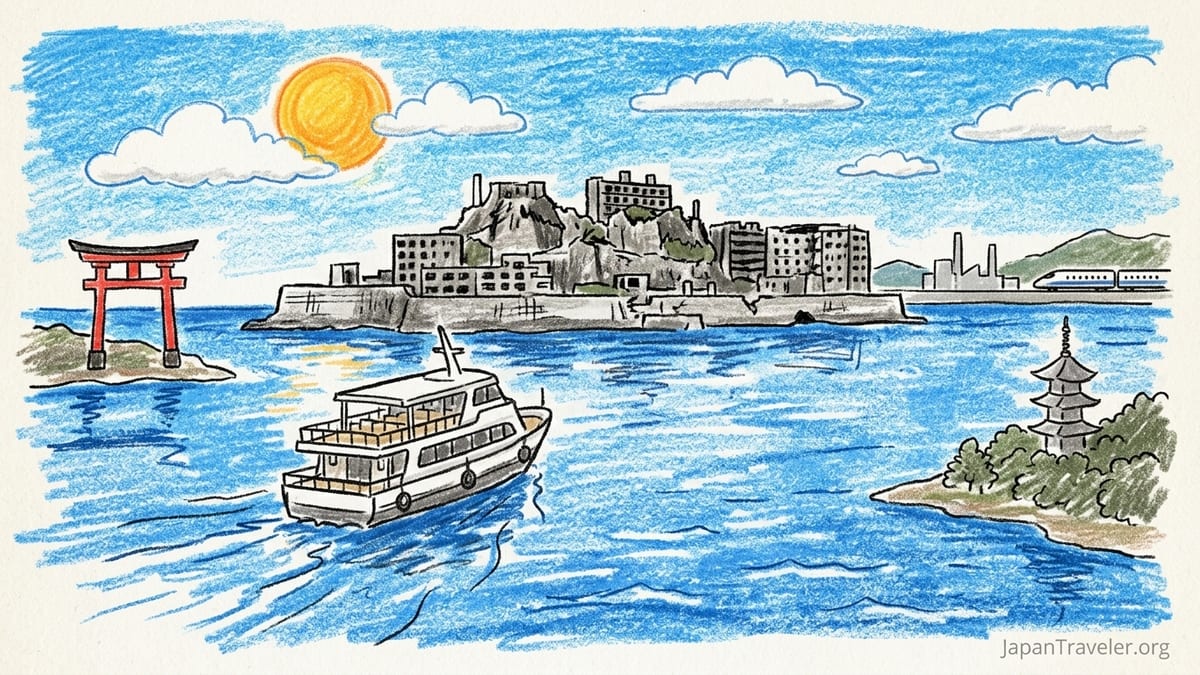
Gunkanjima’s silhouette emerged gradually, first as a dark line on the horizon and then as a mass of stacked concrete blocks. Seen from the sea, the nickname “Battleship Island” makes sense: the seawall forms a low hull, while the dense apartment blocks rise like turrets and superstructure. This was the moment when cameras came out in force. The crew allowed passengers to move from side to side, but the railings filled quickly, especially around the bow.
Photography from the sea yielded some of the most atmospheric images of the day. Long telephoto shots captured the cracked windows, roofless halls and exposed stairwells. Wide frames showed the entire “ship” profile against the water. The boat sailed around the island slowly, pausing several times so that each side of the deck could enjoy clear views. The commentary explained that coal was discovered here in the early 19th century and that Mitsubishi officially purchased Hashima in the 1890s, transforming it into a concrete mining city with schools, a hospital, shops and multi-story apartments.
Even before landing, the crew emphasized an important restriction. None of the ruined apartment buildings are accessible. Visitors can only walk along designated concrete paths behind safety barriers. Looking through the lens, it was already clear that the iconic “urban exploration” images often associated with Hashima do not reflect the reality of a tightly controlled heritage site.
History on the Pier: Coal, Crowded Lives and Coercive Labor
After circling the island, the captain received radio confirmation that sea conditions at the pier were within safety limits. The boat edged carefully into position, crew members secured lines and passengers disembarked in small groups. A heavy concrete seawall towered above the narrow landing, and the sense of entering a sealed world was immediate.
On the island, visitors assemble behind a guide and follow a prescribed route of three main observation points along the southern edge of Hashima. At the first stop, the guide described the early years of the mine, when workers descended deep under the sea floor along shafts that extended out beneath the surrounding waters. Mine galleries once stretched for several kilometers, and the coal extracted here helped power factories, ships and homes across Japan during the late 19th and early 20th centuries.
The guide also addressed population and daily life. At its peak in the 1950s and 1960s, more than 5,000 people lived on this tiny rock of roughly 6 hectares. That made Hashima one of the most densely populated places on earth at the time. Families lived stacked in reinforced-concrete apartment blocks that rose up from the seawall. There were schools, bathhouses, a cinema, small shops and rooftop playgrounds. The concrete landscape that now appears desolate was once packed with children, workers and domestic routines.
Critically, the guide did not romanticize the island’s prosperity. During Japan’s imperial expansion, especially in the 1930s and during World War II, coal mines including Hashima used forced and coercive labor. Korean and Chinese laborers, and some prisoners, were brought under conditions that were far from voluntary, facing harsh work underground and strict discipline. The commentary acknowledged this difficult history, noting survivor testimonies about long hours, dangerous conditions and limited freedom of movement. The narrative presented the island not only as a symbol of technological progress, but also as a reminder of the human cost embedded in that progress.
Controlled Routes on the Island: What You Actually See on Foot
From the landing pier, the visitor path follows a series of concrete walkways built specifically for tourism. Metal railings and fences line both sides to keep guests at a safe distance from unstable structures. Guides lead each group in sequence, and there is no opportunity to wander off alone or backtrack. In total, my time actually walking on the island amounted to roughly 30 to 40 minutes.
At the first viewpoint, you look back toward the south side of the island, where some of the oldest buildings and mine-related facilities stand closest to the sea. The second viewpoint opens a vista of the famous apartment blocks, including one of Japan’s earliest reinforced-concrete high-rises. Vegetation now grows through cracked walls and stairwells, and rusted steel frames stand exposed. There are no interiors to explore. Every door and window that once led into family homes is either collapsed or far beyond the permitted line.
The final viewpoint looks toward the northern side of the island, where the school and some community buildings once stood. From this angle, you can see collapsed roofs, partial walls and a jumble of girders. The guide pointed out where the small shrine once stood and where rooftop spaces served as playgrounds. Photographically, the perspectives are strong. You can capture the density and decay of Hashima with a wide lens, frame detailed telephoto shots of staircases and balconies, and shoot the contrast between the intact visitor walkway and the crumbling city beyond.
What you cannot do is enter any of the buildings, climb stairs, or linger too long in one spot once the group moves on. For safety reasons this is entirely understandable. Typhoons, salt spray and decades of neglect have left many structures dangerously unstable. Still, travelers expecting a free-form urban exploration experience will be disappointed. This is a carefully choreographed heritage visit where the route, timing and viewpoints are fixed.
Weather, Non-Landing Policies and Time-of-Day Differences
Weather is the single biggest wild card when assessing whether Gunkanjima is worth the cost. On my morning departure, seas were moderate and visibility good, allowing for a safe landing. The experience would have been very different under stronger winds or swell. Crew members described how even when the skies above Nagasaki are blue, waves at the exposed island pier can make disembarkation impossible. In those cases, the captain and island staff decide to skip landing, and the boat spends additional time circling the island as a cruise-only tour.
Passengers are reminded of this policy at check-in and again on board. If landing is canceled, the fare is partially adjusted to the lower cruise-only price category, but travelers do not receive a full refund, nor can they extend the trip to a future day without rebooking. For visitors who have come specifically for the experience of standing on Hashima’s concrete, this can be a serious disappointment, especially if they have no remaining days in Nagasaki.
Comparing morning and afternoon departures, I experienced only the morning sailing, but discussed timing with staff. Morning cruises often benefit from calmer winds and more stable sea conditions, especially in warmer months, which can slightly improve landing odds. Afternoon light can be warmer for photography, but summer humidity may build haze over the sea. Because conditions can change fast, no departure time guarantees a landing, but if you are planning your itinerary around the highest likelihood of success, a morning tour with a spare afternoon the next day offers a practical buffer.
My conclusion after talking to crew and fellow passengers who had rebooked is straightforward. If you would be devastated by a non-landing day, avoid scheduling Gunkanjima as your last fixed activity in Nagasaki and consider staying at least two nights. Keep your following morning or afternoon free enough that you could try again if the first attempt becomes a cruise-only trip.
The Gunkanjima Digital Museum and Overall Cost for Couples and Families
Back in Nagasaki, the Gunkanjima Digital Museum provided valuable context, especially for areas of the island not visible from the tourist path. My excursion included admission bundled with the cruise ticket, and I visited in the same afternoon. Inside, interactive exhibits, large-scale photographs, models and reconstructed interiors showed how apartments were arranged, what school classrooms looked like and how mine workers descended underground. Short films combined archival footage with testimony from former residents.
For travelers who experience only a cruise-only day with no landing, this museum becomes almost essential. It offers a rare chance to “enter” the interiors virtually and to understand daily life beyond the ruins. Even for those who do land, it fills the gaps left by the restricted route. In practical terms, adding the museum ticket increased the cost of the day but also substantially increased the depth of understanding.
When you factor in real costs, a couple purchasing standard seats plus museum access, tram fares to and from the port, and perhaps a simple lunch or coffee near the terminal will spend the equivalent of a mid-range dinner for two in a major Japanese city. For a family of four, the outlay can approach the cost of a full-day private tour elsewhere in Kyushu. That makes Gunkanjima one of the more expensive half-day excursions out of Nagasaki, especially given that the on-island portion is tightly limited in both space and time.
Despite the price, the museum component softened the risk of weather-related disappointment. If waves had prevented landing, I would still have felt that I gained significant insight into Hashima’s history through the combination of close-up coastal views from the boat and detailed exhibits ashore.
Value for Money: Expectations vs Reality and Premium Seating Verdict
Going in, I expected a dramatic landing on an empty concrete battleship, with time to wander among skeletal apartment blocks. The promotional images and many social media posts lean into this mood of solitary exploration. In reality, the experience is more controlled, more educational and more crowded, with plenty of safety railings, timed movement and structured commentary. It is not an abandoned island adventure. It is a supervised industrial-heritage visit.
The boat trip delivered more than I anticipated. The approach and slow circumnavigation of Gunkanjima were visually powerful. The combination of wind, sea spray, rusted rebar and looming concrete created an atmosphere that photographs only partly capture. The onboard commentary, especially when augmented with the audio guide, provided clear historical framing, including the difficult chapter of coercive labor.
What I actually saw ashore was narrower than my imagination had drawn. The designated route is short, with only three main viewpoints. I never stepped inside a building, never walked the inner alleys, and never climbed stairs to rooftop playgrounds. While the guide’s explanations were thorough, the sensation was closer to walking along the edge of a closed archaeological site than exploring a ghost city. My main disappointment was this gap between the visual promise of the skyline and the relatively small section accessible on foot.
As for premium seating, I concluded that it was not necessary for travelers who are comfortable standing on the open deck for much of the journey. Standard seating was adequate as a base camp for bags and a short rest. The best views and photographs came from the upper deck, open to all. Premium might be worthwhile for those who strongly prefer a guaranteed good window seat inside or who have mobility issues that make frequent trips to the upper deck difficult, but for most visitors the money might be better spent on the museum or on other Nagasaki experiences.
The Takeaway: Who Should Go, Who Should Skip and Would I Book Again?
Looking back, would I book Gunkanjima again? Yes, but with a different mindset and a few conditions. I would still choose a morning departure to slightly improve the odds of landing, and I would again bundle the Digital Museum to deepen the experience and hedge against weather. I would not pay extra for premium seating unless traveling with older relatives who might need a guaranteed comfortable view from inside the cabin.
For industrial-history enthusiasts, Gunkanjima is a rare and powerful site. The combination of ruins, detailed commentary and museum context makes it one of Japan’s most striking examples of rapid industrialization and its human cost. The uncomfortable chapter of coercive labor is addressed more directly than in many other industrial-heritage settings, and that honesty adds weight to the visit.
Photographers will find the approach and sea circumnavigation the richest moments. Bring a zoom lens for compressed shots of balconies and stairwells, plus a wide lens for the full “battleship” profile. Accept that you will shoot from a distance on both boat and island, and that you will not be composing moody interior frames from inside abandoned apartments.
Families should weigh the cost against children’s interests and attention spans. The boat ride is relatively short and the island walk is not physically demanding, but younger children may find the historical content heavy and the strict walking route repetitive. For cruise passengers on tight port calls, the key question is your tolerance for risk. If your only possible slot is a single morning and you would feel deeply disappointed by a cruise-only day with no landing, your money might be better spent on Nagasaki’s Peace Park, Dejima or a more flexible city tour. Gunkanjima rewards those who understand its limits in advance and approach it as an insightful, controlled window into Japan’s industrial and wartime past, rather than as a free-roaming ruin.
FAQ
Q1. Can I freely explore the abandoned buildings on Gunkanjima?
Visitors cannot enter any of the ruined apartment blocks or interior spaces. Movement is restricted to a fixed, guided route along reinforced concrete walkways behind safety railings.
Q2. How likely is it that my tour will actually land on Hashima Island?
Landing depends entirely on sea and wind conditions at the island’s pier. Even on sunny days, waves can be too strong for safe disembarkation, in which case the tour becomes a cruise-only trip.
Q3. Do I get a full refund if the boat cannot land?
No. Operators typically adjust your fare down to a “cruise only” price, but they do not offer a full refund once the boat has departed. Check the exact policy when booking.
Q4. Is premium seating worth the extra cost on Gunkanjima tours?
Premium seating offers better indoor views and more comfort, but the best photography and sightseeing occur on the open deck, which is available to all passengers.
Q5. How long do you actually spend on the island itself?
The time on Gunkanjima is usually around 30 to 40 minutes. The rest of the excursion is spent sailing to and from the island and circling it for views from the sea.
Q6. What is the Gunkanjima Digital Museum and is it worth adding?
The Digital Museum in Nagasaki uses exhibits, films and reconstructions to show life inside Hashima’s apartments and mines. It adds important depth, especially if weather prevents landing.
Q7. How much should couples and families budget for a Gunkanjima excursion?
A couple adding museum access can expect to spend the equivalent of a substantial mid-range meal for two. A family of four should budget in the mid-20,000 yen range for tickets and extras.
Q8. Is the history of forced labor addressed during the tour?
Yes. Guides and museum displays acknowledge the use of Korean and Chinese forced and coercive labor during Japan’s imperial expansion, presenting Gunkanjima as both an industrial and moral legacy.
Q9. Which departure time is better, morning or afternoon?
Morning departures may benefit from somewhat calmer seas, which can help landing chances. Afternoon light can be warmer for photography but does not guarantee better conditions.
Q10. Who is most likely to be disappointed by a Gunkanjima tour?
Travelers expecting free-roaming urban exploration or those who would feel very upset by a cruise-only day with no landing are most at risk of disappointment and should consider the weather risk carefully.