


On paper, the Ogasawara Islands sounded like the ultimate side trip from Tokyo: turquoise coves, wild dolphins, ancient forests and none of the crowds of Okinawa. Then I looked at the logistics. There are no flights, only a single 24-hour ferry that runs on a fixed six-day cycle, and fares that rival discount air tickets to Southeast Asia. I decided to commit anyway, complete the full Tokyo–Chichijima return by sea, and track every major cost and compromise to answer a simple question: are the Ogasawara Islands really worth this much time and money?
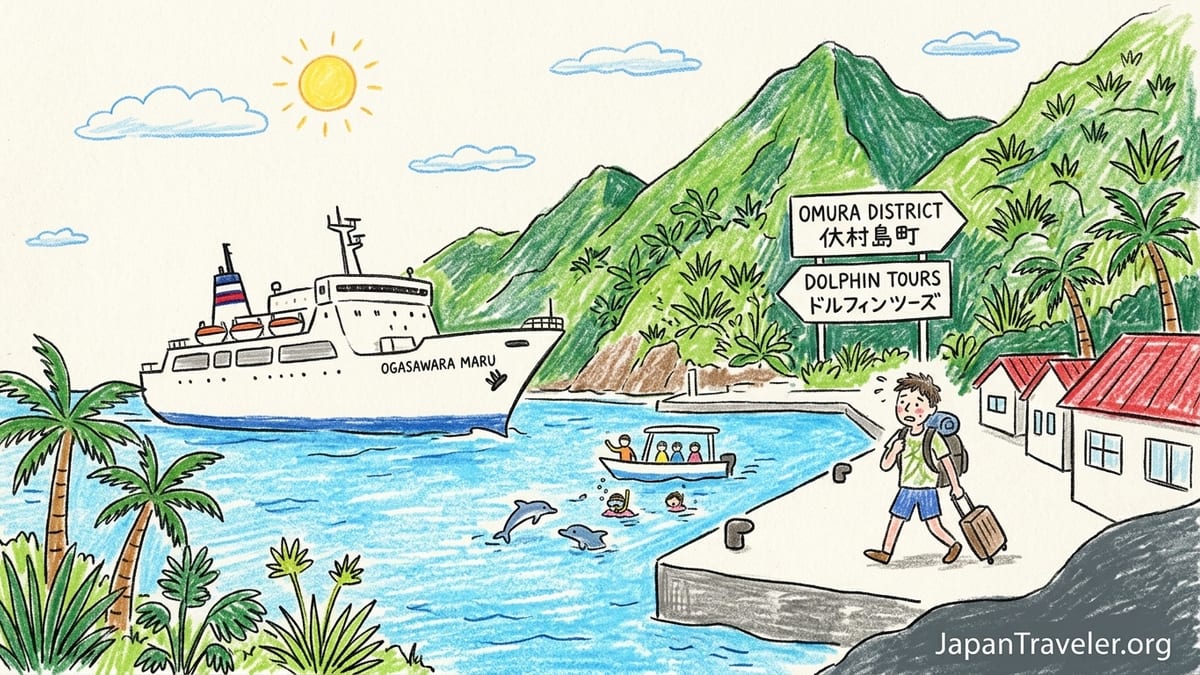
The Journey I Expected When I Booked the Ogasawara Maru
Planning started with the only operator that matters for Ogasawara: Ogasawara Kaiun, which runs the Ogasawara Maru liner between Tokyo’s Takeshiba Passenger Ship Terminal and Chichijima. According to official information, the ship covers roughly 1,000 kilometers in about 24 hours, usually departing Tokyo at 11:00 and arriving at Chichijima’s Futami Port at 11:00 the next day. It sails on a roughly six-day cycle, which effectively dictates the minimum length of any trip: one day out, four nights on the island, one day back.
Fares were the first real shock. In late 2026, published one-way adult fares from Tokyo to Chichijima in the cheaper categories range from around 35,000 to a little over 40,000 yen for an economy berth, with higher prices in peak seasons. Round trip in an economy berth typically lands around 70,000 to 85,000 yen per person before any seasonal surcharges or discounts. Private cabins, such as standard or deluxe classes, start significantly higher and can double those prices. These are ship-only costs before accommodation or tours.
Since I wanted to keep spending realistic for a value-oriented traveler, I chose an economy berth for both legs rather than a private cabin. This is the large, shared sleeping area on tatami-style or bunk-style spaces in gender-segregated rooms. I booked directly through the Ogasawara Kaiun reservation system, which opens sales several months in advance and becomes competitive for popular school holiday periods. There is also a package option that bundles round-trip economy berth and several nights in local accommodation, but I opted to arrange lodging and activities separately so I could track each expense.
Going in, I expected the ferry to feel like a long domestic overnight train: mildly inconvenient but manageable. I imagined a calm Pacific crossing, plenty of time for reading and photos from deck railings, a clean bunk for sleep, and basic cafeteria meals. The plan was to use the six-day cycle exactly as designed: depart Tokyo, spend four nights on Chichijima without extending to Hahajima, and return on the next scheduled sailing, all while documenting what the journey actually felt like and what it cost.
24 Hours Aboard: Choosing a Berth, Boarding and Life at Sea
On departure day I arrived at Takeshiba Passenger Ship Terminal about 90 minutes before the 11:00 sailing. The terminal is reachable from central Tokyo by Yurikamome or JR lines, but with a backpack and a small suitcase I chose a simple taxi from Tokyo Station, which cost just under 2,000 yen. Check-in and ticket collection are handled inside the terminal, and I exchanged my reservation confirmation for a printed boarding pass and cabin assignment in the economy berth section.
Boarding began roughly an hour before departure. Economy passengers file up the gangway with luggage, which is usually brought on board with you and stored near your sleeping area or in designated racks. Larger suitcases are manageable but not ideal, and I was glad I kept mine to carry-on size. Once inside the shared sleeping room, shoes come off at the entrance and each passenger finds their assigned sleeping space: a narrow mattress or bunk with simple bedding. There is no privacy beyond a small partition or curtain in some sections, so earplugs and an eye mask are essential for light sleepers.
Life during the 24 hours at sea revolves around the ship’s public areas. The Ogasawara Maru offers a self-service cafeteria with set meals, curry rice, noodles and basic side dishes, plus vending machines for drinks and snacks. Prices are higher than convenience stores but not outrageous: a simple meal might cost 800 to 1,200 yen, bottled drinks around 150 to 200 yen. Over the full day I spent roughly 3,000 yen on food and drinks, a bit more than I might have on land but still a fraction of the ferry fare itself.
For someone who dislikes long crossings, the physical experience is mixed. The Pacific off Tokyo can be calm in settled weather but swell builds once the ship leaves the shelter of the Izu Islands. On my outbound leg seas were moderate: enough roll to make walking a bit uneven, but not enough to close the deck. Several passengers wore motion-sickness patches or took over-the-counter medication. I felt mild queasiness for an hour or two and was glad I had snacks and water on hand. Showers, available in shared facilities, were clean and functional, but hot water is limited at peak times and the motion of the ship is very noticeable when standing.
Sea Conditions, Sleep, Connectivity and Who Will Struggle With the Crossing
Nightfall at sea comes with a different rhythm. After sunset, many passengers settle into their berths to read, watch videos or nap. The economy berth lights dim, but snoring and the rustle of people moving in and out of the room continue through the night. I managed about five fitful hours of sleep. The motion intensified slightly in the early morning hours as swells shifted, and each roll of the ship translated directly into a slow rocking of the mattresses. Those accustomed to sleeper trains or ferries will adapt, but travelers who are sensitive to motion or noise are unlikely to sleep well in the cheapest category.
Connectivity is another factor that surprises some visitors. For much of the 24-hour crossing, mobile signal is limited or disappears entirely. There may be intermittent reception when passing closer to islands, but anyone expecting to work online or stream content will be disappointed. I pre-downloaded reading material and offline maps, which turned out to be essential. The upside is that the lack of connection encourages time on deck. When visibility was good, we watched flying fish skitter across the surface and distant silhouettes of islands on the horizon.
Comfort-wise, public spaces on the Ogasawara Maru are more on the functional side than luxurious. There are lounges with basic seating, a small shop for snacks and souvenirs, and open deck areas where passengers gather for fresh air. The ship is clean and well maintained, but if you hate being confined for long periods, 24 hours each way will feel long, especially on the return when the novelty has worn off. For those travelers, upgrading to a smaller shared cabin or private room can make the time more bearable, but at a significant cost increase.
Disembarkation on Chichijima is straightforward. The ship glides into Futami Port around 11:00 and passengers line the decks for first views of the island’s green ridges and bright blue harbor. Announcements guide everyone down to the vehicle deck and gangways, and within about 20 minutes I was on the pier, sleep-deprived but excited. From there, most visitors walk directly to pre-arranged pickups from guesthouses or simply roll their luggage a short distance into the main Omura district.
Four Nights on Chichijima: Accommodation, Food and Everyday Costs
The standard six-day cycle left me with four nights on Chichijima before the same ferry returned to Tokyo. That meant roughly four full days on the island, plus a few extra morning and afternoon hours on arrival and departure days. I booked a small family-run guesthouse in the Omura area, within walking distance of the harbor and the main cluster of restaurants, dive shops and tour operators. Nightly rates for this style of minshuku or pension commonly fall in the 8,000 to 12,000 yen range per person with breakfast, sometimes including dinner in higher-priced plans. For this trip I paid about 9,500 yen per night with breakfast included, totaling approximately 38,000 yen for four nights.
Food on Chichijima is more limited and a bit pricier than in mainland Japanese cities but still offers good value considering the remoteness. The island has several simple restaurants serving fresh fish, island vegetables and dishes like ginger pork. I budgeted around 2,000 to 3,000 yen per meal at sit-down places, and supplemented with convenience-store style snacks and drinks from small local shops, where prices are slightly higher than in Tokyo. Over four nights, I spent close to 18,000 yen on lunches, dinners and snacks, not counting the breakfasts already included with lodging.
Basic logistics on the island are relatively straightforward. Chichijima is compact and many sights are reachable by rental scooter, bike or on organized tours. I opted for one day of rental car use shared with another traveler, which brought my share to about 4,000 yen including fuel. On other days I relied on walking and pickups included with guided activities. There is no rail or conventional bus network like on the mainland, so travelers who prefer independent exploration should factor in the cost of vehicle rental or taxi rides.
Everyday costs add up quietly. I visited the Ogasawara Visitor Center, beaches in the Omura and Sakaiura areas and a couple of short forest trails independently, which were free. I bought sunscreen and reef-friendly lotion at local shops, added a few hundred yen each day for drinks and ice creams in the heat, and spent a modest amount on small souvenirs. In total, incidental spending on the island probably added another 6,000 to 8,000 yen to the trip.
The Best and Worst of the Islands: Snorkeling, Hiking and a Marine Excursion
Where the Ogasawara Islands start to justify their difficult access is in the water and forest. I booked a full-day marine excursion with a licensed operator that combined dolphin watching, offshore snorkeling and beach time. These tours commonly cost around 13,000 to 16,000 yen per person, including snorkel gear and lunch. My tour was roughly in the middle of that range. The boat headed out into deep blue water where spinner dolphins often travel, and we were fortunate to encounter several pods that swam and leapt near the bow without any need for feeding or bait.
Later in the day we anchored near a reef area where visibility was excellent. Coral formations around Chichijima are not as extensive as some parts of Okinawa, but the combination of clear water, reef fish and steep underwater slopes created a striking seascape. We snorkeled for about an hour before shifting to a quiet cove for lunch. The guide also pointed out seabirds and explained local rules on approaching wildlife. At every stage, it was clear that regulations tightly control how tour boats operate, especially in areas like Minamijima, a small protected island with a famous lagoon and karst landscape that can only be visited with authorized tours and often with limited landing numbers.
On land, I spent one day hiking short forest trails leading to viewpoints over the island. These routes cut through subtropical vegetation and remnants of wartime infrastructure. Trails around spots like Asahidaira and Ogamiyama Park offer elevated views of the harbor and surrounding sea, and can be reached by road plus a modest uphill walk. Another half-day went to exploring beaches reachable by road, including calm bays that are ideal for casual swimming and beginner snorkeling from shore. None of these activities required additional paid entry fees, just the cost of transportation to reach trailheads and beaches.
The disappointment, for me, lay not in the quality of any single activity but in how compressed everything felt within four nights. Between the travel fatigue of the outbound ferry and the need to keep an eye on weather and return schedules, it was hard to relax fully. I chose not to add an overnight side trip to Hahajima by the smaller Hahajima Maru ferry, which would have added another layer of scheduling and cost. That decision likely meant missing some of the quietest landscapes in the island group, but for a six-day cycle it felt unrealistic.
What Disappointed Me: Cost, Weather Risk and the One-Boat Problem
The biggest structural issue with an Ogasawara trip is the lack of alternatives if anything goes wrong. Official information makes it clear that the Ogasawara Maru is the only public transport between Tokyo and Chichijima, and even it can be delayed or canceled if seas are rough or a typhoon approaches. If the return sailing is postponed, there is no backup flight or additional ship you can switch to. You simply wait on the island, potentially for days, paying for extra accommodation and food while perhaps missing nonrefundable reservations back in Tokyo or abroad.
Because of this, scheduling an international flight immediately after your planned return to Tokyo is a significant risk. Even in relatively stable weather seasons, crossings can be lengthened or rescheduled. The prudent approach is to build at least one, and preferably two, buffer days between your scheduled Tokyo arrival and any long-haul departure. In practical terms, that might mean returning on a Wednesday and booking your flight home for Friday or later, accepting the extra cost of one or two nights in Tokyo as a kind of insurance premium.
Value is the other sticking point. When I added up the cost of the ferry, accommodation, food and activities, the total outlay rivaled or exceeded what many travelers would spend on a week in Okinawa with flights, or even a budget trip to a neighboring country. While the Ogasawara Islands deliver a rare combination of isolation and nature, they do not necessarily offer more comfort or dramatically better wildlife experiences than more accessible Japanese islands. For travelers with a strict budget, this can feel like a questionable investment.
Finally, expectations around wildlife need careful management. Dolphins are frequently seen on marine excursions, but whale sightings depend heavily on season and luck, and landings on protected areas such as Minamijima are strictly controlled and sometimes unavailable due to conditions or conservation limits. No operator can honestly guarantee close encounters or access to specific lagoons or beaches. On my trip, our boat could approach Minamijima and view its lagoon from offshore, but a full landing was not possible on our date. That reality may disappoint travelers who have built their hopes around iconic photographs.
The Best Excursion and Whether Hahajima or Private Tours Are Worth It
Of everything I did, the full-day marine excursion that combined dolphin observation and snorkeling offered the clearest sense of value for money. At around 15,000 yen including lunch, it provided an entire day on the water, multiple wildlife encounters and access to offshore reefs that are impossible to reach otherwise. Guides balanced conservation messaging with practical help in the water, and group sizes were small enough to feel personal without being exclusive. If you do only one paid activity on Chichijima, I would recommend this type of tour over shorter, cheaper outings.
By contrast, the extra cost of extending to Hahajima needs closer scrutiny. Access between Chichijima and Hahajima is handled by the smaller Hahajima Maru, which has its own schedule and fares. A round-trip ticket and at least one night of additional accommodation can quickly add 20,000 yen or more per person to a six-day itinerary, not counting any guided activities you might book there. For travelers who prioritize quiet hikes and remote scenery above all else, that premium may be justified. For value-focused visitors already stretching their budget, it is a luxury rather than a necessity.
Private or small-group charters for diving, photography or custom itineraries push costs even higher. Specialized diving days can reach several tens of thousands of yen per person once equipment rental and multiple boat dives are included. Wildlife photographers may consider this worthwhile in order to control timing and locations, but casual snorkelers and general nature lovers will usually find scheduled group tours sufficient.
Overall, my impression was that the islands reward depth rather than breadth. Given the ferry cost, adding more paid excursions does improve the “value density” of your days, but each extra commitment also ties you more tightly to weather and schedule constraints. Balancing one or two substantial guided outings with free exploration on foot or by rental vehicle felt like the right mix for both budget and energy levels.
What the Six-Day Ogasawara Trip Really Cost Me
To give a transparent picture, here is a simplified breakdown of my major expenses as a solo traveler in yen, rounded to the nearest thousand where appropriate. Round-trip economy berth on the Ogasawara Maru cost approximately 78,000 yen. Four nights in a midrange guesthouse with breakfast totaled about 38,000 yen. Food and drinks on the islands and ferries, outside included breakfasts, came to roughly 21,000 yen across six days. One full-day marine excursion with dolphin watching and snorkeling added about 15,000 yen. Local transport, including my share of a rental car and occasional taxis, was around 6,000 yen. Miscellaneous shopping and small extras such as sunscreen and souvenirs accounted for another 6,000 to 7,000 yen.
Added together, the solo total landed near 164,000 to 167,000 yen for six days, not counting any accommodation in Tokyo before or after the ferry. If you add two buffer nights in Tokyo at a modest business hotel before and after the trip, you could easily add 20,000 to 30,000 yen more, pushing the grand total toward or above 190,000 yen.
For a couple sharing the experience, some costs halve while others double. Each person would still pay the full ferry fare, so two round-trip economy tickets would be around 156,000 yen combined. A double room in a similar guesthouse might cost around 16,000 to 20,000 yen per night for two, depending on meal plan, translating to roughly 64,000 to 80,000 yen for four nights. Food spending might sit around 40,000 yen between two people, and joining the same full-day marine excursion would likely cost about 30,000 yen in total. Local transport and incidentals might reach 20,000 yen shared.
That puts a realistic six-day total for a couple in the ballpark of 310,000 to 330,000 yen before any Tokyo hotels. The table below summarizes these approximate figures, based on my actual spending and current published fares and price ranges:
Solo traveler (yen): ferry 78,000; four nights lodging with breakfast 38,000; food and drinks 21,000; marine excursion 15,000; local transport 6,000; extras 7,000; approximate total 165,000. Couple (yen): ferry 156,000; four nights double lodging with breakfast 72,000; food and drinks 40,000; marine excursion 30,000; local transport 20,000; extras 12,000; approximate total 330,000.
The Takeaway: Would I Go Again, and Who Is It Really For?
If I lived in Japan or visited frequently, I would consider returning to Ogasawara with a different strategy: perhaps staying longer than one ferry cycle, adding Hahajima, and choosing a quieter season when seas and schedules are historically more stable. As a once-in-a-lifetime detour for an international visitor on a tight itinerary, I am more cautious. The combination of high ferry costs, rigid schedules and the risk of delay means you pay not only in yen but in flexibility and peace of mind.
For families, Ogasawara can be rewarding if children are reasonably good sailors and comfortable with shared sleeping arrangements. The long ferry ride, lack of instant connectivity and simple island infrastructure can be challenging for younger kids used to constant stimulation. Families would benefit from booking higher-grade cabins for more privacy and budgeting extra time in Tokyo around the sailing dates, which raises costs considerably.
Honeymooners who dream of an uncrowded, nature-focused escape may find Chichijima appealing, especially if they upgrade to a private cabin on the ferry and a nicer guesthouse or small hotel on the island. However, they should be comfortable with low-key nightlife, simple dining and the possibility that rough seas or rain might disrupt plans. For couples expecting polished resort amenities and guaranteed romantic sunsets each evening, Okinawa or other islands might provide better value and reliability.
Divers and serious wildlife photographers are the groups for whom Ogasawara most clearly makes sense. The combination of offshore visibility, pelagic species, dolphin encounters and controlled access to special sites offers experiences that are hard to replicate elsewhere in Japan. These travelers are also often more accepting of weather-related uncertainty and higher per-day costs, because their primary goal is specific underwater or wildlife encounters, not a general beach holiday.
For travelers whose entire Japan trip is under two weeks, the calculus changes. Dedicating six days and a substantial portion of your budget to Ogasawara means sacrificing time in places like Kyoto, Hiroshima, alpine regions or other islands that are far easier and cheaper to reach. In that scenario, unless you have a very strong, specific interest in Ogasawara’s ecosystems or history, I would not recommend prioritizing it on a first visit. The islands reward those who can travel slowly, accept uncertainty and are prepared to invest both money and time in a single, remote destination.
FAQ
Q1. How long is the ferry from Tokyo to the Ogasawara Islands?
The Ogasawara Maru liner takes about 24 hours each way between Tokyo’s Takeshiba Passenger Ship Terminal and Chichijima’s Futami Port, not including any delays caused by weather.
Q2. How many days do I actually spend on the islands on a standard trip?
On the regular six-day schedule you spend one day sailing out, four nights on Chichijima, and one day sailing back, leaving you with roughly four full days on the island.
Q3. How much does the ferry cost for one person?
Recent published fares for a one-way adult economy berth are generally in the mid-thirty-thousand to low forty-thousand yen range, meaning a typical round trip costs around 70,000 to 85,000 yen before any seasonal adjustments.
Q4. Is it necessary to book far in advance?
Yes. Because there is only one ship on a fixed schedule and cabin categories are limited, it is wise to reserve as soon as bookings open, especially for Japanese holiday periods such as Golden Week or summer vacation.
Q5. Will I get seasick on the Ogasawara Maru?
Sea conditions vary, but the ship passes into open Pacific waters where swells can cause noticeable motion. Many passengers use motion-sickness medication, and those who are very sensitive may find the 24-hour crossing challenging.
Q6. Can I rely on mobile internet during the crossing?
No. Mobile reception is patchy and often absent for long stretches of the voyage. You should download any entertainment or work materials in advance and treat the crossing as mostly offline time.
Q7. Do I need to join a tour to see dolphins or visit Minamijima?
Yes. Dolphin-watching, offshore snorkeling and any approach to protected areas such as Minamijima are handled by licensed marine tour operators. Independent access is either restricted or impractical.
Q8. Is it safe to schedule an international flight right after returning to Tokyo?
It is not recommended. The ferry can be delayed or rescheduled due to weather, and with no alternative transport you risk missing your flight. Allow at least one full buffer day in Tokyo after your planned return.
Q9. Is Ogasawara a good choice for a first trip to Japan under two weeks?
Usually not. A standard Ogasawara trip consumes six days and a significant budget. Most first-time visitors on short trips will get better overall value by focusing on more accessible destinations like Tokyo, Kyoto and one or two other regions.
Q10. Who will get the most out of visiting the Ogasawara Islands?
The destination best suits divers, dedicated wildlife enthusiasts, photographers and repeat visitors to Japan who can accept high costs, rigid schedules and the risk of weather disruptions in exchange for remote nature and quiet island time.