


When Sado Island’s gold mines finally made it onto the UNESCO World Heritage List in 2024, I pictured a solemn, almost cinematic descent into history: rough hand-dug tunnels, dim lantern light, and powerful stories about the people who worked here. On a recent trip to Niigata Prefecture, I set aside a full day to test whether the Historic Site Sado Gold Mine actually lives up to that UNESCO label, focusing on the regular underground courses most travelers book, the practical costs of getting there, and the difference between World Heritage expectations and the reality of a structured visitor attraction.
UNESCO Status Versus Visitor Reality
The first thing to understand before you buy a ticket is that “Sado Island Gold Mines” on the UNESCO World Heritage List is not the same thing as a single ticketed attraction. UNESCO inscribed a wider cultural landscape in 2024, centered on Edo period mining methods at the Nishimikawa Placer Gold Mine and the Aikawa Tsurushi Gold and Silver Mine, recognized for their unmechanized seventeenth to nineteenth century technology and townscape. The Outstanding Universal Value focuses on the way Sado’s mines shaped early modern Japan, not only on the specific tunnels most visitors walk today.
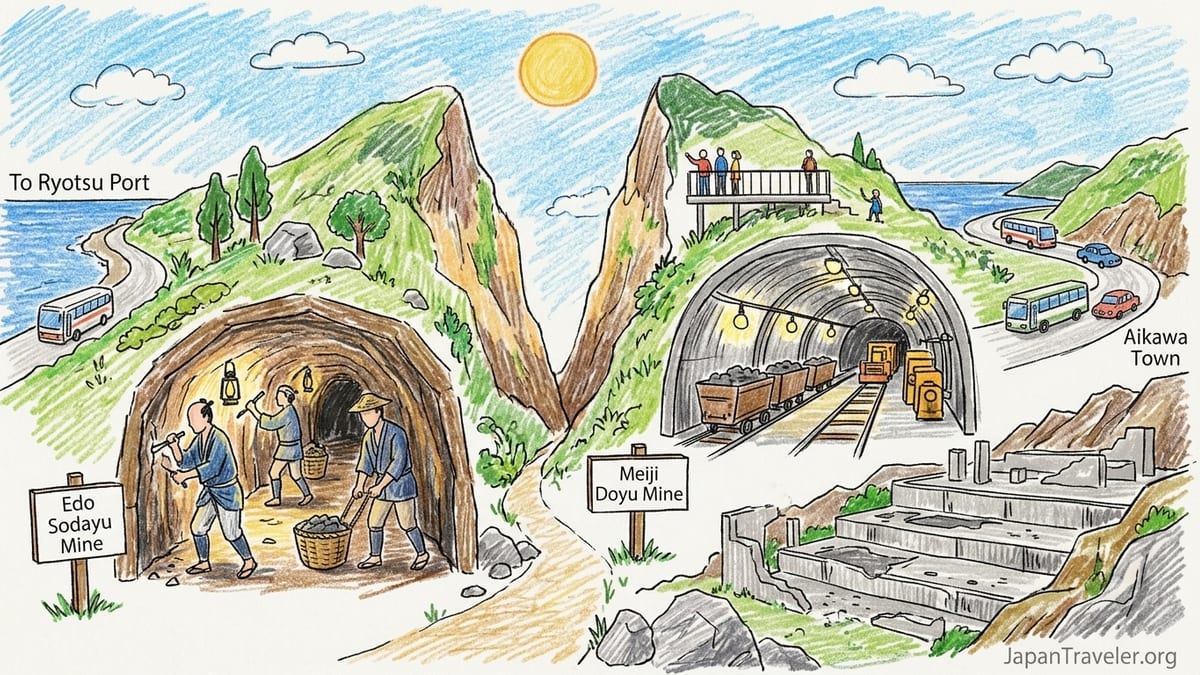
By contrast, the paid Historic Site Sado Gold Mine facility in Aikawa presents a curated slice of that history: two main underground routes, the Sodayu (often spelled Sotayu or Soutayu) hand-dug Edo period pit and the later Doyu Mine associated with Meiji and twentieth century mechanization. The UNESCO inscription highlights pre-industrial mining methods and their broader landscape, while the visitor site inevitably compresses centuries of work into an hour underground and a small museum. Going in with this distinction in mind helps manage expectations, especially if you are imagining a wild, natural cave system.
UNESCO status also shapes expectations about interpretation. The World Heritage Committee has already asked Japan to enhance historical explanations at the site, particularly around different periods of operation and sensitive topics such as labor. On the ground, that translates into multilingual panels, some video content and a carefully controlled route, but not yet the deep narrative you might expect from a flagship World Heritage site. The attraction still feels more like a traditional industrial-heritage visit than a fully reimagined UNESCO interpretive center.
All of this matters at the ticket counter. When you pay for the Sodayu or Doyu course, you are buying access to specific restored or stabilized tunnels and a museum, not a comprehensive World Heritage experience. The wider landscape, including Aikawa town, Kitazawa Flotation Plant and Kirarium Sado, contributes to the UNESCO story but comes with its own logistics and, in some cases, separate costs.
Getting There: From Ryotsu Port to the Mine
Most visitors arrive on Sado by ferry from Niigata to Ryotsu Port. From there, the Sado Gold Mine complex in Aikawa is roughly 25 to 30 kilometers away along the island’s western side. Driving by rental car from Ryotsu takes about 45 to 50 minutes on regular roads, matching official estimates that put the journey from Ryotsu to the Aikawa mining area at around 50 minutes by car. This is the simplest option if you are comfortable driving in Japan and want flexibility to visit other historic sites the same day.
Car rental desks operate directly at Ryotsu Port, including the local ferry company’s branded counter. Day rentals for a compact car on Sado tend to start in the ballpark of 8,000 to 10,000 yen for 24 hours, before fuel. Add roughly 1,000 to 1,500 yen in gasoline for a loop that covers Ryotsu, Sado Gold Mine, Kitazawa Flotation Plant and back. Parking at the mine site itself is free for passenger cars. If you are traveling as a couple or small group and want to visit multiple sites, the rental car cost spreads out reasonably well per person.
Travelers without a car can rely on the island’s buses. From Ryotsu Port to the Historic Site Sado Gold Mine takes about 70 minutes by route bus with at least one transfer, which matches official tourism information. Fares vary slightly by route, but you can expect to pay around 1,500 to 2,000 yen one way per adult in accumulated stage fares. Schedules outside peak seasons can be infrequent, so it is important to download current timetables or pick them up at the tourist information center in the port building.
Taxis exist but quickly become the most expensive option. Locals estimate that a one-way taxi ride from Ryotsu to the Aikawa gold mine can easily land in the 9,000 to 11,000 yen range, depending on traffic and exact drop-off. That may make sense if you are sharing costs among four people and returning by bus, but for solo travelers it is a significant premium over a rental car. For those who prefer a private car but not to drive, some companies and hotels can arrange charter taxis for a set number of hours, but you need to book in advance and budget carefully.
Arriving at Sado Gold Mine: Tickets, Waiting and What Is Open
The Historic Site Sado Gold Mine ticket office sits above the tunnel entrances, with parking stretching along the slope. On my visit in early autumn, I arrived mid-morning around 10:00 after driving from a hotel near Ryotsu. Even with the UNESCO buzz, there were only a handful of cars and one small tour bus, and I waited less than five minutes to buy a ticket. Staff told me that on peak summer weekends and during the Obon holidays, ticket lines can stretch to 20 to 30 minutes, mostly for large groups.
As of the latest published prices, adult admission for a single underground course (either Sodayu or Doyu) is listed at 1,000 yen, with a combined ticket that allows you to visit both routes for 1,800 yen. The official price chart notes that if you first do one course, you can add the other for an extra 500 yen by showing your original ticket on the same day. Children and students receive discounted rates, and entrance to the small attached museum is included with either ticket. Prices have been stable recently but are always subject to change, so consider these as approximate figures and confirm at the time of travel.
On the day of my visit, both the Sodayu Edo period pit and the Doyu modern mine course were operating. Staff mentioned that in periods of heavy rain or icy winter conditions, short sections of tunnel can temporarily close for safety, but full closure of an entire course is rare. There was no timed-entry system; visitors simply walked into their chosen tunnel within opening hours, which kept waiting times minimal even as more cars arrived before noon.
For travelers debating between the two, the main difference lies in atmosphere and storytelling. The Sodayu course is shorter and more focused on hand-dug Edo period passages, while the Doyu route is longer, involves more stairs and leads directly beneath the dramatic V-shaped split in the mountain known as Doyu no Warito. If you have the time and budget, the combined ticket is the best way to understand how Sado’s mines evolved from hand tools to mechanized extraction.
Inside Sodayu: Recreated Edo Period Mining Scenes
The Sodayu pit is marketed as the “Edo Gold Mine Picture Scroll Course,” referencing a seventeenth-century illustrated scroll that recorded mining activities. This hand-dug tunnel system has been stabilized and fitted with low metal walkways and railings. Over about 30 to 40 minutes at a gentle pace, you follow a one-way route that uses around seventy life-sized mannequins to recreate different stages of early mining. These include miners chiseling rock by lantern light, supervisors tallying output and workers hauling ore in woven baskets.
Conditions in the Sodayu tunnel feel authentic in some respects and clearly curated in others. The air is cool, in the 10 to 12 degrees Celsius range even in summer, with a damp smell and occasional drips from the rock ceiling. Lighting is quite low but safe, mainly warm-toned bulbs tucked into rock niches and spotlighting mannequins. There are no wild cavernous spaces; the walls are close, the ceiling often just above head height, and the floor has been leveled for visitors. Sensitive travelers should know that some stretches feel narrow and enclosed, but the path is wide enough for two people to pass.
Historically inspired equipment, such as wooden ladders, simple hand tools, baskets and timber supports, has been installed beside the mannequins. Signage panels in Japanese and English explain the role of each scene and often reference actual practices recorded from the Edo period. The narrative focuses largely on techniques and output, with only brief references to the social organization and hardships of mining life. Audio elements are modest: the sound of dripping water, occasional tool impacts and a sparse soundtrack in some sections.
As a visitor, you are free to progress at your own pace, and many people stop to photograph mannequins in the atmospheric lighting. The route felt safe underfoot, with anti-slip surfaces, though some short sections of the ceiling are low enough that taller visitors will instinctively duck. This is not a physically demanding course for most travelers, but families with very young children or people with severe claustrophobia might find the enclosed spaces challenging. Overall, Sodayu delivers on its promise as a carefully curated window into Edo period hand-mining, though it feels more like a preserved industrial corridor than a raw cave.
Doyu Mine and Doyu no Warito: Mechanized History in the Mountain
The Doyu course begins closer to the twentieth-century surface facilities and descends via staircases into wider, more engineered tunnels. This route is often labeled the “Meiji Government Mine” or modern Doyu Mine course, reflecting the period when Sado became a model mine with mechanized extraction, electric lighting and large-scale ore processing. Official guidance suggests 40 to 60 minutes to complete the loop, and that matched my own experience when stopping frequently for photos and signage.
Immediately, conditions feel different from Sodayu. The main drift is higher and broader, with concrete supports and side niches where compressors, rails and ore carts once stood. Lighting is brighter and cooler in tone, with long fluorescent strips in some stretches. Interpretation focuses on machinery and production capacity: diagrams explaining ventilation, cross-sections of shafts and displays of actual drilling equipment and rails. There are fewer mannequins and more original hardware, which will appeal to industrial-history enthusiasts.
The highlight of the Doyu route for most visitors is the moment when you emerge at a viewpoint beneath Doyu no Warito, the mountain split. Centuries of open-pit mining and erosion have carved a sharp V-shaped cleft in the peak, and from the viewpoint platform you look directly up through the gap to the sky. The scene is both stark and beautiful, with raw rock faces, streaks of mineral color and mossy patches that soften the scars. It is the closest the attraction comes to the kind of “wow” natural-rock vista that some travelers imagine when they hear “gold mine.”
Physically, the Doyu course includes more staircases and inclines than Sodayu. Surfaces can be damp and slightly slippery, especially near drainage channels, and temperatures again stay in the cool low-teens Celsius. Some ceilings dip lower between reinforced arches. People with knee issues or balance concerns should take the handrails seriously, and families with excitable children will want to keep a close eye near steeper sections. Still, for most reasonably fit visitors in flat shoes, the route is manageable and does not require special equipment beyond a jacket.
Premium Tunnel Experiences and Safety Considerations
Beyond the standard Sodayu and Doyu courses, the site has periodically offered premium or special experiences in limited sections of tunnel. One currently promoted option is a mixed-reality “Island Mirage” experience using MR glasses inside the Doyu mine. These sessions typically carry an additional fee on top of the base Doyu ticket and operate in specific time slots, with participant numbers capped. Equipment includes the MR headset and occasionally a helmet when walking near lower ceilings. Staff check that visitors can walk comfortably and follow instructions before joining.
Special guided excursions into less-modified tunnels, when available, tend to come with stricter restrictions. Closed shoes are mandatory, and helmets and sometimes light rain jackets are provided. The footing in these less-developed sections can be significantly more slippery, with rough rock, standing water and steeper gradients. On some routes, guides warn of very low ceilings that require you to crouch or bend for short distances. These experiences are typically unsuitable for young children and may have age limits and health disclaimers.
Because these premium tours change seasonally and may be suspended during maintenance or adverse weather, you should treat any description as approximate and verify details close to your visit. The key point for planning is that the regular Sodayu and Doyu courses are designed to be accessible to a wide audience, while premium tunnels are more physical, closer to spelunking and require readiness for cold, damp and cramped conditions. If you envision a rugged adventure underground, you will only get that feeling on the special excursions, not on the basic ticket.
In weighing value, I found the regular combined Sodayu and Doyu ticket to deliver a coherent narrative without needing a premium add-on. The extra fee for mixed-reality glasses or deeper excursions will appeal mainly to repeat visitors or those particularly interested in immersive tech or physically demanding routes. For first-timers, the premium options are a nice bonus if you have the budget and time, but not essential for understanding Sado’s mining story.
How Much History Do You Really Get Without a Guide?
A constant question in any industrial heritage site is whether the self-guided panels provide enough depth. On Sado, the underground courses rely heavily on static signs and occasional video screens. The English translations are generally clear and cover basic facts: tunnel dates, methods of ore extraction, numbers of workers and rough timelines. They mention that Sado’s mines evolved from early hand-mining to mechanized operations that once processed astonishing volumes of ore. However, the narrative rarely lingers on social history, labor conditions or the more contested aspects of the twentieth century.
Guided tours in English are limited and often need to be arranged through tour operators or in Japanese with partial translation. A guide can dramatically change your experience by connecting the tunnels to broader themes: the role of Sado’s gold in Tokugawa finance, the development of modern Japanese mining, and the complex politics surrounding UNESCO recognition. On my self-guided visit, I often wished for more stories about individual miners or specific incidents that brought the machinery and mannequins to life.
This gap lines up with recent requests from international bodies that Japan enhance the historical explanations on-site to address the “whole history” of the mines, including uncomfortable topics. As of now, the regular visitor circuit feels informative but cautious. Families and casual travelers will probably feel they learned “enough” about how a gold mine works, but history enthusiasts may walk out with a list of questions to research later. If you place a high value on interpretive depth, you might consider hiring a local guide in Aikawa or joining a small-group tour that builds commentary around the tunnels.
For many travelers, though, the self-guided approach has advantages. You can walk at your own pace, retreat quickly if the cold becomes unpleasant, and spend extra time at features that interest you, such as cross-section models or specific Edo period scenes. The key is to recognize that the basic ticket buys physical access and a baseline level of interpretation, not a fully narrated historical journey.
The Wider Mining Landscape: Aikawa, Kitazawa and Kirarium Sado
To bridge the gap between UNESCO-level expectations and the reality of a single attraction, it helps to see the Sado mines as a whole landscape. The town of Aikawa sprawls below the tunnels, with relics of administrative buildings, workers’ housing and narrow streets that retain an Edo and Meiji flavor if you know what to look for. Walking through Aikawa after your underground tour adds context: the mine never existed in isolation, and the town’s layout and remaining structures echo the long era when this was a national economic engine.
A short drive from the main mine entrance brings you to the Kitazawa Flotation Plant, a vast concrete ruin where ore was once processed using modern flotation techniques. This facility, with its tiered tanks and adjacent brick power plant, is recognized as a key monument to Sado’s modernization period and has been designated as a National Historic Site. Illuminations during certain seasons give the plant a striking, almost haunting beauty, making it a favorite subject for photographers. Importantly, Kitazawa is not included in the Sado Gold Mine tunnel ticket; access is separate, though the site is often open as a free or low-cost open-air ruin where you can stroll along paths and read interpretive panels.
Another piece of the puzzle is Kirarium Sado, a modern facility near Aikawa that functions as a visitor center and small museum focusing on the island’s mining heritage. Exhibits typically include models of the mine, historical documents and multimedia explaining how gold extraction shaped Sado’s economy and environment. Again, admission here is separate from the tunnel ticket, and opening hours and displays can change. Many visitors find that stopping at Kirarium either before or after the underground visit helps tie together what they have seen in Sodayu and Doyu with the broader UNESCO-recognized story.
When you add these sites together, the Sado Gold Mine experience starts to feel more like the layered heritage landscape UNESCO recognized. However, you need to plan transport time carefully. Linking the main mine, Kitazawa Flotation Plant, Kirarium Sado and Aikawa town in a single day is comfortable with a rental car and more challenging but still possible by bus if you start early and track departure times. The attractions complement one another but are not bundled, financially or logistically, which is easy to miss if you only glance at the term “Sado Island Gold Mines” in UNESCO materials.
Managing Expectations: Industrial Heritage, Not a Wild Cave
Potential disappointment around Sado Gold Mine often stems from a mismatch between expectations and reality. If you imagine a rugged adventure into a natural cave with stalactites and unlit chambers, you will not find that on the standard courses. The tunnels are entirely man-made, with smoothed floors, safety railings and electric lighting. The focus is squarely on industrial processes, not on geological drama beyond the striking Doyu no Warito split.
Visitors who thrive on industrial history usually react very positively. The chance to walk through hand-cut Edo period galleries, then contrast them with wider mechanized drifts and the vast ruins of Kitazawa, is unusual even within Japan’s many heritage sites. The heavy machinery, rusting rails and concrete terraces offer a distinctive, somewhat melancholic visual vocabulary that suits photographers who like textures, decay and repeating patterns.
Families with school-age children often appreciate the clarity of the mannequins and diagrams. Children can clearly see “this is how miners dug,” “this is how ore was hauled,” and “this is the big machine that crushed the rock.” The self-guided format allows parents to skip over or explain more sensitive details at their discretion. However, very young children may be frightened by the dim lighting and lifelike mannequins deep underground.
If your main interest is raw nature, the mine may feel overly structured. In that case, your Sado itinerary might be better balanced by pairing a half-day at the mine with coastal scenery such as the cliffs of Senkaku Bay, rice terraces or hiking on Mount Kinpoku. Thinking of the mine as one component of a diverse island trip, rather than the sole centerpiece, makes it easier to appreciate what it does well without expecting it to deliver everything.
The Takeaway
Before visiting Sado, the new UNESCO designation led me to expect a deeply interpretive, perhaps even confronting experience that wove together early modern mining, twentieth-century industrialization and the full human story of labor on the island. I pictured a site where every sign and guide connected the tunnels to global narratives about resource extraction and heritage. That was a high bar to set, and it is not yet fully met on the ground.
The actual underground tour delivered a more traditional industrial-heritage experience: two clearly designed routes through historic tunnels, atmospheric lighting, mannequins, original machinery and a dramatic glimpse of the Doyu no Warito split in the mountain. The Sodayu course excelled at evoking Edo-period hand-mining through its tight galleries and detailed scenes, while the Doyu route impressed with its broader tunnels and sense of modern engineering power. Together, they formed a satisfying physical journey that contrasted different eras of mining in a tangible way.
The most interesting discovery for me was how much the surrounding landscape completed the story. Standing amid the concrete terraces of Kitazawa Flotation Plant and then walking Aikawa’s slopes, I finally sensed the scale of Sado as an integrated mining system over centuries. Kirarium Sado’s exhibits filled interpretive gaps that the underground panels only hinted at, especially in connecting Edo taxation policies and Meiji industrial strategy to what I had seen underground. It became clear that the UNESCO label really belongs to this wider mosaic, not just the ticketed tunnels.
What disappointed me, particularly given UNESCO status, was the relative thinness of the historical explanation on sensitive or complex topics, and the limited storytelling about individual lives. The mannequins and equipment are evocative, but the panels rarely push beyond technical description. A knowledgeable guide, even for an hour on the surface before entering, would have improved the visit considerably for me, and I would recommend one to travelers with a strong interest in history.
In terms of ticket value, the combined Sodayu and Doyu admission felt worth the cost, especially compared with what I had already spent reaching the island and renting a car. The premium mixed-reality or deeper tunnel options, while intriguing, struck me as add-ons primarily for enthusiasts or repeat visitors. For a first visit, the regular courses deliver enough physical immersion and photographic opportunity without needing the extra expense or physical challenge, especially if you are already budgeting for fuel, ferries and accommodation on Sado.
Would I return? Yes, but with a different focus. On a second trip I would try to coordinate with a specialist guide, spend more structured time at Kirarium and walk more of the historic streets of Aikawa. I would also aim for late afternoon or evening at Kitazawa to photograph the illuminated ruins. For families, I would recommend allocating half a day to the mine complex, choosing at least the Sodayu course and possibly both if children seem engaged. Industrial-history enthusiasts could easily fill a full day or more, delving into tunnels, Kitazawa and archival exhibits.
Photographers will find the greatest rewards by combining the textured darkness of the tunnels with the open-air drama of Doyu no Warito and Kitazawa’s terraced ruins. Visitors deciding how much of their Sado itinerary to devote to the mine should weigh their interests: if heritage and history are central to your trip, plan on a substantial visit that includes Aikawa and nearby sites. If your focus is nature and coastal scenery, a concentrated half-day underground followed by outdoor exploration will likely strike the right balance. In either case, approaching Sado Gold Mine as an organized industrial-heritage experience within a broader UNESCO landscape, rather than as a single all-encompassing attraction, is the best way to ensure it feels worth both the ticket and the journey.
FAQ
Q1. Is Sado Gold Mine included as a single site in the UNESCO listing?
The UNESCO World Heritage inscription covers the broader Sado Island Gold Mines landscape, including multiple historic mining areas, not just the paid tunnel attraction most visitors enter in Aikawa.
Q2. How much time should I plan for the Sodayu and Doyu underground tours?
Most visitors spend about 30 to 40 minutes in Sodayu and 40 to 60 minutes in Doyu, plus extra time for the museum and photography, so a relaxed visit takes around two to three hours.
Q3. Are the tunnels very cold or wet inside?
The tunnels stay cool year-round, generally in the low teens Celsius, with damp air and occasional drips, so a light jacket and closed shoes are recommended even in summer.
Q4. Can I visit Sado Gold Mine without renting a car?
Yes, bus routes connect Ryotsu Port and Aikawa, with about 70 minutes of travel time, but services can be infrequent, so you need to plan carefully around current timetables.
Q5. Is the mine suitable for young children and older travelers?
Healthy older travelers and school-age children usually manage the regular courses if they can handle stairs and cool, dim conditions, but very young children or people with severe claustrophobia may find the tunnels challenging.
Q6. Do the ticket prices include Kitazawa Flotation Plant and Kirarium Sado?
No, the standard mine ticket covers the Sodayu and Doyu tunnels and the attached museum; Kitazawa Flotation Plant and Kirarium Sado are separate sites with their own access and, in some cases, separate admission.
Q7. Are there English-speaking guides available at Sado Gold Mine?
Regular visits are self-guided with multilingual signs; English-speaking guided tours exist but are limited and typically need to be arranged in advance through tour companies or local guides.
Q8. How physically demanding are the premium tunnel excursions?
Special guided tunnels, when offered, can involve steeper slopes, rougher, slippery surfaces, low ceilings and colder, wetter conditions, so they are best suited to reasonably fit visitors in sturdy footwear.
Q9. What is the best way to combine the mine with other Sado sights in one day?
With a rental car, a common route is Ryotsu to Sado Gold Mine for the underground tours, then on to Kitazawa Flotation Plant and Aikawa town before returning along the coast or across the island’s central plain.
Q10. Is Sado Gold Mine worth visiting if I am more interested in nature than industry?
If your main passion is nature, the mine is still worthwhile as a half-day contrast to Sado’s coasts and mountains, but you may want to prioritize outdoor scenery and treat the tunnels as one component of a broader island itinerary.