


I went to Tanegashima for one reason: to see how a remote subtropical island became the front line of Japan’s space program. Tanegashima Space Center is where JAXA launches its H3 rockets toward orbit, yet the island still feels like a quiet fishing and surf destination. Spending several days there in 2026, I booked the official facility tour, started at the Space Museum, and tried to understand what it really means to visit an active rocket base as an ordinary traveler.
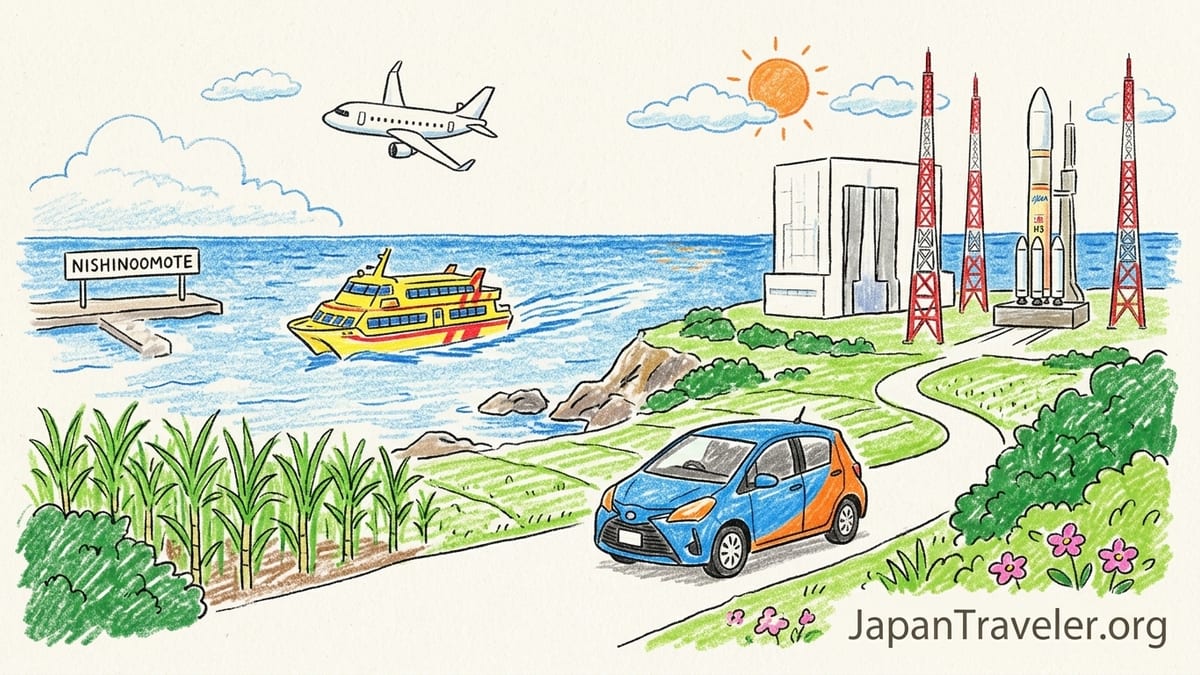
Getting to Japan’s Science Island from Kagoshima
I began my trip in Kagoshima, the southern Kyushu city that serves as the main springboard to Tanegashima. You can reach the island either by air or by high speed ferry. For this visit I chose to fly out and ferry back, partly to compare the experience and partly to hedge against weather disruptions that often affect one mode but not the other.
On the outbound leg, I booked a Kagoshima to Tanegashima round trip with a major domestic airline. In mid 2026, advance purchase economy fares on this route were commonly listed from just under 37,000 yen for a weekend return, though the price climbed quickly on peak summer and launch related dates. The flight itself took around 40 minutes, with Tanegashima’s modest airport sitting on the central part of the island, about an hour’s drive from the launch complex in the south.
For the return leg I used the Toppy/Rocket high speed ferry that links Kagoshima with Tanegashima and Yakushima. A one way adult ticket between Kagoshima and Nishinoomote on Tanegashima was priced in the high 9,000 yen range in early 2026 for the standard class cabin, with small seasonal variations and occasional discount campaigns. The trip took about 95 minutes under calm seas. Arriving at Nishinoomote Port, you immediately feel that you are on a small island, but there are rental car counters and convenience stores within a short walk or quick taxi ride.
Because public transport on Tanegashima is sparse and the space center is spread over a large area, I reserved a compact rental car in advance. At both the airport and Nishinoomote, daily rental rates for a small automatic hatchback in 2026 were typically around 7,000 to 8,000 yen including basic insurance, with larger vehicles and full coverage pushing the price higher. I paid just under 8,000 yen per 24 hours, picked up the car at the airport and drove south along the island’s spine toward Minamitane, the town that hosts the space center.
Driving South and Checking into a Base Near the Space Center
The drive from Tanegashima Airport to the Tanegashima Space Center area took me roughly 60 minutes at an unhurried pace. The road network is straightforward: mostly two lane roads, low traffic, intermittent ocean views and frequent signs pointing toward the “Space Center” and “Space Museum.” Fuel stations thin out as you head south, so topping up in the central area is wise if you are making multiple trips between the museum, beaches and launch viewing spots.
For accommodation, I wanted to stay close enough to the launch complex to drive there in less than 20 minutes. Options here are limited to small minshuku style inns, a few business hotel class properties and some self catering cottages. I chose a modest guesthouse in Minamitane, paying a little over 7,000 yen per night for a simple ensuite room with breakfast. More comfortable resort style stays are concentrated farther north, which would add driving time if you are scheduling a morning tour.
After checking in, I drove a reconnaissance loop to the space center gates and nearby coastal roads. What surprised me immediately was how visually open the facility is from outside. Tall lightning towers around the Yoshinobu Launch Complex stand right above the shoreline, and from public roads and beaches you can see the launch pads and assembly buildings silhouetted against the Pacific. Yet security signs, cameras and gatehouses make it clear that access to the operational core is tightly controlled outside the official tours and special open days.
I ended the day with a quick stop at a supermarket in Minamitane to stock up on snacks and drinks. Food options near the space center are limited, especially outside lunch hours, so carrying your own supplies is practical if you plan to spend a full day between the museum visit, bus tour and coastal exploration.
Booking the Official Tanegashima Space Center Tour
JAXA operates an official visitor program at Tanegashima that combines the Space Museum with a guided bus tour of parts of the launch complex. Reservations are strongly recommended and are often essential during school holidays, weekends and in the weeks around major H3 launches. I made my booking through the Japanese language reservation system several weeks in advance, choosing a midweek slot in October 2026 to avoid the end of the MMX launch campaign crowds.
The basic pattern on my visit day was a morning free exploration of the Space Museum followed by an afternoon bus tour departing from the same site. The tour I joined was free of charge, in line with JAXA’s broader public outreach policy, though visitors must cover their own transport to and from the museum. At check in, staff confirmed my identity against the reservation list and handed out a short bilingual information sheet outlining safety rules, photography restrictions and the planned route.
Language support is an important point for international travelers. On the day I joined, the main narration on the bus was in Japanese, delivered by a guide who clearly knew the technical side of launch operations. Non Japanese speakers were given printed English summaries for each stop, while some video segments on board the bus had English subtitles. From speaking with staff, I gathered that full English guided tours are occasionally offered when demand and staffing allow, but most regular tours prioritize Japanese narration.
The key safety messages were straightforward and firm. Passports or national identity documents are required for adults, large bags are discouraged on the bus, and visitors must remain within designated areas at each stop. Photography is allowed in many outdoor zones but prohibited when the bus passes certain operational facilities or security checkpoints. The guide emphasized that even on a quiet non launch day, the complex is an active rocket range, and any attempt to go beyond ropes, signs or staff instructions would lead to the immediate termination of the tour.
Inside the Space Museum: Learning Japan’s Launch Story
I deliberately began my day at the Space Museum, because it frames everything you see later on the tour. The museum sits on a low hill with sweeping views toward the launch pads and ocean. Entry during my visit was free, though donations were encouraged. Inside, the layout moves chronologically from early Japanese rocketry to the current H3 era, with plenty of hardware and models that help non experts grasp the scale of the technology.
In the first galleries, I spent time with full scale models and cutaways of Japan’s earlier launch vehicles, including the pencil rocket lineage, the Lambda and Mu solid fuel rockets, and then the liquid fueled H II and H IIA families. Interactive displays allowed you to compare payload capacities, orbits and mission types, highlighting how Tanegashima evolved from a primarily scientific launch site to Japan’s principal gateway for satellites supporting Earth observation, communications and deep space exploration.
One gallery focused on the H II A and H II B rockets, with engine nozzles and fairing segments displayed at eye level. Standing next to them brought home just how large even a single stage component is compared with the coastal hills outside. Another section introduced the new generation H3 rocket, which has become the core of Japan’s large launch program. Annotated models explained the three digit naming scheme that encodes strap on booster count and fairing type, and wall panels described how H3 aims to reduce launch costs while increasing annual cadence through changes in engine design and ground operations at Tanegashima.
The payload and mission exhibits were equally compelling. I lingered over displays about the Martian Moons eXploration mission, which had launched from Tanegashima only two days before my visit. Screens replayed footage of the H3 lifting off from the coastal pad and tracings showed the complex trajectory toward Mars and the moons Phobos and Deimos. Nearby cases summarized past achievements like the Hayabusa sample return missions, global navigation satellites in the Michibiki series, and Earth observation platforms that monitor climate, forests and disaster zones. For travelers interested in the science and purpose behind the rockets, these sections are worth at least one to two unhurried hours.
The Guided Bus Tour: Route, Stops and Restrictions
After lunch at the museum’s small café, I boarded the JAXA tour bus for the facility visit. The vehicle was a standard 40 seat coach with belts, wide windows and a monitor at the front for explanatory videos. Our route first passed through forested areas, then approached the sprawling assembly and test buildings where stages are integrated and checked before rollout to the launch pads. From the bus, the scale of these hangarlike structures compared with surrounding farmland was striking.
The first major stop was an elevated observation point overlooking the Yoshinobu Launch Complex. From this fenced terrace you can see the two main pads and the nearby vehicle assembly building, as well as the flame trenches opening toward the ocean. Signboards in Japanese and English explained how rockets are transported upright on mobile launch platforms, how the umbilical towers feed fuel and electricity into the vehicles, and how sound suppression water deluge systems protect both hardware and the concrete structure during liftoff.
Photography was allowed at this point, and nearly everyone on the bus spent the full allotted time trying to frame the pads with the coastline and cliffs. The guide pointed out recent modifications made to support H3 operations, including mobile platforms designed to allow more flexible turnaround between launches. Even from this public viewpoint, it was clear that Tanegashima is not just a launch pad, but a complex ecosystem of tracking antennas, safety bunkers and environmental monitoring gear spread across the island’s southern tip.
After leaving the observation point, the bus followed internal roads closer to some of the assembly areas and telemetry sites. Here, window curtains were partially drawn and the guide asked us to refrain from taking photos or video. The restrictions felt more procedural than oppressive. We still had clear glimpses of the massive building volumes, crane tracks and transporters that make a modern launch site work, but without lingering long enough to risk capturing sensitive details. The tour did not take us onto the actual launch pads or into any cleanrooms or assembly halls, which matched my expectations given global security and safety norms at operational ranges.
Touring the Complex Versus Witnessing an Actual Launch
Experiencing Tanegashima on a quiet post launch weekday was very different from the scenes I saw on recorded launch videos inside the museum. A facility tour gives you close but controlled proximity to the infrastructure. You stand on hills looking down at empty pads, you drive past buildings humming invisibly with preparation work, and you hear stories of missions that left these shores. It is contemplative rather than explosive.
Witnessing a live launch is a separate, less predictable proposition. Public viewing during a rocket launch does not happen from inside the core of the space center. Instead, JAXA and local authorities designate external viewing zones along coastal roads, hillsides and parks. These are typically several kilometers from the pad, outside exclusion zones that protect people from debris, sound and toxic exhaust in the event of an anomaly. For the October 19 H3 launch that carried the MMX mission, for example, local information boards in Minamitane directed visitors toward specified stretches of shoreline and temporary parking zones, while clearly marking areas closed to the public.
I chose this particular week hoping to combine the tour with a launch, and was fortunate that the MMX liftoff proceeded near the opening of its launch window. On launch day, I joined several hundred locals and visitors at a seaside park about eight kilometers from the pad. Access was simple: we drove to a temporary parking area marked by town staff, then walked a few minutes to the shoreline. Volunteers handed out flyers in Japanese with a safety notice, the planned launch time and instructions on where not to enter. There was a faint festival atmosphere, but also a noticeable seriousness among long time residents who had seen both flawless launches and scrubbed attempts.
When the H3 finally rose above the pad, it appeared first as a bright flare framed by the lightning towers, then climbed in silence for a few seconds before the delayed roar reached us across the water. The rocket quickly disappeared into high clouds, leaving an angled contrail and a subtle vibration in the air. From the public viewing zone you could not see the pad details that the tour bus showed the next day, but you did feel the raw power that those structures are designed to control. It reinforced that facility tours and launch viewing are complementary experiences rather than a single combined product.
Weather, Scrubs and Planning Around Launch Schedules
Anyone traveling to Tanegashima specifically for a launch needs to understand just how sensitive schedules are to weather, technical status and range safety. Official launch dates and reserve periods for H3 and other missions are published through JAXA and vehicle operator announcements, often with multi week backup windows. In 2026, several H3 missions carried lengthy reserve periods spanning many days to navigate seasonal rains, high level winds and upper atmosphere conditions.
Locals repeatedly reminded me that same week slips are common. High winds aloft, sea fog or lightning risk can move a planned launch by 24 hours or more, sometimes with decisions made only hours before liftoff. On earlier H3 flights in 2026, launch attempts were adjusted within reserve periods after weather reviews. For visitors this means that a two or three night stay carries a very real risk of missing a liftoff if the rocket slips outside your travel window. I met one Tokyo based student group in my guesthouse who had already rebooked their return ferry once to chase a previous launch date move.
Exclusion zones also tighten considerably during active countdowns. Roads that were open during my tour day can be partially closed on launch day, both on land and at sea. Local fishing boats are kept out of downrange splashdown zones and some coastal car parks used for everyday sightseeing may be re designated as safety or emergency access areas. Importantly, the space center’s official bus tours are generally suspended on launch day itself, as staff shift to operational roles. This is another reason not to expect to combine a standard facility tour with a same day launch viewing.
The practical takeaway for travelers is to treat a launch as a bonus rather than a guarantee. If you are highly focused on seeing a rocket rise from Tanegashima, consider staying at least four to five nights, maintain flexibility on ferries or flights, and prepare for the possibility that you will spend your time exploring the island’s beaches and space history instead of watching an actual liftoff.
Beaches, Coastal Roads and the Island Beyond the Pads
I used the non launch afternoons to get a sense of Tanegashima beyond its gantries. The same coastal geography that attracted JAXA to the island also makes it appealing to surfers, divers and beachgoers. Several stretches of sand near the space center double as informal viewing spots and quiet recreation areas when launches are not imminent. On one calm evening I walked along a beach where you can clearly see the lightning towers framed against the sunset, with only the sound of waves and the distant hum of generators from the launch complex.
Driving farther west, I visited a cliff top viewpoint that locals recommended for its combination of ocean panoramas and distant pad views. The road was narrow but paved, winding through sugarcane fields and small hamlets before reaching a windswept parking area. From there, I could trace the island’s contour, pick out the white shapes of tracking antennas and appreciate how the space center has been integrated into the landscape rather than dominating it. There were no tour buses here, only a few local cars and a couple of surfers scanning the swell.
Historic sites on Tanegashima add another technological layer. I made a short detour to the area associated with the introduction of firearms to Japan in the 16th century, when Portuguese traders landed on the island. Simple monuments and small exhibits recall how an unfamiliar technology once arrived by sea and then reshaped warfare and politics across the country. The parallel with rockets arriving by barge today, then rising skyward to reshape our understanding of space, felt almost too neat but still resonant.
On balance, I left with the impression that Tanegashima’s identity is now split between its fishing and farming heritage, its well regarded surf breaks and its role as a national spaceport. For travelers, that mix allows you to build an itinerary that is not entirely hostage to launch schedules or museum opening hours.
What the Trip Cost Compared with Mainland Space Exhibitions
For a three night stay focused on the space center, my total out of pocket costs from Kagoshima added up quickly enough to make comparisons with mainland options relevant. Flights between Kagoshima and Tanegashima for my dates were a little under 37,000 yen round trip. The return high speed ferry alternative would have been roughly 10,000 yen one way, so using air one way and sea the other came out to just under 47,000 yen in transport between Kagoshima and the island.
Rental car costs for three days reached around 24,000 yen including basic insurance and fuel. Accommodation at about 7,000 yen per night for three nights added another 21,000 yen. Daily food and incidental expenses such as café lunches at the museum, supermarket snacks and one restaurant dinner near Minamitane totaled around 8,000 to 10,000 yen. The official JAXA tour and Space Museum admission did not charge a fee during my visit, which softened the overall total.
All in, my Tanegashima space focused trip from Kagoshima cost on the order of 100,000 yen over three days excluding the initial journey to Kagoshima itself. By contrast, a visit to a mainland space related site such as the JAXA Tsukuba Space Center’s exhibition hall or urban science museums with space galleries would entail far lower incremental costs if you are already in the Kanto region. A one day return by train from Tokyo to Tsukuba, local buses and a modest lunch can easily come in under 10,000 yen, with free or low cost admission to exhibits.
The price difference underscores that Tanegashima is not the budget way to learn about Japanese rocketry. It is instead a destination for travelers who value being physically present at the country’s working spaceport, surrounded by launch pads, telemetry towers and ocean instead of city streets and indoor mockups. For many, the additional cost is justified by that sense of place and by the chance, if luck aligns, to see a live H3 launch streak into the sky.
The Takeaway
What impressed me most about touring Tanegashima Space Center was the contrast between the island’s quiet, almost sleepy atmosphere and the immense technological ambition embedded along its southern coastline. Standing on a windswept hill above the Yoshinobu pads, looking down at the same concrete flame trench that had sent the MMX spacecraft on its way to Mars’s moons two days earlier, I felt a rare combination of remoteness and global relevance.
The Space Museum did an excellent job of preparing me for what I saw outside, connecting past and present Japanese launch vehicles with satellites that touch everyday life, from navigation signals to weather images. The guided bus tour delivered meaningful proximity to the hardware while staying honest about what must remain off limits. Not stepping onto the pad itself or into assembly buildings might disappoint visitors expecting Cape Canaveral style on pad photo moments, but the trade off is a clear sense that Tanegashima is first and foremost a working rocket range, not a theme park.
There were, inevitably, limitations. Language support, while improved with written English materials, still centered on Japanese narration on my tour. Independent travelers without a rental car would find it difficult to navigate between airport, accommodations, museum and viewing spots. Dining choices close to the space center are sparse, and weather can rapidly rearrange both tourist plans and rocket schedules.
Even with those caveats, I would return to Tanegashima, ideally with a slightly longer stay to better ride out potential launch delays. For travelers deeply interested in space technology, launch operations and the physical reality of a coastal rocket range, the trip is worth the extra cost and logistical effort. For those content with models, simulators and indoor exhibits, mainland space centers will be easier on both wallet and schedule. Tanegashima offers something narrower but more visceral: the chance to stand on a small Japanese island, feel the ground tremble as a rocket climbs, and then tour the place where the next one is already being prepared.
FAQ
Q1. Do I need to book the Tanegashima Space Center tour in advance?
Yes. While same day slots sometimes exist on quiet weekdays, reservations are strongly recommended and can be essential around school holidays or launch periods, when buses fill quickly.
Q2. Is the Tanegashima Space Museum and bus tour free?
During my 2026 visit, admission to the Space Museum and participation in the official JAXA bus tour were free of charge, though this could change and small donations were encouraged on site.
Q3. Can I go onto the actual launch pad during the tour?
No. The standard visitor tour does not step onto active launch pads or into assembly buildings. Instead, it uses observation points and internal roads that give safe but restricted views of the operational areas.
Q4. Are there English language tours at Tanegashima Space Center?
The regular tours I experienced were guided in Japanese, with written English summaries and some subtitled videos. Fully guided English tours may be offered on selected dates or for special events but cannot be guaranteed.
Q5. How long does the full visit to the Space Museum and bus tour take?
Allow at least half a day. I spent about two hours in the museum exhibits, then joined a bus tour that took roughly 90 minutes including stops, plus extra time for check in and moving between zones.
Q6. What is the best way to get around Tanegashima without a car?
Public buses exist but are infrequent and do not always align well with tour times. Taxis are available but can be expensive over longer distances, so renting a car is the most practical option for most visitors.
Q7. Can I see a rocket launch from inside the space center?
Ordinary visitors watch launches from designated public viewing areas outside the operational complex, such as coastal parks and roads, not from inside the core facility itself.
Q8. How risky is it to plan a trip around a specific launch date?
Launches are highly sensitive to weather and technical status. Even with published reserve periods, delays and scrubs are common, so there is a real risk of missing a launch on a short trip.
Q9. Is Tanegashima worth visiting if there is no launch scheduled?
Yes, if you are interested in space infrastructure, coastal landscapes and quiet island life. The museum, bus tour, beaches and historic sites offer enough content for a rewarding stay even without a live launch.
Q10. How does visiting Tanegashima compare to visiting a mainland JAXA center?
Mainland centers and science museums are easier and cheaper to access, with strong exhibits, but lack the immersive feeling of being at an active launch range with pads, ocean and exclusion zones right outside.