


The Izu Islands sit in the Pacific south of Tokyo, a volcanic chain that feels surprisingly remote yet is still part of the capital. For Tokyo-based travelers and visitors who do not want to commit to a long flight to Okinawa, these islands offer black and white sand beaches, clear snorkel water, coastal hot springs and dramatic crater landscapes within a few hours of the city. With ferries, jetfoils and short flights linking multiple islands, they also work well for short-break escapes and low-key island-hopping.
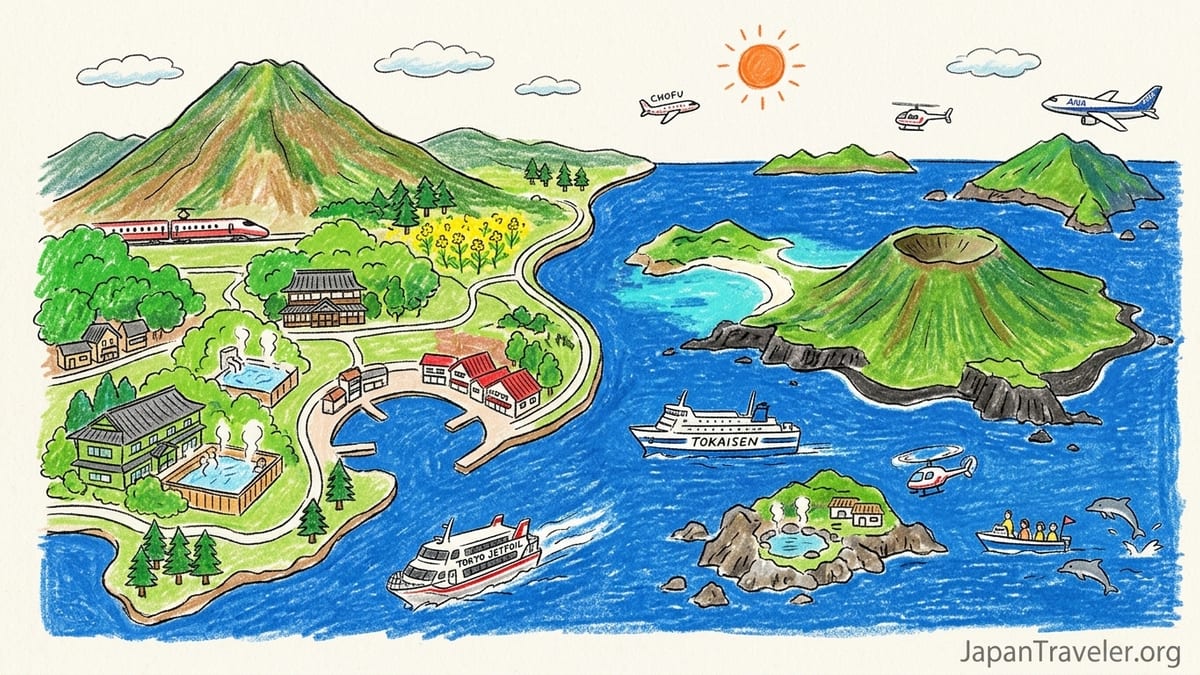
Izu Islands vs Izu Peninsula: Know the Difference
The Izu Islands and the mainland Izu Peninsula are often confused, but they deliver very different trips. The Izu Peninsula juts into Suruga Bay southwest of Tokyo and is linked to the main Honshu rail network, so it works well for onsen towns like Atami, Ito and Shuzenji or coastal resorts such as Shimoda without ever boarding a ship. You can ride the Shinkansen to Atami, change to JR local lines or private railways, and be soaking in a ryokan bath the same afternoon.
The Izu Islands are a scattered arc of volcanic islands that belong administratively to Tokyo but sit out in the Pacific. They include larger islands such as Izu Oshima and Hachijojima, classic beach islands like Niijima and Shikinejima, and outlying Mikurajima and Aogashima. Access is by boat or plane rather than train, and the atmosphere is distinctly more remote. Instead of dense hot-spring towns you find small ports, simple minshuku guesthouses, starry skies and dark lava cliffs.
For visitors considering whether to fly to Okinawa for beaches and subtropical scenery, the Izu Islands can act as a practical alternative, often with lower costs and travel times from Tokyo. You trade long domestic flights and pricey resorts for three to ten hour ferries or one hour flights and locally run inns. Water temperatures are cooler than Okinawa in winter, but summer and early autumn bring warm seas, sand-bottom coves and good snorkeling without leaving the Kanto region.
Most first-time island visitors combine a mainland Izu stop with one or two islands, or choose between a ferry-based short break and a deeper, flight-based escape to Hachijojima. The key is to understand how the transport pieces fit together and match islands to your interests, whether that is hiking a crater rim, surfing beach breaks, soaking in seaside hot springs or swimming with wild dolphins.
Getting There: Ferries, Jetfoils, Flights and Island-Hopping
The main gateway for the northern Izu Islands is Takeshiba Passenger Ship Terminal on Tokyo Bay, near Hamamatsucho. Tokai Kisen operates overnight car ferries and daytime high-speed jetfoils from here to Izu Oshima, Niijima, Shikinejima, Kozushima and on to southern islands such as Miyakejima and Hachijojima. As of 2026, jetfoils from Takeshiba to Izu Oshima typically take around 1 hour 45 minutes, and to Niijima about 2 hours 20 minutes, while the slower overnight ferry departs late evening and calls at several islands the following morning, with total times of 6 to 10 hours depending on route.
Jetfoils are the fastest way to maximize a weekend, but they come with more restrictions. Tokai Kisen notes that checked baggage is not handled on jetfoils, and larger items such as full-size diving gear bags or bicycles must be checked on the large ferries instead. On large ferries from Tokyo, standard checked items up to a combined 200 centimeters and 30 kilograms can be accepted as entrusted baggage, and special pieces such as bicycles in bags or diving equipment incur an additional fee of about 600 yen one way per item, while fully assembled bicycles are charged around 1,800 yen one way and require advance reservation. Oversized outdoor wagons or large coolers are treated as large baggage and charged more.
Flights add another layer of choice. Izu Oshima is linked to Chofu Airport in western Tokyo by short turboprop flights, while Hachijojima has multiple daily flights from Haneda Airport operated by ANA and partner carriers. Flight times are roughly 30 minutes to Izu Oshima and about 55 minutes to Hachijojima. Domestic checked baggage allowances on these routes usually follow ANA’s standard domestic rules, currently allowing at least 20 kilograms free for most economy fares, with personal item size guidelines updated in mid 2026 to 40 by 30 by 20 centimeters. Chofu Airport is compact and closer to western Tokyo suburbs, while Haneda is better connected to central Tokyo and international flights.
Island-hopping within the chain is possible but requires planning. Tokai Kisen ferries connect Niijima, Shikinejima and Kozushima on the same north-south line, and Niijima Village operates a small local boat linking Niijima and Shikinejima several times a day, which makes it realistic to split three or four nights between two neighboring islands. For southern islands, helicopters operated under the “Tokyo Ai-Land Shuttle” banner and smaller ferries knit Hachijojima with Aogashima and other remote islands, but these services are capacity-limited and highly weather dependent.
Weekend-Friendly: Izu Oshima for Mount Mihara and Easy Access
Izu Oshima is the closest and best-connected island, making it the top choice for a two-night escape from Tokyo. Jetfoils from Takeshiba or Atami put you at Oshima’s ports in under two hours when seas are calm, and flights from Chofu are even faster. Because Oshima has multiple daily services by both sea and air, cancellations due to rough weather can often be worked around by switching to a different time or mode, which is not always possible on the smaller islands.
The island is dominated by Mount Mihara, an active volcano whose broad crater and lava fields are laced with hiking trails. Many visitors base themselves in Motomachi or Okata port and take the bus or a taxi up to the trailheads. Recent local tourism materials highlight loop walks along the crater rim and routes across black lava plateaus, though access can be restricted after heavy rain or volcanic alerts. It is essential to confirm which trails are open with the Oshima tourist office before setting out, particularly in winter and early spring.
Accommodation on Oshima ranges from simple minshuku to onsen hotels and diving guesthouses. Around Motomachi Onsen area, seaside ryokan offer oceanview baths fed by natural hot springs, including some properties with outdoor pools overlooking the Sagami Sea. Budget travelers find family-run minshuku that include home-style dinners featuring local seafood and island vegetables. For divers, guesthouses near Habu Port and on the south coast cater to groups with gear storage, rinse tanks and boat charters to offshore sites.
Costs for a two-night Oshima break can be relatively modest. As of 2026, advance jetfoil fares on Tokai Kisen from Takeshiba to Oshima and back can often be found around 14,000 to 18,000 yen round trip in standard class outside peak holidays, while simple minshuku with two breakfasts and two dinners might range from 9,000 to 13,000 yen per person per night. A realistic budget for two people sharing, including transport, two nights of half-board lodging and local buses, starts from roughly 70,000 to 90,000 yen for the weekend, depending on season and room type.
Niijima, Shikinejima and Kozushima: Beaches, Surfing, Hot Springs and Clear Water
South of Oshima, Niijima, Shikinejima and Kozushima form the classic beach and snorkeling trio that many Tokyo residents use as a warm-season alternative to Okinawa. All three are served by Tokai Kisen overnight ferries from Takeshiba, and by jetfoils in high season from Tokyo or, in some cases, from Izu Peninsula ports like Atami and Shimoda. Once you reach Niijima, a small local ferry connects it with Shikinejima, and mainline ferries continue farther south to Kozushima.
Niijima is best known for its long white-sand coastline and surf culture. Habushiura Beach, a sweeping sandy bay on the east coast, hosts surf competitions and draws board riders throughout summer. Jetfoils from Takeshiba reach Niijima in a little over two hours in good conditions, while the overnight ferry arrives early in the morning. Around Niijima’s Maehama Beach near the port there are guesthouses and small hotels directly across from the sand, along with simple minshuku in residential streets behind the main road. These often bundle home-cooked dinners and breakfast, with fresh sashimi and island specialties such as ashita-ba greens.
Neighboring Shikinejima is more compact and relaxed, with indented coves, emerald bays and several natural hot springs by the sea. At Jinata Onsen and Matsugashita Miyabi-yu, hot spring water seeps into the rocky shore, mixing with the tide to form rustic seaside baths. These onsen have local rules about bathing suits and mixed bathing that visitors must follow, and tidal conditions determine safe soaking times, so it is important to check details with the tourist office or accommodation. Shikinejima has a cluster of minshuku and small pensions near the port and around Tomari Beach, some only a few minutes’ walk from sheltered swimming coves appropriate for families.
Kozushima, farther out, offers some of the clearest water in the northern islands and is a favorite for snorkeling and beginner diving. The main beach near the port has soft sand and designated swimming areas during the summer season, while rocky inlets on the west coast offer coral and rock reef snorkeling when conditions are calm. Diving guesthouses and lodges support shore and boat dives, providing tank rental and guided excursions. Because Kozushima sits farther out in the Pacific, ferries and flights are more prone to weather disruptions than Oshima, so a minimum of three nights is advisable for travelers who want to be sure of enjoying the water.
These three islands are the easiest to mix on one trip. A typical island-hopping itinerary might use an overnight ferry from Tokyo to Niijima, spend one or two nights, then hop by local boat to Shikinejima for one or two nights of coastal hot springs, before returning to Tokyo by jetfoil. Alternatively, Niijima and Kozushima can be combined by using the main Tokai Kisen route, though schedules sometimes require careful matching of departure days.
Hachijojima and Mikurajima: Subtropical Scenery, Diving and Wild Dolphins
Farther south, Hachijojima feels closer in spirit to Okinawa, with lush ridges, subtropical vegetation and warm waters influenced by the Kuroshio Current. Daily flights from Haneda make it one of the most accessible “far” islands, while overnight ferries from Takeshiba provide a lower-cost option, albeit with journey times over 10 hours. Hachijojima’s coastline mixes rocky cliffs, black-sand beaches and manmade seawater pools, and the interior offers hiking on old volcanoes such as Hachijo-Fuji, though volcanic and erosion-related closures can affect some trails.
Diving is one of Hachijojima’s main draws. Numerous dive shops and guesthouses operate around Sokodo, Yaene and Kashitate, offering boat dives to offshore pinnacles and drift sites where pelagic fish, sea turtles and seasonal hammerhead sharks may appear. Many accommodations in these areas function as hybrid diving lodges and minshuku, with gear storage, rinse tanks and in-house guides. For non-divers, coastal walking paths, local museums and hot springs such as Miharashi-no-Yu provide enough activity for a relaxed three or four night stay.
Mikurajima, reached by ferry from Tokyo via Miyakejima or by boat trips from Miyakejima itself, is famous for regulated wild-dolphin encounters. The waters around the island host a resident population of Indo-Pacific bottlenose dolphins, and swimming with them is only allowed on guided tours with licensed operators. Both the official Tokyo tourism guides and local Mikurajima organizations stress that dolphin swimming is strictly controlled to protect the animals and that hiking on the island’s trails is also guided-only, as the entire island is a designated national park.
Dolphin swim tours typically run from around mid April to October, when seas are warm enough for extended snorkeling. Operators based on Mikurajima and on neighboring Miyakejima supply wetsuits, masks, fins and, in some cases, underwater camera rentals for additional fees. Water temperature can vary considerably depending on the exact path of the Kuroshio Current. When the current sits close to the islands, surface temperatures in summer frequently rise into the mid twenties Celsius, similar to subtropical destinations, but they can drop sharply if the current shifts. Given the exposure to ocean swells and the limited ferry and accommodation capacity, travelers should allow at least three nights centered on Mikurajima and be prepared for possible schedule changes.
Aogashima: Japan’s Remote Volcanic Caldera Island
Aogashima is a tiny inhabited volcano set inside a larger crater, often featured in dramatic aerial photographs. Despite its inclusion in many social media bucket lists, it is a specialist destination that should not be treated as a simple weekend side trip. Access involves a combination of ferry and helicopter from Hachijojima, with both services frequently disrupted by wind, waves and low cloud.
The regular small ferry between Hachijojima’s Yaene Port and Aogashima Port has a limited number of sailings each week and can be canceled for days in a row in rough seas. The Tokyo-run helicopter shuttle between Hachijojima Airport and Aogashima Heliport connects the two in about 20 minutes but has very limited seats and weight restrictions. Official operation status pages routinely show partial cancellations or days where one mode is operating and the other is not. On arrival, there is no public transport network, only a handful of minshuku and local shops, and facilities can book out months in advance.
Because of the combination of weather risk, small-boat exposure and minimal services, Aogashima suits experienced Japan travelers who can allocate extra buffer days on Hachijojima and accept the possibility of being stranded by canceled sailings or flights. For most visitors seeking a simple short beach break from Tokyo, it is better to admire Aogashima in photographs and focus on Oshima, Niijima, Shikinejima, Kozushima or Hachijojima, all of which can be reached on more reliable schedules.
Those determined to visit should build in at least two nights on Hachijojima on either side of a planned Aogashima stay, monitor official traffic information in the days before departure and reconfirm accommodation and transfers directly with local hosts. Aogashima is not a destination where you can safely plan a tight long-weekend itinerary or same-day flight connections.
Seasons, Swimming, Snorkeling and Safety
The main swimming season in the Izu Islands typically runs from mid July to late August, when beaches have lifeguards, flagged swimming areas and full facilities. In these peak weeks, sea surface temperatures around the northern islands often sit in the low to mid twenties Celsius, rising slightly farther south toward Hachijojima. Many local visitors continue to swim and snorkel in June, early July and September, especially in wetsuits, but official beach management, jellyfish monitoring and lifeguard services may be limited or absent outside the core period.
Snorkeling conditions vary by island. Niijima and Kozushima offer sand-bottom bays where visibility can be excellent on calm days, while Shikinejima’s smaller coves provide more shelter from swells. Around Hachijojima and Mikurajima, water clarity can be remarkable under the influence of the Kuroshio Current, rewarding snorkelers and divers with encounters with schools of reef fish, sea turtles and, on organized trips, dolphins. However, exposure to open-ocean swells means that conditions can deteriorate quickly, and there have been years when strong currents or typhoons have curtailed water activities for extended periods.
Marine-life regulations differ by island but generally prohibit feeding or chasing wildlife and restrict how many boats and swimmers can approach sensitive areas at once. On Mikurajima, for example, dolphin tours must follow strict rules set by the local community and Tokyo authorities that limit approach distances and the time spent with each pod. Guides brief participants on correct behavior before entering the water, and failing to follow instructions can result in being asked to sit out a session. On all islands, collection of corals and shells from protected zones is forbidden, and some reefs are off limits for conservation.
Volcanic landscapes bring their own safety considerations. Trails on Mount Mihara on Oshima, high ridges on Hachijojima and forest circuits on Mikurajima can close with little notice following rain, rockfall or increased volcanic activity. Local governments and tourist associations publish closure information in Japanese and sometimes English, and accommodation hosts usually have the latest updates. Visitors should avoid entering any closed areas, pack for rapid weather changes and recognize that winter and early spring conditions can be significantly cooler and windier than Tokyo, even on islands that appear subtropical in photos.
Where to Stay: Beachfront Hotels, Minshuku, Diving Lodges and Onsen Inns
Across the Izu Islands, accommodation skews smaller and more personal than on the mainland. Beachfront hotels are relatively limited, with most properties falling into the minshuku, pension and onsen inn categories. On Niijima’s Maehama Beach and Habushiura area, for example, you will find low-rise pensions and family-run minshuku with a handful of rooms rather than high-rise resorts. Guests usually eat dinner and breakfast at the property, which creates a sociable, homey feel but also means you should book meal plans in advance, especially outside the busiest weeks when local restaurants may have short hours.
On Shikinejima, many minshuku cluster near Tomari Beach and Nobushi Port. Typical stays include two meals, futon bedding on tatami floors and shared bathrooms, with rates in 2026 often starting from under 10,000 yen per person per night for half board in shoulder seasons. Several properties are within walking distance of the island’s coastal hot springs, allowing guests to soak morning and evening without using a car or bus. Kozushima’s port area mixes small inns near the waterfront with hillside lodges overlooking the bay, some oriented toward snorkeling and diving groups.
Diving-focused guesthouses are concentrated on Kozushima, Hachijojima and parts of Oshima. These usually include package prices that bundle accommodation, meals and a set number of boat or shore dives, along with equipment rental if needed. They may also offer pickup from the ferry or airport and daily transfers to dive sites, which helps when public bus schedules are sparse. Because diving is highly weather dependent, reputable operators build flexibility into their plans, switching between shore and boat sites or offering partial refunds or alternative land tours if multiple days are blown out by rough seas.
Onsen properties are most plentiful on Oshima and Hachijojima. Around Motomachi on Oshima and the Miharashi-no-Yu area on Hachijojima, you can soak in open-air baths overlooking the ocean, sometimes with views of neighboring islands or the distant mainland on clear days. Some inns also operate day-use bathing for non-guests, which can be appealing if you are staying in a simpler minshuku without private baths. Families should check whether baths are segregated by gender and whether there are set times for children, as local customs vary.
Trip Lengths, Costs and Practical Tips
When planning island time from Tokyo, matching the island choice to the number of nights available is crucial. For a two-night escape, Izu Oshima is the most practical option, followed by Niijima or Shikinejima if you are willing to accept slightly longer crossings and a bit more weather risk. Jetfoils make it realistic to depart Tokyo on a Saturday morning and return Monday evening while still enjoying two full days on the ground. Kozushima, Hachijojima, Mikurajima and any itinerary involving Aogashima are better suited to at least three nights and, ideally, four or more, to absorb delays and cancellations.
In terms of budget, a two-night Izu Oshima trip for two people taking a jetfoil from Takeshiba, staying in a midrange minshuku with half board and using local buses might be approximated at around 70,000 to 90,000 yen in total outside major holiday peaks. By contrast, a three-night Hachijojima trip for two, flying from Haneda and staying at a diving-oriented guesthouse or comfortable inn with some meals included, often reaches around 120,000 to 160,000 yen once you factor in higher airfares, slightly more expensive rooms and the added cost of diving or rental cars. These figures move up during school holidays and long weekends and can be moderated by using overnight ferries or more basic lodgings.
Luggage and transport logistics matter more than on typical mainland trips. Large suitcases, surfboards and dive bags are best matched to the overnight ferries, which accept entrusted baggage for a fee and have more generous storage areas. High-speed jetfoils emphasize carry-on style luggage that you can handle yourself. Bicycles must be bagged or booked as special cargo on large ferries and, in some cases, are restricted or even banned from use on particular islands, so it is essential to read the latest carrier rules. Because many accommodations include port or airport pick-up within certain hours, it is worth confirming your arrival time directly and notifying hosts if you are delayed.
Finally, cancellation risk should always be part of island planning. Summer brings typhoons and strong swells, while winter and early spring can see persistent low pressure systems. Operators publish daily status updates for ferries, jetfoils and flights, but decisions to sail or cancel may not be made until a few hours before departure. Building in flexible hotel bookings in Tokyo for the night before or after your island trip, as well as travel insurance that covers weather-related disruption, can make the experience less stressful.
The Takeaway
The Izu Islands give Tokyo visitors access to beaches, crater hikes, hot springs and surprisingly clear subtropical seas without the time and cost of a full Okinawa itinerary. Izu Oshima delivers volcanic landscapes and easy logistics for a two-night break, Niijima and Shikinejima provide classic beach and coastal onsen escapes, Kozushima adds standout snorkeling and blue water, and Hachijojima and Mikurajima push deeper into subtropical diving and dolphin territory. Aogashima, spectacular but logistically fragile, belongs on a dedicated, flexible itinerary rather than a casual long weekend plan.
By understanding the differences between ferries, jetfoils and flights, taking baggage rules and cancellation risks seriously, and picking accommodation that matches your interests, you can construct a Tokyo island escape that feels adventurous yet achievable. Whether you are a family looking for safe swimming coves, a couple chasing quiet hot springs at sunset, divers in search of pelagic encounters, or independent travelers who want to hike caldera rims and watch the Milky Way rise over the Pacific, the Izu Islands offer a spectrum of options within a day’s reach of the capital.
FAQ
Q1. Which Izu Island is best for a quick weekend from Tokyo?
Izu Oshima is generally the best choice for a two-night weekend because it has the most frequent ferries and flights, shorter travel times and a range of onsen and hiking options.
Q2. Can I visit multiple islands on one short trip?
Yes, Niijima and Shikinejima are easy to combine over three or four nights using the local ferry between them, and Kozushima can also be added if schedules line up, but southern islands like Hachijojima and Mikurajima are usually better enjoyed on separate trips.
Q3. How far in advance should I book ferries and flights?
Reservations for Tokai Kisen ferries typically open about two months ahead, and summer weekends often sell out, while flights to Oshima and Hachijojima should be booked several weeks in advance for good fares and seat availability, especially during school holidays.
Q4. When is the best time for swimming and snorkeling?
Mid July to late August offers the warmest water and lifeguarded beaches, while June and September can still be pleasant for confident swimmers and snorkelers, particularly with wetsuits, though official beach services may be limited.
Q5. Is it possible to swim with wild dolphins on a day trip?
No, dolphin swim programs around Mikurajima require you to stay at least one or more nights because boat departures depend on sea conditions and regulations limit the number of daily participants, so overnight stays and flexible dates are needed.
Q6. Do the islands have ATMs and card payments?
Larger islands such as Oshima, Niijima and Hachijojima have a few ATMs and increasing card acceptance, but smaller islands rely more on cash, so visitors should bring enough yen for accommodation balances, meals and local buses.
Q7. Can I take my bicycle to the Izu Islands?
Standard bicycles can usually be transported on large Tokai Kisen ferries for an additional fee and with advance reservation, but cannot be checked on jetfoils and may not be allowed for use on every island, so it is important to confirm both ferry and island rules before traveling.
Q8. Are the Izu Islands suitable for families with young children?
Yes, islands like Niijima, Shikinejima and Oshima have gentle beaches, family-friendly minshuku and summer lifeguard services, though parents should pay close attention to local swimming flags, currents and jellyfish information.
Q9. How do I get from ports or airports to my hotel?
Many accommodations offer free or low-cost pick-up at scheduled ferry and flight times if arranged in advance, and larger islands also have local buses and taxis, but evening arrivals may require confirming exact transfer details with your host.
Q10. Is Aogashima realistic for a first-time visitor to the Izu Islands?
For most first-time visitors it is better to start with Oshima, Niijima, Shikinejima, Kozushima or Hachijojima, because Aogashima’s ferries and helicopter are frequently canceled and the limited lodging and services demand flexible dates and prior experience with rural Japan.