


I love “prettiest beach” lists as much as anyone, but the Ryukyu Islands taught me that two beaches with the same electric-blue water can feel completely different once you factor in currents, reef access, shade, and whether you can rinse off without sprinting back to your hotel sandy and sunburned. What follows is not a gallery of beaches I scrolled past on a map. These are the ones I actually swam and snorkeled on across Okinawa Main Island, the Keramas, Miyako, and Yaeyama, and the ones I would genuinely return to. I’m also leaning hard on what Okinawa’s official beach database gets right: facilities like parking, lifeguards, jellyfish nets, showers, lockers, and marine activities change the entire experience, even when the views look similar.
How I Compared Beaches (And Why Facilities Matter As Much As Color)
I kept notes the way I would on an assignment: what the sand felt like underfoot, what color the sea read in midday sun versus late afternoon, and what the water looked like once my mask was on. I also logged the unglamorous basics that determine whether you stay an hour or an entire day: toilets that are actually open, showers that aren’t a rumor, lockers that fit more than a phone, and whether there’s shade when the UV index is doing what it does in Okinawa.
Okinawa’s official beach database is helpful because it treats “beach” as a practical place people use, not just a pretty backdrop. Filters like parking, lifeguards, jellyfish nets, showers, lockers, and marine activities explain why one bay is a relaxed family day and another is a gorgeous, stressful photo stop where you keep one eye on your stuff and one eye on the waterline. It’s also a reminder that “safe” is not a permanent label. Conditions are the product of that day’s wind, tide, swell, and your own decisions.
Sea safety, for me, was non-negotiable. On every beach day I checked the water as I arrived: the flag situation if there was one, wave period, rip-like channels, and whether the “calm looking” water was actually pulling sideways along the reef edge. I’m describing what I experienced on the day I visited, not claiming a beach is permanently safe. Okinawa Prefecture also publishes warnings about hazardous marine life including habu jellyfish, and those advisories are a useful reality check when the water looks inviting.
I’m also intentionally archipelago-wide. Okinawa Main Island is the easiest to access and has the most developed public and resort-managed beaches. The Keramas can look like the Maldives on a clear day, but logistics and weather can make or break your plan. Miyako is the “white sand, shallow turquoise” poster child, yet some of its best beaches are better for long swims and photos than casual snorkeling. Yaeyama mixes easy beaches with very real current risks, especially around small islands where facilities can be minimal.
Okinawa Main Island: The Two Beaches I’d Rebook for Convenience
On Okinawa Main Island, the beaches I return to are the ones that let you actually relax. That usually means: clearly marked swim areas, some kind of supervision, decent showers, and a sense that the beach is set up for people who will be in the water for hours. My two repeat picks here are Emerald Beach (Motobu) for a structured family-friendly swim day, and Manza Beach (Onna) when I want resort-level comfort plus water that’s interesting enough to snorkel with minimal fuss.
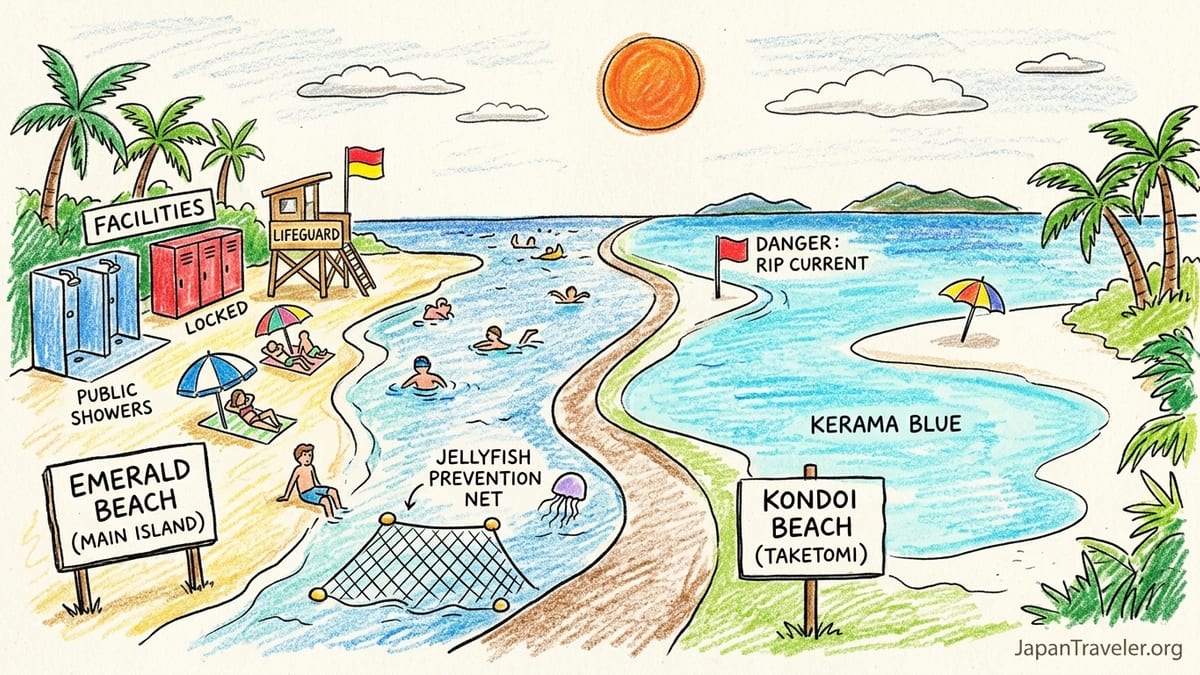
Emerald Beach at Ocean Expo Park is the rare Okinawa Main Island beach where the facilities feel deliberately designed rather than added as an afterthought. When I visited, the practical side was as good as the scenery: showers were available and free, lockers were inexpensive (the park lists small baggage lockers at 100 yen), and there were lifeguards and a jellyfish prevention net in place during the swimming season. That combination changes your stress level immediately. I stayed about three hours, mostly swimming and floating rather than snorkeling, because the netted area is about easy water time, not chasing reef structure. The sea color was a bright emerald-to-turquoise gradient in sun, and clarity was good enough to see the sandy bottom clearly in the shallows. Depth stayed beginner-friendly close in, with gentle waves on my day and a calm surface that made it a genuinely restful swim.
Manza Beach, tied to the ANA InterContinental Manza Beach Resort area in Onna, is where I go when I want the “beach day” to feel effortless. It’s the sort of place where you can do a morning swim, rinse properly, and still look presentable for lunch. On my visit, the sand was clean and comfortable, the sea color leaned cobalt where it drops off, and the water clarity was good enough that even nearshore snorkeling felt worth doing. I stayed roughly half a day because the convenience kept me from leaving early. The beach is known for organized marine activities and typically has lifeguards during operating hours, and the resort promotes snorkeling experiences around its house reef. Conditions on my day were moderate: small waves, but enough movement to remind me to watch where the reef and sandy patches meet, because that’s where surge can surprise you. If you’re after pure scenery, there are more dramatic coastlines on the island, but for swimming plus “easy snorkeling without a full expedition,” this was a repeatable choice.
Facilities are the real separator on Okinawa Main Island. Even if a less-developed beach looks similar in photos, having a staffed area, a netted swim zone in season, and reliable showers can turn a quick stop into a full day. If you’re traveling with kids, nervous swimmers, or anyone who wants to minimize risk, these are the places where the infrastructure supports the experience rather than fighting it.
Kerama Islands: The Water That Ruined Other Beaches for Me
If you’ve heard people say “Kerama blue,” it’s not hype, but it’s also not a promise. The same islands that give you aquarium visibility can also give you wind-driven chop, lateral currents, and a long swim that feels short until you turn around and realize you’re farther from shore than you thought. The beaches I’m recommending here are the ones I personally tested and would return to because they balance the color-and-clarity fantasy with real, usable setups.
Aharen Beach on Tokashiki is the Kerama beach I’d return to when I want the full-service version of Kerama. The water color was bright, almost unreal in sun, and the clarity on my day made snorkeling immediately rewarding. The beach shelves gently, then deepens enough to swim properly without walking forever. Waves were small-to-moderate when I visited, but there was noticeable movement near the edges, the kind that nudges you along the shoreline if you stop paying attention. Snorkeling quality was good for a casual session, with reef and fish activity that justified staying in the water rather than just photographing it. Reef condition, from what I could see nearshore, looked decent, though like most popular beaches, you could tell it has pressure from many visitors.
Aharen’s practical advantage is that it’s built for day users. On the day I went, toilets were close, showers and changing facilities were available, and coin lockers were an actual thing rather than a vague “maybe.” Local operators around Aharen also advertise rental gear and tours, and published facility information for the beach area includes paid lockers in the few-hundred-yen range. Shade is mixed: there’s some natural relief around the edges and behind the beach, but mid-day on the sand you still need sun protection. I stayed about five hours because I could alternate between swimming, snorkeling, eating something simple nearby, and getting back in without feeling like I was roughing it.
Tokashiku Beach, also on Tokashiki, is the one I’d return to specifically for swimming and the chance of seeing sea turtles in the shallows. On my visit, the sea felt calmer than Aharen inside the main swim area, with a slightly more relaxed vibe. The water clarity was excellent, with that “mask-on and suddenly you’re in an aquarium” feeling. Depth was comfortable for long swims, and waves were gentle on my day. Snorkeling was solid but more dependent on where you enter and how far you’re willing to venture while staying mindful of any designated swim zones. The current felt mild nearshore that day, but it’s exactly the sort of place where you should reassess every time you enter, because conditions can change quickly with wind and tide around island bays.
Kerama takeaway: these are beaches I’d plan a full day around, but I would never treat the day’s calm surface as a permanent truth. The Keramas reward people who swim with a plan: stay aware of lateral drift, respect designated areas and staff instructions where present, and don’t let the color distract you from the fundamentals.
Miyako: White Sand, Shallow Turquoise, And the Snorkel Reality Check
Miyako has the kind of beach visuals that make you think you’ll snorkel for hours, but the island taught me to separate “best swimming beach” from “best snorkeling beach.” My return beach here is Yonaha Maehama, because it delivers exactly what it promises: a long, beautiful arc of sand and water that feels made for walking, floating, and open-sky photographs. If I want reef-heavy snorkeling, I treat it as a separate plan rather than assuming every perfect turquoise shallows equals coral right offshore.
Yonaha Maehama’s sand is fine and pale, the kind that squeaks a little underfoot when it’s dry. The sea color on my day went from clear, pale mint in the shallows to brighter turquoise farther out, with excellent water clarity over the sandy bottom. The nearshore depth is forgiving, which is why the beach feels so approachable for casual swimmers. Waves were low when I visited, and the surface was mostly smooth, which made it a relaxed place to spend time in the water without constantly bracing against chop. Current felt minimal inside my comfort zone that day, but I still stayed conservative and close in, because wide shallow beaches can hide subtle lateral movement that only becomes obvious when you look back at your towel and realize it’s no longer lined up with you.
Snorkeling quality at Yonaha Maehama, for me, was limited right off the main swimming area because the bottom is primarily sand. I still did a short mask session because I always test it, but it confirmed what many Miyako repeat visitors learn: this is a swimming and scenery beach first. Reef condition isn’t the issue, it’s access to reef structure without a boat or a drive to another spot. That’s not a downside if you set expectations correctly. I stayed about four hours, mostly swimming and walking the shoreline for photographs, and it felt like time well spent because the beach keeps opening new angles as the light shifts.
Facilities were a key reason I’d return. On the day I visited, I had access to toilets and showers and didn’t have to gamble with logistics. Miyakojima’s own visitor materials also remind travelers that small change in cash can be required for parking and showers at beaches, which matches the “bring coins” reality of a lot of Okinawa beach days. Shade at Yonaha Maehama is limited, and that matters in practice. If you show up at noon without an umbrella, you may find yourself leaving earlier than planned simply because you can’t comfortably take breaks out of the sun.
Yaeyama (Ishigaki and Taketomi): Easy Lagoons, Harder Decisions
Yaeyama can feel like a different country compared with Okinawa Main Island: smaller islands, bigger nature, and beaches where the most important feature might be what is not there. In this region, I’d return to Sukuji Beach on Ishigaki when I want a managed, user-friendly swim day near Kabira, and I’d return to Kondoi Beach on Taketomi for shallow, spectacular lagoon scenery with the clear understanding that the lack of lifeguards and nets changes how you behave in the water.
Sukuji Beach (Ishigaki) is a practical traveler’s beach that still photographs beautifully. The sand is light and comfortable, and the water on my day was a clean turquoise with good clarity. Depth is gentle nearshore, and waves were minimal when I visited, which made it easy to relax in the water without constantly checking the horizon. The big facility note here is seasonality: published local beach information indicates that surveillance staff and jellyfish prevention nets are installed from April 1, which means the experience in March can be meaningfully different. On my visit, the beach felt set up for swimmers rather than hardcore snorkelers. Snorkeling was okay for a casual look, but not the main reason I’d come back. I stayed about three hours, swimming, cooling off, and taking photos that actually looked like the brochures because the light and the shallows cooperated.
Facilities at Sukuji made it a repeatable choice. I had reliable parking, toilets, and a straightforward “arrive, set up, swim” experience. This is exactly what the official-beach-database approach captures: a beach can be “similar looking” to another bay nearby, but if one has a defined swimming season setup with staff and nets and the other does not, your day changes. Crowds were moderate when I went, building around the warmest part of the day. It never felt like a festival, but it also wasn’t secluded.
Kondoi Beach (Taketomi) was the opposite: pure visual calm with fewer safety and comfort layers. The sand is pale and soft, and the lagoon color can shift from milky turquoise to glassy emerald depending on cloud cover. Water clarity in the shallows was excellent on my day, and depth stayed very shallow far out, especially around low tide, which created that dreamy sandbar feeling. Waves were tiny, but this is where Yaeyama demands respect: calm-looking lagoons are not proof of safety, and Taketomi is repeatedly described in traveler guidance as a place where beaches outside Kondoi may lack facilities and where you should beware of strong currents and hazardous marine life. Kondoi itself is widely noted as lacking lifeguards and jellyfish nets, and that absence is something you feel immediately when you enter the water.
I stayed about two hours at Kondoi, and that was deliberate. It was a scenery and photography beach for me first, a short gentle swim second, and not a place where I wanted to push distance or swim alone. Shade exists in patches behind the beach, but it’s not a “set up for the entire day” situation unless you come prepared. Toilets and showers are not something I counted on in the way I would on a more developed beach, and that reality should shape your plan: bring water, bring sun protection, and decide in advance what conditions would make you skip swimming entirely.
On-the-Day Sea Safety: What I Actually Looked For Before Getting In
Every beach day in the Ryukyus begins with a reality check at the shoreline. I’m not a lifeguard, and I’m not treating a single good day as a permanent rating, but I do follow the same basic process every time: I watch the water for several minutes before entering, looking for consistent lateral movement, rip-like channels, and how waves break near reef edges. If there are lifeguards or staff, I ask where they want swimmers to stay. If there are rope boundaries or netted zones, I assume they exist for a reason, not as decoration.
Jellyfish nets, when present, are not a magical shield. They are one layer of risk reduction, and Okinawa authorities have repeatedly warned about dangerous marine creatures such as habu jellyfish during beach season. Even inside managed areas, I still wear a rash guard when snorkeling, and I avoid solo swims in unfamiliar water. If a beach is “closed” or out of season, I treat that as a major signal that the safety ecosystem has been removed: nets may be down, flags may be absent, and rescue response may be slower.
Depth and bottom type change the risk profile too. Shallow sandy beaches like Yonaha Maehama can feel extremely safe because you can stand up, but they also encourage long wades that can take you farther out than intended. Reef-adjacent beaches like Aharen reward snorkelers but introduce hazards like surge and sharp coral. On my Kerama days, I paid special attention to how quickly I was drifting relative to fixed points on shore. If I noticed consistent drift, I shortened my swim and stayed closer in.
The most practical safety tool I used was conservative decision-making. If visibility dropped, wind rose, or the water started pushing sideways, I ended the session early. That’s not dramatic, it’s how you stack good beach days in an archipelago where the weather can turn quickly and where “it looks fine” has ended too many Okinawa water days badly.
The Takeaway
If you want one sentence: I’d return to Emerald Beach and Manza Beach on Okinawa Main Island for facility-backed ease; Aharen and Tokashiku in the Keramas for the best balance of color, clarity, and actual usable beach days; Yonaha Maehama on Miyako for swimming and photographs more than reef snorkeling; and Sukuji (Ishigaki) plus Kondoi (Taketomi) in Yaeyama for, respectively, a managed swim day and a shallow-lagoon scenery stop that demands conservative choices.
Across the Ryukyus, “best” isn’t just the view. It’s whether you can comfortably stay long enough to enjoy it. Parking and showers determine whether you linger. Lockers determine whether you relax. Lifeguards and nets determine whether you can focus on the water instead of running worst-case scenarios in your head. That’s why two beaches that look identical on your phone can feel completely different in your body.
And if there’s one promise I won’t make: I won’t label any of these beaches permanently safe based on one visit. I can tell you which ones made me want to come back, and exactly what worked on the days I was there. The rest is the discipline of checking conditions, respecting seasonal setups, and letting the ocean tell you what kind of day it is.
FAQ
Q1. What months are jellyfish nets typically installed at beaches in Okinawa?
It depends on the beach, but many managed beaches install nets during the swimming season. For example, published information for Sukuji Beach notes nets and monitoring staff from April 1, and Okinawa issues seasonal advisories about habu jellyfish.
Q2. Is “Kerama blue” guaranteed every day in the Kerama Islands?
No. The Keramas can be stunning, but wind, cloud cover, and surface chop can change the look and the in-water experience quickly, even when the water is still clear.
Q3. Which beach in this article is best purely for swimming laps and long easy water time?
Yonaha Maehama on Miyako was the most straightforward “swim and float for hours” beach in my experience, thanks to its long sandy shoreline and gentle entry.
Q4. Which beach had the most reliable, clearly defined facilities for a full day?
Emerald Beach stood out for a structured setup including showers, low-cost lockers, lifeguards, and jellyfish prevention nets during the swimming season.
Q5. Are Kerama beaches better for snorkeling than Miyako beaches?
In my personal experience, the Keramas were more immediately rewarding for nearshore snorkeling. Miyako can be spectacular, but some famous beaches are primarily sand-bottom swimming beaches rather than reef-right-there snorkeling.
Q6. Can I count on shade at these beaches?
Not always. Yonaha Maehama, in particular, felt low on natural shade in the main beach area, so you should plan sun protection or a portable umbrella if you’re staying long.
Q7. How crowded do these beaches get?
Crowds varied by beach and time of day. Managed, easy-access beaches like Yonaha Maehama and Sukuji built to moderate crowd levels during peak hours, while smaller-island beaches can feel quieter but still concentrate people in limited areas.
Q8. Is Kondoi Beach on Taketomi safe for everyone to swim?
I would not label it “safe for everyone.” Kondoi is shallow and calm-looking, but widely noted as lacking lifeguards and jellyfish nets, and Yaeyama guidance commonly warns about strong currents and hazardous marine life. Swim conservatively, and consider skipping swimming if conditions look questionable.
Q9. Do I need cash for Okinawa beach facilities?
Often, yes. Some beach materials in Miyakojima specifically remind visitors that small change may be required for parking fees and shower fees, and coin lockers at some beaches are coin-operated.
Q10. What’s the single most useful habit for beach safety in the Ryukyus?
Treat every swim as a new decision: watch the water for several minutes, follow staff guidance where present, stay aware of drift and reef edges, and end the session early if conditions change.