


Fukuoka has become the natural landing point for exploring Kyushu. With Hakata Station at its core and a dense web of JR and Nishitetsu trains, highway buses and guided tours, you can sleep in Fukuoka and fan out to temples, hot springs, canal towns and volcanic landscapes on easy day trips. The challenge is not how to get around, but how to choose where to go and when it makes sense to spend a night instead of rushing back.
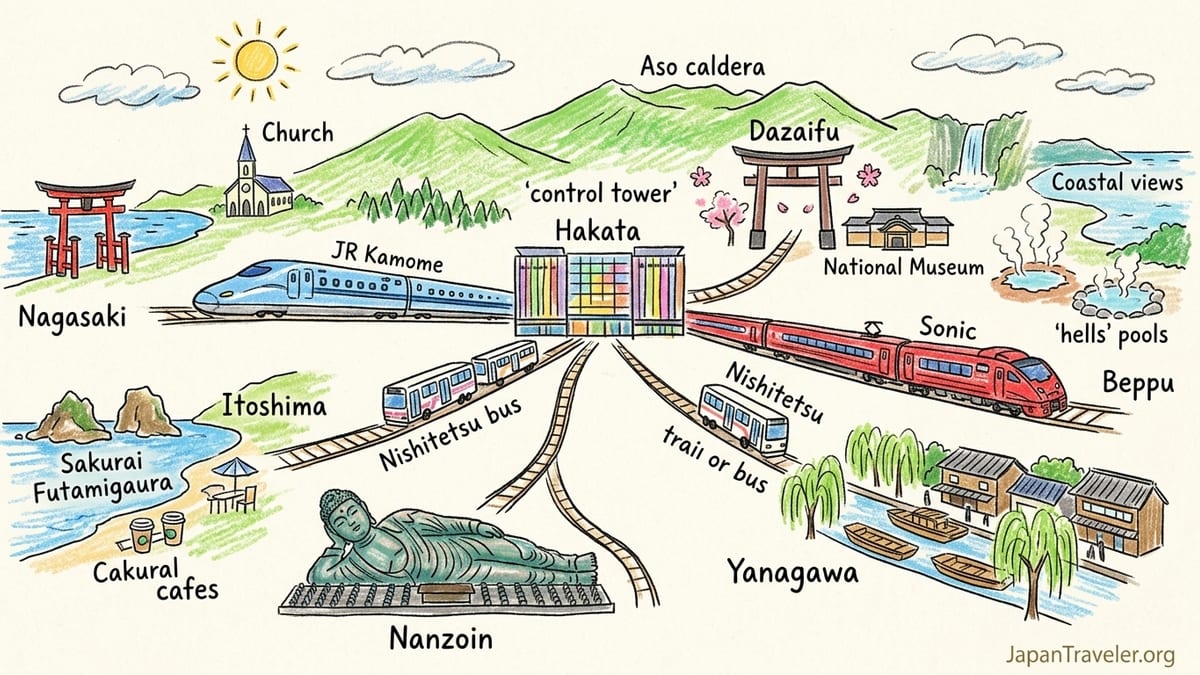
Fukuoka as Your Kyushu Hub
Think of Fukuoka, and especially Hakata Station, as the control tower for Kyushu. From here, JR Kyushu’s Sonic limited express runs along the north coast to Beppu and Oita in around 2 hours, while transfer connections via Takeo Onsen link you to the Nishikyushu Shinkansen for Nagasaki in roughly 1 hour 20 to 40 minutes depending on the train you choose. Nishitetsu’s Tenjin and Fukuoka stations funnel you south and west toward Dazaifu, Yanagawa and the suburbs of Itoshima. For most visitors this means you can keep one hotel in Fukuoka and treat much of northern Kyushu as your backyard.
In practice, day-tripping from Fukuoka works best within a travel time of about 90 minutes one way. That comfortably covers Dazaifu, Yanagawa, Itoshima, Nanzoin, Mojiko and even Beppu or Nagasaki if you accept an early start and a late return. Once you are looking at 2.5 to 3 hours each way, which is the reality for places like the Aso caldera or the gorge of Takachiho, it becomes smarter to plan at least one overnight stop so you are not spending more time in transit than on the ground.
JR Kyushu offers area rail passes that can make these trips cheaper if you are stacking several long journeys into a few days. The Northern Kyushu Rail Pass, for example, is typically good value if you plan to visit both Nagasaki and Beppu plus perhaps a side trip to Kokura or Kumamoto. For shorter hops to Dazaifu, Yanagawa or Nanzoin, local tickets or IC cards such as Suica or ICOCA are usually simplest, while some canal-boat and temple combinations are bundled into set tickets sold at stations.
Guided tours can fill in the gaps when direct public transport is less convenient. In Fukuoka you will see day tours advertised that combine Dazaifu, Nanzoin’s giant reclining Buddha and the seaside of Itoshima into one loop, usually by minibus. There are also more ambitious day and overnight tours from Fukuoka up to Aso or as far as Takachiho Gorge, which can be appealing if you do not want to navigate rural transfers or drive yourself.
Dazaifu: Classic Half-Day Escape
Dazaifu is the archetypal Fukuoka day trip. From Nishitetsu Fukuoka (Tenjin) Station, frequent trains run to Nishitetsu Futsukaichi in around 15 to 25 minutes, where you change to the short Dazaifu Line for a 5 minute hop to Dazaifu Station. The total journey usually takes about 30 to 40 minutes and costs only a few hundred yen each way, which makes it an easy outing even if you have just a spare morning. There are also seasonal direct “Dazaifu Liner” buses from Hakata Station that drop you close to the shrine approach.
Visitors come mainly for Dazaifu Tenmangu, a major Shinto shrine popular with students who pray for exam success, and for the Kyushu National Museum on the hillside behind it. A typical pattern is to arrive by 10:00, stroll the shop-lined approach, visit the shrine, then continue by escalator or walkway up to the museum for a few hours. On the way back you can detour to the atmospheric ruins of the former government office or to nearby temples such as Komyozenji, known for its rock garden.
Because the sights cluster within walking distance of the station, Dazaifu rarely requires a guided tour. However, combination tickets occasionally bundle rail fares from Tenjin with museum admission or limited-edition sweets, which can be worthwhile if you find them at Nishitetsu counters. If you prefer everything prearranged, half-day tours from Fukuoka sometimes add a short visit to Dazaifu onto an airport transfer or a city sightseeing loop.
A day trip is more than enough for Dazaifu, and an overnight stay there is rarely necessary unless you are attending a special festival or want a very quiet temple lodging. The saving in cost or time from moving hotels would be minimal compared with staying in Fukuoka and using the frequent trains.
Yanagawa: Canal Town and River Cruise
Yanagawa offers a different rhythm, with low wooden boats drifting along canals framed by willows and old storehouses. From Nishitetsu Fukuoka (Tenjin), direct limited express trains reach Nishitetsu Yanagawa Station in about 45 to 55 minutes. One-way fares are typically in the range of 1,000 yen or less, depending on the service. From the station you either walk or take a short shuttle to embarkation points for the canal cruises.
The classic experience is a “kawa kudari” downriver course of around 70 minutes, where a guide poles the boat under stone bridges and past traditional walls while giving commentary in Japanese. Several companies operate these cruises, and some sell convenient packages that include round-trip train fare from Tenjin, the boat ride and a set lunch such as unagi no seiro-mushi, Yanagawa’s signature steamed eel over rice. These packages are typically good value compared with purchasing each component separately.
For many travelers, Yanagawa fills a relaxed half to three-quarter day. If you leave Tenjin around 9:00, you can ride the canals, enjoy lunch, stroll a bit around the old town and still be back in Fukuoka by mid-afternoon. In winter there may be special “kotatsu boats” with heated tables, while some operators run evening or seasonal illumination cruises that return later than usual.
An overnight stay in Yanagawa is mainly for those who want a small-town ryokan experience, perhaps with riverside views. From a pure logistics standpoint, the town works best as a day trip from Fukuoka: hotels there are fewer and early-morning or late-night transport choices are limited compared with city connections out of Hakata and Tenjin.
Itoshima and Nanzoin: Coastal Views and a Giant Buddha
West of Fukuoka, Itoshima has emerged as a laid-back beach and cafe escape. From Hakata or Tenjin, the JR Chikuhi Line connects you to stations such as Chikuzen-Maebaru in around 35 to 45 minutes, with local fares in the mid-hundreds of yen. From these stations you often rely on local buses or taxis to reach popular spots like the “couple rock” of Sakurai Futamigaura or stylish seaside cafes, so travel times can stretch if you are juggling infrequent buses.
Itoshima makes a great flexible day trip if you enjoy cycling, surfing or hopping between cafes and craft shops. Some visitors rent bicycles near the station and ride relatively flat coastal roads, while others book small-group tours that include transport from Fukuoka, a photo stop at Futamigaura’s torii gate in the sea, and a slow lunch at a farm-to-table restaurant. If you are traveling on weekends or during summer holidays, pre-booking any rental car or tour is a wise idea because local capacity is limited.
Nanzoin, by contrast, is a concentrated temple visit anchored by one of the largest bronze reclining Buddha statues in the world. It is accessed by JR from Hakata to Kido Nanzoin-mae Station on the Sasaguri Line, usually taking around 20 to 30 minutes with a simple local fare. From the station it is a short walk uphill to the temple complex, where paths weave around statues and prayer halls to the massive reclining figure.
Because both Itoshima and Nanzoin lie relatively close to Fukuoka, they are ideal for travelers who want low-commitment outings without early starts or long train rides. You can easily combine Nanzoin with an afternoon in central Fukuoka, or book a guided day tour that visits Nanzoin in the morning and an Itoshima beach for sunset. Overnight stays are only worth considering if you want to wake up beside the ocean or book a secluded guesthouse, but transport-wise you lose the advantages of Fukuoka’s wider dining and nightlife options.
Mojiko and Kitakyushu: Retro Port and City Scenery
North along the coast, Kitakyushu and its Mojiko Retro district are within straightforward reach from Fukuoka. From Hakata, JR trains via the Kagoshima Main Line and sometimes the Sonic limited express reach Kokura in around 15 to 20 minutes by shinkansen or about 45 to 60 minutes by local and rapid services. From Kokura, local trains continue another 15 minutes to Mojiko, with total travel times from Hakata typically between 45 and 70 minutes depending on whether you pay extra for the shinkansen segment.
Mojiko Retro is a compact waterfront area where Meiji and Taisho era buildings have been restored as museums, cafes and shops. Many travelers simply stroll the promenade, sample yaki curry, the local baked curry specialty, and perhaps walk across the Kanmon Strait footbridge or take a short ferry to Shimonoseki on the Honshu side. Since everything is clustered around Mojiko Station, there is no need for a guided tour unless you want a deeper historical focus in English or Korean.
Kitakyushu also offers Kokura Castle, industrial heritage sites and the night view from Mount Sarakura, which some domestic visitors rank among Japan’s most impressive cityscapes. To combine these in a day from Fukuoka you need to start fairly early and plan your transfers between Kokura, Yahata and Mojiko, using local trains and buses. A regional JR pass can be worthwhile if you are coupling Kitakyushu with onward travel toward Beppu or Oita along the same line.
Staying overnight in Kokura or Mojiko is rarely necessary for most itineraries, because hotel rates in Fukuoka are usually competitive and late trains back are frequent. However, if you are boarding an early morning ferry from Shin-Moji Port, or connecting to long-distance services the next day, one night in Kitakyushu can make sense and reduce backtracking.
Nagasaki and Beppu: Bigger Days that Sometimes Deserve a Night
Nagasaki and Beppu are the longest of the classic day trips from Fukuoka that still feel practical in a single day, especially for fast-paced travelers. To reach Nagasaki, you travel from Hakata Station on a limited express such as Relay Kamome to Takeo Onsen, then transfer to the Nishikyushu Shinkansen Kamome to Nagasaki. Timetables vary by departure, but typical total journey times are around 1 hour 20 to 1 hour 40 minutes each way. Fares in ordinary reserved class commonly fall in the 6,000 to 7,000 yen range for a one-way ticket if purchased on the day, with potential savings from advance-purchase web fares or rail passes.
Once in Nagasaki you have a full menu of sights: the Peace Park and Atomic Bomb Museum, the sloping streets of Dutch and Chinese quarters, Glover Garden and Mount Inasa’s nighttime view. Trams and local buses tie these together efficiently. A determined traveler could catch an early train from Hakata, spend 7 to 8 hours on the ground and return on an evening service, making it a very full but feasible day trip. However, many visitors find an overnight stay in Nagasaki more comfortable, allowing time for a relaxed dinner in the port area and a night view from the ropeway without worrying about the last train back.
Beppu sits on the opposite side of Kyushu, famous for hot springs and plume-like steam vents. Limited Express Sonic trains link Hakata to Beppu in roughly 2 hours, with standard adult one-way fares for unreserved ordinary cars usually in the range of 6,000 to 6,500 yen, and slightly higher for reserved seats or green car. Sonic trains typically operate at least once per hour and more often at busy times, but seat reservations are wise on weekends and during holiday periods.
A day trip to Beppu from Fukuoka is just enough to experience one or two hot spring baths and perhaps a circuit of the “hells,” the colorful hot spring viewing pools scattered around Kannawa and Kamegawa districts. Many travelers leave Hakata mid-morning, check in at a day-use onsen such as a hotel bathhouse, enjoy lunch and a short stroll among the steam, then take an early evening train back. If you want to mix sand baths, multiple onsen, the ropeway up Mount Tsurumi or side trips to nearby Yufuin, then scheduling at least one night in Beppu or Yufuin will make the experience far more relaxed.
For both Nagasaki and Beppu, JR Kyushu rail passes can significantly reduce costs if you are making return trips or combining several of these longer legs within a few days. As a broad rule, if you plan to ride the Relay Kamome and Kamome, plus at least one round trip on the Sonic between Hakata and Beppu within the validity period, it is worth comparing the combined ticket price against pass options before you travel.
Ambitious Guided Options to Aso and Takachiho
The volcanic landscapes of Aso and the dramatic gorge at Takachiho are among Kyushu’s headline natural sights, but they sit far enough from Fukuoka that they are best treated differently from straightforward day trips. Reaching Aso by rail typically involves traveling from Hakata to Kumamoto on the shinkansen in about 35 to 45 minutes, then changing to a local or limited express toward Aso Station, often for another 1.5 to 2 hours. To reach Takachiho, which currently lacks a train station, you generally rely on highway buses or private vehicles, with total travel times from Fukuoka frequently pushing 3.5 to 4.5 hours one way depending on route and transfers.
Given those distances, many visitors opt for guided tours that bundle transport, sightseeing stops and sometimes accommodation. From Fukuoka, you will find overnight itineraries that visit Aso’s crater area, the Kuju highlands and Takachiho over two or three days, usually by comfortable coach. These packages can be good value if you factor in what it would cost to rent a car, pay fuel and tolls and arrange lodgings yourself across rural areas where English support at smaller inns is still limited.
If you strongly prefer independent travel, one workable approach is to ride the shinkansen from Hakata to Kumamoto, spend a night there, then continue by bus or local train up to Aso the next morning. Another option is to base yourself in Beppu or Yufuin after traveling from Fukuoka, and take a guided day tour from there to the Kuju and Aso region, reducing your total backtracking. Whichever route you pick, it is wise to confirm current operating conditions for crater access and mountain roads, as these can change due to volcanic activity or weather.
Trying to visit Aso or Takachiho as a pure day trip from Fukuoka is technically possible on certain fast bus routes if everything lines up, but it leaves little margin for delays and often results in more time staring out of windows than enjoying the mountains or gorge. Unless your schedule is extremely tight and you are comfortable with a very long day, the smarter decision is to treat these destinations as separate overnight excursions, whether self-planned or as part of an organized tour.
Choosing the Right Day Trip from Fukuoka
When you are deciding between Dazaifu, Yanagawa, Itoshima, Nanzoin, Mojiko and the bigger days to Nagasaki or Beppu, start by weighing travel time against what you enjoy most. If your priority is classical culture and museums with minimal transit, Dazaifu wins on convenience. For a slower pace with a distinctive local experience, Yanagawa’s canal boats or Mojiko’s retro port atmosphere fit well. If sea views and cafes appeal, Itoshima feels tailor-made, while Nanzoin delivers a temple hit with minimal planning.
Budget is another factor. Short hops to Dazaifu, Nanzoin or Itoshima are inexpensive, and you can rely on IC cards or regular paper tickets bought on the day. To keep costs in check for Nagasaki and Beppu, consider whether a JR Kyushu rail pass suits your itinerary, especially if you will also travel to Kumamoto or Kagoshima during your stay. Occasionally, discount web fares from JR Kyushu reduce the price of reserved seats when booked a few days ahead, though these often have limited seat allocations and may sell out at busy times.
Tour availability can tip the balance if you value ease of logistics over absolute flexibility. For example, a small-group tour that loops Dazaifu, Nanzoin and Itoshima in one day can help first-time visitors see more without studying timetables, while a guided Beppu and Yufuin day trip from Fukuoka can handle hotel pick-up, Sonic train tickets and local transfers between hot spring districts. More specialized tours might focus on photography in Itoshima, food in Nagasaki or industrial heritage in Kitakyushu.
Finally, think about whether an overnight stay might deepen your experience. If you want to soak in multiple hot springs at different times of day, Beppu or Yufuin deserve at least one night. If you dream of Nagasaki’s night view or wish to walk its sloped streets at dawn, plan to sleep there. For purely practical day trips like Dazaifu or Nanzoin, however, Fukuoka remains the most efficient and comfortable base, with more dining options and onward trains awaiting every evening.
FAQ
Q1. Can I visit both Dazaifu and Yanagawa in one day from Fukuoka?
Yes, it is realistic if you start early. Many travelers visit Dazaifu in the morning, then continue by Nishitetsu train from Tenjin to Yanagawa for an afternoon canal cruise, returning to Fukuoka by early evening. Be aware that you will spend a fair amount of time in transit and may want to prioritize just one highlight in each place.
Q2. Is Nagasaki really doable as a day trip from Fukuoka?
It is possible but makes for a full day. With the relay limited express and Nishikyushu Shinkansen combination, travel time is around 1.5 hours each way in typical cases, leaving perhaps 7 hours on the ground if you take an early train out and a later one back. Many visitors still prefer at least one overnight stay to enjoy the evening atmosphere and night views without rushing.
Q3. Do I need a JR Kyushu Rail Pass for these day trips?
No, you do not need a pass for short outings to Dazaifu, Nanzoin, Itoshima or Yanagawa, where regular tickets are usually simplest. A Northern Kyushu or All Kyushu rail pass becomes useful if you plan multiple long-distance rides such as Nagasaki, Beppu and perhaps Kumamoto or Kagoshima within a few consecutive days, but you should compare the total cost of individual tickets against the pass price before buying.
Q4. Are guided tours from Fukuoka worth it, or should I travel independently?
For straightforward routes like Dazaifu, Yanagawa and Mojiko, independent travel by train is easy and cost-effective. Guided tours become more valuable when destinations involve multiple transfers or rural buses, such as combined trips to Nanzoin and Itoshima, or more ambitious itineraries toward Aso and Takachiho. They also help if you prefer structured commentary in your language and do not want to worry about timetables.
Q5. When is an overnight stay better than returning to Fukuoka?
Overnights make sense when travel times from Fukuoka approach or exceed 2 hours each way, or when evenings are part of the appeal. Beppu, Yufuin and Nagasaki are common choices for one or two nights, as is the Aso region or Takachiho on longer routes. Shorter destinations like Dazaifu or Nanzoin do not usually justify moving hotels unless you specifically want a quiet local stay.
Q6. Can I use IC cards like Suica or ICOCA on trains and buses around Fukuoka and Kyushu?
Yes, most urban trains and many buses in and around Fukuoka accept major IC cards issued in Japan, including Suica, ICOCA and local cards. You can generally tap in and out for trips to Dazaifu, Nanzoin and parts of the Itoshima and Kitakyushu area, though some rural buses and private railway segments may still require cash or separate tickets. It is wise to carry a small amount of cash as a backup.
Q7. How busy do trains from Hakata to Beppu and Nagasaki get?
Limited express and shinkansen services can be quite busy on weekends, public holidays and during peak travel seasons such as Golden Week, Obon and New Year. For Nagasaki and Beppu, reserving seats in advance is strongly recommended at those times. On regular weekdays outside holidays, you can often still secure seats on the day, but popular departure times may sell out.
Q8. Is renting a car from Fukuoka a good idea for day trips?
Renting a car works well for places with limited public transport, especially rural parts of Itoshima, the Aso region and routes toward Takachiho. However, driving into and out of central Fukuoka can be congested, and parking in busy districts is not always cheap. For purely rail-friendly trips such as Dazaifu, Yanagawa, Mojiko, Nagasaki or Beppu, trains are usually more relaxing and predictable.
Q9. What time should I leave Fukuoka for a relaxed day trip?
For nearby destinations like Dazaifu or Nanzoin, leaving between 9:00 and 10:00 still gives ample time. For Yanagawa, Itoshima or Mojiko, aiming for an 8:00 to 9:00 departure allows for a leisurely lunch and sightseeing without rushing back. For Nagasaki or Beppu, catching trains around 8:00 or earlier is wise if you plan to return the same day.
Q10. Can I combine Beppu with Yufuin on a day trip from Fukuoka?
It is technically possible to visit both Beppu and Yufuin in one day by using limited express trains and local transfers, but it compresses two hot spring towns into a tight schedule. Most travelers either choose one for a day trip or stay overnight in one town, visiting the other as a side trip. If you try to see both in a single day from Fukuoka, be prepared for an early start and careful timetable planning.