


Kyushu rewards travelers who slow down. Japan’s southwestern main island is compact on the map yet vast in experience, from Fukuoka’s ramen alleys to Yakushima’s ancient cedar forests. For first-time visitors, the biggest mistake is trying to see Kyushu as a series of day trips from Fukuoka. Distances, winding mountain roads and limited rural transport mean you will enjoy the region far more if you choose several bases and build your trip around them. This guide explains how Kyushu fits together, what is realistically possible in one trip, and how to experience its headline destinations without turning your holiday into a blur of trains and buses.
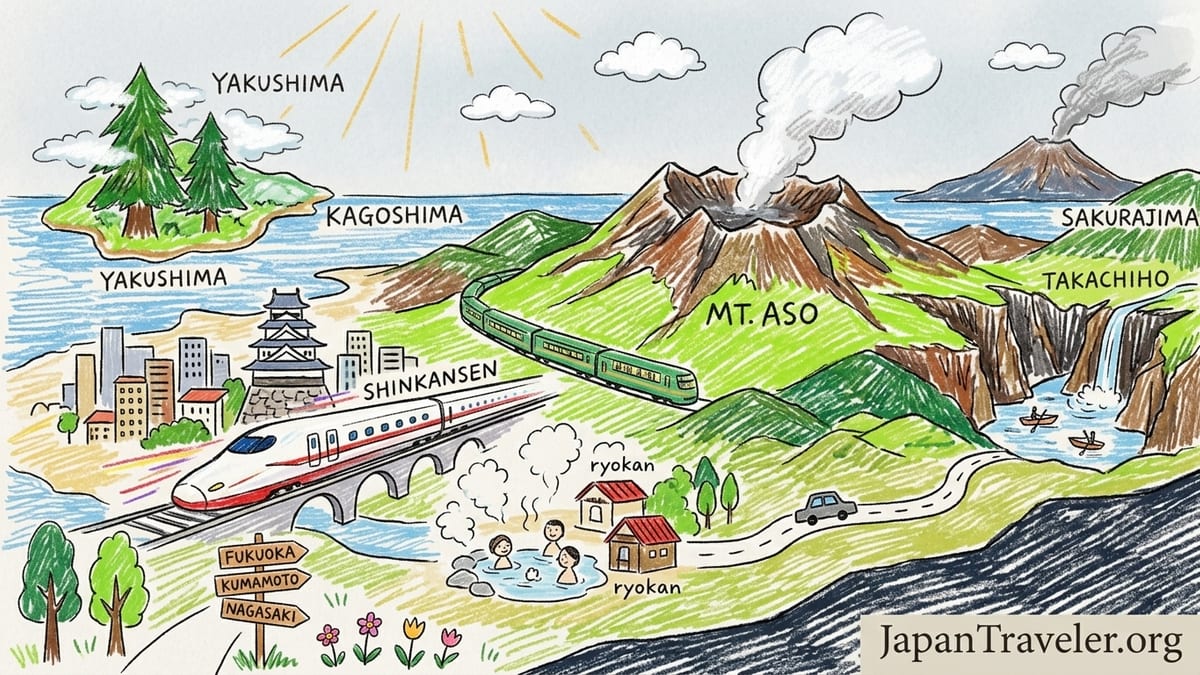
Understanding Kyushu’s Geography and Why Bases Matter
Kyushu is often described as “small” compared to Honshu, but that is misleading for trip planning. Fukuoka to Kagoshima is around 260 kilometers as the Shinkansen runs, and popular spots like Yakushima, Takachiho, Kurokawa Onsen and Mount Aso are well off mainline stations. On paper, Google Maps might show two to three hours between headline sights. In reality, transfers, infrequent buses, mountain roads and weather can stretch days thin. Treating Kyushu as a cluster of regions is far more realistic than assuming it can be conquered from one city.
For a first trip of about ten to fourteen days, most travelers do best with three or four bases. Common combinations include Fukuoka plus Nagasaki and Beppu or Yufuin for a northern focus, or Fukuoka, Kumamoto or Aso, and Kagoshima or Kirishima for a north–south route. Adding Yakushima typically requires at least two, preferably three nights there because access is by high-speed ferry or flight and departures can be weather affected. Thinking in bases forces you to prioritize, but it also gives you slower mornings, unhurried onsen time and the freedom to explore nearby villages or viewpoints.
A practical example: Fukuoka to Beppu takes around two hours by Sonic limited express train, and Beppu to Mount Aso by public transport can be another two to three hours with a connection in Kokonoe or Oita. Turning that into a day trip would leave very little time at Aso and have you watching the clock for the last bus back. Instead, basing in Beppu or Yufuin for two nights lets you do a full-day visit to Aso and still return to a hot spring and dinner. Similar logic applies to Takachiho Gorge from Kumamoto, or to Kurokawa Onsen, which is best experienced with at least one overnight stay rather than a rushed soak.
Car rental changes the equation but does not eliminate distance. Driving from Fukuoka to Kurokawa Onsen via the scenic Yamanami Highway can take about three hours without long stops, and it is normal to want to pull over at viewpoints, roadside markets and farm restaurants. Choosing Kurokawa as a base for a night or two allows you to explore the Mount Aso caldera, Daikanbo viewpoint and the Kuju Mountains at a relaxed pace before heading onward to other regions.
Fukuoka: Gateway City and Food-Lover’s Base
Most visitors start in Fukuoka, the island’s largest city and main transport hub. Hakata Station is the northern end of the Kyushu Shinkansen, with direct trains from Osaka via the Sanyo Shinkansen, and Fukuoka Airport has frequent domestic flights from Tokyo and other Japanese cities. That connectivity makes Fukuoka an excellent first or last base, particularly if you want a gentle landing with big-city conveniences before heading into rural Kyushu. You can easily spend two or three nights here at the start of a trip to adjust to the pace and sample the food scene.
Fukuoka is known across Japan for its casual, hearty cuisine. Hakata-style tonkotsu ramen, with rich pork-bone broth and thin noodles, is the headline dish. Visitors often compare a bowl at a small Hakata shop, where you order by buying a ticket from a vending machine, with a more polished chain experience. Equally iconic are the open-air yatai food stalls that line parts of the Naka River and Tenjin area in the evening. At a yatai, you might sit shoulder to shoulder with office workers over plates of grilled skewers, oden stew and local mentaiko, the spicy cod roe that Fukuoka is famous for.
Beyond ramen and yatai, the city is a good place to try regional specialties you will encounter elsewhere in Kyushu. Mizutaki, a simple chicken hotpot, appears on many menus and gives a preview of the kind of warming dishes that pair well with cool evenings in onsen towns. Modern Fukuoka also has a growing coffee and craft beer scene. Travelers using prepaid IC cards like Suica or local equivalents can tap through Fukuoka’s subway and bus network to reach neighborhoods such as Nishijin or Momochi Seaside Park, and still be back at Hakata Station in time for a Shinkansen or limited express train the next day.
As a base, Fukuoka works best for day trips to nearby destinations like Dazaifu’s Tenmangu Shrine or the pottery towns of Saga Prefecture rather than deep rural Kyushu. While you can technically day trip to Nagasaki or Beppu from Fukuoka, both are far more enjoyable with one or two nights in each city. Think of Fukuoka as your urban anchor point, a place to regroup between loops into the countryside rather than a single fixed point for the entire island.
Nagasaki and Northern Kyushu: History, Harbors and Scenic Rail
Nagasaki, on Kyushu’s west coast, deserves at least one or two nights in most itineraries. The city’s harbor setting, hills and complex history as one of Japan’s early windows to the world give it a different atmosphere to Fukuoka or Osaka. Most visitors split their time between the peace-related sites around the Atomic Bomb Museum and Peace Park, the historic neighborhoods of Dejima and the Dutch slopes, and evening viewpoints such as Mount Inasa, reached by ropeway or bus for one of Japan’s celebrated “night views.”
Reaching Nagasaki from Fukuoka has become faster with the opening of the Nishi Kyushu Shinkansen between Nagasaki and Takeo Onsen. Travelers from Hakata ride a limited express to Takeo Onsen and change to the Shinkansen, turning what used to be a longer conventional rail trip into a roughly two-hour journey in total depending on connections. This route underlines why Nagasaki works far better as its own base than as a day trip. An overnight stay gives time for museums, a tram ride through the old city, and a relaxed dinner featuring champon noodles or sara-udon, dishes that reflect Nagasaki’s Chinese influences.
Saga Prefecture sits quietly between Fukuoka and Nagasaki but is worth a stop if you enjoy crafts and smaller towns. Karatsu offers a castle and coastal scenery, while Arita and Imari are renowned for porcelain. These can be visited as side trips either from Fukuoka or as you move toward Nagasaki. On the northern coast of Kyushu, the Sonic limited express connects Fukuoka with Oita via Kitakyushu and the resort areas around Beppu, giving you the option of a loop that takes in both the west and east coasts without backtracking by highway bus.
JR Kyushu is known in rail enthusiast circles for its “Design & Story” sightseeing trains. In northern Kyushu, the Yufuin no Mori limited express stands out. Running between Hakata and Yufuin, this green train with large windows and wood-accented interiors turns the journey itself into part of the experience. Seats on such trains are reserved and often sell out on weekends or during holiday periods, so advance booking is wise if riding them is a priority. These trains support the broader idea of using multiple bases: you can travel from Fukuoka to Yufuin by Yufuin no Mori, stay two nights, then continue to Beppu or Aso, making each leg of the journey something to savor rather than rush.
Beppu, Yufuin and Oita: Onsen Towns and Rural Escapes
The Oita region on Kyushu’s east coast is one of Japan’s best introductions to onsen culture. Beppu is the more urban of the hot spring towns, spreading up the hillside in a low-rise cityscape punctuated by constant plumes of steam. Yufuin, inland at the foot of Mount Yufu, feels more like a small resort town, with boutique ryokan, galleries and cafes lining its main streets and paths around Lake Kinrin. Both can serve as good bases, with most first-time visitors choosing one for two or three nights rather than trying to shuttle between them daily from Fukuoka.
In Beppu, you can experience everything from simple public baths costing only a few hundred yen to high-end ryokan with private open-air tubs. Many travelers visit the “Hells” of Beppu, a series of vividly colored hot spring pools designed for viewing rather than bathing, then spend the evening soaking in more traditional baths. The city’s Yukemuri Observatory offers a classic view of steam rising from rooftops against the backdrop of the bay. From Beppu Station, buses run into the surrounding hills and to neighboring onsen areas, but services thin out in the evening, another reason to stay overnight rather than risk a late return from a distant bath.
Yufuin has a gentler pace. The limited express Yufuin no Mori brings visitors over rolling countryside, and the town itself is walkable from the station. Many accommodations here include two meals, with dinner featuring local beef, river fish and seasonal vegetables. Afternoon strolls to Lake Kinrin or through the back lanes often reveal small galleries and cafes housed in old wooden buildings. Because many ryokan serve carefully timed kaiseki dinners, basing yourself in Yufuin or Beppu avoids the stress of watching the clock from another city as the dinner window closes.
Both Beppu and Yufuin work well as jumping-off points for Mount Aso and the Kuju highlands, especially if you rent a car. From Yufuin, the Yamanami Highway runs through grasslands and past viewpoints into the Aso region, making for a memorable day with multiple short stops. Public transport options exist but typically require planning around infrequent buses, turning a day trip into something that can easily consume twelve hours. Parking at trailheads and roadside viewpoints is usually straightforward, reinforcing the value of a multi-night base with a rental car rather than a string of cross-island dashes.
Mount Aso, Kurokawa Onsen and Takachiho Gorge: Kyushu’s Mountain Heart
Central Kyushu is dominated by the vast caldera of Mount Aso, one of the world’s largest volcanic calderas. Towns like Aso and Minamiaso sit within sweeping grasslands, where narrow roads curve past grazing cattle and volcanic ridges. Aso is an excellent base for hikers and scenery lovers, with access to viewpoints such as Daikanbo on the caldera rim and to ropeways or shuttle buses near the active crater area when safety conditions permit. Because volcanic activity and weather can affect access, it is wise to treat Aso as a flexible base, using a two- or three-night stay to choose the best day for higher elevation outings.
North of Aso, Kurokawa Onsen is a compact, atmospheric hot spring village straddling a river valley. Instead of large hotels, Kurokawa is known for its cluster of ryokan, many of which open their baths to day visitors using a wooden onsen-hopping pass sold in the village. The appeal of Kurokawa lies in its scale: narrow lanes, earthen walls, bridges and lanterns that feel especially magical in the evening. Because public transport is limited, most visitors arrive by highway bus from Fukuoka, Kumamoto, Beppu or Yufuin, or by rental car via scenic roads like the Milk Road above the Aso caldera. An overnight stay here turns bathing into an unhurried ritual instead of a quick stop on a long driving day.
Takachiho Gorge, in neighboring Miyazaki Prefecture, is one of Kyushu’s most photographed natural sights. Sheer cliffs line a narrow river where rental rowing boats glide beneath Manai Falls. Above the gorge, Takachiho town is home to shrines associated with Shinto mythology and evening kagura dance performances. Public transport access is workable but involved, typically involving a train and then a bus from Kumamoto or Nobeoka. Many travelers therefore visit Takachiho as a day trip by rental car from Aso or as an overnight stop between Kumamoto and Miyazaki. Trying to fold Takachiho into a day trip from Fukuoka by public transport would mean more time riding buses than actually on the water or exploring the shrines.
Combining Aso, Kurokawa and Takachiho in a three or four-day loop is a classic central Kyushu road trip. A common pattern is to rent a car in Kumamoto or Oita, drive into the Aso caldera for hikes or viewpoints, stay in Kurokawa for a night of onsen, visit Takachiho Gorge the next day, then return the car in another city before continuing by rail. Each overnight base trims several hours off future journeys, freeing time and energy for walks, photography and lingering in hot spring baths.
Kagoshima, Kirishima and Yakushima: Southern Volcanoes and Island Forests
At Kyushu’s southern tip, Kagoshima faces the active volcano Sakurajima across its wide bay. The city itself mixes palm-lined streets with views of ash-dusted peaks, and a short ferry ride connects central Kagoshima to Sakurajima’s lava fields, observation points and coastal hot springs. The Kyushu Shinkansen links Kagoshima-Chuo Station with Fukuoka in around an hour and a half on the fastest services, making Kagoshima a logical southern anchor point if you are traversing the island north to south. It pairs well with stays in Kumamoto or Aso in the middle and Fukuoka at the northern end.
North of Kagoshima, the Kirishima region is known for its volcanic plateau, hiking trails and hot spring clusters. Kirishima Onsen has a range of lodgings from simple inns to resorts with large outdoor baths, while the Kirishima-Kinkowan National Park includes crater lakes and forested ridges. Travelers interested in hiking, but who do not have time for Yakushima, can base themselves in Kirishima for two or three nights and explore trails, roadside onsens and local farms. Buses connect Kirishima with Kagoshima Airport and Kagoshima-Chuo, though service frequency again encourages a base rather than long day trips.
Yakushima, an island south of Kagoshima, feels like a world apart. Reached by high-speed ferry from Kagoshima’s port in a few hours or by flight from Kagoshima or Fukuoka, it is famous for ancient cedar forests, mossy ravines and high rainfall. There are several round trips daily between Kagoshima and Yakushima by jetfoil, but services can be delayed or canceled in rough seas. This is the clearest example of why Yakushima cannot be treated as a casual side trip from the mainland. Most visitors stay at least two nights on the island, with three nights giving enough time for a full-day hike, a gentler coastal walk and a buffer day in case of weather disruptions.
On Yakushima, having a rental car is almost essential outside of guided tours. Accommodation is scattered around the coast, and trailheads for hikes such as Shiratani Unsuikyo or the routes toward Jomon Sugi are not clustered in one town. Buses do run, but at limited intervals that may not align with your hike duration or daylight hours. Treat Yakushima as its own dedicated base within your Kyushu trip, and allow time for both the big-name hikes and small pleasures like a soak in seaside hot springs or a slow drive along the less developed sections of the coast road.
Getting Around Kyushu: Shinkansen, Scenic Trains, Buses and Cars
Kyushu’s core rail network is centered on the Kyushu Shinkansen, which runs from Hakata in Fukuoka to Kagoshima-Chuo. Services named Mizuho, Sakura and Tsubame cover this line at up to around 260 kilometers per hour, with travel times between Fukuoka and Kagoshima typically under two hours on the fastest trains. Separate from this spine, the Nishi Kyushu Shinkansen connects Nagasaki to Takeo Onsen, with onward connections by limited express to Hakata. For many visitors, a regional rail pass from JR Kyushu can offer good value if you plan several long train days, though it is important to check which Shinkansen segments are included and which require separate tickets.
Beyond the Shinkansen, conventional limited express trains connect different parts of Kyushu in a more scenic, slower fashion. The Sonic links Hakata with Oita and Beppu, while other limited express services reach Miyazaki, Kagoshima and smaller coastal cities. JR Kyushu also operates sightseeing trains branded as “Design & Story” trains. Yufuin no Mori is one of the best known for visitors heading to Yufuin, and family-oriented trains like Aso Boy! operate on routes into the Aso region. These trains typically require seat reservations, and their timetables are more limited than regular services, so you should not rely on them for tight connections.
Highway buses fill in many gaps, especially to onsen towns and rural areas off the rail network. Direct buses run from Fukuoka to Kurokawa Onsen, Beppu, Yufuin and other resorts, and reservations are usually recommended on weekends and holidays. Costs are often comparable to, or a bit less than, limited express trains over similar distances, but journeys can take longer because of road conditions. In mountain regions like Aso or Takachiho, local buses may only run a few times per day, making them viable for patient travelers who are willing to build their days around fixed departures.
Car rental opens up far more flexibility, especially in central and southern Kyushu. Major companies have branches at Fukuoka Airport, Hakata Station, Kumamoto, Oita, Kagoshima and on Yakushima. Roads are generally well maintained, and signage includes English on main routes, though narrow rural lanes and weather conditions require caution. Costs vary, but renting a compact car for a day often works out similarly to several long-distance bus tickets for two people. The key is to combine car days with strategic bases: pick up a car in Kumamoto, spend three days looping through Aso, Kurokawa and Takachiho while staying in two or three places, then drop it in Oita or Miyazaki to continue by train.
Onsen Etiquette, Food and Seasons in Kyushu
Onsen are central to Kyushu’s appeal, and understanding basic etiquette will make your stay more comfortable. In almost all traditional baths, you wash thoroughly at a shower station before entering the shared tub. Swimwear is not worn, and tattoos may still be restricted in some older establishments, though many ryokan and some public baths are increasingly flexible or offer private baths for exclusive use. Towels should stay out of the water; most locals fold a small towel and rest it on their head or on the edge of the bath. If you are unsure, watch what others do or ask staff quietly.
Many travelers find it easiest to experience onsen culture by staying in a ryokan in places like Yufuin, Kurokawa or Kirishima. A typical stay includes an afternoon arrival, bathing before dinner, a multi-course kaiseki meal featuring local ingredients, and a second bath either in the evening or before breakfast. While top-tier ryokan can be expensive, more modest inns with shared baths offer similar rhythms at lower prices. Public onsen in cities like Beppu can cost the equivalent of a few dollars, making it possible to try several baths over the course of a day. Always check opening hours, as some baths close in the afternoon for cleaning.
Kyushu’s food reflects its climate and proximity to the sea. In addition to Fukuoka’s ramen, Nagasaki’s champon and sara-udon, and Oita’s chicken dishes, coastal cities across the island serve excellent sashimi and sushi, often with locally caught mackerel, amberjack and squid. In mountain regions, you will encounter hearty stews, charcoal-grilled meats and simple vegetable dishes. Seasonal sweets such as mikan oranges in winter or shaved ice desserts in summer appear in cafes and roadside stands, offering small, affordable tastes of local life.
Seasonality affects both what you eat and how you travel. Spring brings cherry blossoms and fresh greenery, with late March and early April particularly popular around cities and lower elevations. Summer is lush but can be very hot and humid, with a rainy season typically in early summer and a risk of typhoons that can disrupt ferries to places like Yakushima. Autumn, from late October into November in many areas, offers cooler temperatures and foliage in mountain regions like Aso and Kirishima. Winter is generally milder than northern Japan at sea level, but mountain roads can see snow and ice, and onsen towns take on a special charm with steam rising into crisp air. Aligning your plans with the season, and building in rest days within your chosen bases, will help you enjoy Kyushu’s variety rather than fight its climate.
The Takeaway
Planning a first trip to Kyushu is as much about what you leave out as what you include. The island’s Shinkansen backbone, distinctive cities, volcanoes, onsen towns and island forests invite ambitious itineraries, but distances and rural transport mean that a “see everything” approach quickly turns into a string of rushed checklists. Using three or four bases such as Fukuoka, Nagasaki, Beppu or Yufuin, the Aso and Kurokawa region, Kagoshima or Kirishima, and optionally Yakushima, allows you to slow down, explore side roads and adapt to weather.
Think in loops rather than lines. Link Fukuoka to Oita’s onsen towns and the Aso highlands, or connect Nagasaki’s harbor history with Kagoshima’s volcanic bay via central Kyushu’s mountains. Choose one or two signature experiences, whether that is soaking in a riverside bath at Kurokawa, rowing beneath the cliffs of Takachiho Gorge, riding a scenic JR Kyushu train or hiking through Yakushima’s misty forests, and build days around them with generous margins. Kyushu rewards this kind of patient, base-focused travel with moments of quiet beauty that linger long after the journey ends.
FAQ
Q1. Is it realistic to explore Kyushu using only day trips from Fukuoka?
For most travelers it is not. Distances to places like Beppu, Aso, Kurokawa, Takachiho and Kagoshima are long enough that round trips from Fukuoka can take six to eight hours, leaving little time on the ground. Using multiple bases such as Beppu, Aso, Nagasaki or Kagoshima makes itineraries more comfortable and flexible.
Q2. How many days should a first-time visitor spend in Kyushu?
If you only have a week, focusing on two or three bases such as Fukuoka, Nagasaki and Beppu or Yufuin works well. With ten to fourteen days, you can add central Kyushu around Aso and Kurokawa, and possibly Kagoshima or Kirishima. Adding Yakushima generally makes sense when you have at least twelve to fourteen days.
Q3. Do I need a rental car to enjoy Kyushu?
You can visit major cities like Fukuoka, Nagasaki, Beppu and Kagoshima entirely by train and bus. A rental car becomes very helpful for central mountain areas such as Aso, Kurokawa Onsen and Takachiho Gorge, and on Yakushima. Many travelers mix public transport with a few strategic rental days based from rural towns.
Q4. Which is better as an onsen base, Beppu or Yufuin?
Beppu offers a huge variety of public baths and feels like a lively onsen city, while Yufuin is smaller and more resort-like with many ryokan stays. First-time visitors who enjoy local urban atmosphere often choose Beppu, while those seeking a quieter, more boutique experience lean toward Yufuin. Both can pair well with day trips into the Aso region.
Q5. How should I include Mount Aso and Kurokawa Onsen in my itinerary?
A common pattern is to base for two or three nights in the Aso area or Kurokawa Onsen with a rental car. Use one day for viewpoints and short walks in the Aso caldera, another for onsen time and rural drives, and optionally a third for a trip to Takachiho Gorge. Arriving and departing by train from cities like Kumamoto or Oita keeps long-distance travel straightforward.
Q6. Is Yakushima worth the extra travel time?
For travelers who enjoy hiking, forests and quieter island life, Yakushima is often a highlight. The key is to allow enough time: at least two nights, ideally three, because access by ferry or plane is weather dependent and hikes are full-day commitments. It works best as a dedicated base linked with Kagoshima rather than as a rushed add-on to a short northern Kyushu itinerary.
Q7. What is the best season to visit Kyushu?
Spring and autumn are generally the most comfortable, with spring blossoms and fresh greenery and autumn foliage in the mountains. Summer is lush but hot, with a rainy season and potential typhoons that can affect ferries and mountain access. Winter is softer than in northern Japan, but higher areas like Aso and Kirishima can see snow, making onsen towns especially atmospheric.
Q8. Are JR Kyushu rail passes good value?
They can be, particularly if you plan several medium and long-distance train journeys within a set period, such as Fukuoka to Nagasaki, then to Beppu, and onward to Kagoshima. If your route relies heavily on buses, rental cars or long stays in one base, individual tickets may be more economical. It is worth sketching your exact train days before deciding.
Q9. What should I know about onsen etiquette in Kyushu?
Etiquette is similar to the rest of Japan: wash thoroughly before entering the shared bath, do not wear swimwear, and keep towels out of the water. Speaking quietly, avoiding photos and checking for any tattoo policies are all important. In doubt, ask staff or observe regulars. Many ryokan offer private baths that are ideal for first-timers.
Q10. How can I avoid making my Kyushu itinerary too rushed?
Limit yourself to three or four bases, and aim for at least two nights in each, with three nights in more remote spots like Yakushima. Group nearby sights together rather than zigzagging across the island, and accept that you will not see everything on one trip. Leaving open time in each base often leads to your most memorable, spontaneous experiences.