


Nagoya is one of Japan’s most practical bases for exploring the Tokai and central Japan region. Fast rail lines, dense local train networks and a web of highway buses make it possible to reach castles, onsen towns, samurai districts and World Heritage villages in a single day. Yet not every place that looks close on the map works well as a day trip in real life. This guide compares the major day trips travelers actually consider from Nagoya and breaks them into easy single-day options and destinations that are usually better with at least one overnight.
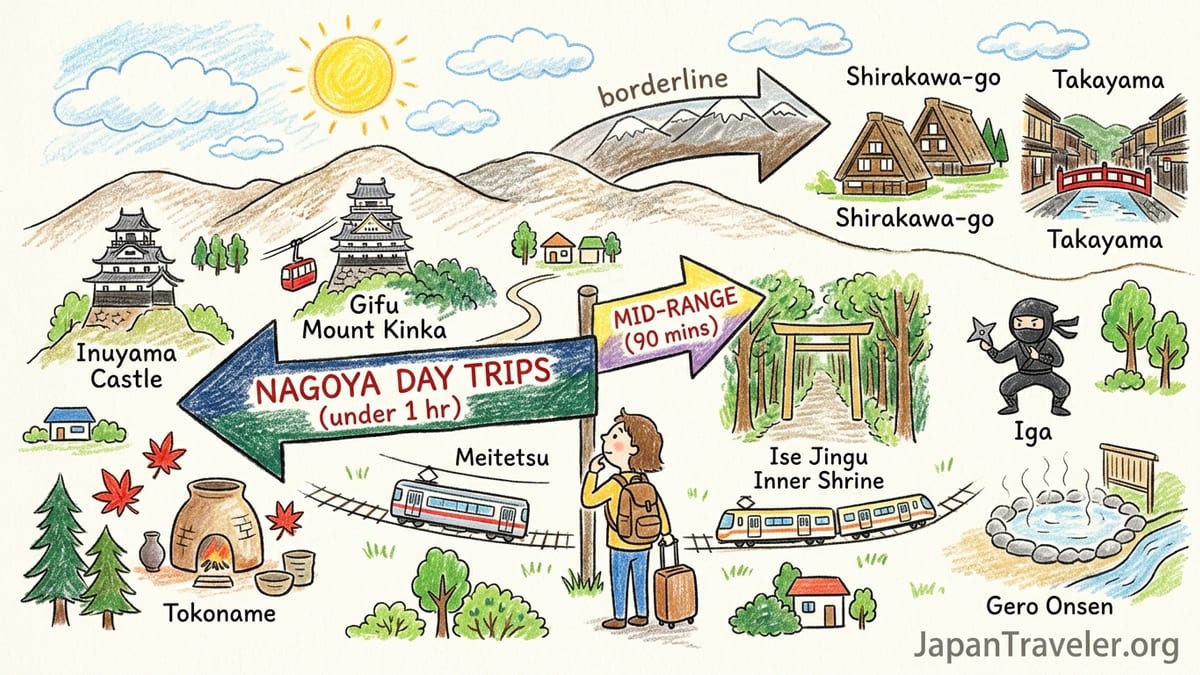
How to Choose the Right Day Trip from Nagoya
The key question for Nagoya-based travelers is not “What can I reach?” but “How much can I realistically see without turning the day into a rush?” On paper, highway buses make it possible to reach Takayama or Shirakawa-go in under three hours one way. In practice, that can mean 6 hours of transport for only 3 or 4 hours on the ground, which many visitors later describe as too tiring or too shallow.
To keep expectations realistic, this guide focuses on four elements for each destination: typical travel time one way, main transport type, approximate round-trip cost for an adult in standard class, and what you can reasonably see in a standard 9 to 11 hour day. Costs are indicative and can change, but they provide a useful order of magnitude when comparing options. Local passes, advance purchase discounts and rail passes can all lower the price slightly.
From Nagoya Station, most easy day trips sit within 30 to 70 minutes on a private Meitetsu or JR local line. These are places like Inuyama, Gifu, Tokoname and seasonal leaf spots such as Korankei, where you can leave after breakfast, spend a relaxed six or seven hours and still be back in time for dinner in Nagoya. Longe-range favorites such as Ise Jingu, Gero Onsen, Takayama and Shirakawa-go are still possible in one day, but start to push into what many travelers consider “borderline” or “too rushed” territory.
Below, destinations are grouped by practicality: truly easy day trips first, then the classic but longer excursions that work better when you can spare at least one night away from Nagoya.
Easy Day Trips Under 1 Hour: Inuyama, Gifu, Tokoname and Korankei
Inuyama is one of the simplest and most rewarding escapes from Nagoya. The Meitetsu Inuyama Line connects Meitetsu Nagoya Station with Inuyama Station in around 25 to 30 minutes on a regular express train. A one-way ticket is typically in the range of 600 to 700 yen in regular class, with no seat reservation required. This makes Inuyama an ideal half- or full-day outing even for travelers with rail passes that favor JR, because the private line is so quick and inexpensive.
With a relaxed 9 a.m. departure, you can be walking toward Inuyama Castle before 10 a.m. and still have time to tour the original wooden tenshu, stroll the Edo-style castle town streets, and stop at the nearby Urakuen Garden and Jo-an teahouse. Many visitors also add a riverside walk along the Kiso River or a cormorant fishing cruise in season. Realistically, most travelers spend 4 to 6 hours in Inuyama and return to Nagoya in the late afternoon, keeping total day length under eight hours including transport.
Gifu City is similarly straightforward. JR rapid trains from Nagoya to Gifu often take roughly 20 minutes, and Meitetsu runs parallel services to Meitetsu Gifu in just over 30 minutes. Tickets typically cost under 700 yen one way. Once there, a compact loop bus system and gentle walking paths let you link Gifu Castle on Mount Kinka, the Nagara River cormorant fishing area and the historic Kawaramachi district in one relaxed day. Many visitors time their return so they can still enjoy Nagoya’s izakaya scene in the evening.
Tokoname, on the Chita Peninsula near Chubu Centrair International Airport, sits about 35 minutes from central Nagoya on the Meitetsu line. A regular one-way fare from Meitetsu Nagoya to Tokoname is generally a little over 700 yen, with a modest supplement if you choose a limited express with reserved seating. Travelers spend the day following the Tokoname Pottery Footpath, exploring old climbing kilns and ceramic-lined alleys, then return easily before dinner. Korankei, famed for its autumn foliage, is less straightforward because it requires a combination of Meitetsu train to Toyotashi and seasonal buses or tours onward. On busy November weekends, the journey can stretch to 90 minutes or more each way with traffic, but on a normal weekday you can still manage a roughly nine-hour round trip from Nagoya including a relaxed walk along the gorge, shrine visits and a riverside snack.
Mid-Range Day Trips: Ise Jingu, Iga and Gero Onsen
Ise Jingu is one of the most significant shrines in Japan and regularly appears on lists of “must-do” Nagoya day trips. Direct Kintetsu limited express trains from Kintetsu Nagoya Station reach Ise-shi or Ujiyamada Station in around 80 to 100 minutes. A reserved seat on a limited express typically runs in the range of 3,000 to 4,000 yen one way depending on train type and booking method, so a return journey for one adult usually falls in the mid-6,000 to 8,000 yen range.
On a well-planned day, you can leave Nagoya around 8 a.m., arrive near Ise Jingu’s Geku (Outer Shrine) mid-morning, transfer to a short bus ride to Naiku (Inner Shrine), then spend a few hours walking the forested shrine approach and the traditional shopping street of Okage Yokocho. From there, many travelers either return directly to Nagoya by late afternoon or add a quick detour to Futami’s Meoto Iwa “Wedded Rocks” provided they accept a fairly tight schedule. Total day length typically stretches to 10 or 11 hours door to door.
Iga, in neighboring Mie Prefecture, is famous for its ninja history and Iga-ryu Ninja Museum. Access usually involves taking the Kintetsu line from Nagoya to Iga-Kambe, then transferring to the Iga Railway into Iga-Ueno. Total one-way travel time is typically around 90 minutes with a cost in the ballpark of 2,000 to 3,000 yen each way depending on train category. Once there, most visitors focus on Iga Ueno Castle, the ninja museum complex and the old town streets. The town itself is compact, so 4 to 5 hours is normally enough, making a full day of about nine to ten hours from Nagoya very realistic without feeling rushed.
Gero Onsen, in Gifu Prefecture, sits further into the mountains on the JR Takayama Line. Limited express trains from JR Nagoya Station cover the journey in roughly 90 minutes. A reserved seat on the limited express often falls somewhere around 4,000 yen one way, so a round trip for one adult generally runs near 8,000 yen in standard class. Many visitors use a day-trip ticket that includes discounted onsen access when available through local campaigns, but these offers vary by season.
On a day trip, it is realistic to leave Nagoya around 9 a.m., arrive about 10:30 a.m., then spend midday to late afternoon enjoying a few different baths. Some ryokan offer daytime onsen plans where non-staying guests can use their facilities for a few hours, sometimes with a light meal included. With an evening train back around 5 or 6 p.m., you can keep the total day length to roughly 9 hours. The main trade-off is that you only experience Gero’s hot springs and river scenery in daylight, not the more atmospheric illuminated streets and multi-course kaiseki dinners that overnight guests enjoy.
Borderline Day Trips: Takayama from Nagoya
Takayama frequently appears in Nagoya day-trip discussions, and it is technically achievable in one very long day. JR limited express trains from Nagoya to Takayama take around 2 hours and 20 to 30 minutes each way. Typical standard reserved fares sit in the broad range of 5,500 to 6,000 yen one way per adult, with unreserved slightly cheaper but often crowded during peak seasons. Highway buses from the Meitetsu Bus Center take about 2 hours and 45 minutes and can be slightly less expensive, although prices vary by operator and season.
In pure time terms, a same-day round trip by rail means about 5 hours on trains. If you leave Nagoya around 8 a.m., you will usually arrive in Takayama close to 10:30 a.m., walk into the preserved old town, explore the morning markets along the Miyagawa River, tour the Takayama Jinya former government office and grab a Hida beef lunch. You then have perhaps three to four solid hours in town before you need to make your way back for an afternoon or early evening train to Nagoya.
For some travelers, especially those who are short on time and do not mind a long day, this trade-off is acceptable. They get a taste of the old wooden merchant houses and mountain-town atmosphere and are back in Nagoya the same night. Others find that the combination of long train rides and crowds during cherry blossom or autumn foliage season makes the day feel compressed and tiring. Overnighting in Takayama allows for evening strolls when the streets quiet down, visits to more outlying temples and perhaps a side trip to nearby Hida Furukawa.
Travelers weighing a Takayama day trip from Nagoya should consider their appetite for transport-heavy days and their overall itinerary. If you already plan to pass through the Japan Alps elsewhere, saving Takayama for a night or two on a Tokyo to Kanazawa or Nagoya to Toyama route often delivers a better balance than trying to squeeze it into a single day from Nagoya.
Borderline Day Trips: Shirakawa-go and Combined Routes
Shirakawa-go, with its steep thatched gassho-zukuri farmhouses, is one of central Japan’s iconic sights. From Nagoya, the most straightforward option for independent travelers is a direct highway bus from the Meitetsu Bus Center to Shirakawa-go’s bus terminal. Typical timetables give a one-way journey of around 2 hours and 40 minutes. Round-trip fares depend on the operator and a seasonal fare calendar but are usually positioned in the mid-range for long-distance buses, often somewhat less than a Takayama train round trip but still a significant part of a daily travel budget.
A single day from Nagoya to Shirakawa-go looks, in practice, like this: depart around 8 a.m., arrive close to 11 a.m., have about 4 hours to explore the village, then board a 3 p.m. or 4 p.m. bus back, arriving in Nagoya early in the evening. During those four hours, travelers typically walk through the main Ogimachi village, visit at least one open farmhouse museum, climb or shuttle up to the observatory viewpoint and enjoy a casual lunch in a local restaurant. You can do all of that, but you have little flexibility for lingering at cafes or exploring less crowded side streets.
Many visitors also consider combined routes such as Nagoya to Takayama by morning limited express, Takayama to Shirakawa-go by mid-day bus, then Shirakawa-go back to Nagoya by late-afternoon direct coach. While it is possible to design such a circuit in one day by carefully matching timetables, it leaves very little margin for delays and results in an extremely transport-heavy experience. For this reason, most repeat visitors and local tourism offices subtly encourage at least one overnight, either in Takayama or at a minshuku in Shirakawa-go, to spread the travel and enjoy morning and evening light in the mountains.
Travelers determined to keep Shirakawa-go as a day trip from Nagoya often find it worthwhile to book bus tickets as early as reservation windows allow, especially during New Year, winter illumination events or the main snow season. Same-day walk-up tickets can sell out on peak weekends. If you are already staying in Takayama, shifting your Shirakawa-go visit to a half-day from there is usually more comfortable, as the bus ride is approximately 50 minutes one way, leaving more time in the village itself.
What Travelers Can Realistically See in a Single Day
Looking across all of these destinations, a pattern emerges. The easy sub-one-hour excursions like Inuyama, Gifu and Tokoname give you time to move at a walking pace without much clock-watching. A typical day might involve four to five distinct stops or experiences, such as castle, museum, old town streets and a cafe or onsen. Trains run frequently enough that you can adjust return times depending on weather or energy levels without losing much money on reservations.
The mid-range options such as Ise Jingu, Iga and Gero Onsen still sit comfortably within a 9 to 11 hour day, but you must be more selective. In Ise, for example, trying to cover both Geku and Naiku thoroughly, Okage Yokocho and an extra side trip to the coast often proves too ambitious for all but the most focused travelers. In Gero, adding more than two or three different baths plus a longer riverside walk can leave you rushing for the return train. Many travelers find that choosing a single theme, like “shrine and atmosphere” in Ise or “soak and relax” in Gero, leads to a more satisfying day.
The borderline mountain trips demand even sharper choices. In Takayama, you will realistically have time for the old town, one or two markets and perhaps a single indoor site like Takayama Jinya. In Shirakawa-go, focus naturally clusters around Ogimachi village and the viewpoint, leaving less scope for extended hikes or visiting outlying hamlets. If you hope to photograph the gassho houses in different light, shop for local crafts and sit for a full-course meal, an overnight becomes far more appealing.
In all cases, remember that Nagoya’s own sights and dining scene are part of the equation. A day that brings you back by 6 or 7 p.m. leaves time for hitsumabushi or miso katsu in Sakae, while a return closer to 9 or 10 p.m. from the mountains often means a quick station bento and an early night. Thinking about how each day trip fits into the rhythm of your overall stay can help you decide whether a technically possible long excursion is worth the fatigue.
Practical Decision Guide: Matching Day Trips to Your Style
If you value short train rides and low planning stress, prioritize Inuyama, Gifu and Tokoname as your first choices from Nagoya. All three are reachable in under about 40 minutes on frequent local or rapid trains, with round-trip transport costs that usually stay well below 2,000 yen per person in standard class. These destinations suit families with children, jet-lagged first-time visitors and anyone who prefers late starts and flexible return times.
Travelers who want a deeper cultural or spiritual experience in one big day should look closely at Ise Jingu, Iga and Gero Onsen. Expect roughly 90 minutes each way and round-trip transport costs that typically fall somewhere between 4,000 and 8,000 yen per person depending on train type and seat choice. These trips benefit from a bit more advance planning for train reservations and local buses, but still leave room for a proper sit-down lunch and an unhurried main activity, whether that is walking the cedar-lined paths of Ise or soaking in an outdoor bath above the Hida River.
Those considering Takayama or Shirakawa-go as day trips from Nagoya should be comfortable with three hours or more each way counting transfers and waiting time, plus total transport costs that often run into the mid-teens of thousands of yen for two adults. Budget travelers may find that the price of a round-trip ticket plus meals starts to resemble the cost of a simple overnight stay, especially in shoulder seasons when business hotels and guesthouses in Takayama offer moderate rates. This is one reason why so many experienced visitors recommend building at least one night into any plan that includes the Hida region or World Heritage gassho villages.
Finally, seasonal factors matter. Korankei in peak autumn color, Ise during major festivals or Shirakawa-go under deep snow all draw crowds that can lengthen travel times and strain reservation systems. From Nagoya, though, you still hold an advantage compared with travelers coming from Osaka or Tokyo, because your starting point sits closer to the region’s core. With a clear-eyed look at journey length, ticket costs and your own energy levels, you can use Nagoya as a flexible base for everything from gentle half-days to ambitious mountain adventures.
The Takeaway
From a practical standpoint, the best day trips from Nagoya fall into two clear groups. Inuyama, Gifu, Tokoname and, with a bit more effort, Korankei are genuinely easy single-day outings, each under roughly an hour away with modest costs and plenty to fill a relaxed schedule. Ise Jingu, Iga and Gero Onsen sit in the middle, rewarding travelers who can manage about 90 minutes of travel each way and who are happy to shape their day around one primary theme such as shrines, history or hot springs.
Takayama and Shirakawa-go, meanwhile, occupy a different category. They are absolutely reachable from Nagoya in a day, and for some itineraries that is the only realistic option. Yet the long transport times and relatively high costs mean many visitors ultimately feel that at least one overnight stay delivers better value, more atmosphere and a less rushed experience. Treating these as overnight excursions rather than true day trips often transforms them from “checklist” stops into highlights of a central Japan journey.
When planning from Nagoya, start by deciding how many “long days” you are willing to have in your trip. Fill the remaining slots with easy, nearby excursions and time in the city itself. With that framework, you can mix a half-day at Inuyama Castle, a contemplative circuit of Ise Jingu and, if your schedule allows, an overnight in Takayama or Shirakawa-go into a varied, manageable itinerary that matches your travel style rather than exhausting it.
FAQ
Q1. Is Takayama really doable as a day trip from Nagoya?
It is technically possible, with around 2.5 hours each way by JR limited express, but you will only have about three to four usable hours in town. Many travelers feel that at least one overnight in Takayama makes the journey more worthwhile.
Q2. How long does it take to reach Shirakawa-go from Nagoya?
Direct highway buses from near Nagoya Station take roughly 2 hours and 40 minutes one way, so a same-day return usually means about 6 hours on the road and around 4 hours in the village.
Q3. What is the easiest day trip from Nagoya for first-time visitors?
Inuyama is one of the easiest. It is around 30 minutes by Meitetsu train, inexpensive, and offers an original castle, historic streets and riverside scenery in a compact area.
Q4. Can I visit both Ise Jingu and Meoto Iwa in one day from Nagoya?
Yes, if you use early Kintetsu limited express trains and keep a close eye on local bus times. Expect a long but manageable 10 to 11 hour day, with a relatively tight schedule.
Q5. Is Gero Onsen worth visiting if I am not staying overnight?
Gero works well as a day trip if your main goal is to try hot springs. With about 90 minutes each way by limited express, you can enjoy a few public baths or a daytime plan at a ryokan and still return to Nagoya in the evening.
Q6. Which Nagoya day trip is best for autumn leaves?
Korankei Gorge is one of the region’s classic foliage spots. Reaching it from Nagoya involves a combination of train and bus, and in peak November season crowds can extend travel times, but it is still manageable in a single day.
Q7. Do I need to reserve train seats for day trips like Inuyama or Gifu?
For short hops to Inuyama or Gifu on local or rapid trains, reservations are not required and are often not available. You simply tap in with an IC card or buy a regular ticket and board the next train.
Q8. Is a rail pass necessary for these Nagoya day trips?
A nationwide rail pass is not essential for short trips like Inuyama, Gifu or Tokoname. For longer journeys to Ise, Gero, Takayama or beyond, regional passes or discount tickets can help, but you should compare their cost against individual fares.
Q9. Which destination is best for travelers who want a quiet, traditional town without long travel?
Inuyama and nearby Gifu both offer traditional streets and castle views within about 30 minutes of Nagoya, making them good choices if you want atmosphere without a long train ride.
Q10. How early should I book buses from Nagoya to Shirakawa-go?
During busy periods such as winter snow season or major holidays, it is wise to reserve as soon as the booking window opens, because direct buses can sell out. Outside peak times, booking a few weeks ahead is usually enough for most travelers.