


The Japanese Grand Prix at Suzuka is one of Formula 1’s most atmospheric races, but the very things that make it special also make logistics more complicated. Suzuka is a compact city in Mie Prefecture, served by overlapping private and JR rail lines, shuttle buses and temporary Grand Prix services that only appear on race weekend. Ordinary journey-planner apps often fail to capture this picture. To get the most from your weekend, you need to plan around how the network is reorganized specifically for Formula 1 fans.
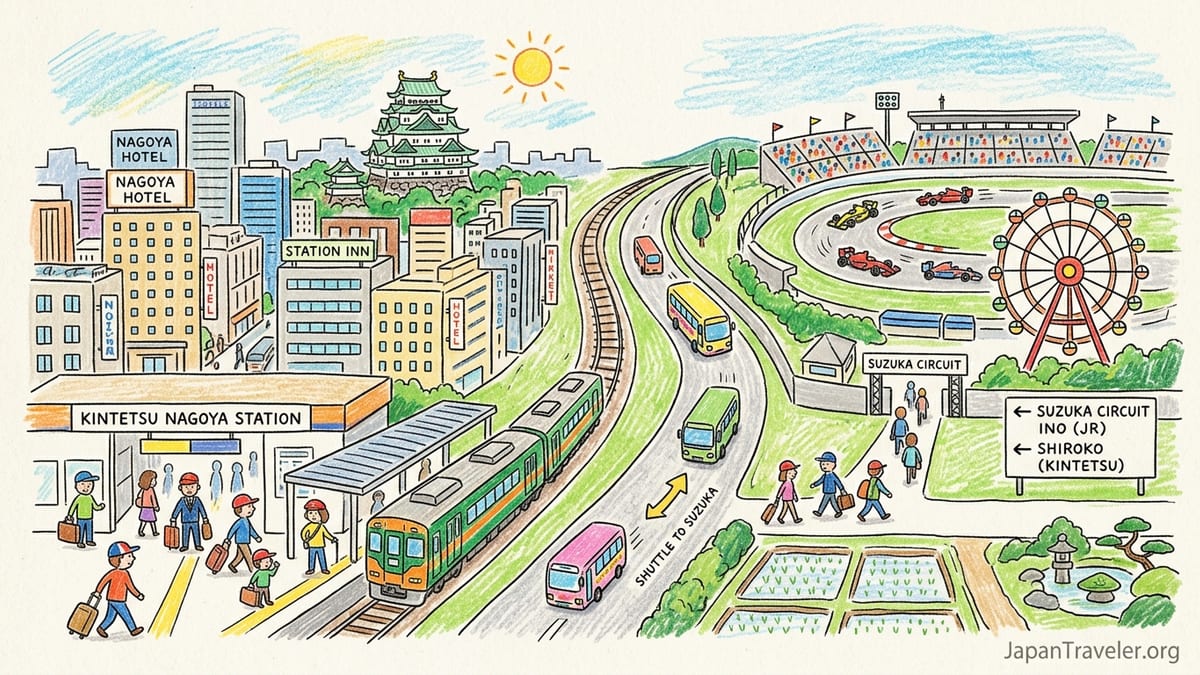
Should You Stay in Suzuka or Base in Nagoya?
Most first-time visitors assume they should stay as close to Suzuka Circuit as possible. In reality, the decision is a trade-off between atmosphere and flexibility. Suzuka city has a limited number of business hotels and guesthouses, many of which are fully booked by teams, media and repeat visitors as soon as the next year’s dates are confirmed. When you do find a room in Suzuka or nearby towns such as Shiroko or Yokkaichi, prices over Grand Prix weekend are usually much higher than in a normal week and minimum stays of two or three nights are common. For fans who want to walk or take a short shuttle to the circuit and do not mind very quiet evenings, this can still be worth it.
Nagoya, about 60 to 90 minutes away by race-week trains and buses, is the alternative base that many international fans now prefer. It is a major city with a full range of hotels, from international chains near Nagoya Station to business hotels and hostels in Sakae. Because it serves normal business and tourism demand as well as Formula 1, Nagoya often offers more reasonable prices and availability, especially if you book three to six months before the race. You also gain restaurant options, nightlife and easy onward connections by Shinkansen to Tokyo, Kyoto and Osaka.
In practice, the choice often comes down to your priorities for mornings and nights. Staying near Suzuka Circuit or around Shiroko Station usually means early starts are less stressful and you can linger at the track after the race without worrying as much about missing your last train. Basing in Nagoya means you may be standing in bus queues and crowded platforms at the same time as thousands of other fans, but you return each night to a big-city environment with more to do and see. Couples and groups combining the Grand Prix with a broader Japan itinerary often base in Nagoya; hardcore fans who mainly care about track time tend to accept Suzuka’s limited infrastructure for the simplicity of being nearby.
A hybrid strategy can also work well. Some visitors stay in Nagoya for Thursday and Friday, when crowds are smaller, then move to a Suzuka or Yokkaichi hotel for Saturday night to avoid the heaviest post-qualifying and post-race pressure on the lines. This does require more reservation juggling, but it reflects the way the transport network actually behaves under Grand Prix strain.
Understanding Suzuka’s Grand Prix Transport Network
Suzuka Circuit sits in a suburban area reachable by two main public transport corridors. The first is the JR Central and Ise Railway route to Suzuka Circuit Ino Station, about a 20 to 25 minute walk from the circuit’s main gates. On ordinary days, this involves a transfer from Nagoya via the Kansai Main Line and Ise Railway, taking around 60 to 90 minutes with a change at Yokkaichi or Suzuka. On race weekend, JR Central overlays special direct services from Nagoya to Suzuka Circuit Ino, often branded as Grand Prix or limited express trains, which replace or supplement the usual Rapid Mie services and shorten the journey to roughly an hour.
The second corridor is the Kintetsu Railway line to Shiroko Station combined with shuttle buses to the circuit. Kintetsu’s Nagoya Line between Kintetsu Nagoya and Shiroko normally offers frequent local and express services taking around 35 to 50 minutes depending on train type. On Grand Prix weekend, Kintetsu adds extra capacity and Suzuka city arranges intensive shuttle bus operations from Shiroko Station direct to the circuit. The bus ride is usually around 20 minutes in light traffic, but at peak times the bottleneck is often boarding rather than driving, with reports of queues lasting well over an hour after qualifying or the race.
On top of these core routes, the circuit and local authorities have added direct express buses on certain days from Nagoya and other cities, as well as contracted tour buses tied to specific ticket packages. There are also authorized ride-share arrangements and occasional charter services which are heavily regulated. All of this means that, for three days a year, Suzuka’s access map no longer looks like normal regional transport. Trains that appear in everyday timetables may be replaced by temporary services, and platforms at Nagoya, Shiroko and Suzuka Circuit Ino are marshalled by staff with bilingual signs directing flows of fans.
The key for travelers is to recognize that this overlay of special capacity is designed around when large crowds move, not around neat half-hour intervals. Before the first practice session and just after major on-track events, movement is dominated by waves rather than steady streams. Planning your movements by “wave” instead of by timetable will make your weekend smoother.
Getting from Nagoya to Suzuka: Ino vs Shiroko in Practice
From Nagoya, almost every fan chooses between two main options: the direct or semi-direct JR route to Suzuka Circuit Ino, and the Kintetsu route to Shiroko plus shuttle bus. Each has distinct advantages and pain points that only emerge under Grand Prix conditions. In theory, the JR route with special limited express services sounds ideal, delivering you nearly to the circuit gates with no bus transfer. In practice, those special trains are limited in number and require either advance reservations or patient queuing. After the race, the platform at Suzuka Circuit Ino can become extremely crowded, and once the most popular departures are full you may wait a long time before your train actually leaves for Nagoya.
The Shiroko route spreads the load across many more trains and buses. From Kintetsu Nagoya you can take a reserved-seat limited express, a rapid express or a local train, reaching Shiroko in as little as about 40 minutes. On weekdays you might choose the limited express for comfort, but during F1 many experienced fans deliberately ride slightly slower non-reserved services because they run more frequently and keep your options open if you decide to travel earlier or later than planned. At Shiroko, you follow clearly marked signs to shuttle bus stops where buses fan out toward different circuit gates. In recent years, local operators have run shuttles almost continuously during peak arrival and departure windows.
Real-world experiences show that neither route is immune to congestion. Fans who used Suzuka Circuit Ino in recent years reported needing close to three hours to get from their grandstand seats back to Nagoya on Sunday if they waited for the podium ceremony and on-track celebrations. Others who relied on the Shiroko shuttle after the race described queues snaking multiple blocks from the bus stops, with staff warning of waits around 90 to 120 minutes before boarding. By contrast, those who left their seats as the cars took the checkered flag, or skipped the podium entirely, often managed to reach Nagoya in roughly 90 minutes using the same infrastructure.
Because Suzuka has invested in both corridors, the choice may come down to where your accommodation is and which direction you are heading afterward. If you are based near Nagoya Station and plan to continue by Shinkansen to Tokyo or Osaka on Sunday night, the JR route to Suzuka Circuit Ino aligns neatly with onward JR connections when trains are running smoothly. If you are staying in a Kintetsu-served city such as Osaka Namba or Kyoto via Kintetsu, or you are sensitive to long-standing queues, the Shiroko shuttle system via Kintetsu often feels more manageable, especially if you time your departures away from the absolute peaks.
Race-Weekend Timings: When to Travel and What to Expect
On paper, Nagoya to Suzuka Circuit via train and shuttle can be described in neat numbers. Normal Kintetsu trains to Shiroko take around 40 to 50 minutes. The bus needs roughly 20 minutes. JR special services to Suzuka Circuit Ino are scheduled around an hour. But during the Japanese Grand Prix these numbers only tell part of the story because queuing and crowd control can easily double or triple total door-to-door time. Fans who treat the timetable as if it were an ordinary weekday schedule are often the ones sprinting between platforms or arriving late to practice sessions.
For Friday practice, demand is generally lighter, but that makes it a perfect dry run. If you are basing in Nagoya, consider leaving between 8:00 and 9:00 in the morning to arrive comfortably for the first session, using either route. Pay attention to signage and where staff direct race-goers, note where queues start to build, and time your return by leaving the circuit either before the final support races or after the main crowd has thinned. This rehearsal will teach you more about Suzuka’s practical geography than any map.
Saturday and Sunday are tighter. To be in your seat for qualifying or the race without stress, plan to leave Nagoya at least two and a half to three hours before the scheduled green flag. That means departures around 9:00 to 10:00 for early afternoon sessions. If you want to explore the fan zone, merchandise stalls and Honda museum exhibits before the track action, leave even earlier. After the sessions, your strategy matters even more. Many seasoned visitors choose one of three patterns: leaving as soon as the main session ends and watching the podium on screens elsewhere; staying at the circuit for two hours after the race to wander the park, eat and wait for queues to shrink; or accepting the wait and using the bus or train queues as time to decompress, armed with snacks and drinks.
Whatever your choice, remember that Suzuka’s operators intentionally push extra capacity into short windows. Late morning inbound and mid-evening outbound periods have the most special trains and buses stacked up. Early afternoon or late night movements may rely more on ordinary services, which can be slower and more crowded with everyday commuters. That is why two friends taking theoretically identical routes can report wildly different journey times: one left in the sweet spot when extra services were rolling in, the other stood in a queue while those same services already pulled away full.
Arriving via Tokyo, Osaka, Kyoto or Chubu Centrair
International visitors usually approach Suzuka from four main gateways: Tokyo, Osaka, Kyoto and Chubu Centrair Airport near Nagoya. Each involves a slightly different chain of trains, and all benefit from planning around the Grand Prix overlay. From Tokyo, the natural path is by Shinkansen to Nagoya, taking roughly 1 hour 40 minutes on the fastest services. Many fans board a morning train from Tokyo Station or Shinagawa, drop bags at a Nagoya hotel, then connect to Kintetsu or JR for the final leg to Suzuka the same day. Because race-weekend Shinkansen seats can also be busy, reserving your Tokyo to Nagoya leg when bookings open is wise if you are traveling on Friday afternoon or Sunday night.
From Osaka and Kyoto, there are two philosophies: ride the JR Shinkansen to Nagoya and follow the same pattern as Tokyo travelers, or stay within the Kintetsu network and connect directly toward Shiroko via Osaka Namba or Kyoto Station. The JR route is usually faster in pure travel time but costs more, while the Kintetsu alternative may be cheaper and take you directly into the corridor where Suzuka’s shuttle buses originate. For example, a fan staying in Osaka Namba might take a Kintetsu limited express through to Yokkaichi or Tsu on Thursday, then a short local hop to Shiroko on Friday and Saturday, avoiding Nagoya Station altogether.
Chubu Centrair Airport, the closest international gateway, sits on an artificial island linked by the Meitetsu Railway to Nagoya in about 30 minutes. Typical Grand Prix itineraries see fans land at Centrair, ride the airport express to Meitetsu Nagoya, then walk through clearly signed passages to either JR Nagoya or Kintetsu Nagoya. If you arrive midday on Friday or early Saturday, you can feasibly go straight from the plane to Suzuka, but it is usually more comfortable to check into a Nagoya hotel first and head to the circuit with a lighter day bag. Airport limousine buses also serve cities like Yokkaichi, which can be attractive if your accommodation is in Mie Prefecture rather than Nagoya itself.
Whichever gateway you use, avoid last-minute arrivals on Saturday morning or Sunday lunchtime. Immigration queues, luggage delays and Shinkansen reservations all add friction long before you reach Suzuka’s special services. A safer pattern is to schedule your long-distance journey the day before the session you most care about. For example, fly into Tokyo on Wednesday, take the Shinkansen to Nagoya on Thursday, enjoy Thursday evening in the city and travel to Suzuka for Friday’s pit walk or practice without jet lag and timetable pressure. Treat Suzuka as the final, shorter link in a longer chain rather than a place you must sprint to directly from the airport.
How and When to Buy Tickets for Trains and Shuttles
Because Suzuka’s race-weekend transport includes both normal public services and special temporary trains, ticketing can confuse first-time visitors. For JR routes to Suzuka Circuit Ino, you may see references to special Grand Prix limited express trains that require a reserved seat ticket on top of a base fare. These are often sold through JR machines and counters in the weeks leading up to the event, and some operators also work with apps or race-specific passes that can only be activated once you are physically in Japan. Securing a round-trip reservation from Nagoya to Suzuka Circuit Ino in advance reduces stress at the station and often allows you to join shorter boarding queues.
On the Kintetsu side, you can generally board local and rapid express trains with a simple base-fare ticket purchased on the day, while limited express services offer reserved seats for a surcharge. Many experienced race-goers skip the limited express entirely and rely on the dense pattern of non-reserved trains, especially early in the morning when they can still find seats. If you do choose limited express, buying your tickets a day or two ahead at Kintetsu Nagoya Station or via official sales channels in Japan is helpful, since popular departure times around 7:30 to 9:30 in the morning and 17:00 to 20:00 at night can sell out.
Shuttle bus tickets between Shiroko Station and Suzuka Circuit are usually sold either as simple pay-on-boarding fares or as special race-day tickets and passes. In some years, direct express buses from Nagoya or other cities have required advance online reservations linked to your race ticket, with limited seats per departure. These schemes can change from year to year as operators refine their crowd-management plans, so you should always check the current year’s Suzuka Circuit transport page and any official fan guides. As a rule of thumb, if a bus or train is branded as direct, Grand Prix express or reserved, you should assume that some form of pre-booking or time-specific ticket will be involved.
For visitors carrying long-distance rail passes, such as a nationwide JR pass, note that these typically cover standard JR services but do not extend to Kintetsu or private shuttle buses, and they may not fully cover certain special Grand Prix trains depending on how they are designated. It is worth doing the arithmetic: sometimes a simple combination of Shinkansen ticket, local Kintetsu fare and shuttle bus is cheaper and more flexible than a pass you feel obliged to “get value” from. Treat the Suzuka leg as a separate mini-project and be prepared to pay out of pocket where that yields shorter queues or guaranteed seats.
Why Normal Transport Timings Do Not Apply During the Grand Prix
Journey-planning apps and online timetables are built around the idea of stable, recurring services. Suzuka’s Grand Prix weekend is the opposite of that environment. JR Central and Kintetsu both overlay temporary trains, re-label existing services and adjust stopping patterns to funnel huge crowds through relatively small stations. Shuttle buses are dispatched based on real-time demand rather than fixed intervals. As a result, the door-to-door times presented in everyday tools often omit the single biggest factor in your travel day: waiting in a line with thousands of other fans.
This is not just about inconvenience. Under heavy load, operators prioritize safety and orderly boarding over pure speed. At Suzuka Circuit Ino, staff may hold fans outside the ticket gates until the platform has cleared enough to accept another wave, even if the next train is already visible. At Shiroko, buses may depart half full because marshals are staggering loading between different destinations or preserving space for later crowds. Cars and taxi services are constrained by road closures and one-way systems around the circuit, making journey times unpredictable even if you have a vehicle waiting.
Because of this, veteran attendees often speak in terms of time windows rather than specific departure times. Instead of saying “I will take the 17:32,” they plan to leave their seat at the end of Q3 and aim to be at Nagoya Station sometime between 19:00 and 20:00, depending on how quickly they clear queues. They carry snacks, water and small power banks, wear comfortable shoes and layers, and avoid scheduling tight dinner reservations or last trains immediately after sessions. The most common regrets come from those who trusted a neat app-generated itinerary that left them only 20 or 30 minutes of slack between the end of the race and a long-distance connection.
The positive side is that Suzuka has steadily expanded rail, shuttle and express-bus capacity in response to fan feedback. More special trains now run to Suzuka Circuit Ino and along the Kintetsu corridor, additional shuttle buses have been added to Shiroko, and new direct buses from Nagoya and regional cities appear in the run-up to each race. If you respect the fact that the network behaves differently on these three days, you can use that extra capacity to your advantage by traveling just before or just after the main waves.
The Takeaway
Planning a Japanese Grand Prix weekend at Suzuka is less about memorizing exact timetables and more about understanding the flows of people and the infrastructure built around them. Your first decision is where to sleep: close to the circuit in Suzuka or Shiroko for shorter daily commutes but limited amenities, or in Nagoya for big-city comfort and onward Shinkansen links at the price of longer race-day journeys. There is no universally right answer, only a set of trade-offs that become clearer once you picture thousands of fans all leaving the grandstands at the same moment.
Once you have chosen a base, treat the routes to Suzuka Circuit Ino and Shiroko plus shuttle buses as complementary tools rather than rival camps. Both exist because Suzuka has invested heavily in expanding capacity for Formula 1, with special trains, buses and crowd-management systems that simply do not exist on ordinary weekends. Build wide margins into your travel plans on Saturday and Sunday, use Friday as a rehearsal, and avoid counting on tight connections to airports or late-night Shinkansen departures.
If you arrive via Tokyo, Osaka, Kyoto or Chubu Centrair, consider the whole chain of travel from your landing gate to your seat in the grandstand. Reserve key long-distance legs, stay flexible on local ones, and remember that the journey itself is part of the Grand Prix experience. Standing in a queue outside Shiroko or sharing a packed train from Suzuka Circuit Ino with fans from around the world can feel like an extension of race day rather than an obstacle, provided you approach it with realistic expectations and a bit of patience.
Above all, respect that Suzuka’s transport network bends itself around Formula 1 for one intense weekend each year. If you plan like a commuter, you may be frustrated. If you plan like a race strategist, with buffers, contingencies and an eye on changing conditions, you will give yourself the best chance of spending your weekend where you want to be: watching cars sweep through 130R instead of watching departure boards.
FAQ
Q1. Is it better to stay in Suzuka or Nagoya for the Japanese Grand Prix?
Staying in Suzuka or nearby Shiroko reduces daily travel time and stress but offers limited hotel choice and quiet evenings. Nagoya has many more hotels, restaurants and onward train connections, at the cost of longer and potentially crowded race-day journeys. Many visitors choose Nagoya for flexibility, while dedicated fans who prioritize being near the circuit often accept Suzuka’s constraints.
Q2. How long does it really take to get from Nagoya to Suzuka Circuit on race day?
In pure travel time, trains and buses can cover the route in about 60 to 90 minutes, but once you add queuing and crowd control it is safer to allow two to three hours door to door, especially on Saturday and Sunday at peak times. Your exact experience will depend on whether you use JR to Suzuka Circuit Ino or Kintetsu plus the Shiroko shuttle, and on when you choose to travel relative to the main crowds.
Q3. Which is less crowded, Suzuka Circuit Ino station or the Shiroko shuttle buses?
Both can be very crowded at peak times. Suzuka Circuit Ino concentrates fans into fewer special JR trains, leading to dense platform queues after qualifying and the race. Shiroko spreads demand across many shuttle buses but can still see very long snake-like queues. The quieter option is usually whichever route you take slightly earlier or later than the main wave rather than one specific station.
Q4. Do I need to reserve train tickets in advance for race weekend?
Advance reservations are strongly recommended for any special JR limited express trains to Suzuka Circuit Ino and for Shinkansen journeys to or from Nagoya on Friday afternoon and Sunday evening. For Kintetsu, you can ride many local and rapid services with same-day tickets, but limited express seats around popular times often sell out. Shuttle buses from Shiroko are usually pay-on-the-day, while some direct express buses from Nagoya require advance booking.
Q5. Can I use a Japan Rail Pass to get to Suzuka Circuit?
A Japan Rail Pass covers JR segments such as Shinkansen travel to Nagoya and ordinary JR trains toward Suzuka, but it does not include Kintetsu services or private shuttle buses. Coverage of special Grand Prix limited express trains to Suzuka Circuit Ino can vary depending on how the service is classified. Even with a pass, you may need to pay separate fares for certain legs, so it is wise to budget a little extra for the Suzuka portion of your trip.
Q6. What is the best time to leave the circuit after qualifying or the race?
If you want to minimize queuing, leaving your seat as soon as the session ends, or even a few laps before the finish, gives you a head start toward the station or shuttle. If you prefer to stay for the podium and on-track events, consider remaining inside the circuit for an extra one to two hours afterward to let the heaviest crowds clear. Trying to leave immediately after the podium usually combines maximum crowding with tired fans and long waits.
Q7. How should I plan if I am arriving through Chubu Centrair Airport?
From Centrair, take the Meitetsu train to Meitetsu Nagoya Station and transfer to JR or Kintetsu for Suzuka. If you land on Friday or Saturday, it is generally more comfortable to check into a Nagoya hotel first and travel to the circuit with a day bag rather than rushing straight from the airport to the race. Allow extra time for immigration, baggage and ticket purchases, as these steps can easily add an hour or more before you even board your first train.
Q8. Are taxis or rental cars a good idea for Suzuka race weekend?
Driving can seem attractive, but road closures, temporary one-way systems and limited parking around Suzuka Circuit often make cars slower and more stressful than trains and buses. Taxis are expensive for the distance from Nagoya and can get stuck in the same traffic as private cars. Unless you already know the area and have secured parking through official channels, public transport plus shuttles is usually the more reliable choice.
Q9. How early should I arrive at the circuit on race day?
Arriving at the circuit at least two to three hours before lights out gives you time to clear security, find your seat, explore the fan zones and handle any unexpected delays. That typically means leaving Nagoya between about 8:00 and 10:00 for an early afternoon start. Fans who want to browse merchandise or visit the Honda museum often arrive even earlier to avoid long lines at the most popular attractions.
Q10. Is one day at Suzuka enough, or should I attend all three days?
Many travelers on tight schedules attend only race day, but a full three-day weekend is more relaxed and lets you spread out your transport experiments. Friday practice is a valuable chance to test your chosen route with smaller crowds, find your way around the circuit and adjust to local signage. Saturday adds the intensity of qualifying and support races, and Sunday becomes more enjoyable when you already know what to expect from both the track and the trip there.